Previous Story
Grupo Cibest Expects Colombia to Raise Rates to 12.50% and the Fed to Hold
Posted On October 26, 2026
Comment: 0
Tag: 2027 budget, banco davivienda, banco de la republica, bancolombia, bank of the republic, Basis Points, bogotá, brazil, Brent Crude, bull flattener, canada, capital goods, China GDP, cib, CIBEST, citigroup, Citigroup Economic Surprise Index, colcap, colombia, Colombia earthquake, colombian central bank, Colombian Inflation, colombian peso, colombian stock exchange, consumer goods, consumer price index, core inflation, dane, debt service, Departamento Administrativo Nacional de Estadística, devaluation, Donald Trump, economic activity, Economic Monitoring Indicator, economy, el niño, energy prices, etb, eurozone, federal funds rate, Federal Open Market Committee, Federal Reserve, fiscal adjustment, Fiscal Deficit, FOMC, food prices, gasoline prices, General Budget of the Nation, grupo argos, grupo aval, Grupo Cibest, Grupo Energía Bogotá, Grupo Nutresa, Houthi, Imports, indexation, india, inflation, inflation expectations, inflation target, interest rates, ISE, Jose Luis Mojica, La Caisse, labor market, Laura Clavijo, Ley de Ajuste Fiscal, Ley de Rescate Económico, Middle East, mineros, minimum wage, Ministerio de Hacienda y Crédito Público, Ministry of Finance and Public Credit, monetary policy, nonfarm payrolls, oil prices, PCE inflation, perishable foods, PFCIBEST, pmi, policy rate, Presto, Presupuesto General de la Nación, public debt, Radar Bancolombia, rate hike, raw materials, S&P global, saudi arabia, SENA, services inflation, SPGI, tes, trade deficit, Treasury bonds, unemployment, united states, urban unemployment, US Treasuries, USDCOP, Valentina Guáqueta, Verene Energia, wti
Two Rate Decisions, Two Days Apart: Same Direction, Different Pace
Colombia’s central bank, the Banco de la República (Bank of the Republic), would raise its policy rate by 25 basis points on October 30, from 12.25% to 12.50%, while the US Federal Reserve would hold its own rate at 3.75% to 4.00% two days earlier, on October 28. Those are the central expectations set out in the October 26 editorial of Radar Bancolombia, the weekly macroeconomic and markets report from Bancolombia, the Colombian banking subsidiary of Grupo Cibest (NYSE: CIB; BVC: CIBEST, PFCIBEST).
Both central banks raised rates in September, which Grupo Cibest said was the first time since 2023 that the two had moved in the same direction, and the bank expects both to raise again in December. What separates them this week, the report said, is pace rather than direction. Both face inflation that is not receding, but the sources differ: in the United States, energy prices tied to the conflict in the Middle East are keeping inflation above target, while in Colombia the pressure comes from the persistence of indexation mechanisms and from supply shocks to food associated with El Niño. That difference, the report said, would define how much room each authority has.
The editorial, Decisiones de política monetaria: mismo rumbo, distinto ritmo (Monetary Policy Decisions: Same Direction, Different Pace), was written by Valentina Guáqueta, an inflation and central banking analyst, and edited by José Luis Mojica, macroeconomic manager, and Laura Clavijo, director of the bank’s Dirección de Investigaciones Económicas, Sectoriales y de Mercado (Economic, Sector and Market Research Department). Quotations from the report are Finance Colombia translations from the Spanish.
“The discussion in Colombia would not be when the cuts would begin, but how long a sufficiently restrictive stance must be maintained.” — Valentina Guáqueta, inflation and central banking analyst, Bancolombia
Colombian Inflation Reached 6.29% in September
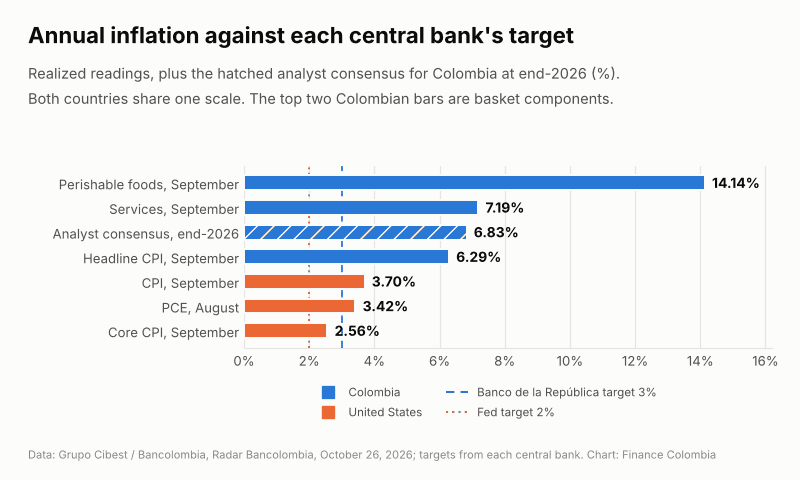
Colombian inflation and the hatched analyst consensus for end-2026 sit far above the 3% target, while US readings run closer to the Fed’s 2% goal. Both countries share one scale. (Chart: Finance Colombia, based on Grupo Cibest data)
The expectation of a further 25 basis point increase rests on an inflation picture that continues to deteriorate, with pressure concentrated in the most persistent components of the basket and in those most exposed to supply shocks, according to the report. Annual inflation accelerated to 6.29% in September, its highest level since July 2024. Services inflation stood at 7.19%, which the report attributed to the fact that a good part of its prices reset on the basis of past inflation or the minimum wage increase, and perishable foods, whose annual variation reached 14.14%, added to that in the face of supply shocks associated with El Niño. Finance Colombia reported the full September breakdown on October 12, and Grupo Cibest’s economists set out the case for a 7.3% peak in 2027 earlier this month.
Analysts’ expectations for the close of 2026 stand at 6.83%, more than double the 3% target, and their expectations for 2027 have risen without interruption in recent months, the report said. None of the fronts the board of directors identified as determining factors points to relief: El Niño would extend into the second quarter of 2027, and the fiscal adjustment has not yet been defined.
The Board’s September Vote Narrowed to Two for a Hold
The report said the persistence of those pressures has gained weight inside the board, pointing to its September vote and the minutes of that meeting. The option of leaving the rate unchanged went from four votes in July to only two. The minutes also noted that, for most of its members, inflationary pressures have stopped being concentrated in isolated shocks and have spread to a larger share of the basket. Grupo Cibest anticipates the board would approve the increase by majority, with a vote that would remain divided.
Activity Contracted in the Earthquake Month
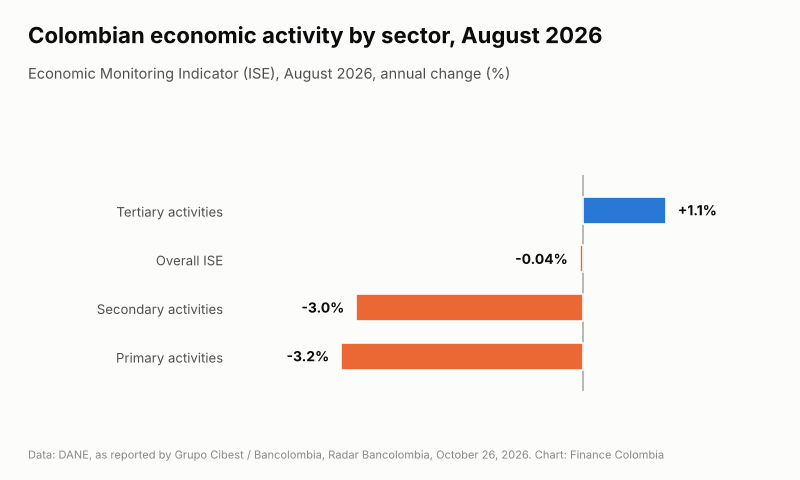
Primary and secondary activities fell while tertiary activities grew, leaving the overall index down 0.04% in August. (Chart: Finance Colombia, based on DANE and Grupo Cibest data)
The loss of momentum in economic activity would be a new element in the discussion, though not enough to interrupt the cycle, the report said. The Indicador de Seguimiento a la Economía (Economic Monitoring Indicator, ISE) contracted 0.04% on an annual basis in August, below Grupo Cibest’s own expectation of 0.3% growth and largely a reflection of the damage caused by the August 10 earthquake. Primary and secondary activities fell 3.2% and 3.0%, with the result in the first case possibly explained by weak performance in agriculture and a negative contribution from manufacturing, alongside still-lagging construction, in the second. Tertiary activities limited the fall, growing 1.1% with increases in five of the seven macro-sectors, though public administration and recreation expanded only 2.2% against an average of 7.1% over the first seven months of the year. The report said the figure would strengthen the position of the two co-directors who voted to hold the rate, but added that part of the shock would be transitory and that activity is still growing 2.27% so far this year.
Grupo Cibest Sees Both Rates Ending the Year Higher
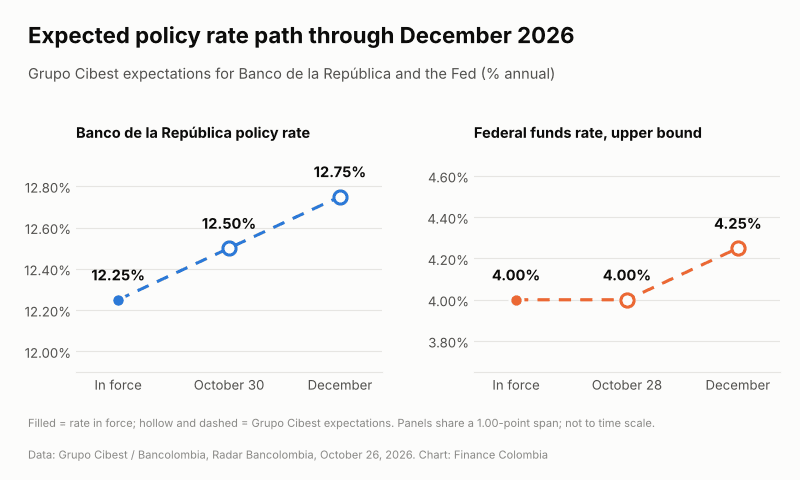
Grupo Cibest expects Colombia’s policy rate to reach 12.75% and the federal funds rate to reach a 4.00% to 4.25% range by December. (Chart: Finance Colombia, based on Grupo Cibest data)
Beyond this week’s decisions, Grupo Cibest said attention would center on the signals both central banks give about the path of rates. In the bank’s scenario, each would close the year with one final increase in December, taking Colombia’s policy rate to 12.75% and the federal funds rate to a range of 4.00% to 4.25%. The report said risks remain skewed to the upside: a more intense El Niño, a prolongation of the Middle East conflict or a significant increase in the minimum wage could all extend the cycle. A Fed pause would not modify the bank’s Colombian scenario, though the report said it would ease external pressures, since a wider rate differential would favor the peso and help contain the prices of imported goods. Finance Colombia reported earlier this month on the bank’s view that higher Fed rates would limit the room for a cheaper dollar in Colombia, and on the September decisions that opened this phase of the cycle.
US Payroll Growth Slowed to 29,000 in September
The Federal Open Market Committee voted unanimously in September to raise the federal funds target range by 25 basis points, to 3.75% to 4.00%. Grupo Cibest noted that it was the first increase since July 2023 and put the rate at its highest level since November 2025. Since then, the report said, the committee’s discussion has stopped turning on whether further increases are needed and has concentrated on when they would be delivered. The behavior of the labor market would be decisive in setting that moment, and its moderation would remove the urgency of a new increase, because employment has stopped being a source of pressure on prices. Nonfarm payrolls grew by 29,000 in September, far below expectations, and wage growth slowed to 3.0%, the weakest pace in five years. Even so, the report described the labor market as showing no deterioration: the unemployment rate has held between 4.1% and 4.3% since March, and jobless claims remain below 200,000.
That moderation, combined with PCE inflation of 3.42% in August against an expected 3.7%, pushed the market to shift the increase it had anticipated for October into December, according to the report. September’s consumer price index, higher than forecast, briefly lifted the probability of an increase at this week’s meeting to near 50%, the report said, but that probability fell back after several committee members dismissed the urgency of a new move. As of the close on Friday, October 23, the market assigned a probability near 90.6% to rates staying unchanged and 69.1% to a 25 basis point increase in December.
US Inflation Accelerated to 3.7% on Energy Prices
A pause would not mean the end of the cycle, the report said. Consumer price inflation accelerated to 3.7% in September, driven by energy, whose annual inflation stands at 20.4%, with gasoline alone accounting for more than half the monthly rise in the index. Core inflation rose to 2.56%, with increases in both goods and services, which Grupo Cibest said suggests the shock is beginning to spread to other prices. On that reading, a new increase in December would be justified even without pressure from the labor market, and Grupo Cibest expects the committee’s statement to keep a restrictive tone.
The Peso Gained as Crude Climbed
The peso appreciated 0.88% over the week, with the USDCOP pair closing the week ended October 23 at $3,145 COP per dollar. The report attributed the move to crude prices, after Houthi attacks on Saudi energy infrastructure revived uncertainty around the Middle East conflict and took Brent to a high of $117 USD per barrel. Brent closed at $116.83 USD per barrel, a 6.34% weekly gain, while West Texas Intermediate stood at $103.27 USD per barrel, up 1.83% on the week. An exemption on sanctions and tariffs for Russian energy transactions ordered by US President Donald Trump moderated the upward pressure, according to the report. The theoretical and implied devaluation curve rose over the week, with the three-to-six-month nodes up an average of 10 basis points, in line with expectations of a Colombian rate increase on October 30.
The TES Curve Gained Most at the Short End
Colombia’s fixed-rate TES curve gained an average of five basis points over the week, with the best performance in the short tranche: rates on the one-to-four-year segment fell 24 basis points, against a one basis point increase in the five-to-nine-year segment and stability beyond 10 years. The local focus was on the fiscal front, following the 2027 budget decree and a $13.8 trillion COP cut to the 2026 budget, and the market also tracked expectations around the Ley de Rescate Económico (Economic Rescue Law) and a second debt swap carried out by the public credit office, which reduced maturities scheduled for 2026 and 2027.
The 2027 Budget Was Issued by Decree on October 22
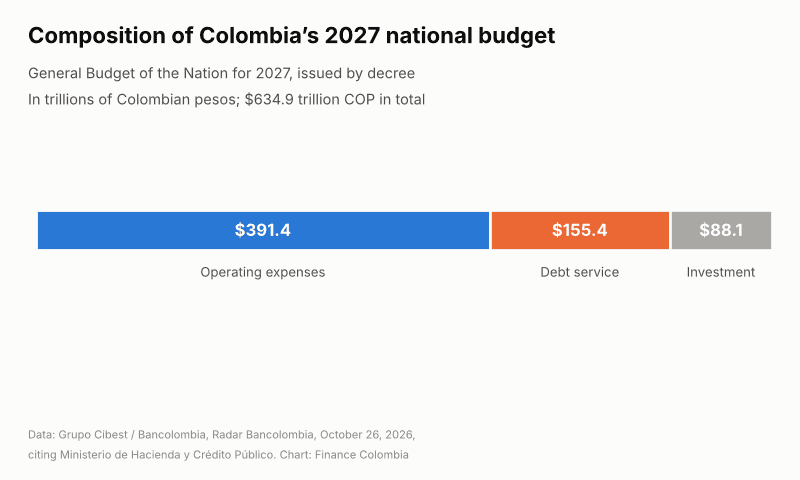
The 2027 budget issued by decree on October 22 splits $634.9 trillion COP across operating expenses, debt service and investment. (Chart: Finance Colombia, based on Grupo Cibest data citing the Ministry of Finance)
Colombia’s Presupuesto General de la Nación (General Budget of the Nation) for 2027 was issued by decree on October 22, after the document fell in Congress over a procedural defect, at a total of $634.9 trillion COP. That represents an increase of $78.6 trillion COP over the appropriations in force for 2026, and the budget comprises $391.4 trillion COP in operating expenses, $155.4 trillion COP in debt service and $88.1 trillion COP in investment. Against the proposal the government presented, the total amount and its distribution among those three lines remained practically unchanged. The main changes in the first debate were reallocations across sectors, including an additional $2 trillion COP for health, $500 billion COP for the Servicio Nacional de Aprendizaje (National Apprenticeship Service, SENA) and $100 billion COP each for the judiciary and for sports, with fewer resources for the Jurisdicción Especial para la Paz (Special Jurisdiction for Peace), the Departamento Nacional de Planeación (National Planning Department) and the civil aviation authority, Aeronáutica Civil. The report said a Ley de Ajuste Fiscal (Fiscal Adjustment Law) will be decisive in defining a credible consolidation path for 2027.
The Central Government Deficit Reached 4.5% of GDP
Figures from the Ministerio de Hacienda y Crédito Público (Ministry of Finance and Public Credit), cited in the report, show the central government ran an accumulated deficit of $91.2 trillion COP through August, equivalent to 4.5% of gross domestic product, which Grupo Cibest described as the second-highest reading for that month in the past two decades, exceeded only by the 5.3% of GDP recorded in August 2020. Accumulated spending reached 15.6% of GDP against accumulated revenue equivalent to 11.1% of GDP. The primary deficit, which excludes interest payments on public debt, stood at 1.8% of GDP, slightly below the 1.9% registered in the same month of 2025.
Imports Rose 31.7% as Fuel Purchases Surged
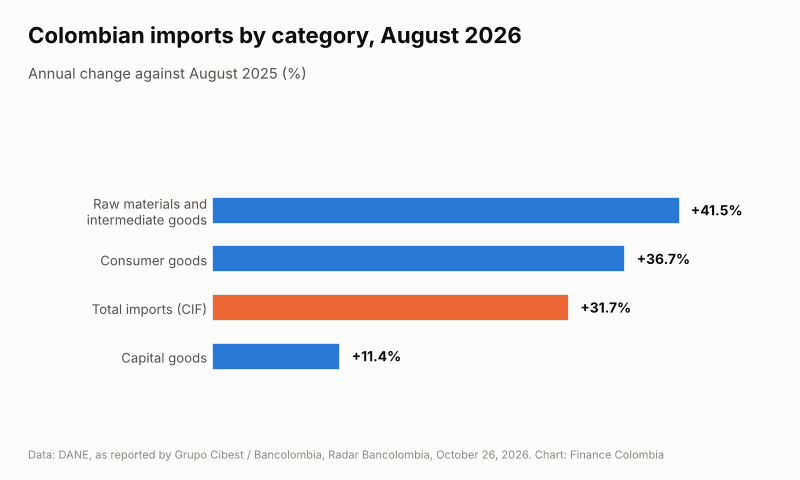
Raw materials and intermediate goods led August’s import growth at 41.5%, ahead of consumer goods and capital goods. (Chart: Finance Colombia, based on DANE and Grupo Cibest data)
Colombian imports reached $7.7 billion USD CIF in August, a 31.7% annual increase and a 17.2% rise so far in 2026, according to figures from DANE, Colombia’s Departamento Administrativo Nacional de Estadística (National Administrative Department of Statistics), cited in the report. Purchases of raw materials and intermediate goods led the gain at 41.5%, especially fuels, which rose 252% against August 2025. Consumer goods imports grew 36.7%, driven by a 54.9% jump in vehicle purchases, while capital goods advanced a more moderate 11.4%, with a 19.6% increase in goods destined for industry and a 6.0% drop in transport equipment. In monthly terms, total imports fell 3.3%, which the report said contributed to a narrowing of the trade deficit to $2.77 billion USD FOB in August from $2.87 billion USD FOB in July.
Grupo Cibest Puts Urban Unemployment at 8.9% in September
Grupo Cibest estimates the urban unemployment rate across Colombia’s 13 metropolitan areas stood at 8.9% in September in its original series, 0.8 percentage points above the level recorded a year earlier, and 9.3% in seasonally adjusted terms, 0.1 percentage point below the August figure. The report said September’s results could still be reflecting disruptions from the August 10 earthquake, particularly in the economic activities and zones most affected by infrastructure damage, and that the most recent data could be starting to show moderation in public hiring in a context of greater spending austerity. The report added that moderate labor participation and strong performance in some labor-intensive sectors could be partly offsetting those effects.
US Treasuries and Foreign Bond Buying in August
The report attributed a gain in US Treasuries to safe-haven demand, in what it described as a bull flattener: nodes between two and five years fell an average of 11 basis points, while the 10-to-30-year segment fell 14 basis points. Citing the US Department of the Treasury, the report put foreign investors’ net purchases of long-term bonds at $108.9 billion USD in August, the highest figure since May 2025, while listing $90.1 billion USD for private investors and $18.1 billion USD for official institutions. Canada and India led the buying at $39.5 billion USD and $16.1 billion USD, while investors domiciled in China were the largest net sellers in a month when their foreign exchange reserves fell by $4.8 billion USD. The Economic Surprise Index compiled by Citigroup (NYSE: C) stood at 42 points, 8.1 points above its average so far this year and below the maximum of 63.2 points reached at the end of June.
China Grew 4.5% in the Third Quarter
The National Bureau of Statistics of China reported that the Chinese economy grew 4.5% annually in the third quarter, slightly above market consensus of 4.4% but only at the lower limit of the 4.5% to 5.0% growth target range. Grupo Cibest attributed the result mainly to the industrial sector and to exports associated with technology value chains, which partly offset weak domestic demand and a contraction in fixed investment. Industrial production and exports expanded at average rates of 5.1% and 28.4% in the quarter, while retail sales grew an average of 0.7% and fixed investment contracted 7.2% in the first nine months of 2026, consistent with a 20.6% drop in real estate investment.
US Activity Stayed Expansionary While the Eurozone Cooled
The US composite purchasing managers’ index compiled by S&P Global (NYSE: SPGI) slipped to 57.6 points in October from 58.4 in September, the report said, remaining in expansionary territory at what it called the second-best reading since March 2022, with services easing to 57.9 points from 58.8 and manufacturing rising to 56.0 points from 55.9, its highest level in 53 months. The eurozone composite index moderated to 51.9 points from 53.1, with new orders rising at the slowest pace in four months, and output in the French private sector returned to contraction.
The Colcap Rose 0.7% on the Week
The Colombian Stock Exchange‘s Colcap index closed the week up 0.7% at 2,540.1 points. Grupo Argos (BVC: GRUPOARGOS) rose 1.8%, while the preferred shares of Grupo Cibest and Grupo Aval (NYSE: AVAL; BVC: GRUPOAVAL, PFAVAL) each gained 1.6%. The largest declines came from Mineros (BVC: MINEROS; TSX: MSA) at 7.4%, the Empresa de Telecomunicaciones de Bogotá (BVC: ETB) at 6.2% and preferred shares of Banco Davivienda (BVC: PFDAVVNDA) at 3.6%. In corporate news, Grupo Nutresa (BVC: NUTRESA) announced the acquisition of the Presto brand and its economic unit through its subsidiary IRCC; Mineros proposed an extraordinary dividend equivalent to $58 million USD, subject to approval at an extraordinary shareholders’ meeting called for November 24; and Grupo Energía Bogotá (BVC: GEB) closed its transaction with La Caisse to create Verene Energía, a joint platform consolidating 26 electricity transmission concessions in Brazil that the report said positions the alliance among the country’s five largest electricity transmission operators. Wall Street finished mixed, with the S&P 500 down 0.5%, the Dow Jones up 0.4% and the Nasdaq down 0.7%, while European indexes fell between 1.4% and 2.2% and the Hang Seng, Nikkei 225 and Shanghai Composite all closed lower.
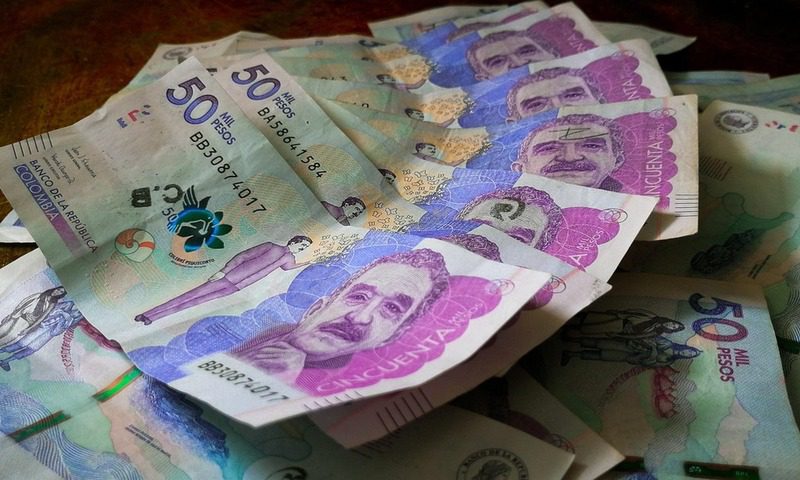
Headline photo: Colombian 50,000-peso banknotes. (Photo: Image by caruizp from Pixabay)