Previous Story

Colombian Households Keep Spending Without Loading Up on Debt, Grupo Cibest Reports
Posted On October 21, 2026
Comment: 0
Tag: banco de la republica, bancolombia, Camilo Miranda, colombia, colombian economy, consumer confidence, consumer credit, consumer finance, consumer spending, credit card delinquency, credit cards, dane, experian, fedesarrollo, financial stability, fintech, Grupo Cibest, Household Consumption, household debt, household income, household leverage, ICV, inflation, interest rates, Laura Clavijo, loan portfolio quality, minimum wage, non-supervised lenders, Radar Bancolombia, remittances, superintendencia financiera, tarjetazo
Colombian households keep spending at a pace that sits awkwardly against the macroeconomic backdrop of high interest rates, still-elevated inflation, and a cooling economy. The latest weekly research from Grupo Cibest (BVC: CIBEST, PFCIBEST; NYSE: CIB), the holding company that owns Bancolombia, argues that this consumption cycle differs from the previous one in a way that matters for financial stability: the spending is not being financed by a renewed build-up of household debt.
The analysis appears in the Radar Bancolombia weekly macroeconomic and markets report dated October 19, 2026, prepared by Bancolombia’s research division, the Dirección de Investigaciones Económicas, Sectoriales y de Mercado (Directorate of Economic, Sector, and Market Research). The editorial was authored by Laura Clavijo, director of the unit, and Camilo Miranda, a financial-sector analyst. It compares the credit cycle of 2022 with conditions in 2026 and concludes that the current resilience of consumption rests on income rather than leverage.
A consumption cycle that defies the macro backdrop
Private consumption remains one of the main drivers of Colombian domestic demand. Grupo Cibest estimates it may grow 2.7% this year and projects that consumption growth above 2% will continue into 2026 and 2027, supported by solid household income and a labor market with historically low unemployment. That dynamism has held even as the Banco de la República (Central Bank of Colombia) keeps monetary policy restrictive, with analysts surveyed by the central bank expecting the benchmark rate to end 2026 near 12.50% and inflation to close the year around 6.8%.
The broader economy has been more subdued. According to the Departamento Administrativo Nacional de Estadística (DANE, the National Administrative Department of Statistics), manufacturing output contracted 3.7% on an annual basis in August, its sharpest drop since September 2024, while retail commerce grew 7.3%. The economy also absorbed the effects of the August 10 earthquake, which weighed on activity in the hardest-hit regions. Consumer confidence, measured by Fedesarrollo, nonetheless held in double-digit positive territory for a 12th consecutive month in September, at 15.7 points.
Scars from the last credit cycle
The report frames the current moment against the correction that followed the pandemic-era credit boom. By late 2022, the consumer loan portfolio had accumulated average annual growth of about 12% in real terms, and the Banco de la República had warned that credit establishments’ exposure to households stood at historically high levels, with some indicators pointing to a rising household financial burden. At its peak, the consumer segment was expanding at an annual rate of more than 60% in real terms.
The reckoning came the following year. In 2023, delinquency levels reached the highest readings of the century, and the past-due portfolio climbed sharply. Those losses are the scars that the report’s authors say should inform how analysts read today’s rebound.
This time, spending without leverage
The distinction the report draws is that higher spending in 2026 has not been matched by an equivalent increase in household leverage. Citing the Banco de la República, the authors note that households carry roughly 27% more income than in 2019 but only about 2% more debt, measured against that 2019 base year.
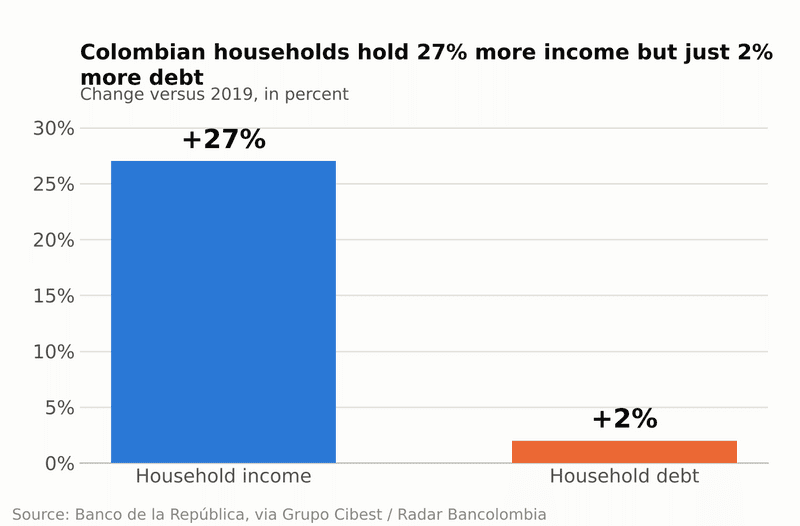
Colombian household income has risen far faster than household debt since 2019. (Chart: Finance Colombia; data: Banco de la República via Grupo Cibest / Radar Bancolombia)
In a September update of its Reporte de Estabilidad Financiera (Financial Stability Report), the Banco de la República found that credit had regained momentum and that, despite restrictive financial conditions, there was no significant deterioration in households’ capacity to pay. That combination — dynamic consumption, a solid financial system, and sound payment behavior — is what the authors describe as a less leveraged cycle than the one that ended in 2023.
More card use, not necessarily more debt
Credit-card disbursements, as tracked by the Superintendencia Financiera (Financial Superintendency), have been accelerating, registering a real annual variation of 23.7% to September on a moving-quarter basis, a pace the authors associate with the improved sentiment reflected in indicators such as consumer confidence. They caution against reading that figure as a new wave of indebtedness, arguing that heavier card use does not necessarily mean heavier borrowing, because the card is now widely used as a means of payment rather than a financing tool.
The way cards are used has shifted. In 2022, 27% of card disbursements were financed over more than seven months, and 34% of transactions were settled in a single installment. By 2026, with consumer financing rates above 21%, cardholders have grown reluctant to defer purchases, and 45% of disbursements correspond to a single full-amount charge, known locally as a tarjetazo.
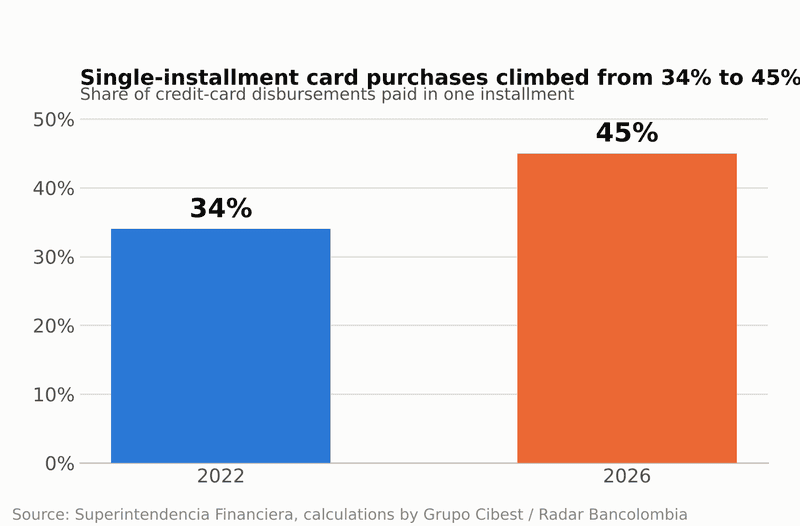
A larger share of credit-card purchases is paid in a single installment than in 2022, as financing rates rose. (Chart: Finance Colombia; data: Superintendencia Financiera, calculations by Grupo Cibest / Radar Bancolombia)
Loan quality has recovered
The indicators also point to a marked improvement in consumer loan quality, particularly for credit cards, after the deterioration seen between 2022 and 2024. Drawing on figures from the Banco de la República, the authors note that the card portfolio’s quality index, or índice de calidad de cartera (ICV), which reached levels near 9% to 10% during the periods of greatest stress, has fallen steadily to around 4.8%. The past-due portfolio, after surging in 2023, has since posted controlled variations.
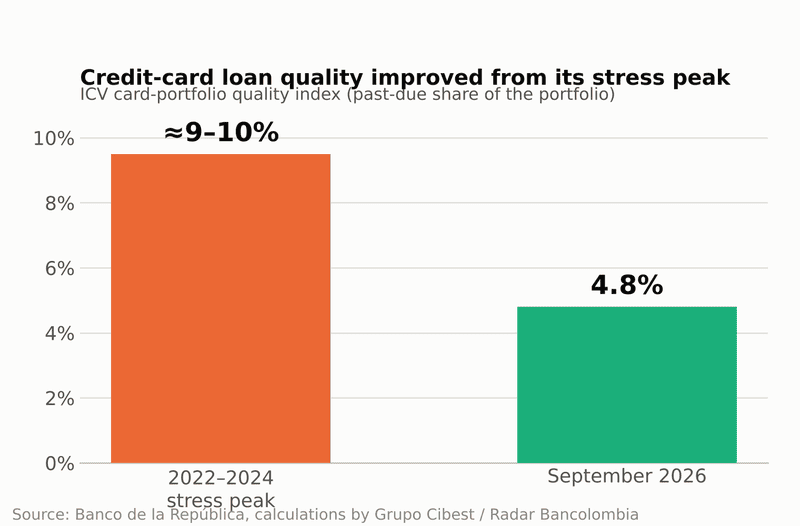
Credit-card loan quality has improved from its 2022–2024 stress peak. (Chart: Finance Colombia; data: Banco de la República, calculations by Grupo Cibest / Radar Bancolombia)
More recently, the decline in the past-due portfolio has begun to moderate at the same time that the gross card portfolio has returned to real growth rates near 9%. The authors read that as a normalization of credit accompanied by better quality indicators, though they flag early signals that warrant monitoring.
The weak link: household income
That households are not heavily leveraged, and that portfolio quality has not deteriorated, offers reassurance for financial stability. It also raises the question the report treats as central: whether households can keep sustaining this pace of consumption. The authors note that household purchasing power has benefited from several tailwinds in recent years — low unemployment, expanded government transfers, a sizable minimum-wage increase, remittance income, and commodity mini-booms in gold, coffee, and cacao.
Household financial burden has remained relatively stable at around 27% of income, but it has edged up since January 2026, driven mainly by greater participation of credit from non-supervised entities, or entidades no vigiladas — a category that, in the report’s accounting, includes telecommunications companies, fintechs, real-sector (non-financial) companies, compensation funds (cajas de compensación), and non-financial cooperatives, among others.
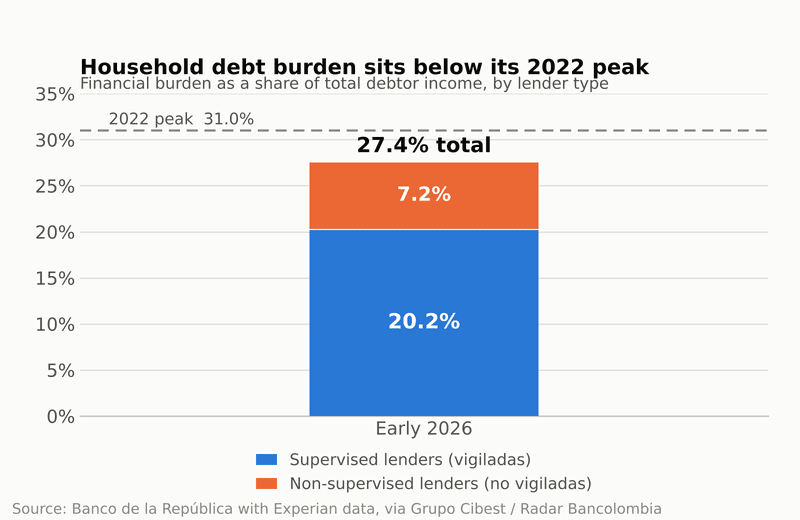
Household financial burden sits below its 2022 peak, with non-bank lenders a growing share. (Chart: Finance Colombia; data: Banco de la República with Experian, via Grupo Cibest / Radar Bancolombia)
The household burden tied to non-supervised lenders is drawn from data compiled by Experian (LSE: EXPN). In an environment of high interest rates and restrictive financial conditions, the authors write, the rising weight of this type of credit could increase household vulnerability to income shocks and lift credit risk.
“The risk does not seem to lie today in the stock of household debt, but in the possibility that still-resilient consumption begins to meet less dynamic income and more demanding financial conditions.”
— Laura Clavijo and Camilo Miranda, Grupo Cibest
What to watch into 2027
The report identifies the main risk as a convergence of factors that could compress purchasing power: inflation, interest rates, and unemployment. The authors frame the exposure as a matter of income rather than debt stock — a resilient consumer running into weaker income growth and tighter credit. If, facing an income shock, households start substituting current income with credit, particularly through cards, they warn the picture could change quickly.
For now, the report expects the resilience of consumption to continue alongside healthy financial indicators. But the authors argue that the scars of the previous rate-hiking cycle are a reminder that the warning sign should not be delinquency itself, by which point the damage is already done. Into 2027, they write, the question will shift from characterizing the resilient consumer to scrutinizing the sustainability of the income and the payment sources that underpin the spending.
The Radar Bancolombia report is prepared for informational purposes by Bancolombia’s research division and, by its own terms, does not constitute investment advice or an offer to trade securities.
Headline photo: Colombian household consumption has stayed resilient despite high interest rates. (Photo: Image by gonghuimin468 from Pixabay)