Previous Story
Grupo Cibest Says Higher Fed Rates Would Limit Room for a Cheaper Dollar in Colombia
Posted On October 2, 2026
Comment: 0
Tag: analyst consensus, banco de la republica, bancolombia, Bank of Japan, brent, Capital Flows, carry trade, cib, CIBEST, CME Group, colombia, Colombia Economy, colombian peso, dot plot, dxy, eia, EME, emerging markets, Exchange Rate, federal funds rate, Federal Reserve, FedWatch, FOMC, Grupo Cibest, Guía 2027, IIF, inflation, interest rate differential, interest rates, Middle East conflict, Ministerio de Hacienda, oil prices, PCE inflation, PFCIBEST, Presupuesto General de la Nación, public debt, Radar Bancolombia, Strait of Hormuz, tes, trm, us dollar, US Treasuries, USDCOP, wti
Fed Tightening Narrows the Rate Edge Behind Colombia’s Strong Peso
Higher US interest rates, even on the Federal Reserve’s own projected path, would reduce the room for the dollar to resume its decline against the Colombian peso, according to the latest weekly Radar Bancolombia report from Grupo Cibest (NYSE: CIB; BVC: CIBEST, PFCIBEST), the holding company of Bancolombia. The report, published September 21, 2026, by Bancolombia’s economic, sector and market research unit and led by an editorial titled La Fed sube la tasa: ¿se agota el espacio para un dólar más barato? (The Fed Raises Rates: Is the Room for a Cheaper Dollar Running Out?), follows the US Federal Reserve‘s first rate increase since July 2023. It says the room for further strength in the global dollar will depend less on the increase expected in October than on whether the Fed moves closer to the steeper 2027 path priced by the market.
The peso weakened 3.0% in the week ended September 18, with the dollar closing at 3,177.5 COP, its highest level since August 31, as the Fed’s more restrictive tone strengthened the dollar globally. The DXY dollar index rose 1.1% over the week to 100.2 points, according to the report.
The Hike Was Priced In; the Change Came in the Projections
The Federal Open Market Committee voted unanimously to raise the target range for the federal funds rate by 25 basis points to 3.75%–4.00%, its highest level since November 2025. The report says markets had widely anticipated the move, so the main change came in the Fed’s projections: most members expect at least one more increase in 2026, and the median of the dot plot now has the rate holding at 4.00%–4.25% throughout 2027. The committee raised its 2026 forecast for headline PCE inflation to 3.7% and for core PCE inflation to 3.4%. The report attributes the persistence of inflation above target to the effects of the conflict in the Middle East, in an economy and labor market that remain solid.
Futures markets go further. As of September 18, pricing tracked by the FedWatch tool of CME Group (Nasdaq: CME) assigned a 57% probability to another 25-basis-point increase at the October meeting and 46% to the rate ending 2026 at 4.00%–4.25%, the report says. The most likely range then rises to 4.25%–4.50% in January 2027 and to 4.50%–4.75% by mid-2027. The Fed and the market therefore agree on one more increase in 2026 but differ on 2027, when the committee projects a pause and futures price further increases.
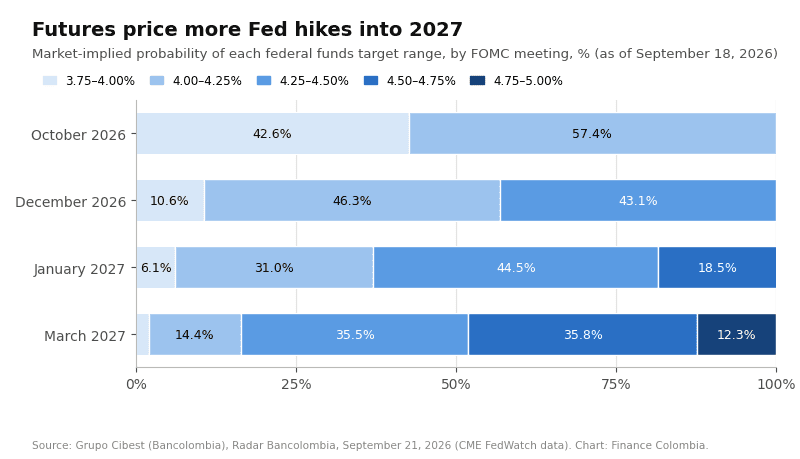
Market-implied probabilities for the federal funds target range at upcoming FOMC meetings, as of September 18, 2026 (Chart: Finance Colombia, based on Grupo Cibest data)
The report ties the outcome of that disagreement to the duration of the Middle East conflict. It cites the US Energy Information Administration (EIA), which expects restrictions on oil exports from the region to persist until the end of 2026, despite a gradual recovery in flows through the Strait of Hormuz and the use of alternative routes, and expects Middle East oil output to stay below pre-conflict levels until the second quarter of 2027. An end to the conflict would remove a significant source of inflation pressure, according to the report, reducing the need for further increases in 2027, although the Fed could keep rates at restrictive levels while it confirms that the moderation in inflation is sustainable.
“Although the Fed’s next rate increase already appears to be incorporated into asset prices, the main uncertainty is whether new increases will be necessary during 2027.”
— Radar Bancolombia, Bancolombia economic, sector and market research
A Narrower Rate Differential
With Banco de la República (Bank of the Republic, Colombia’s central bank) holding its policy rate at 12.00%, the gap with US rates remains wide and has favored carry trades, capital inflows and the peso’s strength, according to the report. If the Fed’s rate reached 4.50%–4.75%, that gap would shrink by another 75 basis points. Colombian assets would still offer attractive returns, the report says, but the differential would have less capacity to contain a further correction in the peso.
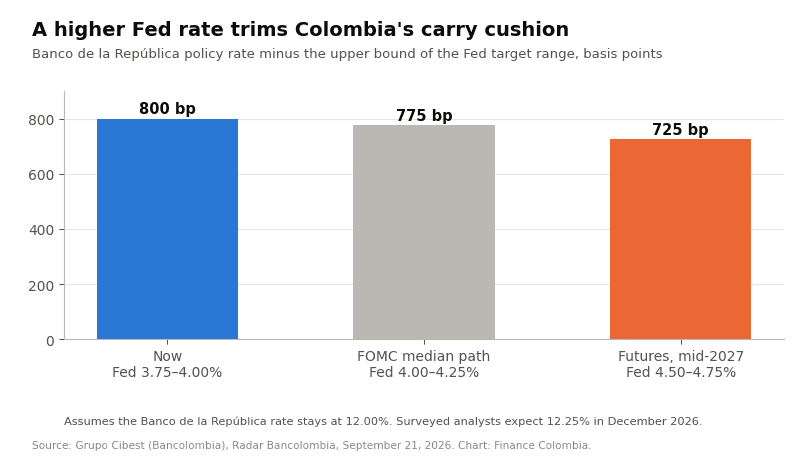
Gap between Banco de la República’s policy rate and the upper bound of the Fed’s target range under three Fed scenarios (Chart: Finance Colombia, based on Grupo Cibest data)
Treasuries and TES Sell Off
Between September 16 and 18, the two-year Treasury yield rose 3.8 basis points to 4.74% and the 10-year yield rose 4.0 basis points to 5.00%. Over the week of September 11 to 18, the Treasury curve bear-flattened, with short-term yields rising an average of 6 basis points and long-term yields 2 basis points, according to the report. The move was reinforced by the Bank of Japan, which raised its policy rate by 25 basis points to 1.25%, its highest level in 31 years. The spread between 10-year and three-month Treasuries stood at 87.8 basis points and has now been positive for more than a year.
Colombian government bonds also sold off. Yields on the fixed-rate curve of Títulos de Tesorería (TES), Colombia’s peso-denominated government bonds, rose an average of 25 basis points: 19 basis points in the short segment (one to four years), 26 in the medium segment (five to nine years) and 28 in the long segment (more than 10 years). The report attributes the move to the Fed decision, higher oil prices tied to the Middle East tensions, the approval of a 2027 Presupuesto General de la Nación (General National Budget) of $634.9 trillion COP, the government’s larger financing needs and the resumption of TES auctions.
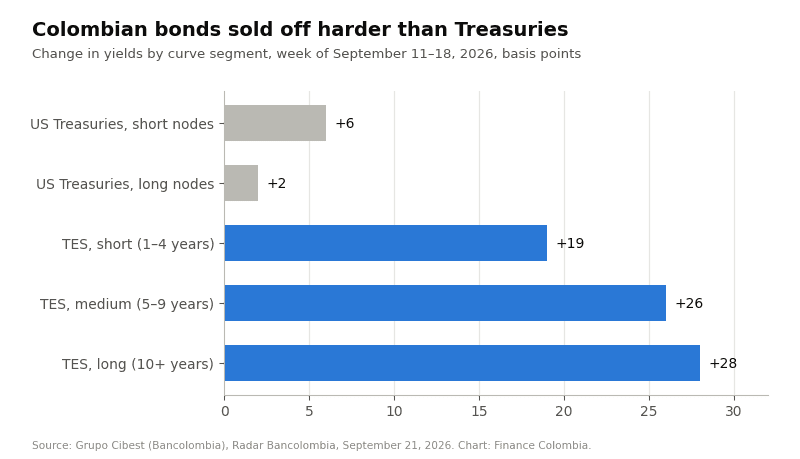
Weekly change in US Treasury and Colombian TES yields by curve segment, September 11–18, 2026 (Chart: Finance Colombia, based on Grupo Cibest data)
Central government gross debt stood at $1,160.6 trillion COP in July, according to Ministerio de Hacienda y Crédito Público (Ministry of Finance and Public Credit) figures cited in the report, up 3.4% from a year earlier but at its lowest level in 11 months. External debt fell 30.7% year on year to $243.5 trillion COP after buybacks of global bonds and the full payment of a total return swap, while domestic debt rose 19.0% to $917.1 trillion COP, with monthly TES placements above $15 trillion COP between May and July.
The report also points to pressure on emerging markets. Net capital flows to emerging economies had been negative for more than six months as of August 17, the report says, citing Institute of International Finance (IIF) data showing cumulative net outflows of $168 billion USD, compared with net outflows of $5 billion USD in the same period of 2025. The report places the outflows in a context of high international interest rates and lower risk appetite; flows into debt instruments have been more resilient than equity flows.
Analysts Expect a Gradually Weaker Peso
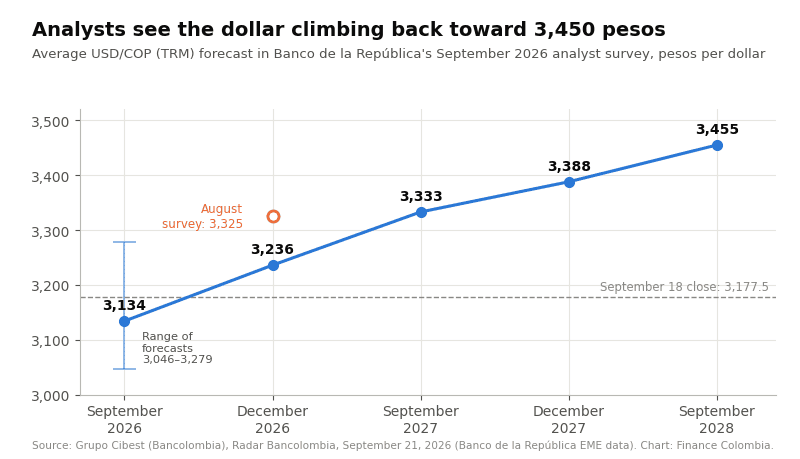
The latest Encuesta Mensual de Expectativas de Analistas Económicos (Monthly Survey of Economic Analysts’ Expectations, EME) by Banco de la República puts the average forecast for the Tasa Representativa del Mercado (TRM, the official representative exchange rate) at 3,134 COP per dollar for the end of September 2026, with individual forecasts ranging from 3,046 COP to 3,279 COP. The report says the dispersion of forecasts remains below mid-year levels, when the presidential elections significantly increased local uncertainty.
Surveyed analysts expect the TRM to end 2026 at 3,236 COP, 89 COP below the 3,325 COP projected in the August survey. The report attributes the downward revisions to the peso’s marked appreciation in the months after the presidential elections, “in a context in which market optimism contrasts with the country’s fiscal challenges.” Survey respondents see the rate at 3,333 COP in September 2027, 3,388 COP in December 2027 and 3,455 COP in September 2028. In the same survey, analysts raised their year-end 2026 inflation forecast by 21 basis points to 6.81%, and they continue to expect a policy rate of 12.25% in December.
Average USD/COP forecasts in Banco de la República’s September 2026 analyst survey (Chart: Finance Colombia, based on Grupo Cibest data)
Grupo Cibest’s own September 2026 projections, published with its annual outlook Guía 2027: Colombia Resiste (2027 Guide: Colombia Endures), point to a year-end rate of 3,219 COP in 2026 and 3,435 COP in 2027, after 3,757 COP at the end of 2025. That implies a slightly stronger peso than the analyst consensus at the end of 2026 and a slightly weaker one at the end of 2027.
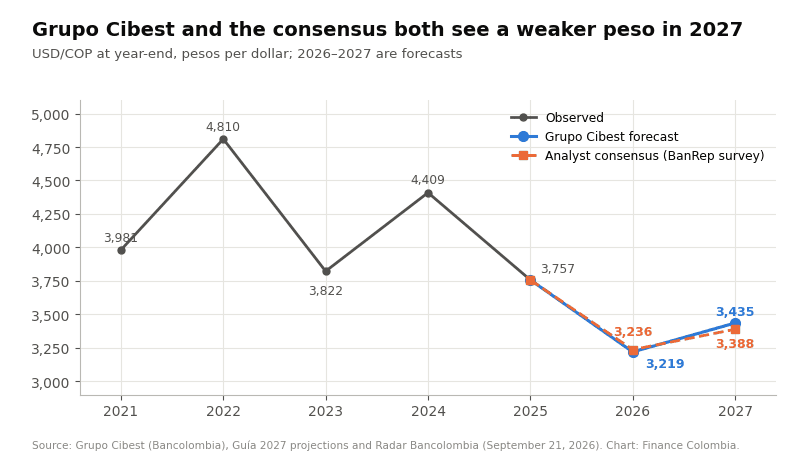
Year-end USD/COP: observed values, Grupo Cibest forecasts and the analyst consensus (Chart: Finance Colombia, based on Grupo Cibest data)
Oil prices remain a factor for both the Fed and the peso. Brent crude closed the week at $103.32 USD per barrel, down 1.23%, while WTI ended at $100.30 USD per barrel, up 0.25%. Concerns about disruptions to Saudi supply eased on higher Saudi oil exports through Oman, rising inventories in the United States, Singapore and Europe, and higher fuel exports from China, according to the report.
Two Paths for the Peso
The report lays out two scenarios. If the end of the conflict reduces energy price pressure, one more increase could be enough, and the Fed could then hold rates at restrictive levels. Markets would have to remove part of the increases they now price for 2027, Treasury yields would fall and the DXY would lose part of its upward pressure even without Fed rate cuts. That would limit the room for further global dollar strength and moderate the pressure on USD/COP.
If the conflict continues, oil stays high and pressure on other prices persists, the global dollar could keep strengthening or remain at elevated levels, and the Fed could move toward the steeper path priced by the market. In that case, the report says, the narrower differential and Colombia’s local vulnerabilities would widen the room for a depreciation of the peso.
Thumbnail photo: Colombian 50,000-peso banknotes. (Photo: Image by caruizp from Pixabay)