Previous Story
Colombia’s Inflation Accelerates to 6.24% in August as Bancolombia Sees Rates Holding at 12%
Posted On September 22, 2026
Comment: 0
Tag: banco de la republica, bancolombia, BBVA Research, colombia, Consejo de Estado, consumer price index, core inflation, dane, el niño, food inflation, Grupo Cibest, Gustavo Petro, IDEAM, indexation, inflation, interest rates, Laura Clavijo, minimum wage, monetary policy, regulated prices, services inflation
Wage Indexation Pushes Services Inflation to Highest Since Late 2024
Colombia’s annual inflation rate climbed to 6.24% in August 2026, its highest level since July 2024, according to consumer price data from the Departamento Administrativo Nacional de Estadística (National Administrative Department of Statistics, DANE) analyzed by Bancolombia. In a September 9 report, the bank, now organized under the financial holding company Grupo Cibest (NYSE: CIB; BVC: CIBEST, PFCIBEST) following a 2025 corporate reorganization, said the annual rate rose 20 basis points on a monthly increase of 0.39%, well above the 0.27% consensus forecast among analysts and the highest August monthly print since 2023. The report is signed by Laura Clavijo, Bancolombia’s chief economist; José Luis Mojica, its macroeconomic manager; Valentina Guáqueta Sterling, a central banking analyst; and Camila Caballero Mercado, an intern, all of the bank’s Economic, Industry and Market Research Area.
Services prices accounted for the bulk of the increase, contributing 22 of the month’s 39 basis points, or 57% of the total, which Bancolombia’s economists attributed mainly to the pass-through of wage and price indexation. Annual services inflation reaccelerated to 7.17% in August, the highest level since November 2024, after two months of moderation; the segment’s 0.45% monthly rate roughly doubled its historical August average of 0.22%. Rents, both actual and imputed, each rose 0.38% for the month, fixed and mobile communications and internet service jumped 0.92%, and cable and network television subscriptions rose 3.01%.
Inflation excluding food, as measured under the central bank’s traditional core classifications, reached 6.30% year over year, its highest level since October 2024 and a sixth consecutive monthly increase. Bancolombia’s team said that pattern suggests underlying price pressures are persistent rather than driven by temporary factors. Annual food inflation, by the report’s classification, reversed course, rising to 6.13% from 5.84% in July on a 0.72% monthly increase, eight times the historical August average of 0.09%, as perishable food prices, including fresh fruit, potatoes, tomatoes and legumes, jumped 10.75% year over year. Goods inflation reached 3.37%, its highest level since February 2024, even as an appreciating Colombian peso continued to hold down prices for new and used vehicles. Regulated prices, which include utilities and transit fares, rose 6.77% annually, their highest level since February 2025 and a sixth consecutive monthly increase, on higher electricity, sewerage, urban transportation, waste collection and parking tariffs.
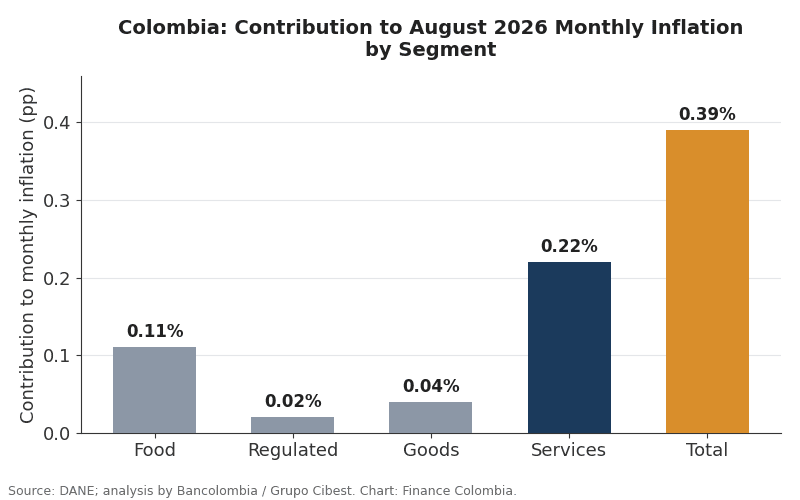
Services contributed more than half of August’s 0.39% monthly inflation increase. (Chart: Finance Colombia, based on DANE data analyzed by Bancolombia / Grupo Cibest)
Bancolombia’s economists tie much of that persistence to indexation and to Colombia’s 2026 minimum wage, which rose 23% to $1,750,905 COP a month. The government reissued the increase on a provisional basis in Decree 0159 of February 19, 2026, to provide legal certainty while the Consejo de Estado (Council of State) reviews a challenge to the original decree, according to elempleo.com. Bancolombia said the pass-through has so far been uneven: it is already showing up clearly in services, particularly categories with annual contractual adjustments such as rents, but remains more contained in goods, where companies are still selling through inventory purchased at lower cost. As those stocks are depleted, the bank expects replacement costs to show up more broadly in consumer prices.
Bancolombia’s economists also expect the effects of El Niño in the second half of 2026 to add upward pressure. On September 10, Colombia’s Instituto de Hidrología, Meteorología y Estudios Ambientales (Institute of Hydrology, Meteorology and Environmental Studies, IDEAM) put the probability that the current El Niño becomes the strongest since 1950 at 75% for the fourth quarter of 2026, and the probability of a “very strong” episode through the first quarter of 2027 at more than 90%, according to El Tiempo. Grupo Cibest’s Food Prices Monitor, published September 4, had estimated annual food inflation for August at 5.7%.
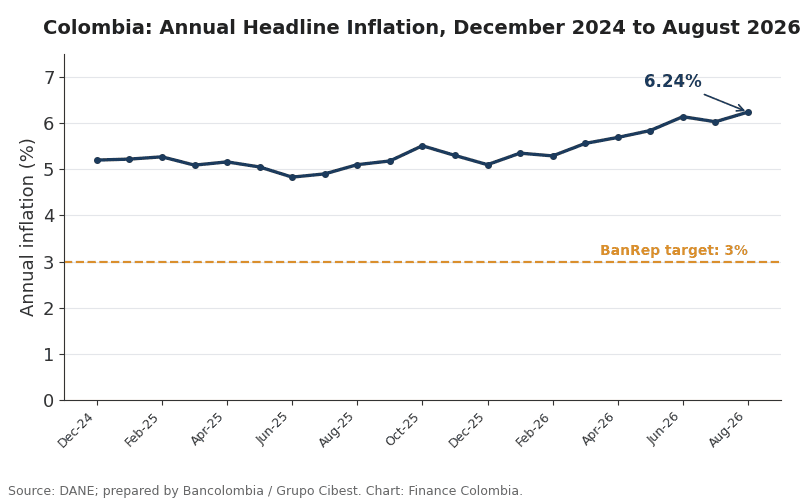
Colombia’s annual inflation rate has trended higher since mid-2025 and remains more than double the central bank’s 3% target. (Chart: Finance Colombia, based on DANE data analyzed by Bancolombia / Grupo Cibest)
Colombia’s central bank, the Banco de la República (Bank of the Republic), targets annual inflation of 3% within a range of 2% to 4%. Its seven-member board raised the benchmark rate to 12% from 11.25% on June 30, 2026, according to El Colombiano, which reported that then-President Gustavo Petro criticized the decision. Petro said that with unemployment in May at the lowest level of the century, “raising the interest rate even further leads only to paralysis.” The board held the rate at 12% on July 31 by a 4–3 vote, with the three dissenting directors favoring a further 50-basis-point increase, according to the central bank. Bancolombia’s economists forecast that the rate will stay at 12% in the months ahead; the board meets next on September 30, 2026.
“The Central Bank will be compelled to maintain a restrictive monetary policy stance to keep inflation expectations anchored.”
— Bancolombia’s Economic, Industry and Market Research Area, August 2026 inflation report
Bancolombia said it expects annual inflation to finish 2026 above 6.5%. BBVA Research said in a September 8 analysis, reported by ABC Economía, that it expects inflation to close the year near 7%, citing domestic demand, El Niño and possible supply shocks. The central bank’s monthly survey of economic analysts, published September 17, raised the year-end inflation expectation to 6.81% from 6.60% and showed analysts expecting a single rate increase, to 12.25%, at the board’s December meeting, according to La República.
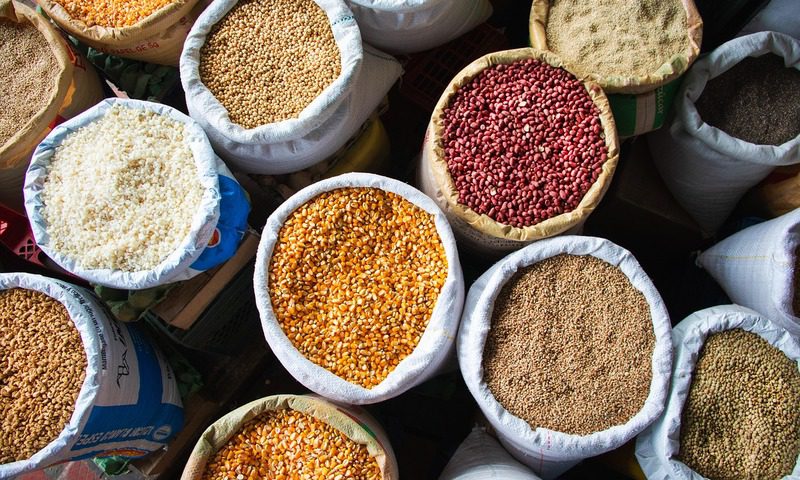
Headline photo by catamejia18 from Pixabay