Previous Story
Colombian Peso’s Historic Rally Cools After Fiscal Shock Rattles Markets in August
Posted On September 8, 2026
Comment: Off
Tag: 2027 National Budget, abelardo de la espriella, anato, andi, banco de la republica, bancolombia, Brent Crude, bruce mac master, carry trade, Central Bank of Colombia, Chocó earthquake, Colombia Exports, Colombia fiscal deficit, Colombia tourism, Colombia trade, colombian peso, Corficolombiana, dxy, fenalco, grupo aval, Grupo Cibest, peso appreciation, USDCOP
The Colombian peso weakened 1.8% against the US dollar in August, closing the month at COP3,215 after the government’s release of its 2027 National Budget triggered a depreciation of nearly 5% in the final week, according to the monthly foreign exchange report from Grupo Cibest (NYSE: CIB; BVC: CIBEST), the financial conglomerate that owns Bancolombia S.A. The pullback interrupted, but did not erase, one of the sharpest currency rallies in the world this year. The peso had appreciated 16.5% against the dollar by August 10, according to an analysis by Corficolombiana (BVC: CORFICOLCF), the investment bank controlled by Grupo Aval (NYSE: AVAL; BVC: PFAVAL), reported by El Colombiano, and as much as 19.9% by August 30, according to the trade association Fenalco (National Federation of Merchants), reported by El Nuevo Siglo — in both cases pushing the exchange rate to its lowest levels since April 2019 and making the peso the best-performing currency in Latin America.
The month split into two distinct phases, Grupo Cibest’s analysts wrote. Early in August, the Banco de la República (Bank of the Republic), Colombia’s central bank, surprised markets. Its board had voted at a July 31 session to hold the benchmark interest rate at 12% and to build up to $4 billion USD in international reserves through a new options-auction mechanism; when the bank ran the program’s first auction on August 3, buying $400 million USD, according to El Universal, the combination of the rate hold and the new dollar demand pushed the dollar down further against the peso. The mood reversed after August 27, when the government of President Abelardo de la Espriella, who took office August 7, submitted a revised 2027 National Budget to Congress that acknowledged a far deeper deterioration in public finances than previously disclosed.
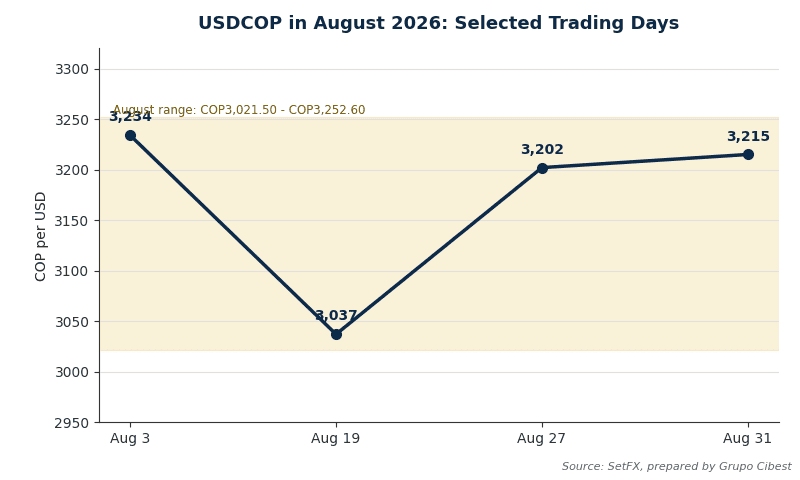
The peso weakened sharply in the final days of August as the 2027 National Budget rattled markets. (Source: SetFX, prepared by Grupo Cibest; chart: Finance Colombia)
The revised budget raised the government’s projected total fiscal deficit from 5.3% to 7.2% of gross domestic product for 2026, and from 4.5% to 9.4% of gross domestic product for 2027, after incorporating obligations tied to debt service, pensions, health care, payroll costs, energy subsidies and the Fuel Price Stabilization Fund that had previously been underestimated. Grupo Cibest called the disclosure “a necessary reality check” and said clarity on the government’s medium-term fiscal adjustment plan, which has yet to be published, would be critical to the peso’s direction from here.
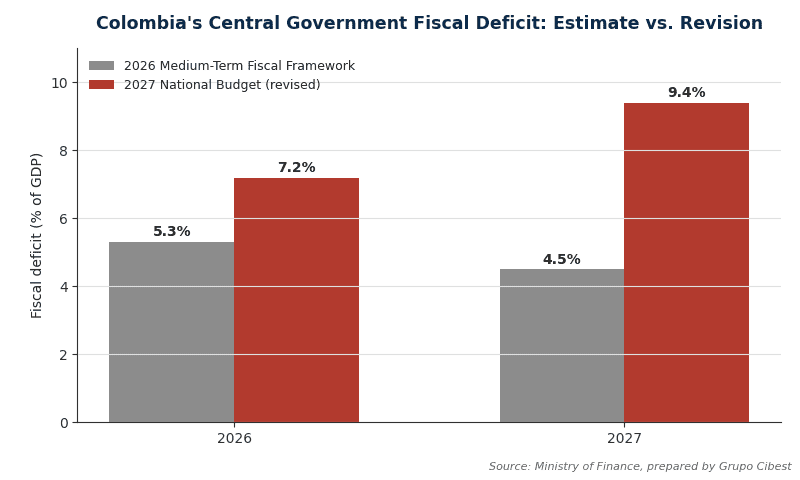
The 2027 National Budget nearly doubled the projected fiscal gap for both years. (Source: Colombia’s Ministry of Finance, prepared by Grupo Cibest; chart: Finance Colombia)
The currency’s slide happened despite favorable conditions abroad. The US Dollar Index fell 0.5% in August after a weak employment report, while Brent crude gained 0.3% to close the month at $90.04 USD per barrel — a combination that would typically support, not weaken, an emerging-market currency like the peso. Grupo Cibest said the divergence showed the depreciation was driven almost entirely by local, not global, factors.
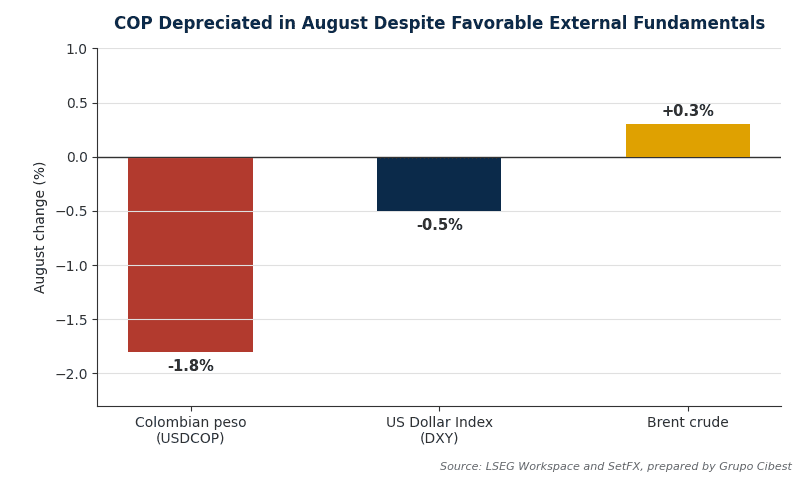
A weaker dollar and firmer oil prices should have supported the peso in August; instead it depreciated. (Source: LSEG Workspace and SetFX, prepared by Grupo Cibest; chart: Finance Colombia)
Even with August’s reversal, the broader trend remains firmly in the peso’s favor. The exchange rate stayed below both its 50-day and 100-day moving averages for most of the month, and Grupo Cibest noted that the medium-term technical structure remains bearish for the dollar, with all three moving averages still trending downward. Analysts at Corficolombiana attributed the rally mainly to lower political and fiscal risk premiums tied to Colombia’s change of government rather than to any structural improvement in economic fundamentals, and it expects a partial correction in the exchange rate in the months ahead.
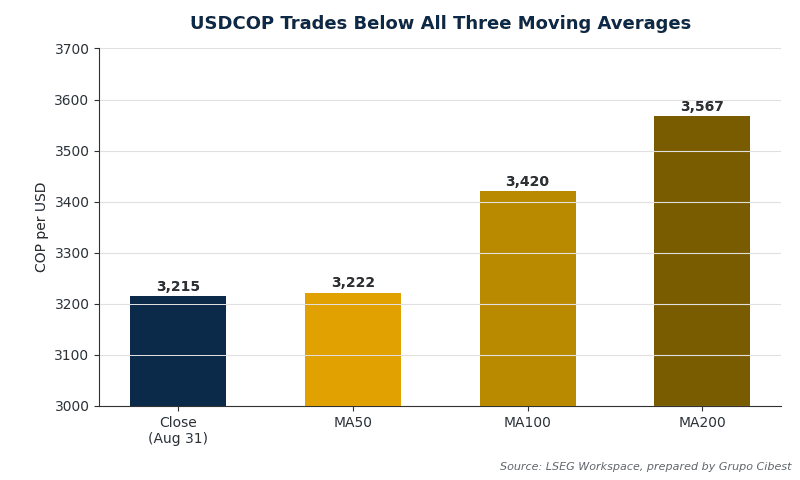
The exchange rate closed August below all three moving averages, a sign of sustained peso strength. (Source: LSEG Workspace, prepared by Grupo Cibest; chart: Finance Colombia)
The strong peso has split Colombia’s export sector from its import-dependent businesses and consumers. Between January and May, exporters stopped receiving approximately $12.2 trillion COP in revenue as a direct consequence of the currency’s appreciation, according to the same Corficolombiana analysis, with coal, bananas, flowers, coffee and labor-intensive manufacturing among the hardest-hit categories. Fenalco noted that those losses have been compounded by higher labor costs and by new United States tariffs on Colombian goods, which combine a 10% universal duty with an additional 2.5-percentage-point surcharge tied to labor-standards enforcement, and it pointed to Colombia’s 12% policy rate, one of the highest in the region, as a magnet for the short-term capital inflows that have helped drive the appreciation. Bruce Mac Master, president of the National Business Association of Colombia (ANDI), said in August that the trend was already undermining the country’s competitiveness as an exporter.
“The dollar is reaching levels of COP3,000, which without a doubt puts us in a very complex situation and takes away our competitiveness. It significantly affects exporters’ income when they convert it into pesos.”
— Bruce Mac Master, president, ANDI
Mac Master said Colombia should study measures to discourage those capital inflows, arguing that the central bank’s inflation mandate now competes with a bigger risk: eroding the country’s productive base. Corficolombiana’s own numbers suggest the picture is more mixed than exporters’ losses alone would indicate. The research firm estimated that cheaper imports saved Colombian businesses and households about $15.6 trillion COP over the same five months, for a net national benefit of roughly $3.4 trillion COP, and it found no significant widening of the trade deficit so far, in part because Colombia’s oil and gold exports have benefited from higher international prices even as their peso-denominated value has been squeezed by the exchange rate.
Tourism has felt a similar split. The association of travel and tourism agencies, Anato, told La República that the arrival of non-resident visitors fell 1.6% between January and May compared with the same period in 2025, as the stronger peso made Colombia a less attractive low-cost destination for foreign travelers. “The appreciation of the Colombian peso can create the perception of a more expensive country for foreigners, a situation that is worsened when combined with risk factors such as informality, security perceptions and travel warnings,” the association said. Anato’s executive president, Paula Cortés Calle, said the currency move complicates outbound travel as well: although a weaker dollar is usually seen as an incentive for Colombians to travel abroad, she said, the operational reality for travel agencies is more complex because of the time gap between quoting a trip and paying international suppliers.
Grupo Cibest expects the exchange rate to trade within a COP3,100-COP3,300 range in September, with risk running in both directions. On the upside for the dollar, the firm is watching the government’s promised Economic Rescue Act proposal, which it said would be critical in assessing Colombia’s ability to stabilize its public debt trajectory, along with continued pressure on US dollar liquidity. Foreign exchange intermediaries’ spot dollar cash position stood at $1.4 billion USD on August 9 before turning negative later in the month; Grupo Cibest expects it to settle near $800 million USD, well below the 2026 year-to-date average of $3.1 billion USD.
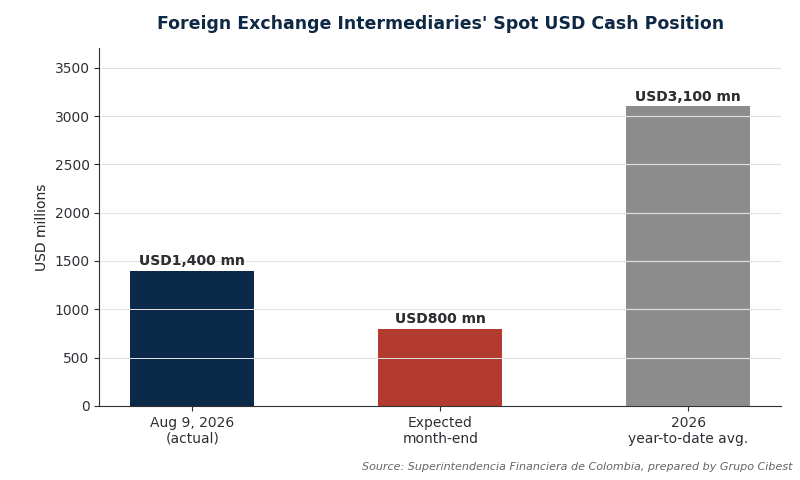
Dollar liquidity among foreign exchange intermediaries tightened sharply in the second half of August. (Source: Superintendencia Financiera de Colombia, prepared by Grupo Cibest; chart: Finance Colombia)
On the downside for the dollar, Grupo Cibest pointed to continued carry-trade activity, in which investors borrow in low-rate currencies to invest in higher-yielding Colombian assets, as well as to the central bank’s plan to keep purchasing close to $400 million USD in reserves per month through September. Additional support for the peso could also come from international aid tied to the reconstruction effort following the magnitude-7.4 earthquake that struck Chocó and neighboring departments on August 10.
As of September 7, the exchange rate stood at COP3,126, near the middle of Grupo Cibest’s forecast band, according to a market report carried by El Universal. Colombia’s August inflation figure, due the same day, was expected to remain above 6%, a reading that would keep pressure on the central bank to hold its policy rate steady even as the fiscal picture it revealed at the end of August continues to work through the market.