Previous Story
Banco de la República’s Leonardo Villar Links the Colombian Peso’s Surge to Deficit Financing
Posted On October 2, 2026
Comment: 0
Tag: abelardo de la espriella, Alianza Valores y Fiduciaria, Andrés Velasco, Asobancaria, asofondos, banco de la republica, capital inflows, cartagena, Central Bank of Colombia, chile, colombia, colombian peso, Convención Bancaria, Decreto 0369, Exchange Rate, export competitiveness, Federal Reserve, Felipe Campos, Fiscal Deficit, Gustavo Petro, interest rates, leonardo villar, minimum wage, Ministerio de Hacienda, monetary policy, pension funds, pension repatriation, peru, peso appreciation, real exchange rate, superintendencia financiera, URF, USD/COP
Central Bank Says It Has Few Tools to Curb the Peso’s Appreciation
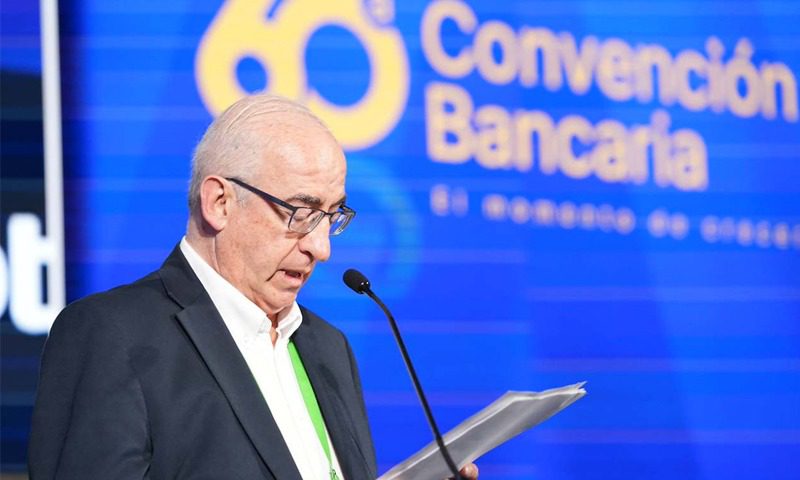
The Colombian peso’s rally this year reflected factors specific to Colombia rather than global weakness in the US dollar, Leonardo Villar, general manager of the Banco de la República (Bank of the Republic), Colombia’s central bank, said in remarks opening the 60th Convención Bancaria (Banking Convention) of Asobancaria, Colombia’s banking association, in Cartagena on August 26, 2026. Villar linked the appreciation in significant part to the financing of the fiscal deficit, reinforced by improved risk perception following the new government’s fiscal announcements, high domestic interest rates, and a rule requiring pension funds to bring investments home from abroad.
Villar said the market had closed the previous day at 3,090 pesos per dollar, which he put at more than 18% below its level at the start of the year, and that unlike in 2025, a generalized dollar depreciation does not explain the move, Valora Analitik reported. The peso has also appreciated more than 18% against the euro, Villar said, and by similar percentages against the currencies of countries such as Chile and Perú.
Two days before the speech, on August 24, the dollar touched an intraday low of 3,021.50 pesos, a level not seen since October 2018, before closing at 3,056.44, El Colombiano reported.
Deficit financing and capital inflows
Villar described the link to the deficit as a paradox, since a large deficit would normally push a currency toward devaluation. Colombia, he said, has a good record of meeting its obligations and access to financing, including international bond sales and purchases of peso-denominated public debt by investors abroad.
“Paradoxically, I believe this phenomenon is significantly related to the large fiscal deficit that the Colombian public sector has today.”
— Leonardo Villar, general manager, Banco de la República
“The financing involves capital inflows that feed the supply of foreign currency, and in that way it becomes an important source of appreciation of the peso,” Villar said, according to Infobae. The effect is reinforced when the country’s risk perception improves, he said.
Villar credited the “healthy announcements” of the new government of President Abelardo de la Espriella about its intention to carry out a significant fiscal adjustment and pursue an economic policy “friendlier to the private sector.” The resulting improvement in risk perception, he said, is “precisely what has happened in the last three months.”
Rates and repatriated pension savings
Villar said the appreciation is also reinforced when inflationary pressures force the central bank to raise interest rates and hold them well above international levels. He noted that the bank raised its policy rate by 275 basis points in the first half of the year. The benchmark has stood at 12% since July 1.
Added to that, Villar said, is “the obligation established by the previous government for pension funds to bring back to the country a significant portion of their investments abroad.” Under Decreto 0369 (Decree 0369), issued April 7, 2026, by the administration of former President Gustavo Petro, mandatory pension fund managers were required to reduce their foreign investments to a ceiling of 30%, with a transition period of up to five years and an intermediate limit of 35% within three years, Infobae reported at the time.
Andrés Velasco, president of Asofondos, the pension fund industry association, warned in April, in the same Infobae report, that forced repatriation would mean selling profitable assets abroad, “in many cases hastily.” He added: “Then those dollars would come in to push the currency toward revaluation, which means receiving fewer pesos for each dollar.”
On September 10, the Ministerio de Hacienda y Crédito Público (Ministry of Finance and Public Credit) published for public comment a draft decree that would eliminate the 30% cap, La República reported. The 30% cap remains in force until a final decree is issued; as of September 10, the proposal was open for public comment before the government would decide whether to adopt it. Velasco welcomed the proposal, according to La República: “A portfolio that is diversified will always be better; it will always be able to deliver greater returns, better risk management and better liquidity.”
The Superintendencia Financiera de Colombia (Financial Superintendency of Colombia) told the Unidad de Proyección Normativa y Estudios de Regulación Financiera (URF, Financial Regulation Projection and Studies Unit), which prepared the draft’s supporting technical document, that as of September 7 no fund manager had submitted the required adjustment plan, Infobae reported. The plans are due October 7; the draft would also eliminate that requirement. Foreign investments fell from 48.4% to 44.5% of the funds’ total portfolio between March 31 and July 31, but the funds’ dollar-denominated positions rose by about $5.73 billion USD, or 8.6%. The drop in share reflected the peso’s appreciation, not asset sales, according to Infobae.
The cost to exporters
Villar said the appreciation “takes competitiveness away from our exports” and makes it very difficult for goods produced in Colombia to compete with imports. The hourly wages that tradable-goods sectors pay low-skilled workers have risen about 28% in pesos, counting the minimum wage increase and the reduction in the legal workweek, and more than 50% when measured in dollars, he said.
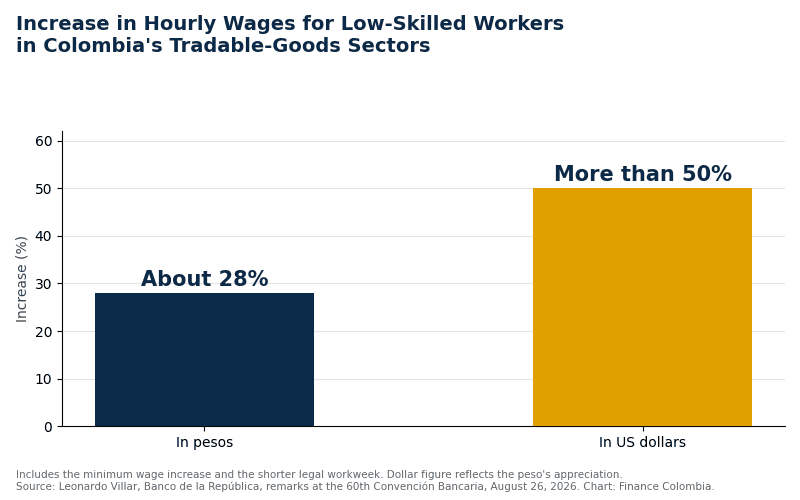
Hourly wages for low-skilled workers in Colombia’s tradable-goods sectors rose about 28% in pesos and more than 50% in dollars, according to Leonardo Villar. (Chart: Finance Colombia, with data from Banco de la República)
Measured with consumer price indices, Colombia’s real exchange rate peaked in the second half of 2022 and has since fallen about 33%, reaching levels in July “similar to the historical lows observed about 15 years ago,” Villar said. He said that “there is not much the Banco de la República can do to prevent these phenomena.” Instead, he said, “the fiscal adjustment and the government’s commitment to income and wage policies consistent with low and stable inflation are indispensable” for inflation to fall amid sustainable growth “without generating variations in the real exchange rate as dramatic as those we are observing in the current situation.”
Felipe Campos, investment and strategy manager at Alianza Valores y Fiduciaria, said on August 24 that attributing the dollar’s fall exclusively to drug trafficking or to the interest rate differential has little basis, according to El Colombiano. In his view, “the movement responds in large part to the entry of investors who are betting on an eventual shift toward greater economic orthodoxy in Colombia and Latin America.”
Where the peso and rates stand now
The peso weakened sharply in late August after the government’s revised 2027 budget disclosed a deeper fiscal deterioration, as Finance Colombia reported. On September 28, the official exchange rate certified by the Superintendencia Financiera stood at 3,306.86 pesos per dollar, down from 3,329.61 pesos for September 25, according to Infobae.
On the US side, the Federal Reserve‘s Federal Open Market Committee voted 12–0 on September 16 to raise the federal funds target range by a quarter percentage point to 3.75% to 4%. At its most recent monetary policy meeting, on July 31, the Banco de la República‘s board held its benchmark rate at 12% in a 4–3 vote. Its next rate decision is scheduled for September 30.
Headline photo: Leonardo Villar, general manager of the Banco de la República, speaks at Asobancaria’s Convención Bancaria in Cartagena on August 26, 2026. (Photo courtesy Banco de la República)