Previous Story
Colombia Draws $1.3 Billion USD in International Pledges After Deadly Earthquake
Posted On August 12, 2026
Comment: Off
Tag: abelardo de la espriella, AECID, argentina, bbva, bolivia, brazil, CAF Development Bank of Latin America and the Caribbean, Catholic Relief Services, chile, chocó, Colombia earthquake, Colombian Red Cross, Copernicus, costa rica, cuba, Delcy Rodríguez, dominican republic, earthquake relief, Economic Development, ecuador, el salvador, European Commission, european union, foreign investment Colombia, france, germany, guatemala, Humanitarian Aid, Inter-American Development Bank, International Federation of Red Cross and Red Crescent Societies, international organization for migration, israel, japan, José Antonio Kast, José Manuel Albares, jose manuel restrepo, mexico, Miyamoto International, Natural Disaster, Nayib Bukele, Omar Bula, One Inversión Social, panama, peru, San José del Palmar, somosone.com.co, spain, sweden, Swiss Agency for Development and Cooperation, switzerland, turkey, UN World Food Programme, United States Department of State, Ursula von der Leyen, venezuela, world bank, World Vision
Relief pledges test Colombia’s disaster-finance framework
A magnitude 7.4 earthquake struck western Colombia at 7:34 a.m. local time on August 10, with an epicenter about 3 miles (5 kilometers) east of San José del Palmar in the department of Chocó, roughly 150 miles (241 kilometers) from Bogotá, according to the US Geological Survey and Colombia’s Servicio Geológico Colombiano (Colombian Geological Survey). The quake originated at a depth of more than 100 kilometers, classifying it as a deep intraslab event tied to the Nazca Plate’s subduction beneath the South American Plate. Tremors were felt as far away as Panama, Venezuela, Ecuador, and Peru.
As of August 12, Colombian authorities had confirmed more than 188 deaths, over 1,600 injuries, 222 people missing, and 260 people still trapped in debris, according to the Unidad Nacional de Gestión del Riesgo de Desastres (National Disaster Risk Management Unit, UNGRD) and figures reported by El Tiempo; earlier tallies from the UN Office for the Coordination of Humanitarian Affairs (OCHA) put damaged homes at close to 5,000, with 61 buildings collapsed and more than 550 schools and 24 health facilities affected across roughly 16 departments. Chocó, Valle del Cauca, Caldas, Risaralda, and Quindío sustained the heaviest damage. President Abelardo De La Espriella declared a national disaster, invoked an economic emergency, and decreed three days of national mourning.
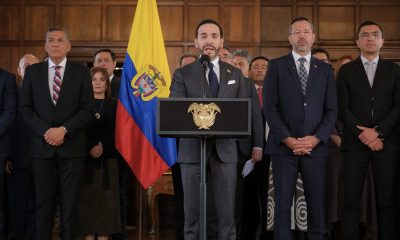
Colombia’s Foreign Ministry, the Cancillería, installed an international cooperation command post led by Foreign Minister Omar Bula to field and coordinate offers of assistance from foreign governments and multilateral organizations. Vice President José Manuel Restrepo said more than 12 countries had formally pledged humanitarian aid or rescue personnel, and that multilateral institutions alone had presented cooperation proposals totaling $1.3 billion USD in assistance of various kinds. “We have already received proposals worth $1.3 billion USD in cooperation of various kinds from multilateral organizations in the midst of this tragedy,” Restrepo said.
“We have already received proposals worth $1.3 billion USD in cooperation of various kinds from multilateral organizations in the midst of this tragedy.” — José Manuel Restrepo, Vice President of Colombia
United States
The US Department of State said it mobilized an initial $15.5 million USD in emergency shelter, food, and protection assistance, along with post-earthquake structural assessments, according to an August 11 media note from the department’s Office of the Spokesperson. The funding is being channeled through five partner organizations: Catholic Relief Services (CRS), the International Organization for Migration (IOM), Miyamoto International, the UN World Food Programme, and World Vision. Of the total, $3 million USD routed through CRS draws on funding already committed under a separate, previously announced global assistance award to that organization, meaning it does not represent new incremental spending beyond what State had already budgeted for CRS programming.
The department also activated a Disaster Assistance Response Team (DART), a standing mechanism of humanitarian specialists drawn from across the State Department, with members arriving in Colombia the day of the earthquake to coordinate needs assessments and the broader US government response alongside embassy personnel in Bogotá.
Separately from the new $15.5 million USD package, the State Department noted that as part of its existing $3.8 billion USD contribution to OCHA, the United States had previously provided $200 million USD to the Colombia Pooled Fund, a standing mechanism OCHA can draw on for earthquake-related needs as well as humanitarian programming in Colombia that predates the earthquake. That $200 million USD figure reflects prior funding availability rather than a new pledge tied specifically to the August 10 disaster.
On consular matters, the US Embassy in Bogotá remained open and continued providing emergency and routine passport, notarial, and consular services; its consular agency in Barranquilla also remained open. The embassy advised American citizens in Colombia to enroll in the Smart Traveler Enrollment Program (STEP) at step.state.gov and to follow [@USEmbassyBogota](profile/USEmbassyBogota) and [@TravelGov](profile/TravelGov) on social media for security updates. US citizens seeking assistance can reach the Bureau of Consular Affairs at 888-407-4747 from within the United States, or +1-202-501-4444 from other locations.
Multilateral development banks
The World Bank disposed $200,000 USD in a non-reimbursable grant, without an associated credit line, to fund post-earthquake damage assessments. Susana Cordeiro Guerra, the World Bank’s vice president for Latin America and the Caribbean, offered technical expertise drawn from the institution’s experience responding to disasters elsewhere, in addition to the grant.
The Inter-American Development Bank (IDB) approved $500,000 USD in non-reimbursable technical cooperation funding, of which $350,000 USD was made immediately available to the Colombian Red Cross and $150,000 USD earmarked for technical support, Restrepo said. Separately, IDB Group President Ilan Goldfajn said the institution has up to $300 million USD in contingent emergency financing available to Colombia should the government request it; wire reports including CNBC and CBC cited a related figure of $50 million USD as immediately available for reconstruction support, reflecting different tranches or reporting of the same contingent facility.
CAF, the Banco de Desarrollo de América Latina y el Caribe (Development Bank of Latin America and the Caribbean), pledged $500,000 USD in humanitarian donations to be channeled through its Social and Human Development Funds, CAF executive president Sergio Díaz-Granados said.
European Union
European Commission President Ursula von der Leyen announced €2.1 million EUR in humanitarian funding for health, water, sanitation and hygiene, shelter, food, protection, and cash assistance in the hardest-hit areas, according to the European Civil Protection and Humanitarian Aid Operations department (ECHO). The European Union activated its Civil Protection Mechanism, which pools resources among the bloc’s 27 member states, and deployed its Copernicus satellite mapping service to support damage assessment. A further €100,000 EUR was reallocated from an existing EU-funded project implemented by the German Red Cross to meet immediate needs of roughly 2,500 families in Chocó and Valle del Cauca.
Switzerland
The Swiss government approved 1 million CHF (about $1.23 million USD) in aid, with half directed to the UN World Food Programme and local nongovernmental organizations for emergency assistance and the remainder allocated to restoring living conditions in destroyed areas, according to the Swiss Agency for Development and Cooperation. Swiss President Guy Parmelin offered solidarity with Colombia the day of the earthquake.
Spain
Spain’s Agencia Española de Cooperación Internacional para el Desarrollo (Spanish Agency for International Cooperation for Development, AECID) mobilized an initial €1 million EUR package covering shelter materials, water and sanitation kits, medication, and support for deployed health personnel, Foreign Minister José Manuel Albares said. Spain’s Ministry of Foreign Affairs reported no confirmed Spanish fatalities as of August 12, though it had not yet located 75 Spanish nationals believed to have been in the affected region.
El Salvador
El Salvador’s president, Nayib Bukele, dispatched two aircraft carrying 100 tons of humanitarian aid along with medical and rescue teams, according to the Presidencia de la República de El Salvador (Presidency of the Republic of El Salvador).
Ecuador
Ecuador’s Ministerio de Relaciones Exteriores y Movilidad Humana (Ministry of Foreign Affairs and Human Mobility) sent 47 rescuers with canine units and equipment provisioned for seven days of operations.
Mexico
Mexico deployed 255 specialized military search-and-rescue personnel, including canine handlers and medical staff, along with 4 tons of medications, 8.4 tons of food, satellite phones, radios, generators, and tents, according to Mexico’s Secretaría de Relaciones Exteriores (Ministry of Foreign Affairs).
Peru
Peru sent a plane carrying 12.5 tons of supplies and 62 rescuers through its Ministerio de Relaciones Exteriores (Ministry of Foreign Affairs).
Chile
Chilean President José Antonio Kast offered his government’s civil and technical resources through Chile’s Ministerio de Relaciones Exteriores (Ministry of Foreign Affairs), without publicly specifying the scope.
Venezuela
Venezuela’s government, through Vice President and Foreign Minister Delcy Rodríguez and the Ministerio del Poder Popular para Relaciones Exteriores (Ministry of People’s Power for Foreign Affairs), said it would send rescue brigades, an announcement that drew domestic criticism within Colombia given the state of bilateral relations.
Brazil
Brazilian President Luiz Inácio Lula da Silva pledged solidarity and said logistical and technical teams were on standby through Brazil’s Ministério das Relações Exteriores (Ministry of Foreign Affairs).
Argentina
Argentina’s Ministerio de Relaciones Exteriores, Comercio Internacional y Culto (Ministry of Foreign Affairs, International Trade and Worship) offered material assistance, civil protection assets, and logistics support.
Additional Latin American and Caribbean support
Several other countries in the region conveyed solidarity or more limited offers of support:
- Panama — President José Raúl Mulino offered collaboration “within our capacity” through the Ministerio de Relaciones Exteriores de Panamá (Ministry of Foreign Affairs of Panama).
- Costa Rica — The government conveyed solidarity through its Ministerio de Relaciones Exteriores y Culto (Ministry of Foreign Affairs and Worship).
- Dominican Republic — President Luis Abinader said his country stood ready to provide assistance, coordinated through the Ministerio de Relaciones Exteriores de República Dominicana (Ministry of Foreign Affairs of the Dominican Republic).
- Guatemala — The disaster-response agency, the Coordinadora Nacional para la Reducción de Desastres (National Coordinator for Disaster Reduction, Conred), remained in contact with Colombian counterparts to determine whether a formal request for assistance would follow, President Bernardo Arévalo de León’s government said.
- Cuba — Expressed willingness to help without publicly detailing specific commitments.
- Bolivia — Expressed willingness to help without publicly detailing specific commitments.
Other countries
Vice President Restrepo named Japan, Sweden, and Turkey among the more than 12 governments that formally offered humanitarian aid or rescue support, though itemized figures for their pledges were not publicly available as of this writing. Israel, France, Germany, Italy, and Ukraine also expressed readiness to coordinate assistance, according to Colombian media reporting, without confirmed dollar figures attached to those offers.
Red Cross and Red Crescent movement
The International Federation of Red Cross and Red Crescent Societies (IFRC) launched an emergency appeal for 11.7 million CHF to support the Colombian Red Cross, which activated its National Crisis Room and deployed a 30-member urban search-and-rescue team from its Antioquia branch to Chocó, alongside volunteers from its Quindío and Caldas branches. The Colombian Red Cross also activated its Restoring Family Links service to help reunite people separated from missing relatives.
Private sector
Among corporate contributions, Spanish bank BBVA (BME: BBVA) (NYSE: BBVA) said it would provide 3,500 food and hygiene kits, including nonperishable staples and personal care items, distributed through Colombia’s regional food bank network.
How to contribute
Colombian donors and members of the international community seeking a vetted local channel for contributions can direct support through somosone.com.co, the Colombian strategic-philanthropy platform operated by ONE Inversión Social. The organization has partnered with Sankofa Danzafro, La Pascasia, and Presentes Corporación on a Chocó-focused relief campaign, with a donation page linked from the platform’s homepage.