Previous Story

De la Espriella Declares Economic Emergency to Accelerate Colombia’s Post-Earthquake Reconstruction
Posted On August 11, 2026
Comment: Off
Tag: abelardo de la espriella, Colombia earthquake, Colombia national disaster, Colombia´s Congress, Colombia´s Presidency, Colombia’s 1991 Constitution, Congress of Colombia, Constitutional Court, earthquake, Fondo Milagro, Gustavo Petro, National Unit for Disaster Risk Management, Patria Milagro, Presidencia de Colombia, Sistema Nacional de Gestión del Riesgo de Desastres, social and ecological emergency, state of economic, ungrd, Unidad Nacional para la Gestión del Riesgo de Desastres
Economic emergency declared after deadly earthquake
Colombian President Abelardo de la Espriella announced the declaration of a state of economic, social and ecological emergency to accelerate the response and reconstruction following the magnitude 7.4 earthquake that struck August 10, leaving more than 265 people dead, nearly 3,500 injured and 495 still missing.
The extraordinary measure will temporarily allow the executive branch to issue decrees with the force of law directly related to the emergency, mobilize resources and expedite procedures that, under normal circumstances, require lengthier administrative or legislative processes.
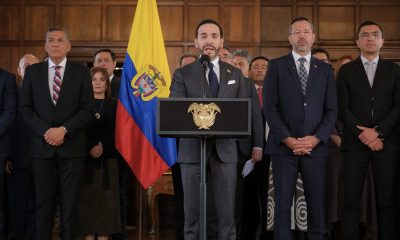
“I am informing the country that I have decided to make use of the economic emergency, a mechanism provided for in our Constitution that will allow us to address this crisis as required,” De la Espriella said during a televised news conference.
According to figures from the Unidad Nacional para la Gestión del Riesgo de Desastres, UNGRD (National Unit for Disaster Risk Management), released by the Presidency, the earthquake also damaged the homes of about 25,800 families and affected critical infrastructure, including medical centers, pedestrian bridges, roads, aqueducts and airports.
Among the hardest-hit areas are cities such as Manizales, Pereira and Cali, as well as the department of Chocó, which was the epicenter of the earthquake. The scale of the damage now opens a reconstruction process that could extend well beyond the duration of the state of exception. But what exactly does this measure entail? Here we explain.
What is a state of economic emergency?
The state of economic, social and ecological emergency is one of three states of exception established under Colombia’s 1991 Constitution to address extraordinary circumstances.
The other two are a state of foreign war, regulated by Article 212 of the Constitution, and a state of internal disturbance for security reasons, established under Article 213. The mechanism now being used by De la Espriella is regulated by Article 215.
That article establishes that when events other than a foreign war or internal disturbance occur that “seriously and imminently disrupt or threaten to disrupt the country’s economic, social and ecological order” or constitute a “serious public calamity,” the president, with the signatures of all Cabinet ministers, may declare a state of emergency.
Each declaration may remain in effect for up to 30 days, and the different periods of emergency may not total more than 90 days within the same calendar year.
To use this mechanism, the government must demonstrate the existence of real and verifiable circumstances that represent a serious and imminent threat and explain why the state’s ordinary powers are insufficient to respond to the crisis.
In addition, measures adopted through emergency decrees must be directly related to the causes that prompted the declaration.
What can the president do during the emergency?
In practice, the mechanism temporarily expands the executive branch’s powers by allowing it to issue decrees with the force of law without initially following the ordinary legislative process in Congress.
Among the measures it can adopt are the reallocation of budget funds, creation of funds to respond to the emergency, authorization of direct contracting mechanisms, changes to tax calendars and, under applicable constitutional conditions, the establishment of temporary taxes.
Those taxes must cease to apply at the end of the following fiscal year unless Congress subsequently decides to make them permanent. Colombia has had several examples of this. In March 2026, amid heavy rains, the government of former President Gustavo Petro enacted Decree 0240, creating two temporary taxes. The first was a 16% consumption tax on gambling platforms, along with an expansion of the wealth tax.
The 30-day window will be particularly important for the immediate response. During that period, the government will be able to establish extraordinary mechanisms to assist victims, mobilize resources and launch the initial phases of reconstruction, including the potential channeling of international cooperation.
However, because the reconstruction of infrastructure and housing will likely extend for months or years, much of its implementation will subsequently have to continue through ordinary legislation and resources from the national budget.
Government announces the ‘Fondo Milagro’
De la Espriella also announced that the emergency will allow the creation of the so-called “Fondo Milagro,” a name connected to “Patria Milagro,” one of his government’s political slogans.
The president described the fund as “an entity that will channel national and international contributions, which will be allocated to the reconstruction of hospitals, educational centers, buildings, roads and airports that were damaged by the earthquake.”
The government also intends to use the extraordinary powers to promote economic recovery in the affected regions.
“The emergency must also include economic recovery measures that stimulate investment, reduce obstacles to project development and generate more jobs,” De la Espriella said.
Is it a blank check for the president?
The scope of the extraordinary powers explains why states of emergency often generate political and legal controversy in Colombia.
The ability to issue decrees with the force of law, temporarily modify certain fiscal and budgetary rules and accelerate contracting processes can be interpreted as a way to reduce the ordinary controls and procedures that normally constrain executive action.
However, the Constitution establishes specific limits.
The president cannot use the emergency to suspend fundamental rights, weaken workers’ social rights or interrupt the functioning of the other branches of government. Nor can the president use extraordinary powers to adopt decisions that are not directly aimed at addressing the causes and consequences of the emergency.
In addition, legislative decrees issued during the state of exception are automatically subject to review by the Constitutional Court.
Congress also retains its political oversight functions and may examine the reasons that led the government to declare the emergency and assess the appropriateness and timing of the measures adopted. Within its constitutional powers, it may also modify, add to or repeal certain provisions issued during the emergency.
Those checks have already had an impact in 2026: In April, 2026, the court struck down the emergency declared by Gustavo Petro in December 2025, while in June it upheld, with restrictions, another declaration issued in February.
An economic emergency and a national disaster are not the same
Before announcing the state of economic emergency, the government had declared a national disaster, a different legal mechanism.
The disaster declaration stems from Law 1523 of 2012 and is linked to the Sistema Nacional de Gestión del Riesgo de Desastres, SNGRD (National Disaster Risk Management System). Among other tools, it allows resources from that fund to be mobilized and expedites the contracting needed to provide humanitarian assistance.
The state of economic, social and ecological emergency, by contrast, is constitutionally grounded in Article 215 and grants the executive branch extraordinary and temporary legislative powers.
The two mechanisms can therefore operate in a complementary manner: One facilitates the administrative and operational management of the disaster response, while the other temporarily allows measures with the force of law to address a crisis that the government considers impossible to manage solely through ordinary mechanisms.
De la Espriella’s use of the mechanism now opens a new period of constitutional and political oversight. Although the executive branch will be able to act more quickly during the initial earthquake response, the measures it adopts must remain directly connected to the calamity and will be reviewed by both the Constitutional Court and Congress.