Previous Story
Colombia Awards Thomas Greg & Sons a $240 Billion COP No-Bid Contract to Resume Passport Production
Posted On November 2, 2026
Comment: 0
Tag: abelardo de la espriella, alvaro leyva, bogotá, Cancilleria, colombia, Colombia Compra Eficiente, Colombia government contracts, Colombian passports, contraloria general de la republica, Gustavo Petro, Imprensa Nacional-Casa da Moeda, Imprenta Nacional de Colombia, IN Groupe, Ley 80 de 1993, no-bid contract, Omar Bula, passport contract, procuraduria general de la nacion, public procurement, SECOP II, thales, Thomas Greg & Sons, travel documents, Tribunal Administrativo de Cundinamarca, Unión Temporal Documentos de Viaje 2027, urgencia manifiesta
Court order forces a direct award as passport book stocks run out
Colombia’s Ministry of Foreign Affairs announced on October 27, 2026, that it has awarded a no-bid contract worth $240.35 billion COP, roughly $75 million USD at the late-October official rate, to resume production of the country’s passports. The work returns to Thomas Greg & Sons de Colombia S.A., the contractor former President Gustavo Petro pushed out, after a Bogotá court suspended the state-run model his government built to replace the company.
Contract 959-2026 went to the Unión Temporal Documentos de Viaje 2027, a consortium that El Colombiano reports as Thomas Greg & Sons de Colombia S.A. with 68%, Thales DIS Colombia S.A. with 28.9% and Thomas Greg & Sons Limited (Guernsey) S.A. with 3.1%. Thales DIS Colombia is a unit of the French defense and digital identity group Thales (Euronext Paris: HO).
The scope covers supply, personalization, custody and distribution of passport booklets, along with the printing, storage and delivery of Colombian visa labels carrying a machine-readable zone. Payment comes from the ministry’s Fondo Rotatorio, its revolving fund. El País reported that the contract covers more than 2 million travel booklets, a quantity the procurement filing itself does not state.
How long the arrangement lasts depends on what the clock is measured from. Execution ends December 17, 2027, a 407-day term in the procurement record counted from the contract’s start-up act; measured instead from the September 17 urgency resolution, the same end date falls exactly 15 months out. The record marks the contract as not extendable, while El Espectador reported it can be extended if the emergency persists and future-year budget authority is in place. Foreign Minister Omar Bula called it a 15-month arrangement; Asuntos Legales and Noticias RCN reported 13 months.
A direct award under emergency contracting powers
The ministry ran no competitive tender. It invoked urgencia manifiesta, or manifest urgency, a mechanism under articles 42 and 43 of Ley 80 de 1993 that lets state entities contract directly when continuity of an essential service is at risk. Resolution 12973 of September 17, 2026, declared that urgency. Such contracts draw after-the-fact fiscal review by the Contraloría General de la República, the national comptroller, and the ministry says all filings appear on SECOP II, the procurement platform run by Colombia Compra Eficiente.
The trigger was judicial. On September 2, 2026, the Tribunal Administrativo de Cundinamarca, the administrative court for the department surrounding Bogotá, provisionally suspended execution of the inter-administrative agreements underpinning the passport model the previous government built, acting on an acción popular, a public-interest suit, brought by lawyer Nicolás Dupont Bernal. It ordered the ministry and its partners to report on how the agreement was being executed and where passports were actually being produced, while keeping the service running. The court declined to lift that order on September 16, and the urgency resolution followed a day later.
The ministry gave three technical reasons. The first was timing: passport booklet inventory runs out in November 2026, and bringing in a different operator would mean certifying a plant and registering a new document design with the International Civil Aviation Organization, which it put at several months. Thomas Greg & Sons already holds a certified production and personalization plant inside Colombia and can restart within 20 business days, it said.
Document security supplied a second argument. Two Colombian passport designs are already in circulation and both remain valid, one produced under the Portuguese arrangement and one by Thomas Greg & Sons. A third transitional design, the ministry argued, would oblige border authorities worldwide to authenticate three different documents issued by the same country.
On cost, the ministry said the consortium held its unit prices from earlier contract periods, with no adjustment for inflation or for the exchange rate.
“There is not a single line item with an increase, and the fees the citizen pays do not change.” — Colombia’s Ministry of Foreign Affairs
Portafolio reported the contracted component prices at $67,835 COP per ordinary booklet and $42,316 COP for personalization, custody and distribution, both including value-added tax, and stressed that those are contracted component costs rather than what citizens pay at the counter. An ordinary passport issued in Bogotá costs the applicant $195,600 COP, a base fee plus stamp tax, according to Bloomberg Línea.
How the contract left Thomas Greg & Sons in the first place
Thomas Greg & Sons has printed Colombian passports since 2007, and the ministry says it served until July 31, 2026. The move to replace it began in 2023, when then-Foreign Minister Álvaro Leyva suspended a public tender, citing a lack of competition in a process where the company stood as the only qualified bidder. Leyva was suspended over his handling of that bid process.
In place of a tender, the Petro government signed a cooperation agreement valued at more than $1.3 trillion COP among the ministry, the Imprenta Nacional de Colombia (National Printing Office), Portugal’s state mint Imprensa Nacional-Casa da Moeda and the French state-owned IN Groupe. The Procuraduría General de la Nación, Colombia’s inspector general, sued in October 2025 to void it, arguing the Portuguese mint contributed only 21% of the project’s value against a 50% statutory minimum for direct awards of that kind. The ministry defended the agreement, and in mid-2026 the court allowed the challenge to proceed.
Portugal objects, Petro objects, and a tender is still promised
The displaced European partners have objected. Infobae reported that Portugal’s government sent a diplomatic note to Bogotá maintaining that the court’s provisional measure did not annul the agreement, which therefore remains in force. The note also cited an unanswered meeting request and a payment for blank booklets due October 14, 2026.
Petro criticized the award within hours. Writing on X, he tied it to his contention that irregularities in the vote count delivered the presidency to Abelardo de la Espriella: “Said and done, this was the quid pro quo for the use of the private software where the irregular uses of the hash lock and algorithms in the elections took place.” Petro has not substantiated that fraud claim, El País noted. De la Espriella won the June 2026 runoff by less than a percentage point.
Bula said a full tender is being structured in parallel, with oversight participation from the Procuraduría and the Contraloría. The ministry says the emergency declaration does not cancel the ordinary process it announced a month earlier, and that the urgency lapses once the court lifts its injunction or a tender-selected contractor begins operating.
The arrangement is not new for this ministry and this contractor. El Tiempo reported that this is the fourth manifest-urgency declaration the Cancillería has signed with Thomas Greg & Sons in under four years, the first three of them under Petro.
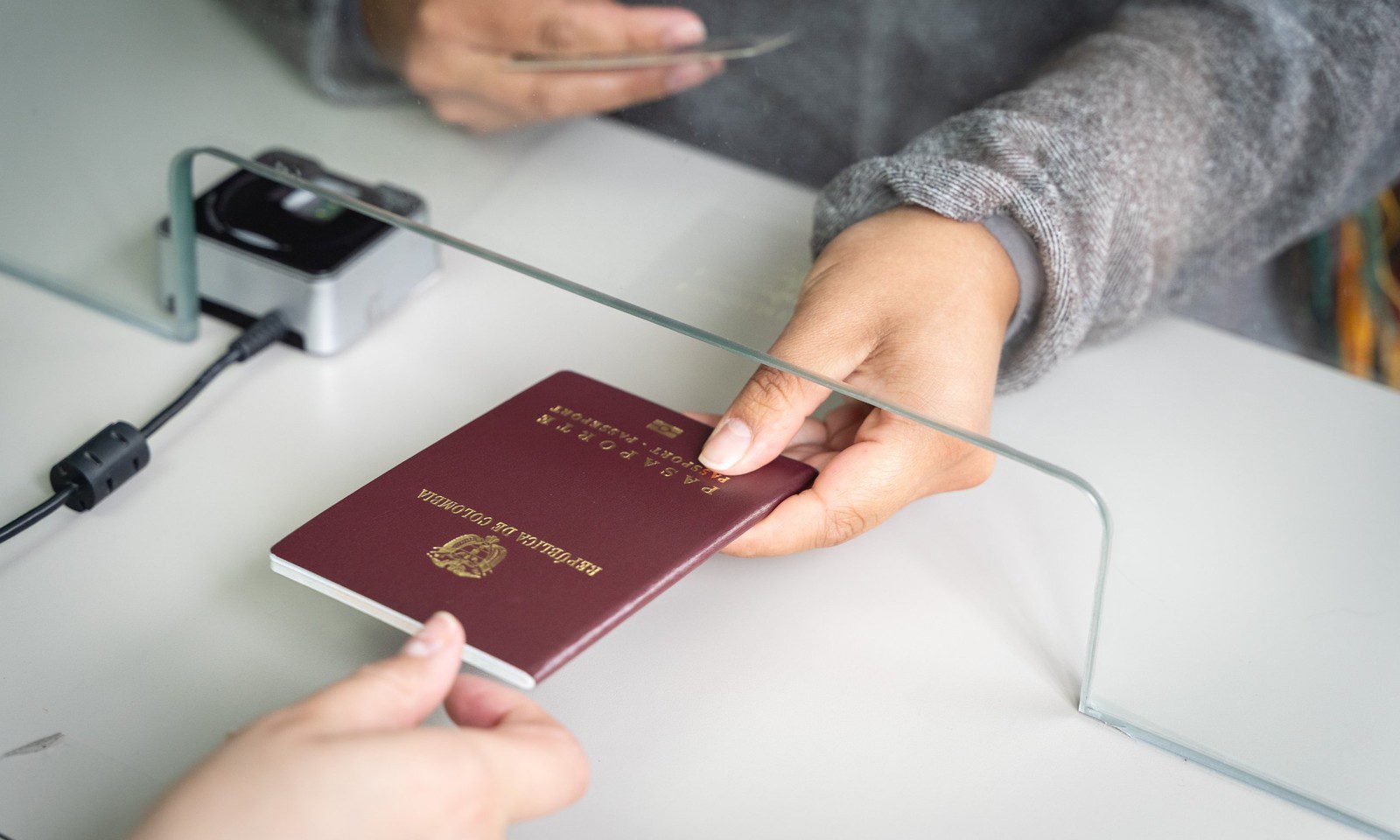
Headline photo: A Colombian passport is handed across the counter at a document issuance window. (Photo courtesy Cancillería de Colombia)