Previous Story
Colombia’s Rescue Bill Reaches Congress With a $51 Trillion COP Adjustment for 2027
Posted On November 17, 2026
Comment: 0
Tag: AMD, AVAL, banco de la republica, bancolombia, Bank of England, bank of the republic, Basis Points, Brent Crude, camara de representantes, cib, CIBEST, colcap, colombia, colombian central bank, Colombian Congress, Colombian Inflation, colombian peso, colombian stock exchange, CONCONCRET, conconcreto, consumer confidence, dane, debt coupon, Departamento Administrativo Nacional de Estadística, dxy, earthquake, ec, Economic Growth, Economic Rescue Law, economy, ecopetrol, el niño, european central bank, eurozone inflation, exports, federal funds rate, Federal Reserve, fedesarrollo, ferronickel, fiscal adjustment, grupo argos, grupo aval, Grupo Cibest, grupo sura, grupoargos, GRUPOSURA, Hang Seng, inflation, Informe de Política Monetaria, iran, isa, Jose Luis Mojica, Ley de Rescate Económico, Manufacturing, Maria Paula Gonzalez, mineros, mining prices, Ministerio de Hacienda y Crédito Público, Ministry of Finance and Public Credit, monetary policy, Monetary Policy Report, MOVE index, Nikkei 225, non-monetary gold, nonfarm payrolls, oil prices, PFAVAL, PFCIBEST, producer price index, public debt, qatar, QCOM, Qualcomm, Radar Bancolombia, retail sales, Semiconductors, Shanghai Composite, share buyback, Strait of Hormuz, terpel, tes, Títulos de Tesorería, united states, us energy information administration, US midterm elections, US trade deficit, US Treasuries, US unemployment, USDCOP, uvr, Valentina Guáqueta, VIX, wall street, wti
Central Bank Cuts Growth to 2.0%; Brent Breaks Below $100 USD
Congressional debate on Colombia’s Ley de Rescate Económico (Economic Rescue Law) opened last week with a fiscal adjustment that would reach $51 trillion COP in 2027 and climb to $121.8 trillion COP by 2030, while yields across the country’s fixed-rate TES curve fell an average of 21 basis points and the peso weakened for a second consecutive week. Those are among the findings in the November 9 edition of Radar Bancolombia, the weekly macroeconomic and markets report published by Bancolombia, the Colombian banking subsidiary of Grupo Cibest (NYSE: CIB; BVC: CIBEST, PFCIBEST).
The same edition carries the central bank’s downgraded growth path, an October producer price index pushed up by mining, a US payrolls figure that beat expectations by a wide margin, and a 16.59% weekly fall in Brent. Its editorial, whose estimates put a responsible 2027 minimum wage increase near 8.4%, is covered separately in Finance Colombia’s report on the minimum wage calculation. The report’s named authors are María Paula González, a macroeconomic analyst, and Valentina Guáqueta, an inflation and central banking analyst; its editor is José Luis Mojica, macroeconomic manager. Quotations are Finance Colombia translations from the Spanish.
The Monetary Policy Report Cut Growth as It Raised Inflation
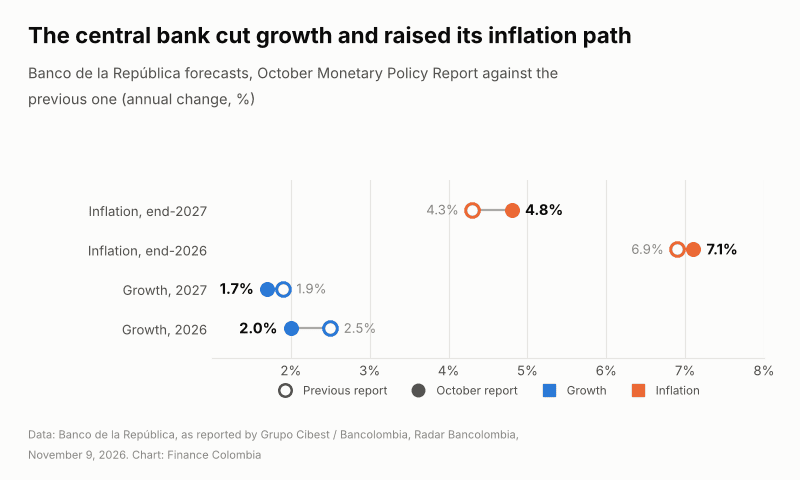
The October Monetary Policy Report cut growth for both years and raised the inflation path for both. (Chart: Finance Colombia, based on Banco de la República figures reported by Grupo Cibest)
The October Informe de Política Monetaria (Monetary Policy Report) of the Banco de la República (Bank of the Republic) cut the growth forecast to 2.0% for 2026 from 2.5% and to 1.7% for 2027 from 1.9%. The weaker path reflects the August 10 earthquake, which the central bank estimates subtracted close to 0.83 percentage points from third-quarter growth, together with the fading of the boosts from the World Cup and election spending, the recent deterioration in employment, and supply shocks to agriculture. It also raised the inflation path, to 7.1% for the close of 2026 from 6.9% and to 4.8% for 2027 from 4.3%, mainly on larger El Niño effects on food and on regulated gas and electricity prices. Inflation would resume its decline from 2027, the report said, though the balance of risks remains skewed to the upside.
Producer Prices Accelerated on Mining While Exports Held Up
Figures from DANE, Colombia’s Departamento Administrativo Nacional de Estadística (National Administrative Department of Statistics), cited in the report, put the domestic supply producer price index up 1.1 percentage points to 2.4% annually in October, its highest level since May, after a monthly variation of 0.37%. Mining prices led, rising 13.8% against 7.8% in September, their largest increase since May, while agricultural prices accelerated to 5.8% from 4.7% and industrial prices rose 0.8% after holding flat in September. Exports reached $5.411 billion USD in September, a 16.4% annual increase that fell short of the bank’s own 18% expectation, with oil and ferronickel sales up 40% and 138%. Brent averaged $114 USD per barrel during September and ferronickel export volumes rose 94.5%. Non-monetary gold exports grew 87.5%. Exports expanded 12.0% annually in the third quarter and have accumulated growth of 13.3% so far in 2026.
Grupo Cibest estimates retail sales grew 9.5% annually in September, driven by a 36.1% rise in vehicle sales, while household consumption excluding vehicles slowed to 1.6% in the third quarter from 1.8% in the June-to-August rolling quarter. Manufacturing is estimated to have grown 1.8%, helped by stronger electricity demand, improved business sentiment and the recovery in activity after the August 10 earthquake, with an 18.9% annual appreciation of the exchange rate lowering imported input costs. Fedesarrollo‘s consumer confidence index is estimated at 16.2 points in October, a 0.5-point monthly gain that would interrupt the slide seen since July while leaving the measure below the 18.6-point average of the first half.
“The fiscal front remains one of the main macroeconomic vulnerabilities and a source of pressure on local debt rates.” — María Paula González and Valentina Guáqueta, authors of Radar Bancolombia, Bancolombia
US Payrolls Beat Expectations and Lifted December Rate Odds
US job creation surprised to the upside in October at 165,000 nonfarm payrolls against a consensus of 65,000, the report said, with the unemployment rate falling to 4.1% from 4.2% and the August and September figures revised up by 53,000 and 31,000. The report puts the monthly job creation needed to absorb growth in the working-age population at about 40,000, a threshold consistently exceeded in August, September and October. The data lifted the market-implied probability of a 25 basis point increase by the US Federal Reserve in December to 77% from 67% a day earlier. The US trade deficit narrowed slightly to $105.047 billion USD in September from $105.737 billion USD in August, better than a forecast deficit of $108 billion USD,.
Eurozone Inflation Is Estimated at a Three-Year High as the Bank of England Raised
Eurozone inflation is estimated to have accelerated 0.2 percentage points to 4.0% annually in October, its highest level since September 2023 and far above the European Central Bank‘s 2.0% target, in line with consensus after a monthly variation of 0.44%. Energy prices, up 20.8% annually amid the persistence of the Middle East conflict, explain most of the move, though the acceleration extended to every component, with services reaching 3.3%, food 1.6% and non-energy industrial goods 1.2%. Core inflation held stable at 2.5%. Having left its rate unchanged in October, the European Central Bank would face greater pressure to move in December, with the probability of an increase at that meeting put at 72%. The Bank of England raised its rate by 25 basis points to 4.00% by majority, its first increase since August 2023, with annual inflation at 3.5% in September and expected to approach 5% by the middle of next year. The committee emphasized that the decision does not mark the start of a tightening cycle.
TES Rallied as the Rescue Bill Reached Congress
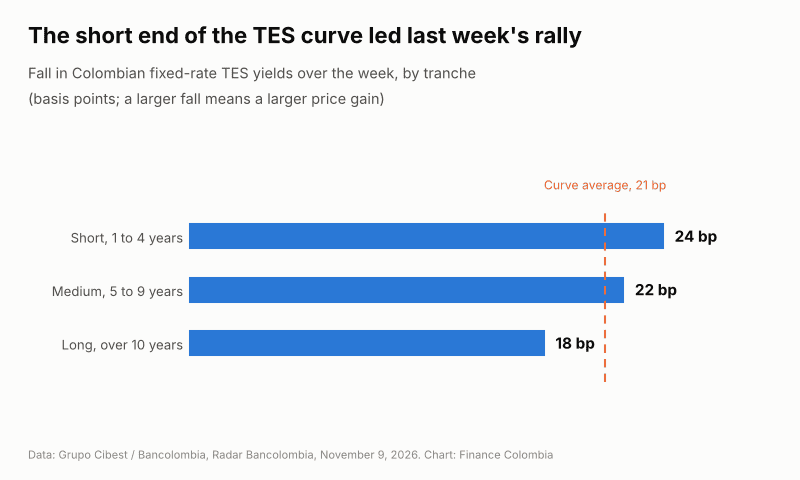
Yields on the one-to-four-year tranche fell 24 basis points, against a 21 basis point average across the curve. (Chart: Finance Colombia, based on Grupo Cibest data)
Yields on Colombia’s fixed-rate TES curve (Títulos de Tesorería, the government’s peso-denominated treasury bonds) fell an average of 21 basis points over the week, lifting prices in a bull steepening, with short-dated yields falling furthest: the one-to-four-year tranche dropped 24 basis points, the five-to-nine-year segment 22 basis points and the segment beyond 10 years 18 basis points. US Treasuries also rallied, in what the report described as a bull steepener, with nodes between two and five years down an average of seven basis points and the 10-to-30-year segment down six, as safe-haven demand following what the report called a resounding Democratic Party win in the US midterm elections offset resilient economic data. So far in November the VIX has risen 22.0% from the October close, to 23.7 points, reaching 28.2 points on November 5, its highest since March, on a correction in technology and semiconductor shares; the MOVE index of Treasury volatility fell 7.4% to 92.8 points.
Inflation expectations priced into US Treasuries extended their correction through October and the first days of November, concentrated at the shorter horizons. The one-year inflation forward one year ahead fell 12 basis points to 2.18% on November 6, and the two-year forward two years ahead fell eight basis points to 2.39%, while the five-year forward five years ahead moved less. The sharper correction at the nearer horizons suggests the market has moderated its view of inflationary pressure ahead, the report said, while longer-dated expectations remain close to the Federal Reserve’s target and anchored.
The bill’s total adjustment for 2027 would reach $51 trillion COP, roughly two-thirds of it from lower public spending and the remainder mainly from resources generated by the bill itself, rising to $97.6 trillion COP in 2028, $111.2 trillion COP in 2029 and $121.8 trillion COP in 2030. The measure must clear four debates before December 16 to avoid being postponed or sent to extraordinary sessions, and begins in the Cámara de Representantes (House of Representatives). Those adjustment figures come from the Ministerio de Hacienda y Crédito Público (Ministry of Finance and Public Credit), as cited in the report. Separately, the average coupon on the government’s class B TES debt rose eight basis points in September to 10.16%, up 151 basis points from the close of 2025, led by inflation-linked UVR debt at 11.05% while fixed-rate debt held near 9.72%.
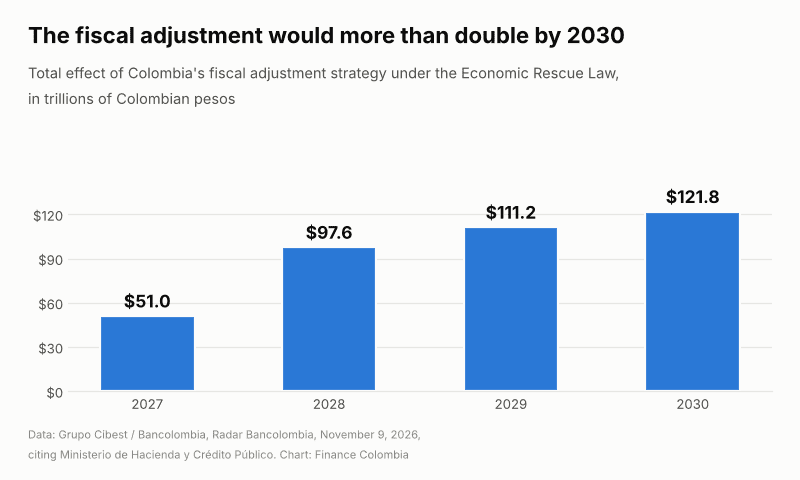
The adjustment would rise from $51 trillion COP in 2027 to $121.8 trillion COP in 2030. (Chart: Finance Colombia, based on Grupo Cibest data citing the Ministry of Finance)
The Peso Weakened a Second Week as Brent Broke Below $100 USD
The peso depreciated 1.42% over the week, with the USDCOP pair closing at $3,239.50 COP per dollar as expectations of a December Fed increase supported global demand for the dollar and the DXY index rose 0.37% to 102.27 points. Brent fell 16.59% to $98.12 USD per barrel and West Texas Intermediate fell 13.16% to $90.42 USD, retreating to September levels after Iran sent a nuclear proposal to the United States through Qatari mediation, though Iran reported three further attacks on oil tankers in the Strait of Hormuz on Thursday. The US Energy Information Administration reported a fifth consecutive weekly decline in crude inventories at the end of October. The report cites economic analysts’ expectations for the USDCOP pair to close 2026 at $3,258 COP and converge toward $3,428 COP by the end of 2027.
The Colcap Slipped as Third-Quarter Results Came in Mixed
The Colombian Stock Exchange‘s Colcap index fell 0.2% on the week to 2,485.26 points, after a 2.3% monthly decline in October to 2,490.92 points. Mineros (BVC: MINEROS; TSX: MSA) gained 9.9%, Grupo Sura (BVC: GRUPOSURA, PFGRUPSURA) 6.6% and Terpel (BVC: TERPEL) 1.9%, while Ecopetrol (NYSE: EC; BVC: ECOPETROL) fell 6.5%, Conconcreto (BVC: CONCONCRET) 4.2% and the preferred shares of Grupo Aval (NYSE: AVAL; BVC: GRUPOAVAL, PFAVAL) 3.9%. Grupo Argos (BVC: GRUPOARGOS, PFGRUPOARG) announced a share buyback offer of up to $150 billion COP, while ISA (BVC: ISA) reported a 23.1% fall in net income on operating revenue down 8.2% and EBITDA down 11.4%.
Wall Street closed lower, with the S&P 500 down 2.7%, the Dow Jones down 0.9% and the Nasdaq down 3.4%. Qualcomm (Nasdaq: QCOM) posted a 26% decline in handset revenue and 8% in its chip segment, and its shares corrected despite guidance above estimates, while AMD (Nasdaq: AMD) reported third-quarter revenue of $13.377 billion USD, up 45% annually, and net income of $2.428 billion USD. European indexes were mostly positive and Asian markets closed mixed, with the Hang Seng up 5.1%, the Shanghai Composite up 1.4% and the Nikkei 225 down 9.3%.
Headline photo: Banknotes from several countries. (Photo: Image by TheDigitalWay from Pixabay)