Previous Story
Aris Mining’s Segovia Costs Climb on a Stronger Peso as Marmato Nears Its First Gold Pour
Posted On November 17, 2026
Comment: 0
Tag: adjusted EBITDA, agencia nacional de mineria, AISC, All-in Sustaining Cost, antioquia, aris, aris mining, caldas, California Santander, carbon-in-pulp plant, Cascabel 3, colombia, colombian peso, Comité para la Defensa del Agua y el Páramo de Santurbán, Contract Mining Partners, Decree 2535 of 1993, Dustin VanDoorselaere, environmental licensing, explosives, free cash flow, gold mining, gold production, gold reserves, Gustavo Petro, guyana, Indumil, Industria Militar, marmato, Matanza, mineral reserves, mining in Colombia, Ministerio de Ambiente y Desarrollo Sostenible, National Mining Agency, neil woodyer, NI 43-101, paramo, Páramo de Santurbán, precious metals stream, procuraduria general de la nacion, Puruni River, santander, segovia, small-scale mining, Soto Norte, Suratá, toroparu, wheaton precious metals
Output tracks guidance’s low end as capital outpaces operating cash
Aris Mining Corporation (TSX: ARIS) (NYSE: ARIS) produced 69,257 ounces of gold at its two Colombian mines in the third quarter of 2026, a second consecutive quarterly decline, and is steering toward the lower end of its full-year guidance range of 300,000 to 350,000 ounces, a position the company first set out in October. It put nine-month production of 217,306 ounces at approximately 72% of the bottom of that range.
The Vancouver-based company spent $143.9 million USD on its mining assets during the quarter, of which $85.8 million USD went to Marmato in Caldas and $40.7 million USD to the Segovia operations in Antioquia. Operating free cash flow after sustaining capital and taxes was positive $69.8 million USD for the quarter and $239.9 million USD for the nine months. Free cash flow after growth and expansion capital was negative $50.8 million USD, a second straight negative quarter on that measure, and negative $47.0 million USD for the nine months against positive $69.2 million USD a year earlier, according to the company’s management’s discussion and analysis.
Adjusted earnings before interest, taxes, depreciation and amortization were $143.8 million USD for the quarter, down from $179 million USD in the second quarter, and $535 million USD for the nine months, which the company reported as an 81% increase over the same period of 2025. Adjusted net earnings were $72.6 million USD, or $0.35 USD per share, against $71.8 million USD and $0.36 USD per share in the third quarter of 2025, taking the nine-month figure to $293 million USD. Gold revenue was $287 million USD at an average realized price of $4,205 USD per ounce. Aris Mining closed September with $419 million USD in cash and net debt of $46 million USD, down from $86 million USD at the end of 2025.
A Stronger Peso Lifted Segovia’s Costs
Segovia’s all-in sustaining cost across owner-operated mining and purchased mill feed averaged $2,174 USD per ounce sold, up 10% from $1,986 USD per ounce in the second quarter. Aris Mining attributed the increase primarily to a 12% appreciation of the Colombian peso, which added about $9.8 million USD, or $156 USD per ounce, to peso-denominated costs reported in dollars. Excluding the exchange-rate effect, the company said unit costs rose by roughly $31 USD per ounce. Measured against the third quarter of 2025 the combined figure is 32% higher, which the company ascribes mainly to a 20% peso appreciation worth some $17.1 million USD, or $273 USD per ounce, together with higher gold-linked purchases of partner mill feed, royalties, social contributions and sustaining capital.
Owner-operated mining milled 136,240 tons during the quarter against 71,790 tons of ore bought from contract mining partners — small-scale miners working inside the company’s infrastructure or on its titles, plus mill feed bought from contractors operating off-title, priced off the gold market. Owner-operated mining recorded an all-in sustaining cost of $1,945 USD per ounce for the quarter and $1,729 USD per ounce for the nine months, at the low end of guidance of $1,700 to $1,800 USD per ounce. Purchased material returned an all-in sustaining cost sales margin of 37% for the quarter, within guidance of 35% to 40%, and 41% for the nine months, above the top of that range. Segovia’s all-in sustaining cost margin fell to $128.8 million USD from $157.1 million USD in the second quarter.
Segovia’s reserve base has grown over the past year. In a separate update released on November 10, Aris Mining raised the mine’s proven and probable reserves by 28% to 1.9 million ounces of gold at 13.32 grams per ton, measured against its November 2025 estimate, a net addition of 418,000 ounces once ounces mined are deducted. The reserve grade rose 24% from 10.7 grams per ton.
Explosives Supply Held Back Mining Rates Until September
Segovia processed 208,030 tons in the quarter, up from 202,480 tons in the second, but at a lower average grade of 9.77 grams per ton against 10.23. The shortfall came from the purchased ore, which graded 9.06 grams per ton against 10.94 in the second quarter even as its tonnage rose. Aris Mining said temporary constraints on access to explosives hit both the tonnage and the grades its partners delivered, and that the problem was resolved in September “under the new Colombian administration.”
Explosives are tightly held in Colombia. Article 223 of the constitution allows only the government to import and manufacture arms, war munitions and explosives, a monopoly the state exercises through the wholly state-owned Industria Militar (Military Industry), or Indumil. Permits to sell munitions and explosives are issued by military authorities including the head of the Departamento Control Comercio de Armas, Municiones y Explosivos (Department of Arms, Ammunition and Explosives Trade Control) of the Comando General de las Fuerzas Militares (General Command of the Military Forces), under Decree-Law 2535 of 1993.
“The resolution of explosives supply constraints is also expected to support increased production from our contract mining partners.” — Neil Woodyer, chair and CEO, Aris Mining
Dustin VanDoorselaere, Aris Mining’s senior vice president of operations, said on the company’s November 4 earnings call that the shortage affected the company’s own mining as well as its partners’ through the first part of the year, and that Aris Mining recovered faster than they did. Contract partner production is down 3% so far this year. Reaching the low end of guidance requires about 83,000 ounces in the fourth quarter, of which Segovia is targeted to deliver 70,000 to 75,000 as partner output recovers and new mobile equipment arrives. Owner-operated mined tonnage rose 9% from the second quarter and about 23% between the first quarter and the third.
Marmato Approaches Its First Gold Pour
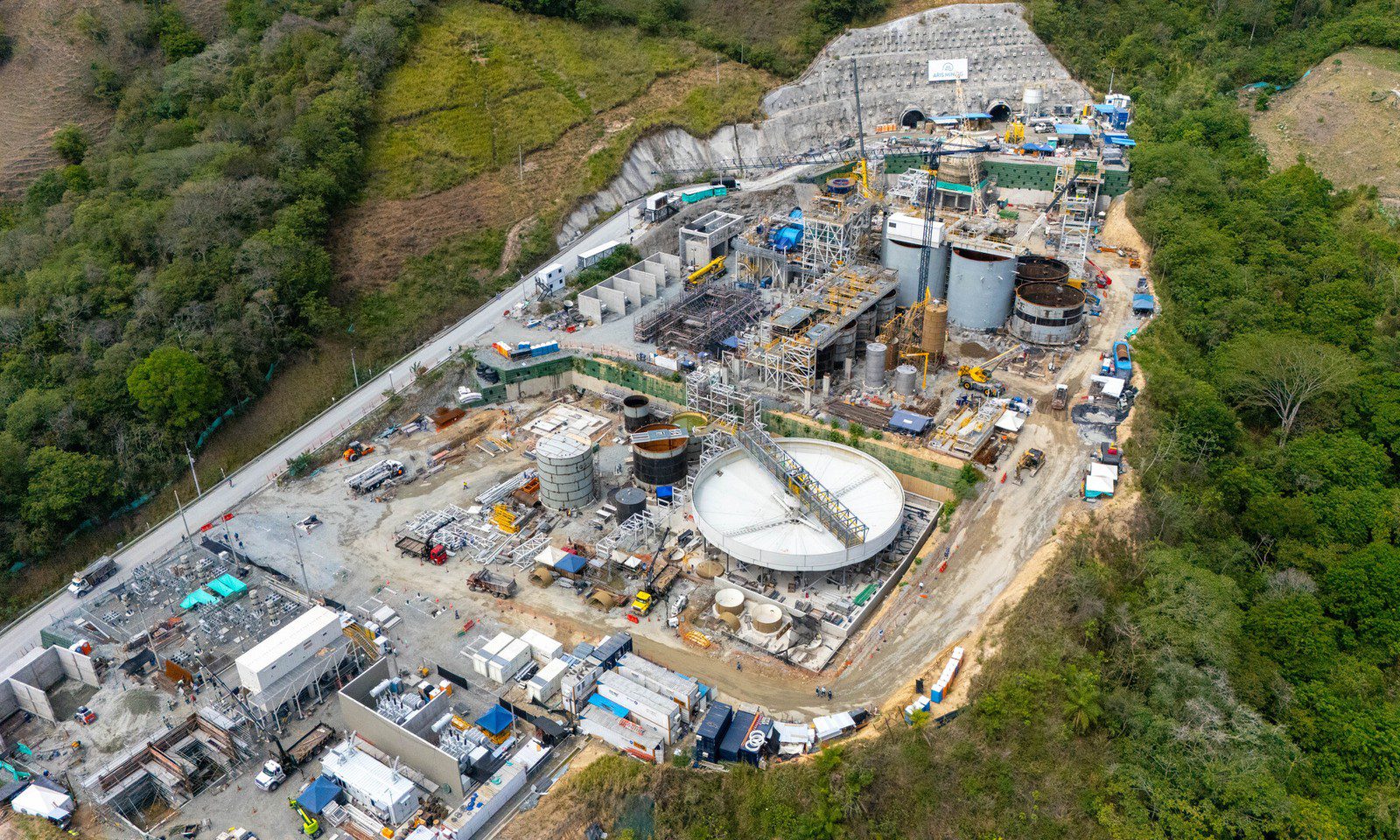
At Marmato, the new 5,000 tons-per-day carbon-in-pulp plant is in the final stages of construction with commissioning under way, and Aris Mining expects a first gold pour in December 2026. It plans to run the plant at about 4,000 tons per day by mid-2027 and reach design capacity by the end of that year, once a paste backfill plant is commissioned. An updated technical report under Canada’s National Instrument 43-101, with new reserve and resource estimates, is due in the first quarter of 2027.
Marmato’s quarterly output of 5,812 ounces was its weakest of the year, from 55,540 tons at 3.68 grams per ton against 84,610 tons at 3.79 in the second quarter. Aris Mining said the lower figure was planned: the switch to the new Cascabel 3 filtered tailings facility required about four weeks of downtime at the existing flotation plant, which the company used to refurbish the primary ball mill and install a new regrind mill and Knelson concentrator, lifting that plant’s capacity to 1,200 tons per day.
Aris Mining received $82 million USD over the first nine months as the project passed its 50% and 75% construction-spending milestones, taking total funding under the precious metals purchase agreement with Wheaton Precious Metals International, a subsidiary of Wheaton Precious Metals (TSX: WPM) (NYSE: WPM) (LSE: WPM), to the full $175 million USD commitment. Marmato absorbed $205.3 million USD of growth capital in the first nine months of this year alone.
Soto Norte and Toroparu Move Through Permitting
Aris Mining said recent government decisions improved regulatory clarity for Soto Norte, its undeveloped gold project in Santander. They came in quick succession. By the company’s account, Resolution 0970 of August 4, 2026, extended a temporary reserve on the western side of the Santurbán massif from March 4, 2027, to March 4, 2029, and Resolution 1277 revoked that extension on September 28, restoring the original date. A separate permanent reserve of about 1,499 hectares at La Baja, in the municipality of California, was created on August 6, 2026, the day before the change of government, and revoked a week later.
The temporary reserve itself has not gone away, and Aris Mining has said it restricted new mining authorizations and environmental licenses in the area, including ground relevant to Soto Norte. Vanguardia reported that the reserve covers more than 75,000 hectares outside the delimited páramo (high-altitude wetland), that no new concessions or exploration and exploitation contracts may be granted while it stands, and that, per the Agencia Nacional de Minería (National Mining Agency), 57 mining titles sit across 23,929 hectares of it. Colombia’s Ministerio de Ambiente y Desarrollo Sostenible (Ministry of Environment and Sustainable Development) confirmed on November 5 that the designation remains in force and said it will carry out hydrological and hydrogeological studies to determine what protection measures the western side of the massif requires, adding that its predecessor had budgeted for such studies without commissioning them. The Comité para la Defensa del Agua y el Páramo de Santurbán (Committee for the Defense of Water and the Santurbán Páramo), which campaigns for stronger protection of the massif, has rejected the revocations.
The National Mining Agency separately approved a modification to the Programa de Trabajos y Obras (Works and Projects Program) for concession 0095-68 on July 29, 2026, covering mine design, the production plan and closure. Aris Mining has stressed that the approval is distinct from environmental licensing and that neither construction nor mining can begin until a license is granted. The company says the environmental and social impact assessment is complete and ready for formal consultation with local communities; in September it said meetings were set for October in Matanza, Suratá and California.
In Guyana, a prefeasibility study for the Toroparu project is due later this month and will carry Aris Mining’s first declared reserve for the deposit, using a mix of mining contractors and self-performed work in place of the owner-mining approach assumed in a 2025 preliminary economic assessment. A large-scale mining license application has been filed, early works including a bridge over the Puruni River are under way, and a construction decision is targeted for early 2027, after first gold at Marmato. Segovia and Marmato together produced about 257,000 ounces in 2025; Aris Mining expects the two expansions to lift annual output to roughly 500,000 ounces once fully ramped up.
Headline photo: Construction at Aris Mining’s Marmato complex in Caldas, where the company expects the first gold pour from its new carbon-in-pulp plant in December 2026. (Photo courtesy Aris Mining)