Previous Story
Colombia Recognizes Morocco’s Sovereignty Over Western Sahara, Reversing Petro-Era Support for Sahrawi Independence
Posted On August 12, 2026
Comment: Off
Tag: abelardo de la espriella, algeria, cali, Cancilleria, colombia, foreign policy, free trade agreement, Golan Heights, Gustavo Petro, israel, jose manuel restrepo, King Mohammed VI, Mauritania, MINURSO, Morocco, Nasser Bourita, Omar Bula Escobar, Polisario Front, Resolution 2797, SADR, Sahrawi Arab Democratic Republic, United Nations Security Council, Western Sahara
Colombia’s government has recognized Morocco’s sovereignty over Western Sahara, reversing a policy that had backed the territory’s independence movement as recently as November 2025. Vice President José Manuel Restrepo and Foreign Minister Omar Bula Escobar announced the shift on August 8, 2026, during a meeting in Cali with Morocco’s Minister of Foreign Affairs, African Cooperation and Moroccan Expatriates, Nasser Bourita, who was in the city representing King Mohammed VI at the inauguration of Colombia’s new president, Abelardo de la Espriella.
“Colombia recognizes Morocco’s sovereignty over its Sahara,” Bula Escobar said at the meeting. Restrepo described the announcement as “a new beginning” for the two countries and called Morocco “Colombia’s first ally in Africa,” adding that Bogotá wants to build a strategic partnership with Rabat. Restrepo also raised the possibility of negotiating a free trade agreement to encourage Moroccan investment in Colombia, though no such talks have formally begun.
Colombia reconoció la soberanía de Marruecos sobre el Sáhara Occidental.
El anuncio se dio durante el primer encuentro del vicepresidente José Manuel Restrepo (@jrestrp) y el canciller Omar Bula (@omarbula) con el Ministro de Asuntos Exteriores del país africano.
Con esta… pic.twitter.com/aas0pirwSc
— Cancillería Colombia (@CancilleriaCol) August 8, 2026
Two days later, Colombia’s Ministry of Foreign Affairs (the Cancillería) issued a formal statement confirming the decision followed a “sovereign review” of the recognition its predecessor government had granted to the entity it calls the República Árabe Saharaui Democrática (Sahrawi Arab Democratic Republic, or SADR), noting that the United Nations does not recognize it as a member state. Bogotá said it would freeze all political and diplomatic contact with the SADR, halt exchanges of missions, and withdraw support for it in multilateral forums, “including the United Nations and the Security Council, where Colombia currently serves as a non-permanent member.” The ministry identified trade, investment promotion, tourism, food security, port and logistics development, and Atlantic connectivity as areas it wants to expand with Morocco.
A colonial-era dispute still unresolved
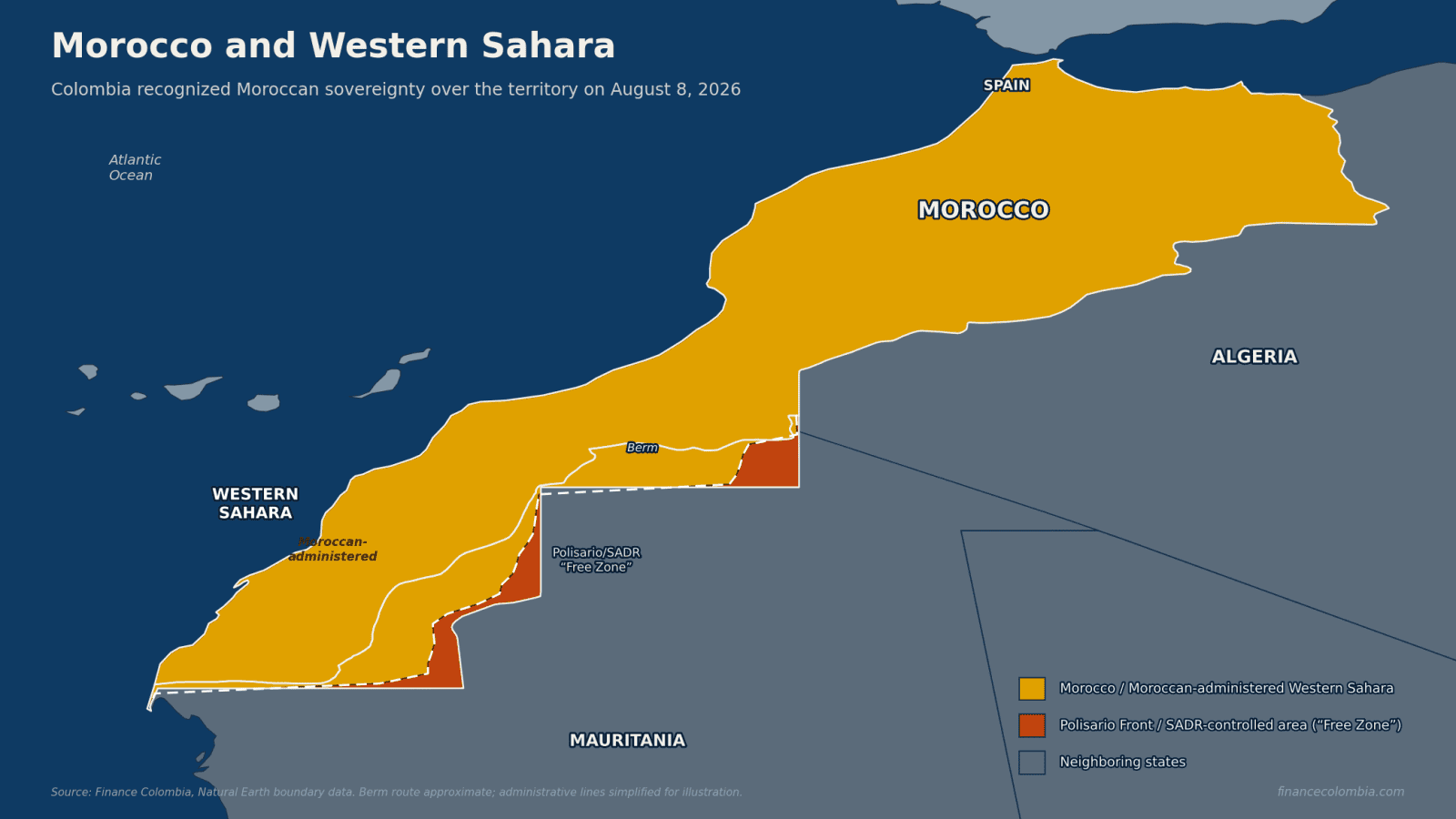
Western Sahara has been contested since Spain withdrew from its former colony in 1975. Morocco organized the “Green March” that year, sending hundreds of thousands of civilians into the territory to press its claim, and has administered most of it since. The Polisario Front, an armed movement representing the territory’s indigenous Sahrawi population, fought Morocco and declared a government-in-exile, the SADR, in 1976. A 1991 ceasefire monitored by the UN Mission for the Referendum in Western Sahara (MINURSO) held for nearly three decades without the referendum ever taking place; fighting between Morocco and the Polisario Front resumed in November 2020 and has continued intermittently since. Morocco controls roughly the western three-quarters of the territory, separated from the Polisario-administered “Free Zone” to the east by a fortified sand berm running the length of the territory. Morocco has offered the region autonomy under its sovereignty since 2007; the Polisario Front continues to demand a UN-supervised independence referendum.
A widening diplomatic tilt toward Rabat
Colombia’s move follows a broader realignment in Morocco’s favor. The UN Security Council adopted Resolution 2797 on October 31, 2025, renewing the MINURSO mandate and, for the first time, calling on the parties to negotiate on the basis of Morocco’s autonomy proposal as the most “feasible” path to a settlement. Eleven Council members voted in favor; China, Russia and Pakistan abstained, and Algeria — not a Council member at the time — did not take part. Morocco’s foreign ministry says more than 130 countries now back the autonomy plan as the most realistic basis for resolving the dispute, and only about a dozen of the African Union’s 54 members still recognize the SADR. Mali withdrew its recognition of the SADR in April 2026 and Ecuador suspended its own in 2024; Peru ended its recognition in 2023. Colombia’s reversal extends that trend into what had been one of the Polisario Front’s remaining strongholds in Latin America.
For Morocco, Colombia’s recognition is a further diplomatic gain and another setback for Algeria, the Polisario Front’s principal regional backer. It also positions Rabat as an intermediary between Latin American and African markets, a role Bourita highlighted directly, saying Morocco and Colombia “could represent economic platforms for each other” given their respective positions on the two continents. He described Colombia’s decision as “historic,” saying it could give “great momentum” to bilateral relations, and said his presence in Cali reflected the Kingdom’s intent to elevate ties “to a higher level.”
“A regrettable quid pro quo arrangement driven by a deeply ideological agenda.” — Polisario Front, in a statement condemning Colombia’s decision
The Polisario Front rejected the decision. In a statement carried by Moroccan outlet Yabiladi, the movement said it “strongly condemned” Colombia’s move, calling it “a regrettable quid pro quo arrangement driven by a deeply ideological agenda” that helps “legitimize a situation resulting from the military occupation of a territory that remains subject to a decolonization process.” The Front argued the decision conflicts with Article 9 of Colombia’s own constitution, which grounds the country’s foreign relations in respect for international law and peoples’ right to self-determination, and said it undermines “Colombia’s international role as an important actor in the pursuit of peace.” It called on Bogotá to reconsider. Algeria has long framed the dispute as a matter of “incomplete decolonization and an unfulfilled right to self-determination,” and has backed the Polisario Front diplomatically and militarily for decades.
Why Colombia had not recognized Morocco’s claim before
Colombia’s position on Western Sahara has shifted with its governments for four decades. Bogotá first recognized the SADR in 1985 under President Belisario Betancur, then froze those ties in 2001 under President Andrés Pastrana. President Gustavo Petro restored full diplomatic relations with the SADR in August 2022, shortly after taking office, framing it as support for Sahrawi self-determination consistent with his government’s broader identification with Global South and non-aligned foreign-policy positions. Petro reaffirmed that stance as recently as November 2025, pledging what he called “unrestricted” support for the Sahrawi cause and linking it to Colombia’s arrival on the UN Security Council for a two-year term beginning in 2026.
That position did not survive the change of government. De la Espriella, a right-of-center former defense lawyer who took office August 7, had campaigned on unwinding Petro’s foreign policy, and moved quickly on more than one front: alongside the Western Sahara reversal, his government also recognized Israeli sovereignty over the Golan Heights and moved to restore ties with Israel, becoming only the second country after the United States to do so. Colombia’s recognition of Morocco’s claim over Western Sahara is best read in that context — less a response to new facts in the territory than a marker of where the incoming administration wants to position Colombia internationally, closer to Washington, Jerusalem and Rabat and further from the non-aligned coalition Petro had cultivated.
What remains untested is the commercial follow-through. Restrepo’s reference to a possible free trade agreement was aspirational rather than an announcement of negotiations, and the Colombian and Moroccan governments have yet to lay out a timeline for the trade, investment, port-logistics and Atlantic-connectivity cooperation both sides say they want to pursue.