Previous Story
Jaguar Uranium Reports Magnet Rare Earths in Retained Drill Core at Colombia’s Berlin Project
Posted On October 2, 2026
Comment: 0
Tag: abelardo de la espriella, Acuerdos de Barranquilla, American Institute of Professional Geologists, Andrés Cáceres, argentina, barranquilla, Barranquilla Accords, Barranquilla Agreements, Berlin Project, Biondi Resources, brazil, caldas, callao, Chubut, civil nuclear cooperation, colombia, colombian geological survey, critical minerals, drill core resampling, dysprosium, Green Shift Commodities, Huemul, IPO, JAGU, jaguar uranium, Laguna Salada, magnet rare earth oxides, magnet rare earths, Marco Rubio, medellin, Mendoza, mineral exploration, MREO, neodymium, NI 43-101, NYSE American, Omar Bula Escobar, OREAS, permanent magnets, peru, phosphate, praseodymium, Rare Earth Elements, rare earths, Regulation S-K 1300, servicio geológico colombiano, SGS, SGS Colombia, SGS SA, Steven Gold, terbium, total rare earth oxides, TREO, U3O8 Corp, uranium, US Department of State, US Securities and Exchange Commission, US-Colombia critical minerals framework, vanadium, yttrium
Berlin Results Arrive Weeks After US-Colombia Minerals Framework
Jaguar Uranium Corp. (NYSE American: JAGU) said on September 24, 2026, that a resampling of drill core stored for more than a decade at its Berlin project in the department of Caldas, Colombia, returned rare earth elements, among them the permanent-magnet metals neodymium, praseodymium, terbium and dysprosium. The rare earths occur with uranium, vanadium and phosphate mineralization in the same sampled horizon. The highest-grade interval, from hole DDB-041, returned 0.63 meters from 170.57 meters downhole grading 3,570 parts per million (ppm) total rare earth oxides (TREO), or 0.357%, with 607 ppm of magnet rare earth oxides (MREO), according to the company’s release.
The company described the figures as exploration results under the US Securities and Exchange Commission‘s Regulation S-K 1300. They do not represent a mineral resource or reserve, and neither the economic viability nor the metallurgical recovery of the rare earths has been established, the company said. Any move to fold the rare earth data into future resource work would require additional drilling, continuity assessment, analytical review and supporting technical studies, Jaguar said.
What the Resampling Returned
Jaguar highlighted three other intervals. Hole DDB-003 returned 1.53 meters at 2,267 ppm TREO and 329 ppm MREO from 80.77 meters downhole; DDB-015 returned 1.00 meter at 2,176 ppm TREO and 349 ppm MREO from 162.86 meters; and DDB-068 returned 0.50 meters at 2,532 ppm TREO and 414 ppm MREO from 435.86 meters.
TREO is the stoichiometric sum of the oxide equivalents of the 15 rare earth elements the laboratory reported, including yttrium, and MREO is the sum of the oxide equivalents of praseodymium, neodymium, terbium and dysprosium.
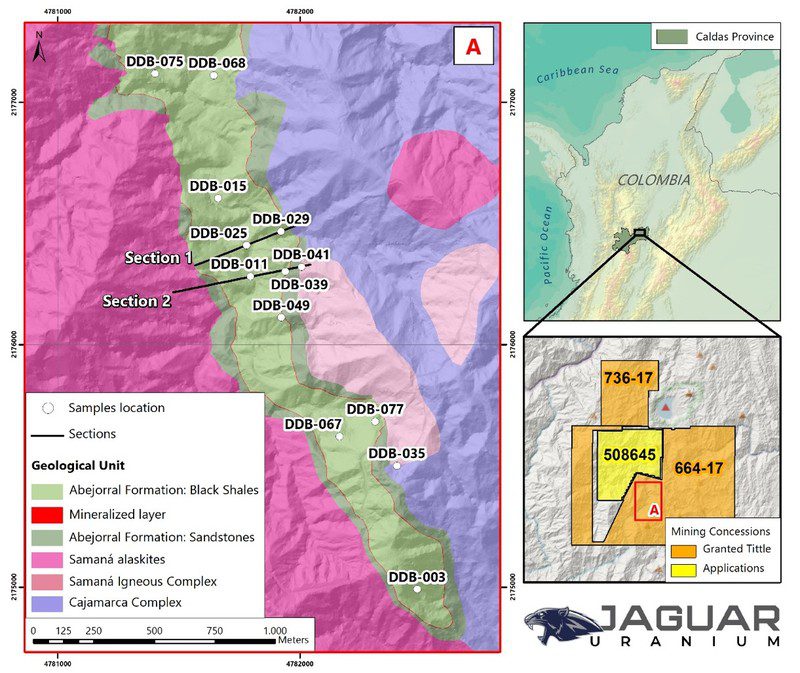
The plan view shows the drill holes selected for the resampling program at Berlin and the lines of cross-sections 1 and 2. (Image courtesy Jaguar Uranium)
The full results table in the release also shows 2,737 ppm TREO and 492 ppm MREO over 0.74 meters in hole DDB-077. That hole and DDB-035, which together account for a material proportion of the intervals, were sampled for historical geochemical verification only, and the company said they are not representative of true thickness.
All reported widths are core lengths, and true widths have not been determined. The company said it selected the intervals from the core still available to test rare earth occurrence and grade variation across the syncline, including both flanks, the hinge, and positions above and below the mineralized horizon. It cautioned that the tested samples are not a systematic resampling of every historical mineralized interval, are not necessarily representative of the horizon as a whole, and were not designed to verify any historical estimate.
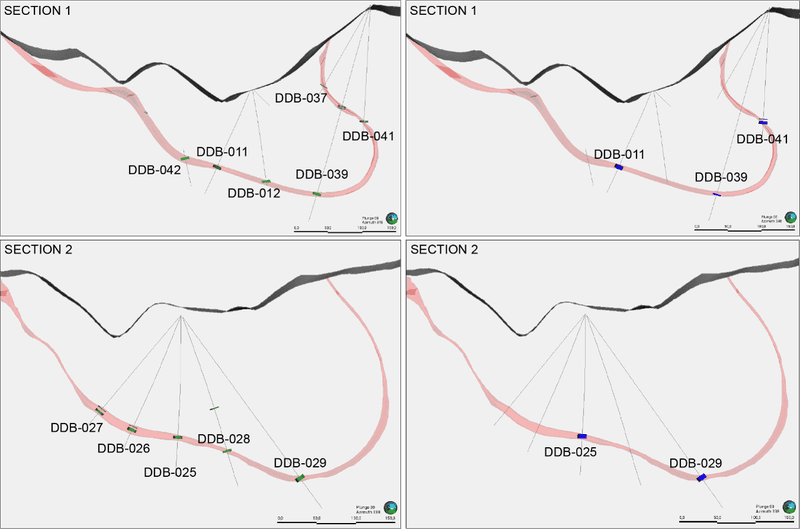
The cross-sections show the drill hole samples selected for reanalysis. Historical intercepts appear in green at left, and samples in the current program appear in blue at right. (Image courtesy Jaguar Uranium)
President and Chief Executive Officer Steven Gold said the company plans to use the results together with trenching, geophysics and drilling to refine its geological model and evaluate the continuity of the mineralization. “The initial results indicate that rare earth elements occur with uranium, phosphate and vanadium mineralization in the selected Berlin core intervals,” Gold said.
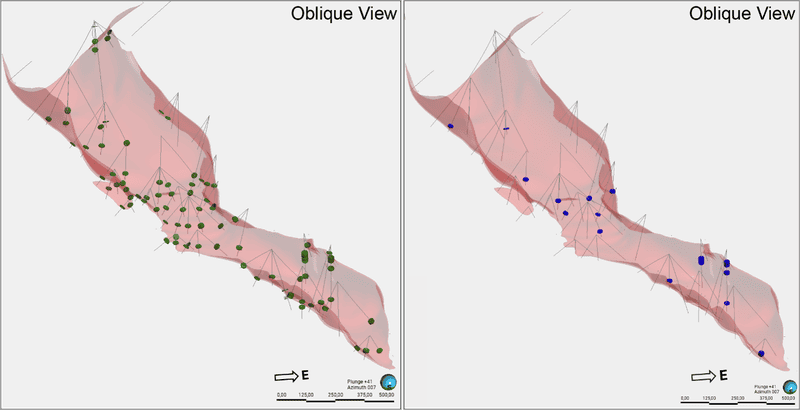
The oblique view of the 3D geological model marks historical intercepts in green at left and resampled intervals in blue at right. (Image courtesy Jaguar Uranium)
Core From Campaigns in 2010-11 and 2012
Berlin is an exploration-stage, sedimentary-hosted polymetallic project where more than 20,000 meters of historical drilling have been reported, according to the company. The core in this program came from two campaigns in 2010-11 and 2012 run by U3O8 Corp., which renamed itself Green Shift Commodities Ltd. (TSXV: GCOM; OTCQB: GRCMF) in 2022. Green Shift announced on April 9, 2024, that it had closed the sale of Berlin to Jaguar for $20,000 CAD in cash, 1,211,687 Jaguar shares and a 1% net smelter return royalty, plus further share and cash consideration tied to milestones.
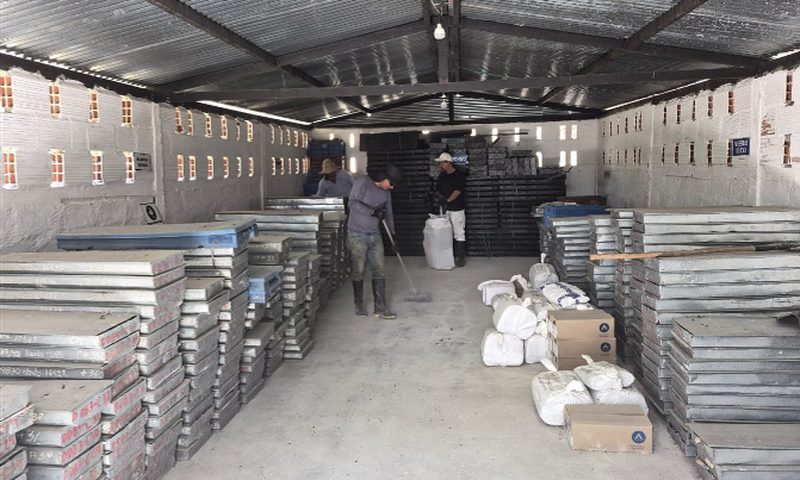
The core has been held since 2015 in a locked storage facility that U3O8 Corp. established on mining concession 664-17, inside the project area. Jaguar acquired the facility in 2024 and said access is limited to authorized personnel and that the sampled intervals showed no signs of degradation or oxidation.
Jaguar collected samples from 13 historical holes. The batch of 150 samples comprised 108 quarter-core samples cut from remaining half-core, 28 pulps retained from earlier analyses, and 14 quality-control inserts: seven coarse blanks and seven certified reference materials, supplied by OREAS, an Australian producer of reference materials. Sample lengths matched those originally taken by U3O8 Corp. and averaged about 1 meter.
Samples were prepared by SGS Colombia S.A.S., a unit of SGS SA (SIX: SGSN; OTC: SGSOY), in Medellín and analyzed at an SGS laboratory in Callao, Peru. The Callao laboratory used a four-acid digestion for trace elements and uranium, and a sodium peroxide fusion, which captures rare earths held in resistate minerals, for the rare earth results.
The program was designed and supervised by Andrés Cáceres, who holds the Certified Professional Geologist designation from the American Institute of Professional Geologists and is the qualified person for the disclosure under Canada’s National Instrument 43-101 and the SEC’s Regulation S-K 1300. Cáceres is an independent contractor to Jaguar and managed the Berlin project for U3O8 Corp., its previous owner, from 2007 to 2015. Because the program relied on retained core and historical pulps, the company said, his verification was limited to the available material, storage and chain-of-custody records, the resampling procedures, laboratory certificates and the quality-control results. Cáceres also spent four years as a senior consultant with the Servicio Geológico Colombiano (Colombian Geological Survey) on uranium and rare earth research and exploration programs, and two years as vice president of exploration for Biondi Resources in Brazil, according to the release.
The Barranquilla Framework
Jaguar tied the results to the critical minerals and civil nuclear arrangements that the United States and Colombia signed in Barranquilla on September 8, 2026. According to a US Department of State fact sheet, Secretary of State Marco Rubio and Colombian Foreign Minister Omar Bula Escobar signed a framework on critical minerals and rare earths and a memorandum of understanding on civil nuclear cooperation. Colombian President Abelardo De La Espriella described the day’s meetings as the opening of a wider package he calls the Acuerdos de Barranquilla (Barranquilla Agreements), as Finance Colombia reported.
The State Department said the minerals framework gives the two governments six months to jointly identify and finance mining and processing projects, drawing on tools that range from loans, guarantees and equity to offtake agreements and insurance. The framework also calls for streamlined permitting, pricing mechanisms such as price floors, national security reviews of critical minerals asset sales, investment in minerals recycling technology and cooperation on geological mapping.
“This multi-commodity profile directly aligns with the accelerating strategic cooperation between Colombia and the United States on secure critical-mineral supply chains and nuclear energy.”
— Steven Gold, president and CEO of Jaguar Uranium
From IPO to Rare Earths
Jaguar priced its initial public offering on the NYSE American in February 2026, raising $25 million USD by selling 6.3 million shares at $4 USD each, the low end of its marketed range, according to Renaissance Capital. Besides Berlin, the company is exploring the Laguna Salada project in Argentina’s Chubut province and the former Huemul uranium mine in Mendoza province.
Finance Colombia reported in March 2026 that Jaguar had begun assessing the rare earth potential of the Berlin core. Jaguar’s September 24 release does not give a timetable for the planned trenching, geophysics and drilling.
Headline photo: Boxes of historical drill core are stacked inside the Berlin project’s core storage facility in Caldas, Colombia. (Photo courtesy Jaguar Uranium)