Previous Story

Grupo Cibest Puts Colombia’s 2027 Minimum Wage Benchmark at 8.4%
Posted On November 17, 2026
Comment: 0
Tag: banco de la republica, bancolombia, bank of the republic, Basis Points, cib, CIBEST, colombia, colombian central bank, Colombian Inflation, core inflation, dane, Departamento Administrativo Nacional de Estadística, economy, el niño, fiscal policy, food prices, formal employment, GEIH, Gran Encuesta Integrada de Hogares, Gross Domestic Product, Grupo Cibest, indexation, inflation, inflation expectations, inflation target, informal employment, informality, Informe de Política Monetaria, interest rates, Job Creation, Jose Luis Mojica, labor market, labor productivity, Maria Paula Gonzalez, mesa de concertación, minimum wage, minimum wage 2027, monetary policy, Monetary Policy Report, pensions, PFCIBEST, policy rate, productivity, Public Spending, purchasing power, Radar Bancolombia, regulated prices, salario minimo, services inflation, SMMLV, social programs, total factor productivity, unemployment, Valentina Guáqueta, wage negotiation
Grupo Cibest Puts Each Point Above 8.4% at 0.15 Points of Inflation
Grupo Cibest puts a minimum wage increase consistent with price stability at about 8.4% for 2027, and estimates that every percentage point awarded above that figure would add roughly 0.15 percentage points to inflation the following year. That is the central argument of the editorial in the November 9 edition of Radar Bancolombia, the weekly macroeconomic and markets report published by Bancolombia, the Colombian banking subsidiary of Grupo Cibest (NYSE: CIB; BVC: CIBEST, PFCIBEST).
The calendar for the decision will be decisive, the report said. Negotiations open on November 18, the productivity reading the calculation depends on arrives from the national statistics agency at the end of November, and the deadline for an agreement falls on December 15. Colombia enters that window with annual inflation at 6.30% in October, its highest level since July 2024 and a third consecutive monthly increase, and with services inflation at 7.2% in September, in a part of the basket the report describes as the most exposed to indexation and to high labor costs.
The editorial, Salario mínimo 2027: un incremento responsable (Minimum Wage 2027: A Responsible Increase), appears in a report whose named authors are María Paula González, a macroeconomic analyst, and Valentina Guáqueta, an inflation and central banking analyst, and whose editor is José Luis Mojica, macroeconomic manager at the bank’s Dirección de Investigaciones Económicas, Sectoriales y de Mercado (Economic, Sector and Market Research Department). Quotations from the report are Finance Colombia translations from the Spanish.
Inflation Plus Productivity Produces the 8.4% Benchmark
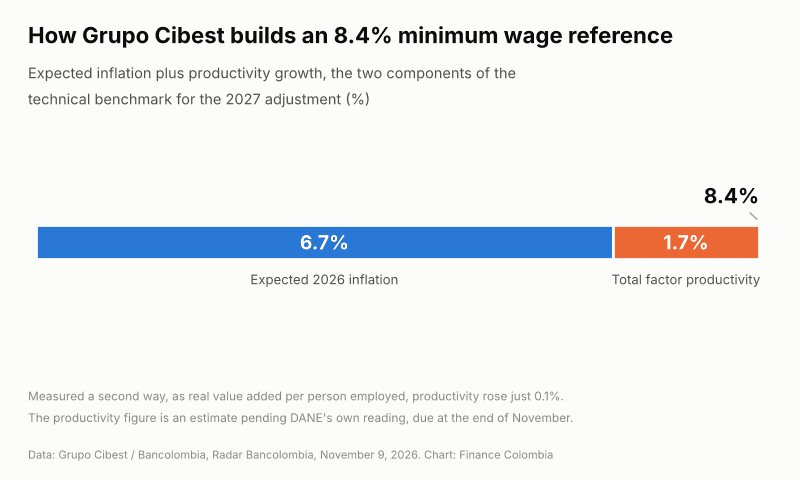
Grupo Cibest builds its 8.4% benchmark from expected 2026 inflation of 6.7% and total factor productivity growth of 1.7%. (Chart: Finance Colombia, based on Grupo Cibest data)
The technical reference rests on two components, according to the report: total inflation, which protects workers against a loss of real income, and the growth of labor productivity, which is what creates room for pay to rise without pushing up unit labor costs. Grupo Cibest expects inflation to close 2026 at 6.7% and estimates growth in total factor productivity, the broader measure that takes in the contribution of both labor and capital, at close to 1.7%. Added together, those two give the 8.4% figure.
Measured more narrowly, productivity looks weaker still. Real value added per person employed rose just 0.1%, the report said, leaving output per worker essentially flat against 2025. The estimate was built from the average value added per worker in the first half of the year and extrapolated through the third quarter using the bank’s own projections for growth and employment. The report is explicit that its 8.4% figure remains subject to the total factor productivity reading that DANE, Colombia’s Departamento Administrativo Nacional de Estadística (National Administrative Department of Statistics), publishes at the end of November, which is what fixes the second half of the technical calculation.
Every Forecast on the Table Sits Above the 3% Target
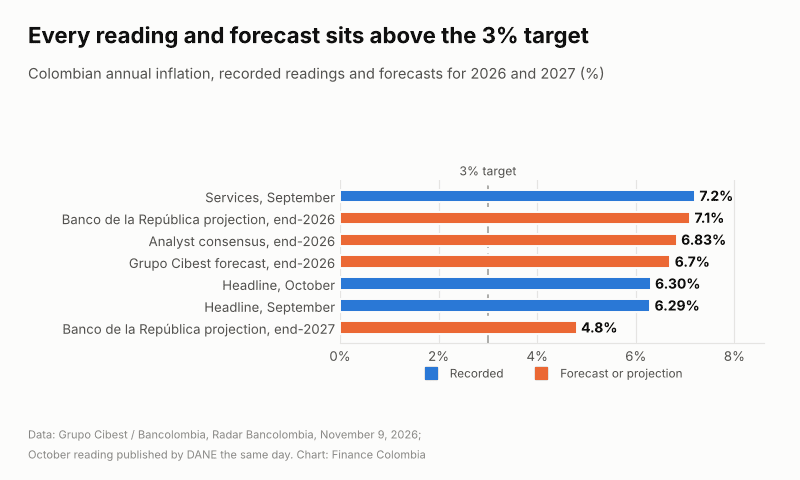
October’s published 6.30% reading, every 2026 forecast and the central bank’s 2027 projection all sit above the 3% target. (Chart: Finance Colombia, based on Grupo Cibest and DANE data)
The report went to press the same day DANE published the October reading, and had expected monthly inflation of 0.25% and an annual rate of 6.36%. The published figures came in slightly below that, at 0.20% for the month and 6.30% for the year, as El Tiempo reported — still a third consecutive monthly increase, up from 6.29% in September, still the highest annual reading since July 2024, and still more than double the 3% target of the Banco de la República (Bank of the Republic). The bank’s own estimate had sat two basis points below the 0.27% average of analysts surveyed by the central bank in its Encuesta Mensual de Expectativas Económicas (Monthly Economic Expectations Survey), and those same analysts raised their expectation for the close of 2026 by six basis points, to 6.83%.
The central bank’s own October Informe de Política Monetaria (Monetary Policy Report) went further, revising the inflation path up to 7.1% for the close of 2026 from 6.9% and to 4.8% for 2027 from 4.3%. The revision reflects stronger effects from El Niño on food and on regulated items including gas and electricity, the report said, compounded by the indexation of a range of prices to a higher 2026 close. Finance Colombia reported Grupo Cibest’s case for a 7.3% inflation peak driven by indexed services last month, and the full September breakdown in October.
Grupo Cibest Puts the 2026 Decree’s Inflation Cost Near 2.5 Points
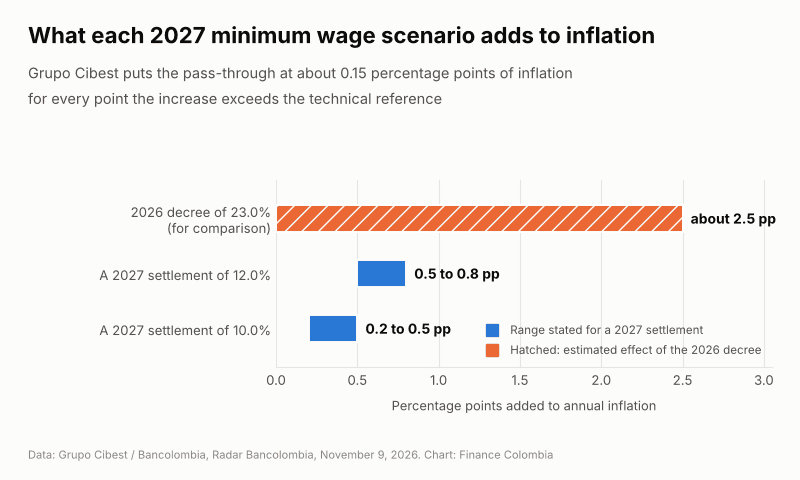
A 10% settlement would add 0.2 to 0.5 percentage points of inflation and a 12% settlement 0.5 to 0.8, against about 2.5 points from the 23% decreed for 2026. (Chart: Finance Colombia, based on Grupo Cibest data)
The effective increase also picks up other factors from the negotiation, the report said. Over the past 20 years the difference between the theoretical adjustment and the one actually awarded averaged 2.9 percentage points, and for 2026 it reached 17.1 percentage points. Grupo Cibest estimates that the 23% increase decreed for 2026 contributed close to 2.5 percentage points to this year’s inflation on its own.
“Our calculations suggest that each percentage point by which the minimum wage exceeds the technical reference adds close to 0.15 percentage points to inflation.” — María Paula González and Valentina Guáqueta, analysts, Bancolombia
The transmission runs through the share of the economy that moves with the wage floor. Compensation of employees accounts for 34.4% of Colombian gross domestic product, and roughly half of what firms pay in wages adjusts with the minimum wage, either because workers earn exactly that amount or because their pay is set in reference to it, according to the Gran Encuesta Integrada de Hogares (Large Integrated Household Survey) cited in the report. The calculation then assumes firms would pass a good part of that higher cost into their prices. This also helps explain why the pressure has been most visible in labor-intensive services such as eating out, domestic service and personal care, the report said.
Applied to 2027, the report puts a settlement of 10% at between 0.2 and 0.5 percentage points of additional inflation and one of 12% at between 0.5 and 0.8 percentage points. A gap of 2 percentage points above the benchmark would add around 0.3 percentage points and a gap of 5 percentage points around 0.75 percentage points. The report’s own scenario estimates are slightly higher and are not zero at the benchmark itself: it puts the added inflation at 0.24 percentage points for an 8.4% settlement, 0.48 for 10%, 0.78 for 12% and 1.23 for 15%.
Formal Hiring and the Public Budget Carry the Rest of the Cost
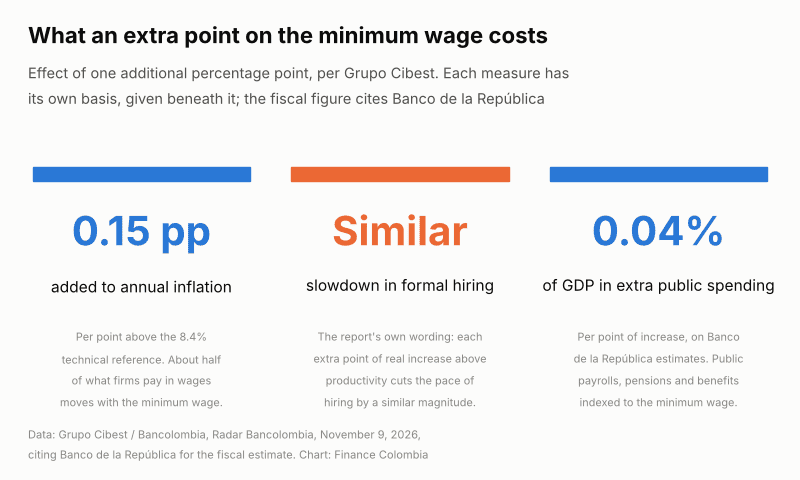
Each additional percentage point carries three costs, each on its own basis: inflation, formal hiring and the public budget. (Chart: Finance Colombia, based on Grupo Cibest data citing Banco de la República for the fiscal estimate)
Inflation is only the first channel. Real increases in the monthly legal minimum wage, or SMMLV, that run ahead of productivity tend to reduce the creation of formal jobs, the report said, with each additional percentage point cutting the pace of hiring by a similar magnitude. That could worsen an informality rate that has sat near 55% for the past four years, the report said. Finance Colombia reported in July on Bancolombia’s finding that Colombia’s low headline unemployment masks deteriorating job quality.
The public finances absorb the third share. Citing estimates from the Banco de la República, the report puts the fiscal cost at 0.04% of GDP for every percentage point of minimum wage increase, arriving through public payrolls, a more expensive pension system, and transfers and social programs whose amounts or eligibility thresholds are expressed in multiples of the minimum wage. Grupo Cibest cut its 2027 growth forecast in September on the strength of the fiscal adjustment ahead.
An increase well above the benchmark would dilute the benefits of protecting purchasing power, the report concluded, through higher inflation and weaker formal job creation. It would also delay the convergence of inflation toward target, keep interest rates high for longer and worsen the fiscal challenge.
The Board Is Already Weighing the Wage
The minimum wage has already entered the central bank’s own deliberations. Minutes of the October meeting showed a divided board on the decision to hold the policy rate at 12.25%, with four co-directors backing the hold and three voting for a 25 basis point increase. For the majority, the decline in core inflation suggested that the moderation of domestic demand could be starting to contain price pressures, though they judged the evidence insufficient and opted to pause while the effects of El Niño are assessed. Two of those directors said that fiscal consolidation and a moderate minimum wage adjustment in 2027 would favor the convergence of inflation. The dissenting members stressed the urgency of restoring credibility in the target and warned that postponing the adjustments would raise the eventual cost in output and employment. Days before that meeting, Finance Colombia reported Grupo Cibest’s expectation that the board would raise the rate to 12.50% on October 30, an increase the board did not deliver.
Finance Colombia reported separately on the rest of the November 9 report, including the central bank’s downgraded growth path and the opening of the fiscal rescue debate.
Headline photo: A farmer broadcasting by hand in a rice field. (Photo by eliasfalla from Pixabay