Previous Story
Three US Announcements the Colombian Government Still Needs to Explain
Posted On August 25, 2026
Comment: Off
Tag: A3C, abelardo de la espriella, alvaro uribe, Americas Counter Cartel Coalition, Article 173 of Colombia’s Constitution, Colombia´s President, Colombia’s Defense Ministry, Colombian Senate, Department of War, Donald Trump, Escudo de las Américas, Gen. Jorge Eduardo Mora, Gustavo Petro, house of representatives, Pete Hegseth, plan colombia, US Defense Secretary, US President, us senate, us state department
Three announcements by the United States in the first days of President Abelardo de la Espriella’s administration have raised questions about the scope of Colombia’s renewed security and economic relationship with Washington.
The announcements involve joint US-Colombian military operations against narcoterrorism, Colombia’s entry into a regional security coalition, and a proposed $1 billion USD assistance package. While all three signal a significant strengthening of bilateral relations, important questions remain about their implementation, legal framework, funding, and oversight.
First: Joint US-Colombian military operations
Colombia has authorized the United States to conduct joint military operations as part of its fight against drug trafficking, US Defense Secretary Pete Hegseth said Wednesday, August 12, in Panama.
According to Hegseth, the cooperation follows new Colombian President Abelardo de la Espriella’s decision to join an anti-drug coalition led by US President Donald Trump. Hegseth made the announcement during a meeting of the alliance, which brings together about 20 countries, in Panama City. Colombia’s defense minister, retired Gen. Jorge Eduardo Mora, attended the meeting.
“Colombia has already requested that the War Department join Colombia in its fight against narcoterrorism, authorizing joint military operations to destroy terrorists and terrorist networks,” Hegseth stated during the meeting.
The announcement is consistent with De la Espriella’s security policy. In his first speech as president, he emphasized the need to confront “narcoterrorism and all criminal organizations without respite.”
But the announcement also raises several questions that the Colombian government will have to address, beginning with what it means by “joint military operations.”
If those operations involve authorizing the presence of armed US military personnel on Colombian territory, congressional authorization could be required. Article 173 of Colombia’s Constitution establishes that the Senate has the authority to “permit the transit of foreign troops through Colombian territory.”
Colombia has maintained a close military relationship with the United States for decades. The two countries have developed training programs, intelligence-sharing arrangements, counternarcotics efforts and interdiction operations. That relationship also included US financing for Plan Colombia beginning in the early 2000s under former President Álvaro Uribe, with Washington providing more than $10 billion.
However, military cooperation and joint training are one thing; the authorization announced by Hegseth to conduct joint military operations involving US forces is potentially broader in scope and raises questions about precisely where and how those operations would take place.
The bilateral relationship had been strained by disputes between Trump and Colombia’s previous president, leftist Gustavo Petro. De la Espriella has made restoring close ties with Washington one of his foreign policy priorities.
Second: Colombia joins Escudo de las Américas
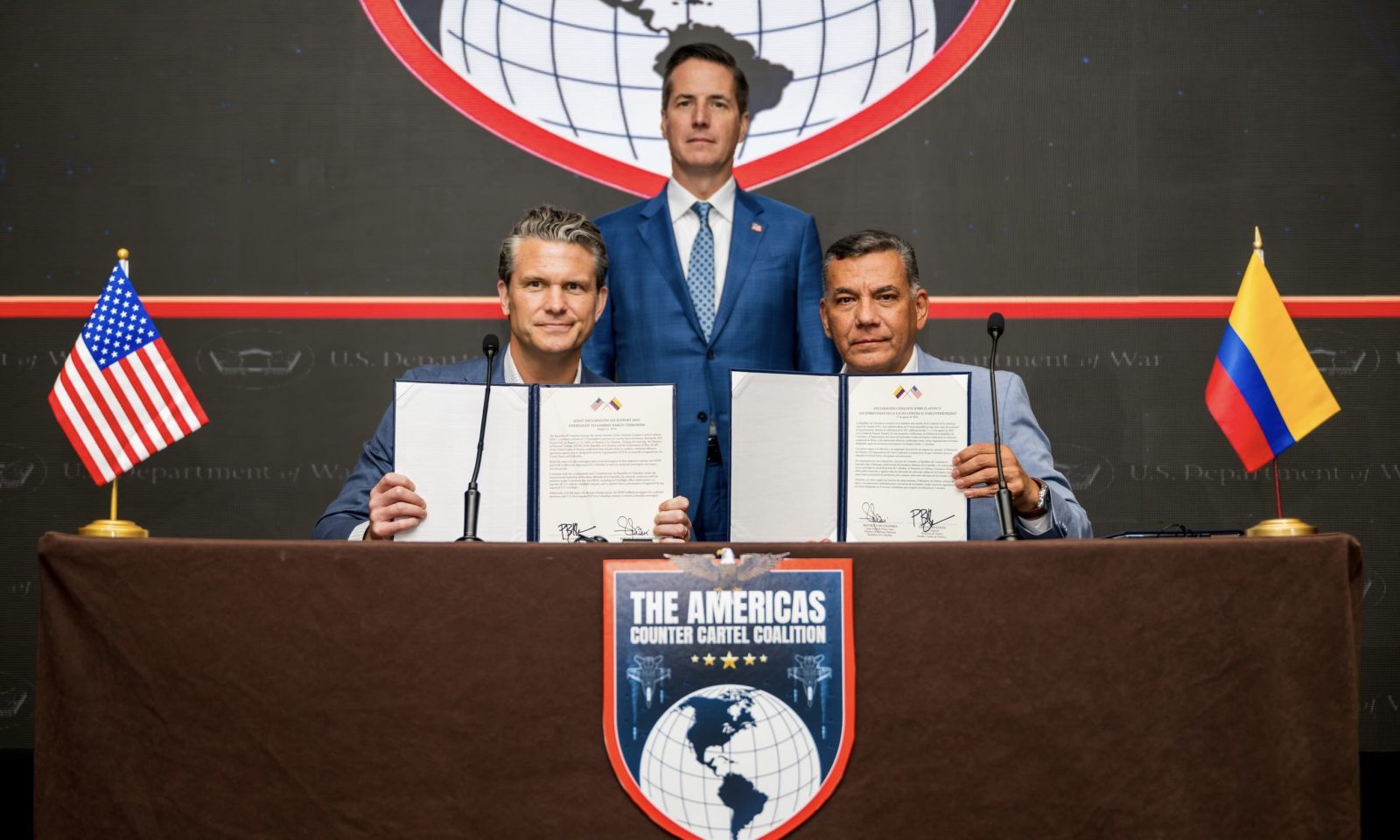
During the same remarks, Hegseth said the United States and its partners would “defend our hemisphere from external threats” and announced that Colombia would join the Americas Counter Cartel Coalition, or A3C, also known as Escudo de las Américas.
“I’m also proud to announce that Colombia will join the A3C, becoming the 19th member. And through the newly inaugurated president, as our president likes to say, ‘President El Tigre,’ Colombia has requested that the Department of War join Colombia in its fight against narcoterrorism” Hegseth said.
During the event, Hegseth met with Mora to formalize Colombia’s entry into Escudo de las Américas.
“It is the beginning of a new stage in defense cooperation between the United States and Colombia,” according to the announcement.
However, the Colombian government has yet to publicly provide detailed information explaining what membership entails, what resources Colombia will commit, what specific objectives have been established or what oversight mechanisms will be implemented to safeguard human rights, international humanitarian law and protections for civilians.
“The minister emphasized that transnational threats do not recognize borders and that no state can confront them in isolation. Consequently, Colombia has offered to place its capabilities and experience at the service of hemispheric security, leading strategic efforts in the Pacific Ocean and Caribbean Sea alongside the nations that make up the coalition. The purpose is unequivocal: to prevent criminal organizations from replacing state authority and to guarantee that, throughout the territory, the Constitution, the law and the legitimate monopoly on the use of force prevail,” Colombia’s Defense Ministry said in a statement.
The announcement establishes Colombia’s participation in the coalition, but further information from the government will be necessary to determine how that commitment will translate into operations, funding and accountability mechanisms.
Third: A proposed $1 billion US assistance package
Immediately after De la Espriella’s inauguration on August 7, the United States announced its intention to provide Colombia with a $1 billion USD assistance package.
In a statement, the US State Department described the proposal as a “cornerstone” of the renewed relationship between the two governments, saying that “the United States, working with Congress, intends to announce $1 billion USD in assistance as part of a security package to support President de la Espriella’s Administration in achieving our shared goals.”
According to the same statement, the funding would focus on dismantling transnational narcoterrorism networks, including by strengthening security forces, disrupting the operations of transnational terrorist organizations, expanding coca eradication programs, intercepting cocaine shipments, curbing illegal immigration and protecting minors from recruitment.
The package would also seek to expand economic opportunities. The State Department said De la Espriella’s “pro-growth agenda and openness to US investment creates an opportunity to increase trade and deepen economic ties between our countries.”
But the $1 billion USD is not yet guaranteed.
The funding is subject to approval by the US Congress, and the legislative process required to authorize the resources has not yet begun.
The timing adds another layer of uncertainty. The United States will hold its midterm elections on November 3, 2026, with control of both the House of Representatives and the Senate at stake, along with several governorships. The outcome could influence the congressional dynamics surrounding approval of the resources announced by the Trump administration.
Taken together, the three announcements point to a rapid expansion of Colombia’s relationship with the United States under De la Espriella. But they also leave significant questions unanswered, particularly about the scope and legal basis of joint military operations, Colombia’s commitments under Escudo de las Américas and whether the proposed $1 billion USD assistance package will ultimately secure congressional approval in Washington.