Previous Story
GeoPark Joins Ecopetrol and Drummond in the Race to Drill Colombia’s First Fracking Well
Posted On October 2, 2026
Comment: 0
Tag: abelardo de la espriella, ACIPET, Afrowilches, Agencia Nacional de Hidrocarburos, Agustín Codazzi, Alberto García, ANH, ANLA, argentina, Bare block, Becerril, bosconia, bucaramanga, Catatumbo, cepi, cesar, Cesar-Ranchería, Chiriguaná, Ciénaga, Colden Investments, colombia, Congreso Colombiano de Petróleo Gas y Energía, Consejo de Estado, Consulta Previa, Corte Constitucional, Drummond, Drummond Energy, ecopetrol, el paso, energy security, ExxonMobil, Felipe Bayón, fracking, Gas y Petróleo del Neuquén, geopark, Grupo Gilinski, Gustavo Petro, hydraulic fracturing, jaime gilinski, Joaquín Gutiérrez Caballero, kale, La Jagua de Ibirico, La Luna formation, lng, Loma Jarillosa Este, magdalena, magdalena medio, Middle Magdalena Valley, natural gas, Neuquén, Oil and Gas, pdvsa, platero, Pluspetrol, prior consultation, procuraduria general de la nacion, puerto wilches, Puesto Silva Oeste, regasification, RIGI, santa marta, santander, shale gas, unconventional reservoirs, Vaca Muerta, venezuela, yacimientos no convencionales
Three operators line up for Colombia’s reopening to fracking
GeoPark (NYSE: GPRK) has said it is ready to take part in hydraulic fracturing in Colombia, joining state-controlled Ecopetrol (NYSE: EC; BVC: ECOPETROL) and coal producer Drummond’s energy unit, Drummond Energy, as companies seeking to develop unconventional oil and gas while the government of President Abelardo De La Espriella reopens the door to the technique. Felipe Bayón, GeoPark’s chief executive and a former president of Ecopetrol, made the announcement on September 22 in Bucaramanga at the XXIII Congreso Colombiano de Petróleo, Gas y Energía (23rd Colombian Petroleum, Gas and Energy Congress), organized by the Asociación Colombiana de Ingenieros de Petróleos, Energía y Tecnologías Afines (Colombian Association of Petroleum, Energy and Allied Technologies Engineers, Acipet).
According to Caracol Radio, Bayón named the regions GeoPark is looking at: “We are convinced that in the Middle Magdalena Valley, but also in other regions of the country, Cesar-Ranchería, among others, in Catatumbo, there are possibilities to do unconventionals and to do fracking.”
Of the three companies, Ecopetrol and Drummond have the most concrete routes to drilling Colombia’s first fracking well, while GeoPark has so far only expressed interest, according to a September 27 analysis by Portafolio. Drummond Energy has set 2027 as its target for a first well in the department of Cesar.
GeoPark cites Vaca Muerta but has no defined project
According to Portafolio, GeoPark is concentrating its analysis on the Middle Magdalena Valley and the Cesar-Ranchería basin, where it sees opportunities for both oil and gas from unconventional reservoirs. The outlet reported that the company has not defined blocks, municipalities, investment amounts, schedules or potential production volumes for any fracking operation in Colombia. No environmental license applications, specific contracts with the Agencia Nacional de Hidrocarburos (National Hydrocarbons Agency, ANH) or prior-consultation processes tied to a particular project have been made public.
Bayón told the congress that “energy sovereignty has to do with taking control of our destiny,” according to Valora Analitik. Red+ Noticias reported that Bayón wants to carry the company’s experience in Argentina’s Vaca Muerta shale formation to regions such as the Middle Magdalena Valley and Cesar-Ranchería.
“At GeoPark, I don’t want to speak for the industry, but we are ready. We are ready to accompany this development of unconventionals. We are committed, we believe we can do it in a rigorous way, and above all we believe it will be a very important change for the country.”
— Felipe Bayón, CEO of GeoPark
In October 2025, GeoPark completed its $115 million USD acquisition from Pluspetrol of the Loma Jarillosa Este and Puesto Silva Oeste blocks in Neuquén Province. Bayón said at the congress that production there rose from about 1,400 barrels per day to more than 5,000 between September 2025 and June 2026, Caracol Radio reported. Bayón’s figure of more than 5,000 barrels per day differs from GeoPark’s own second-quarter 2026 operational update, which reported average gross production in Argentina of 1,400 barrels of oil equivalent per day for the quarter, with hydraulic fracturing under way on five wells, 119 of 218 fracture stages completed by the end of June, and production start-up to follow. In the same update, the company said it and provincial partner Gas y Petróleo del Neuquén had applied to Argentina’s Régimen de Incentivo para Grandes Inversiones (Large Investment Incentive Regime, RIGI) to support more than $1 billion USD in investment, targeting growth from 1,500 to 20,000 barrels of oil equivalent per day within three years.
In March 2026, Colden Investments S.A., an affiliate of Jaime Gilinski, invested approximately $107 million USD for about 20% of the company’s shares, becoming its largest shareholder. On September 2, GeoPark announced an entry into Venezuela’s Bare heavy-oil block, to be paid for with new shares issued to Grupo Gilinski that would give the group about 56.3% of GeoPark, according to El Colombiano. The transaction depends on a 25-year contract with PDVSA Petróleo S.A. taking effect, which GeoPark said is subject to approvals and sanctions-related compliance and estimated would take no more than 120 days.
Ecopetrol’s new president promises “responsible fracking”
Ecopetrol’s board unanimously named Joaquín Gutiérrez Caballero as the company’s president on September 24, and he formally takes office September 28, according to an Ecopetrol statement. Gutiérrez, a business administrator who managed De La Espriella’s presidential campaign, comes to the post without prior experience in the hydrocarbons sector, Infobae reported.
At a ceremony in Santa Marta ahead of that date, reported by Infobae on September 26, De La Espriella swore in Gutiérrez and restated his campaign position: “My government fully reopens the path to exploration and to the signing of new contracts, including fracking, a lo que dé [all the way], as I said during the campaign, with absolutely every criterion of environmental responsibility.” Gutiérrez said: “We will advance conventional and unconventional projects, implement responsible fracking and continue exploring offshore deposits.” He also pledged to guarantee consulta previa (prior consultation) with communities without allowing it to be used to delay energy-security projects, according to Infobae. The same report put Ecopetrol’s proven reserves at 1.94 billion barrels of oil equivalent at the end of 2025, equal to 7.8 years of production, with 6.3 years for gas. Finance Colombia reported earlier this month on De La Espriella’s pledge to rebuild Ecopetrol as gas reserves fell to a record low.
The two pilot projects Ecopetrol pursued with ExxonMobil (NYSE: XOM) in Puerto Wilches, Santander, known as Kalé and Platero, were contracted under ANH Contratos Especiales de Proyectos de Investigación (Special Research Project Contracts, CEPI), which permitted pilot studies but not commercial production. Portafolio, citing El Tiempo reporting, said that Kalé was awarded to Ecopetrol in November 2020 and its contract signed on December 24 of that year, while Platero was awarded to ExxonMobil in April 2021 and contracted that June. In March 2021, the ANH said the two pilots contemplated joint investment of about $130 million USD, subject to environmental licensing.
Kalé went furthest. The Autoridad Nacional de Licencias Ambientales (National Environmental Licensing Authority, ANLA) opened its evaluation in November 2021, held a public hearing in Puerto Wilches on February 22, 2022, and granted the environmental license through Resolución 0648 (Resolution 0648) on March 25, 2022. The ANLA opened its evaluation of Platero through Auto 1341 (Order 1341) on March 9, 2022. Portafolio reported that under the Gustavo Petro administration, Ecopetrol withdrew from the Platero licensing process, and that the Corte Constitucional (Constitutional Court) later conditioned the pilots’ continuation on prior consultation with the Afro-descendant community Afrowilches. Ecopetrol and ExxonMobil subsequently agreed with the ANH to terminate the research contracts early.
Drummond targets a first well in Cesar in 2027
Drummond Energy set aside plans for a liquefied natural gas (LNG) regasification terminal in Ciénaga, Magdalena, to concentrate on unconventional gas in Cesar, Alberto García, the company’s country manager, told El Tiempo in an interview published September 1. García said the La Luna formation in the Cesar-Ranchería basin “can hold up to 20 trillion cubic feet of producible natural gas,” which he said would multiply the country’s current reserves more than tenfold. El Tiempo put those reserves at 5.9 years of supply.
Drummond holds four contracts written specifically for shale reservoirs, along with an association contract with Ecopetrol and a conventional contract for coal-bed methane, García told El Tiempo. Portafolio, also citing El Tiempo, reported that Drummond’s contracts include CR-2, CR-3 and CR-4, signed in December 2016 for the Cesar-Ranchería area, and that another contract, also signed in 2016, was suspended by the ANH on April 27, 2018. According to García, the contracts’ area of influence includes the municipalities of Chiriguaná, La Jagua de Ibirico, El Paso, Becerril, Agustín Codazzi and Bosconia, among others in Cesar.
García said the company’s environmental licensing is well advanced, but that Drummond still needs to work out with the ANLA how to modify existing licenses and apply for new ones. He put the initial investment at “hundreds of millions of dollars” that would later scale to billions, and said Colombia would need long-term legal stability and competitive fiscal terms to compete with Argentina and the United States for that capital. He also set limits on where the technique would be used: “Fracking will never be carried out in natural parks or in mountainous areas; it will be carried out exclusively in flat, open areas.”
García estimated that if fracking becomes viable, all operators together, including Ecopetrol, could invest about $10 billion USD during De La Espriella’s four-year term. “What we require now is solid political will,” he said.
Legal footing and objections
Fracking remains possible under the rules in force, Portafolio noted. In 2022, the Consejo de Estado (Council of State) upheld Decreto 3004 de 2013 (Decree 3004 of 2013) and Resolución 90341 de 2014 (Resolution 90341 of 2014), which set the technical criteria for unconventional reservoirs. Infobae reported that the Consejo de Estado and the Procuraduría General de la Nación (Inspector General’s Office) have nonetheless expressed reservations about the technique, arguing that it may not be compatible with the country’s development or with the protection of collective rights. The government has responded that any use of the technique will be subject to environmental-responsibility criteria and technical evaluation, according to Infobae.
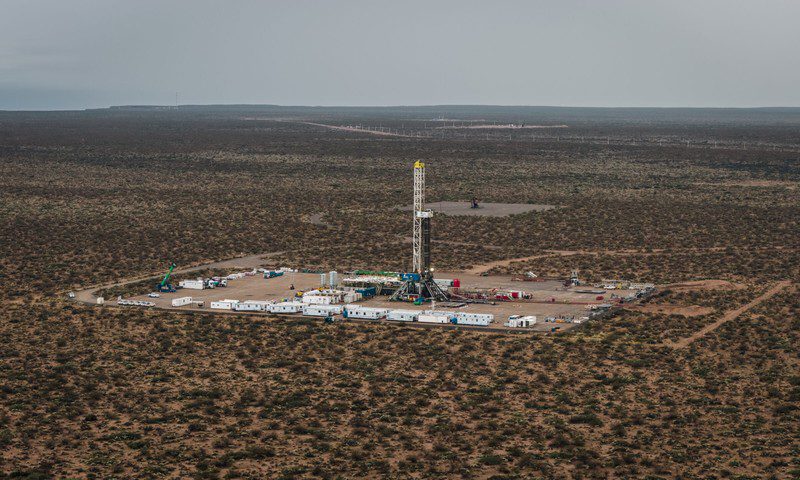
Headline photo: A GeoPark drilling rig in Argentina’s Vaca Muerta formation, Neuquén Province. (Photo courtesy GeoPark)