Previous Story
Seized Documents Trace a 4,000-Rifle Promise From Caracas to Colombia’s FARC Dissidents
Posted On November 25, 2026
Comment: 0
Tag: abelardo de la espriella, AK-103, antioquia, arms trafficking, Calarcá Córdoba, caracas, colombia, Colombia security, Colombia Venezuela border, cucuta, Delcy Rodríguez, Diosdado Cabello, Ejército Nacional, eln, Estado Mayor de los Bloques y Frentes, FARC Dissidents, FN FAL, gentil duarte, hugo chavez, Iván Márquez, ivan mordisco, Jhon 40, kingpin act, Los Rastrojos, narco-terrorism, Nicolas Maduro, norte de santander, ofac, Organization of American States, Pete Hegseth, Ramón Rodríguez Chacín, southern district of new york, venezuela, yarumal
Documents tie Venezuelan officials to Colombia’s armed dissidents
Commanders of Colombia’s FARC dissident factions crossed into Venezuela in 2019, were moved toward Caracas under military escort, and were told by one of Hugo Chávez’s former ministers that rifles would be delivered within 10 days, with the raw notes of that meeting putting the figure at 4,000 FN FALs, according to minutes, letters and working notes seized from the dissidents by Colombian authorities and reviewed by El País. Nothing in the records shows that the rifles arrived.
The Spanish daily, which reported on the cache on November 22, 2026, says it includes correspondence, raw meeting notes, and an internal account one still-armed faction wrote for itself on April 17, 2024, reconstructing the journey years later. The dissidents gave a need for medical attention as their stated reason for crossing.
Three commanders answered Iván Márquez’s summons in 2019, and not one of them had signed the accord he put his name to, and all of them had called him a traitor: Miguel Botache Santillana, known as Gentil Duarte; Néstor Gregorio Vera, known as Iván Mordisco; and Alexander Díaz, who goes by Calarcá Córdoba. Márquez had spent four years at the Havana table, put his name to the 2016 accord and given up his weapons under it, and by 2019 he was back in the war and set on reassembling the FARC under a single command he would hold himself. The minutes record that he arrived with the decisions already made, down to which commander would hold which front. Mordisco refused on the spot, the meeting broke up, and El País reports that the feud that started there is still killing fighters on both sides of the border.
The former minister waiting for them in Venezuela was Ramón Emilio Rodríguez Chacín. He is a retired navy captain who twice ran Venezuela’s interior and justice ministry under Chávez, in 2002 and again in 2008, and who governed Guárico state from 2012 to 2017. The US Department of the Treasury blacklisted him on September 12, 2008, under the Foreign Narcotics Kingpin Designation Act, calling him “the Venezuelan government’s main weapons contact for the FARC.” Treasury said he had tried to arrange a $250 million USD loan that Venezuela would have extended to the guerrillas, that it could not confirm whether that loan was ever made, and that he had met senior FARC figures repeatedly, once inside Miraflores Palace in late 2007.
More than 17 years later, he is a co-defendant in the superseding indictment unsealed in the US District Court for the Southern District of New York on January 3, 2026. Of the six people charged, only Rodríguez Chacín, Nicolás Maduro and Diosdado Cabello, Venezuela’s minister of the interior, justice and peace, face all four counts, narco-terrorism conspiracy among them.
Mordisco’s own account of the trip reads differently, and it survives in the cache because, El País reports, his enemies copied it onto their computers. At a military base in Caracas, by his telling, Márquez went before the Venezuelan government together with Gentil Duarte and Calarcá, the three of them presenting themselves as the Estado Mayor Central, the FARC’s old central command, and asking to be acknowledged as the leadership of a reconstituted insurgency.
Two of the accounts in the cache were written separately and agree on how the Colombians traveled: the Venezuelan army moved them. El País reports that the arrangements fell to Géner García Molina, the dissident commander based in the Venezuelan Amazon who is known as Jhon 40, and that he supplied a guide and an escort for the run toward Caracas. A helicopter took the group the rest of the way, and Rodríguez Chacín met it on the ground.
All three parties to the commitment the dissidents had come to collect were dead before they got there. Manuel Marulanda, who founded the FARC, died in 2008; its military chief, Jorge Briceño, better known as Mono Jojoy, was killed in a Colombian military bombing in 2010; and Chávez died in 2013. The documents describe Rodríguez Chacín reading aloud from a computer screen correspondence in which, the records say, Chávez urged the guerrillas to build a popular movement and undertook that Venezuela would arm and finance them a second time if that came to nothing. The rifles, the minutes record, were to be drawn from a weapons replacement already running inside the Venezuelan armed forces.
“We are going to give you 4,000 FAL rifles.” — the promise as recorded in the raw notes of the 2019 meeting, reviewed by El País
El País reports that the FAL was the Venezuelan state’s service rifle until 2005, when replacement with AK-47s began. Venezuela bought 100,000 AK-103 rifles from Russia that year and took the final shipment on November 29, 2006, according to the Federation of American Scientists, which reported that December that the Venezuelan military “has already inadvertently contributed dozens of its old FAL assault rifles” to the black market that arms Colombian guerrillas. The minutes record that the dissidents waited and that nothing came.
Weapons bearing Venezuelan state markings have been turning up in Colombian seizures for years, according to El País. On August 13, 2020, Gen. Fabio López, then head of the Dijín (Directorate of Criminal Investigation and Interpol), the criminal investigation arm of the Policía Nacional (National Police), announced the recovery of 45 long guns from an underground cache in Cúcuta, Norte de Santander. As El Tiempo reported, 35 were Belgian-made FN FAL rifles in 7.62 caliber carrying the coat of arms of the Republic of Venezuela, and the arsenal was bound for Los Rastrojos, a criminal network then fighting the ELN, Colombia’s National Liberation Army, for territory.
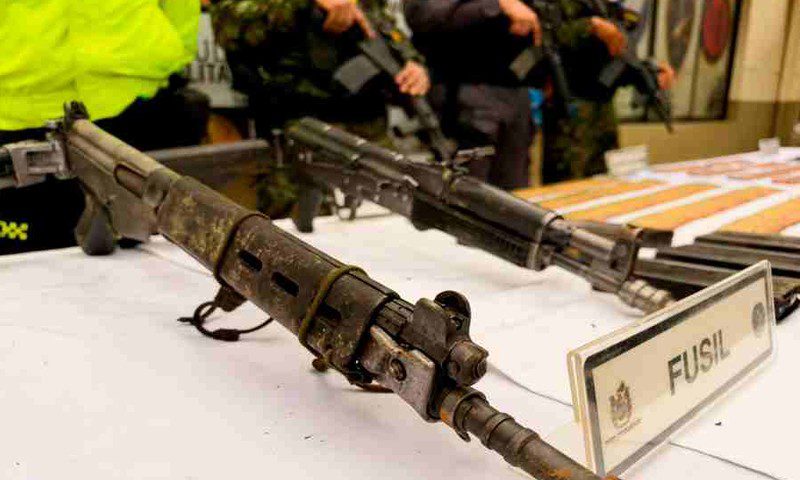
On November 5, 2026, troops of Colombia’s Ejército Nacional (National Army) reported two deaths in combat with presumed members of Structure 36 of the Calarcá faction in Yarumal, Antioquia, and the seizure of two rifles and 710 rounds of ammunition. Infobae reported that one of the two was a FAL that, on preliminary information, belonged to Venezuela’s armed forces. The Army’s release on the operation lists the seized materiel without identifying either rifle as Venezuelan.
CBS News reported that Attorney General Pam Bondi unsealed it after US forces had taken Maduro and his wife, Cilia Flores, into military custody overnight and brought them to the United States. Rodríguez Chacín has not appeared before the New York court, according to El País.
In Colombia, President Abelardo de la Espriella’s government ended its dialogue table with Calarcá’s Estado Mayor de los Bloques y Frentes (General Staff of Blocs and Fronts) on August 28, 2026, citing an absence of will for peace, Blu Radio reported.
Colombia’s Fiscalía General de la Nación (Attorney General’s Office) holds a separate trove taken from the same faction: laptops, cell phones, hard drives and USB drives seized from Calarcá’s commanders at a military checkpoint on the Medellín–Anorí road on July 23, 2024, part of whose contents Noticias Caracol published in November 2025, as El Espectador reported. El País does not say whether the documents in its own report form part of that seizure.
Headline photo: A rifle seized from Structure 36 of the FARC dissidents’ Calarcá faction, displayed after the November 5, 2026, operation in Yarumal, Antioquia. (Photo: Ejército Nacional handout)