Previous Story
Medellín Draws 1.2 Million Foreign Tourists and Pushes Tourism Beyond Comuna 13, Laureles & Poblado
Posted On October 21, 2026
Comment: 0
Tag: agencia nacional de infraestructura, airplan, airport expansion, Ana María López Acosta, antioquia, Área de Desarrollo Naranja, asohost, bogotá, cartagena de indias, colombia, Colombia tourism, comfama, comuna 13, Confecámaras, Consejo Territorial de Planeación, el poblado, Fernando Botero, foreign tourists, Frontier Airlines, Guns N' Roses, j balvin, José María Córdova International Airport, Juan Camilo Vargas, Juan Luis Guerra, Juanes, Laureles-Estadio, Maluma, manrique, medellin, Medellín tourism, Palacio de la Cultura Rafael Uribe Uribe, Perpetuo Socorro, Plan de Ordenamiento Territorial, Plaza Botero, procolombia, registro nacional de turismo, rionegro, Secretaría de Turismo y Entretenimiento, shakira, short-term rentals, Sonido Perpetuo, spotify, tourism foreign exchange, vivienda turística, wellness tourism
Tourism Delivered $5 Trillion COP and the Airport Ran Over Capacity
Medellín counted 1.2 million foreign tourists in 2025 and put the tourism sector’s economic impact for the year at $5 trillion COP, about $1.57 billion USD at the October 19 market rate of $3,174.67 COP to the dollar, according to the city’s Secretaría de Turismo y Entretenimiento (Secretariat of Tourism and Entertainment). The secretariat says foreign arrivals are growing close to 10% a year and calls Medellín Colombia’s second tourism capital behind Bogotá, which closed 2025 with close to 1.9 million foreign visitors by the count of its own district tourism institute. The figures were reported on October 8 by the Spanish news agency EFE, in a dispatch carried by Infobae.
Nationally, ProColombia recorded 4,677,267 foreign non-resident travelers entering Colombia in 2025, a 3.8% increase over the prior year, along with $11.17 billion USD in tourism-related foreign exchange earnings, up 9.4%, according to Forbes Colombia. The two sets of numbers measure different things, since one counts entries to the country and the other counts visitors to a city, but by Finance Colombia’s calculation Medellín’s total is equivalent to about 26% of everyone who entered Colombia last year.
One in three of those visitors came from the United States, the secretariat said, followed by travelers from Mexico, Ecuador, Spain, Peru and Panama. They stay between four and six nights and spend an average of about $210,000 COP a night, close to $66 USD, mostly on food, culture, shopping and wellness. Frontier Airlines, a unit of Frontier Group Holdings, Inc. (NASDAQ: ULCC), begins Orlando service to Medellín on December 10, 2026.
The Airport Is Running Over Its Design Capacity
The secretariat says the real number of international visitors is higher than the count recorded at José María Córdova International Airport in Rionegro, because travelers who clear immigration in Bogotá or Cartagena de Indias and then travel on to Medellín never register there as arrivals. The airport handled about 14.5 million passengers in 2025, 4.2 million of them international, through a terminal designed for 11 million a year, according to Valora Analitik.
Expansion work began in April 2026, after the Agencia Nacional de Infraestructura (National Infrastructure Agency) signed the start order with the concessionaire Airplan. Portafolio reported that the package runs to 11 works and 15 separate interventions and is meant to raise annual capacity from 11 million passengers to 17 million, taking check-in positions from 56 to 80 and hourly aircraft movements from 24 to 28.
Promoting Non-Traditional Tourism Neighborhoods
The secretariat is promoting neighborhoods beyond Comuna 13 and its graffiti route, the city’s best-known attraction. It is pitching Manrique on culture, food, urban art and music, and Perpetuo Socorro, an industrial pocket near the Medellín River rebuilt as a creative quarter.
The city designated Perpetuo Socorro its first Área de Desarrollo Naranja (Orange Development Area) in November 2020, a classification that allows companies locating there to claim tax deductions of up to 165%. Spotify (NYSE: SPOT) and the Antioquia benefits fund Comfama opened a public recording studio in the district, Sonido Perpetuo, in April 2023, according to El Colombiano.
Beyond urban tours, the secretariat is marketing nature, wellness, gastronomy, sport and health services, and says close to 70% of Medellín’s territory is natural area. Ana María López Acosta, the city’s secretary of tourism and entertainment, described that shift to EFE in these terms: “We are increasingly attracting a tourist interested in everything to do with wellness and nature, who wants to take a moment of rest, to come to places where it is possible to be at peace.”
“Medellín has gone through a very large transformation in recent years, and when people get here they are surprised by the city we are today: an extremely innovative city, surrounded by nature and mountains.” – Ana María López Acosta, secretary of tourism and entertainment, Medellín
The secretariat also counts concerts, festivals and large events among the draws pulling domestic and foreign visitors into the city. Shakira, Maluma, J Balvin, Guns N’ Roses, Juanes and Juan Luis Guerra all played Medellín during 2025.
Short-Term Rentals Face Restrictions Under the Draft POT
ASOHOST, the association representing platform-based short-term rental operators, puts the sector’s revenue in Medellín at about $76 billion COP a month and counts more than 15,000 short-term rental units listed in Antioquia, which calculations by Confecámaras drawn from the Registro Nacional de Turismo (National Tourism Registry) put at about 22% of national supply. The association estimates net returns of 8% to 12% in high-demand areas such as El Poblado, where gross monthly income per unit can reach $16 million COP, and 6% to 9% in Laureles-Estadio, according to Publimetro.
Medellín’s draft Plan de Ordenamiento Territorial (land use plan) would restrict that activity. ASOHOST says the proposal bars short-term rentals outright in some zones and permits them conditionally in others, and that its “established use” provision does not protect operators already running units in residential areas. ASOHOST President Juan Camilo Vargas told La República that the draft leaves legal gaps and infrastructure requirements current operators cannot satisfy: “We want to keep building an organized city, but we need clear and workable rules.”
The draft is not final. The city delivered the medium-term POT revision to the Consejo Territorial de Planeación (Territorial Planning Council) in July 2026 for its concept, a required step before the document reaches the Concejo de Medellín. Luz Ángela González Gómez, director of the Departamento Administrativo de Planeación (Administrative Planning Department), said the council must study the document and produce a concept that integrates new perspectives.
The secretariat is also running water-conservation and resource campaigns aimed at residents and visitors alike. “Our resources, which we see as so abundant, are limited,” López Acosta said.
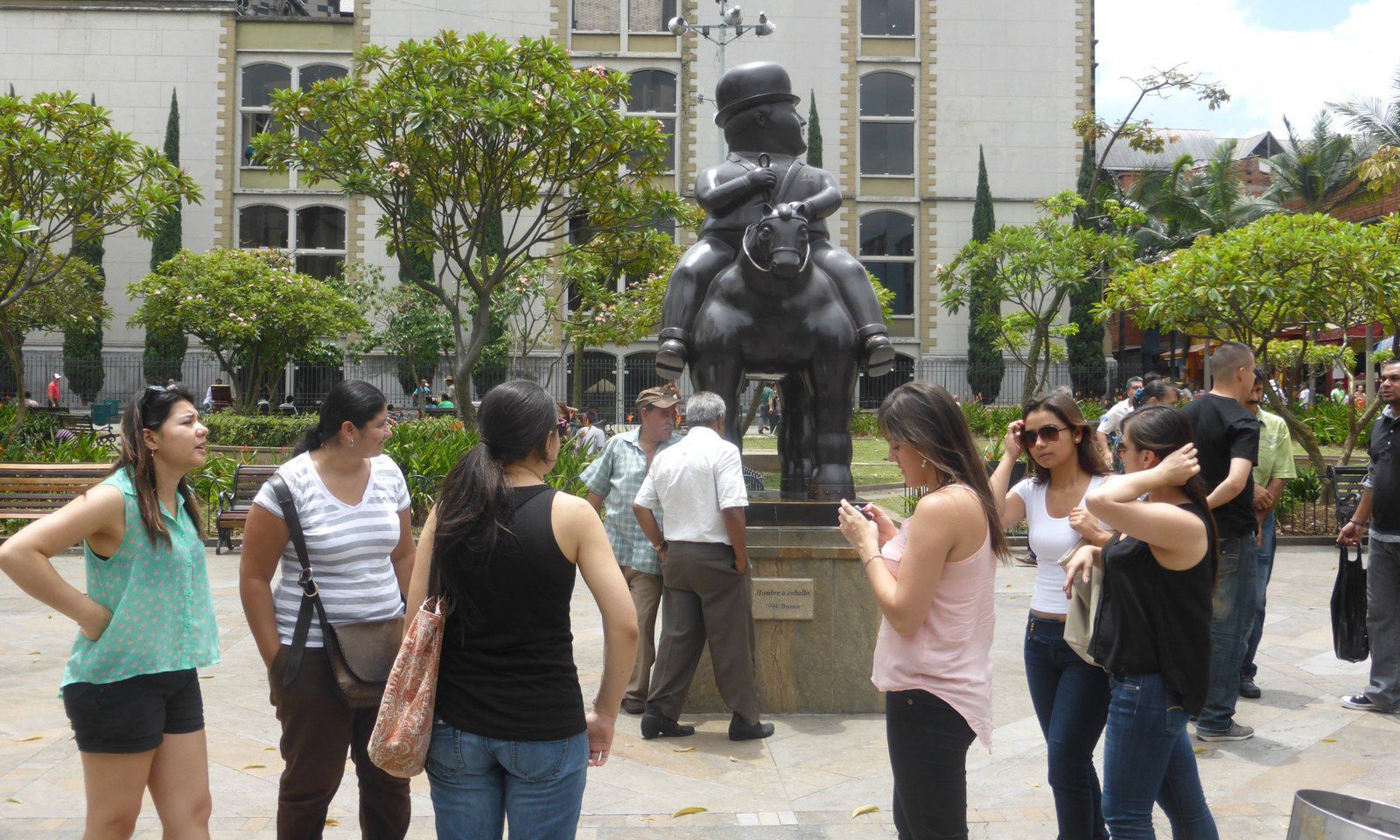
Headline photo: Visitors in Plaza Botero in central Medellín, beside Fernando Botero’s bronze “Hombre a caballo,” with the Palacio de la Cultura Rafael Uribe Uribe behind. (Photo: Loren Moss / Finance Colombia)