Previous Story

From ‘Total Peace’ to Terror Support: How Secret Cartel Concessions Could Drag Petro Officials into US Courts
Posted On July 17, 2026
Comment: Off
Tag: abelardo de la espriella, agc, Boyaco Sinaloa, chiquito malo, Clan del Golfo, Danilo Rueda, DNI, Eduardo Montealegre, extradition, Fiscalia, foreign terrorist organization, Gustavo Petro, ivan velasquez, Jorge Lemus, jose manuel restrepo, Junta del Narcotráfico, ley de sometimiento, m-19, Noticias Caracol, Operation Agamenón, organized crime, paz total, Ricardo Calderón, Ricardo Rey Rosanía
Prosecutorial inaction pushes the reckoning toward US courts
In an extended interview on Noticias Caracol’s analysis program La Clave, Ricardo Calderón, director of the network’s investigative unit, laid out the case that the secret 2022 overtures his team documented between the Petro government and the Clan del Golfo were not empty exploratory talk — because, he argued, nearly everything the government’s peace envoy promised the criminal organization in private is matched, line by line, by what the state then did in public. The interview arrives roughly a month before outgoing President Gustavo Petro hands the Casa de Nariño (presidential palace) to president-elect Abelardo de la Espriella on August 7, and it reframes what began as a Colombian political scandal as a matter that Calderón believes will ultimately be examined in the United States.
The reporting rests on recordings from a September 2, 2022 meeting — three weeks into Petro’s term — in which the government’s alto comisionado para la Paz (High Commissioner for Peace), Danilo Rueda, met Luis Armando Pérez, alias “Jerónimo,” a commander of the Clan del Golfo, formally the Autodefensas Gaitanistas de Colombia (AGC). In the audio, Rueda offers a mutual military standstill he calls a game of “congelados” (freeze tag), a halt to aerial bombardments, a purge of military and police intelligence, and relief on extraditions, with no equivalent commitments recorded from the criminal side. Finance Colombia has tracked the failures of the paz total (total peace) strategy across the Petro term; what Calderón emphasized on La Clave is corroboration — the method by which his team tested whether the promises became policy.
The Method: Promises Checked Against the Public Record
Calderón described a verification process he said took roughly eight months and drew on more than twenty sources. Rather than publish the audio and let it speak for itself, the unit says it cross-checked each recorded commitment against the government’s own subsequent conduct, using official responses obtained through derechos de petición (right-to-petition requests) to the Ministry of Defense.
“What we did was cross every sentence of the conversation with what actually happened in the following years,” Calderón said, describing the core of the exercise as confirming that “they were fulfilled.”
“There may eventually be favoritism shown to a terrorist and drug trafficking group here, and those are cases that will be taken there.” — Ricardo Calderón, director of the Noticias Caracol investigative unit
He also addressed authenticity directly, given the current climate of manipulated media, a concern sharpened by Petro’s claim that material recovered in a separate case had been fabricated with artificial intelligence. Calderón said the unit obtained original voice samples and commissioned forensic audio analysis (peritazgo) to confirm the speakers before publishing, a step he described as slow but essential.
His team, he said, also consulted officials from prior peace processes and former intelligence directors to establish where the legitimate boundaries of each official’s role lay. They concluded that in the cases of both Rueda and the intelligence chief, “there are things that crossed the line.”
Promise by Promise, Matched to What Followed
On bombardments, the recording captures Rueda telling the Clan del Golfo emissaries he had spoken with the minister and that orders had been given to stop planned strikes in the group’s areas. Days after the meeting, then-Defense Minister Iván Velásquez publicly announced a halt to bombings where minors might be present. According to Ministry of Defense figures cited by Noticias Caracol, no aerial bombardment was carried out against the Clan del Golfo for roughly two years afterward; the first did not come until late 2024.
In the officer corps, Rueda presents a “cleanup” of intelligence as evidence of good faith. On August 12, 2022 — three weeks before the meeting — more than 35 generals were retired in the largest single command shakeup in recent Colombian history, and further removals followed, reaching roughly 40 senior officers. Calderón said the unit focused on three colonels named in the conversation because Jerónimo specifically asked for their removal: officers who had served in Operation Agamenón, the multi-year spearhead against the Clan del Golfo.
Their strategic roles, and the systematic drawdown of elite units trained by United States and United Kingdom agencies to pursue the group, were confirmed against the record; Calderón described a gradual but permanent dismantling of “the most experienced units” fighting the Clan del Golfo and the dissident groups.
On intelligence itself, Rueda is heard reassuring the emissary that the government was “dismantling intelligence.” Calderón said the paper trail of command changes and unit disbandments tracked that statement. On extradition, which is historically the Colombian state’s most effective instrument against cartel leadership, the recording shows Rueda accepting the group’s concerns as something that “gets done,” a concession Calderón and his sources characterized as far outside the mandate of a peace commissioner.
The macro-level corroboration, Calderón argued, is what the Clan del Golfo did with the space it was given. Drawing on Ministry of Defense data, Noticias Caracol reported that between 2022 and 2025 the organization’s membership nearly tripled, from 4,061 to 9,915 fighters, while its municipal footprint more than doubled, from 145 to 338 municipalities, even as, in Calderón’s words, the group “did nothing on peace.” InSight Crime has documented the same pattern of criminal expansion under permissive conditions, and Finance Colombia’s editorial analysis concluded that total peace had produced total chaos.
Two Investigations, One Thread
Calderón described the reporting as having “two legs.” The first is the Rueda audio. The second grew out of a parallel inquiry into the Dirección Nacional de Inteligencia (National Intelligence Directorate, DNI), the successor to the disbanded DAS, after the unit obtained conversations involving its then-director, Jorge Lemus.
That strand placed Lemus, who was accompanied by the DNI’s counterintelligence chief, Ricardo Rey Rosanía, in an August 2025 meeting in central Bogotá with Edward Ferney Rincón, an emerald trader (esmeraldero) and confessed former narcotrafficker known as alias “Boyaco Sinaloa.”
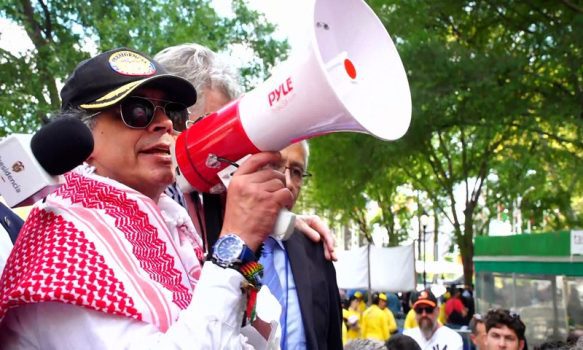
President Gustavo Petro in New York joining rally for Palestine. Photo credit: Colombia Presidency.
According to the recordings, the officials asked Rincón to use his contacts in Congress to advance the ley de sometimiento (criminal-submission bill) that then-Justice Minister Eduardo Montealegre had filed in July 2025, and to help arrange direct contact with alias “Chiquito Malo,” the Clan del Golfo’s top commander. The common denominator across both investigations, three years apart, Calderón said, was the Clan del Golfo.
The DNI thread also cuts against one of Petro’s signature security narratives. In the recording, the intelligence director’s own interlocutor dismisses the existence of the so-called Junta del Narcotráfico (Narcotics Trafficking Board), the Dubai-based cartel “board” that Petro has repeatedly claimed wants to assassinate him. Calderón noted that no intelligence agency, police, or prosecutor has validated the alleged plot, yet the government assembled an organizational chart around it — a construction that, he said, its own sources contradicted.
From Obstruction to Terror-Support: Why the Venue Shifts to Washington
The escalation Calderón stressed is jurisdictional. The United States designates the Clan del Golfo as a Foreign Terrorist Organization, and the US State Department has offered reward money for the capture of its leaders.
Dismantling US- and UK-trained interdiction units in a manner that Calderón says was intended to benefit that structure is, in his framing, more than possible obstruction. “There may be favoring of a terrorist and drug-trafficking organization here, and those are cases that will be handled over there,” he said, pointing to the US.
The same exposure, he added, attaches to the treatment of the dissident groups. Washington’s interest is not abstract: the US Drug Enforcement Administration has already opened a probe of Petro himself for alleged cartel ties.
The Fiscalía’s Silence
Against that backdrop, Calderón pointed to the inaction of Colombia’s Fiscalía General de la Nación (Office of the Attorney General). He noted that when the unit published the “computers of Calarcá” — which were files tied to a dissident commander — in November 2025, the Fiscalía had already held the devices for more than a year and a half.
Had prosecutors acted, he argued, some of the individuals later shown to have participated in the killings of social leaders might have been captured: “in colloquial terms, we could have saved lives.”
On the current matter, he said, the Fiscalía opened a preliminary inquiry into Rueda only in early July 2026 — days before the interview, and more than a week after the audio was published. This is a sequence he said “leaves many questions” about the office’s role. That inquiry names four former officials — Rueda, Iván Velásquez, Jorge Lemus, and Ricardo Rey Rosanía — over the benefits allegedly offered to the Clan del Golfo, and was assigned to the unit of prosecutors delegated before the Supreme Court of Justice.
A Four-Year Pattern, and a Government About to Change
Calderón placed the recordings inside a longer series of disclosures over the Petro term: the Calarcá computers, the emergency-management chats, and other episodes pointing to opaque contacts between senior officials and armed structures. As many as 22 regional peace tables were opened, he noted, on promises resembling those in the audio. The pattern lands at a moment of maximum political consequence: Petro, himself a former member of the M-19 (Movimiento 19 de Abril) guerrilla movement before its 1990 demobilization, is weeks from handing power to a successor who has staked his mandate on the opposite approach.
De la Espriella, who won the June 21 runoff over senator Iván Cepeda with running mate José Manuel Restrepo, has already issued a communiqué urging the vice-president-elect to investigate the disclosures and, if warranted, to refer them to US authorities. In his victory address he vowed that “there will be no zones off-limits to the State” and “no organizations above the Constitution and the law,” and he has said Colombia will join a regional counter-crime initiative promoted by Washington.
Security analysts expect the peace zones established under the Ley de Paz Total (Total Peace Law), which carry no legal permanence beyond the current government, to be revoked after the August 7 handover. Petro has spent his final months pressing to formalize Clan del Golfo concentration zones before he leaves office.
Rueda’s Defense
Rueda, who surfaced only after the first report aired, has maintained that the encounters were preliminary, exploratory approaches involving promises that, by his account, were never fulfilled, and that no presidential decision was ever taken to halt operations against the Clan del Golfo. Calderón’s rebuttal returns to the corroboration: the Ministry of Defense’s own statistics, he said, “prove otherwise.” Whether that gap between the recorded private commitments and the government’s public posture amounts to a crime is now, belatedly, before the Fiscalía — and, if Calderón is right about the US interest, may not stay in Colombia.
Primary reporting by the Noticias Caracol investigative unit, drawn from Ricardo Calderón’s interview on the program La Clave. Related Finance Colombia coverage: Editorial: Gustavo Petro’s Total Peace Has Led to Total Chaos in Colombia; Halfway Through His Term, Petro’s Total Peace Is Failing; InSight Crime: Colombian Criminal Groups Gaining Strength Under Petro; Petro Advances Temporary Concentration Zones for Clan del Golfo.
Headline image: Colombian government representative Álvaro Jiménez (left) shakes hands with Clan del Golfo spokesperson Luis Armando Pérez in the presence of Qatar’s Minister of State for Foreign Affairs, Mohammed bin Abdulaziz bin Saleh Al-Khulaifi (center), in Doha on September 18, 2025, at the start of peace talks. Photo shared by Colombia’s Office of the High Commissioner for Peace