Previous Story

Colombia’s Tax Collection Reached $162.6 Trillion COP in Six Months, Grupo Cibest Trackers Show
Posted On July 28, 2026
Comment: 0
Tag: 2026 national budget, Arturo Yesid González Peña, bancolombia, Bancolombia Execution Tracker, Bancolombia NowCast, Bancolombia Tax Tracker, budget execution, colombia, colombian economy, DIAN, Excise Tax, financial transactions tax, Fiscal Deficit, GMF, Grupo Cibest, Hector Steben Barrios, income tax, Jose Luis Mojica Agudelo, mhcp, ministry of finance, National Budget, PGN, public finances, stamp duty, Tariffs, tax collection, value added tax, vat, wealth tax
Revenue and spending both track at or above the 2026 fiscal path.
Colombia’s tax collection reached $23.3 trillion COP in June, a 6.5% increase over the same month a year earlier, according to proprietary indicators published by Grupo Cibest (NYSE: CIB; BVC: CIBEST, PFCIBEST), the Medellín-based financial holding company that owns Bancolombia. The estimate comes from the group’s Bancolombia Tax Tracker, one of two tools the bank has built from its transactional data to monitor public revenue and spending between official reports.
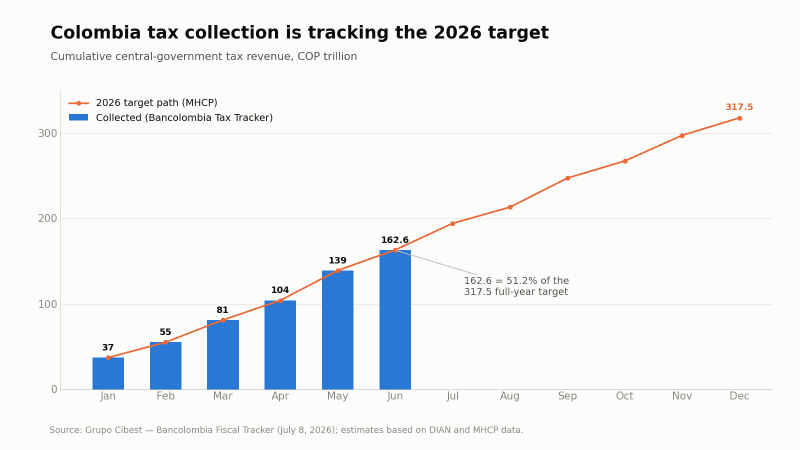
Colombia’s tax collection is tracking the 2026 target.
The trackers are produced by Grupo Cibest’s Economic, Industry and Market Research area. The Tax Tracker applies machine-learning models to the group’s transaction and payment-channel data to estimate monthly tax collection disaggregated by type of tax, while the companion Bancolombia Execution Tracker draws on the Bancolombia NowCast reading for the public administration sector to estimate budget execution by the central government.
Grupo Cibest states that the indicators are intended to complement, and under no circumstances replace, the official figures published by the national tax authority, the Dirección de Impuestos y Aduanas Nacionales (National Tax and Customs Directorate, or DIAN), and the Ministerio de Hacienda y Crédito Público (Ministry of Finance and Public Credit).
“Tax collection is in line with the Government’s tax revenue target for 2026.” — Grupo Cibest, Economic, Industry and Market Research
Increases in Tax Collection Across the Board
On the revenue side, the June increase was driven mainly by domestic value-added tax, up 13.5% year over year; the financial transactions tax (Gravamen a los Movimientos Financieros, or GMF), up 10.9%; and tariff revenues, up 7.6%. With the June result, cumulative tax collection in the first half of 2026 reached $162.6 trillion COP, 9.1% above the level recorded in the same period of 2025.
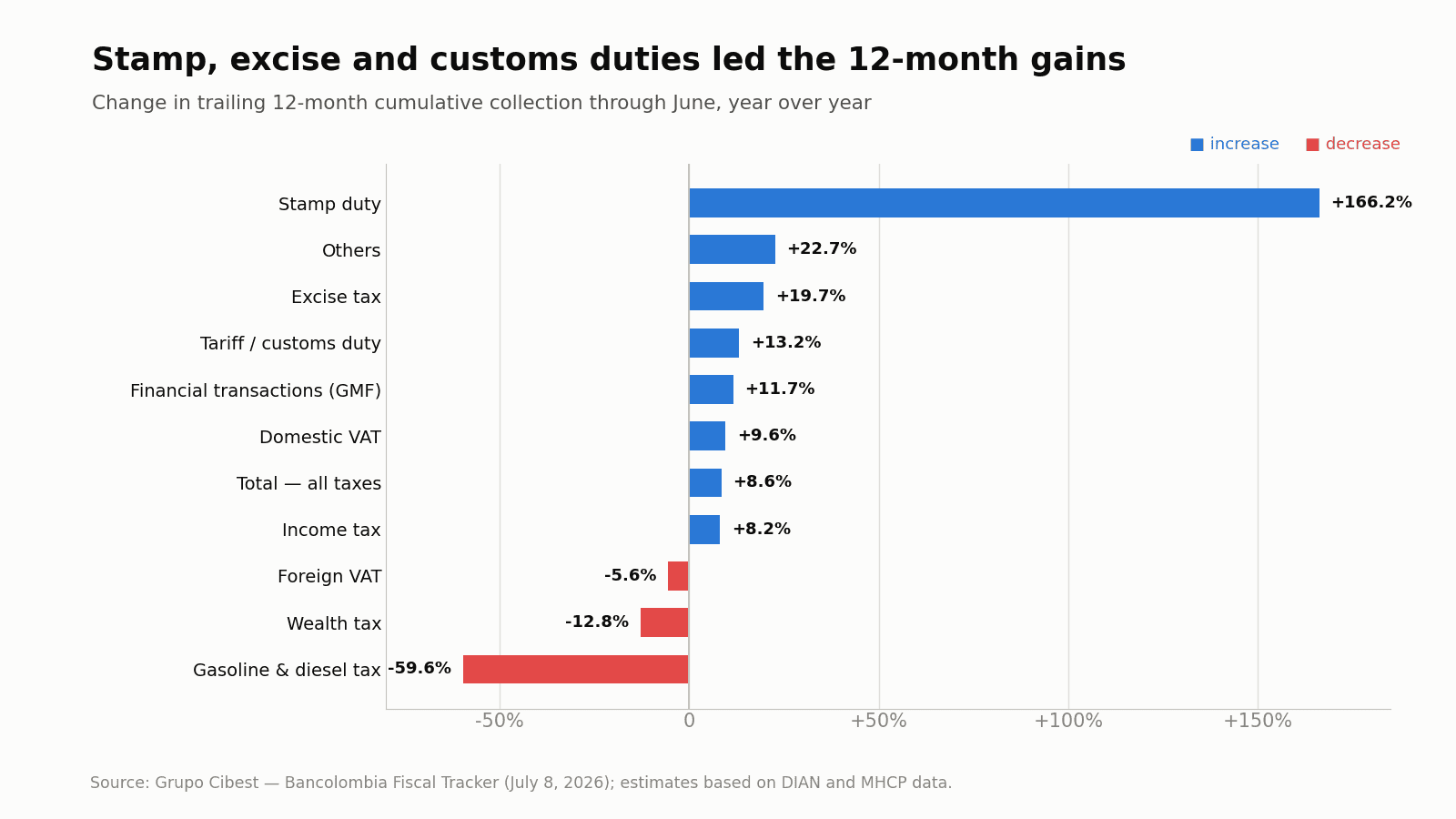
Stamp, excise and customs duties led the 12-month gains.
Measured against the government’s full-year goal, the first-half total is equivalent to 51.2% of the annual target of $317.5 trillion COP. Grupo Cibest estimates that, relative to the objective projected for the first six months of the year, collection reached 100% compliance, placing revenue in line with the government’s 2026 target.
The tracker’s breakdown by tax type, expressed as the year-over-year change in the trailing 12-month cumulative total through June, shows the widest gains in stamp duty, up 166.2%, and excise taxes, up 19.7%, followed by tariff and customs duties at 13.2%, the financial transactions tax at 11.7%, domestic VAT at 9.6%, and income tax at 8.2%, for a total increase of 8.6%. Three categories moved the other way: revenue from the gasoline and diesel tax fell 59.6%, the wealth tax declined 12.8%, and foreign VAT contracted 5.6%.
Government Expenditure Overshoots Target
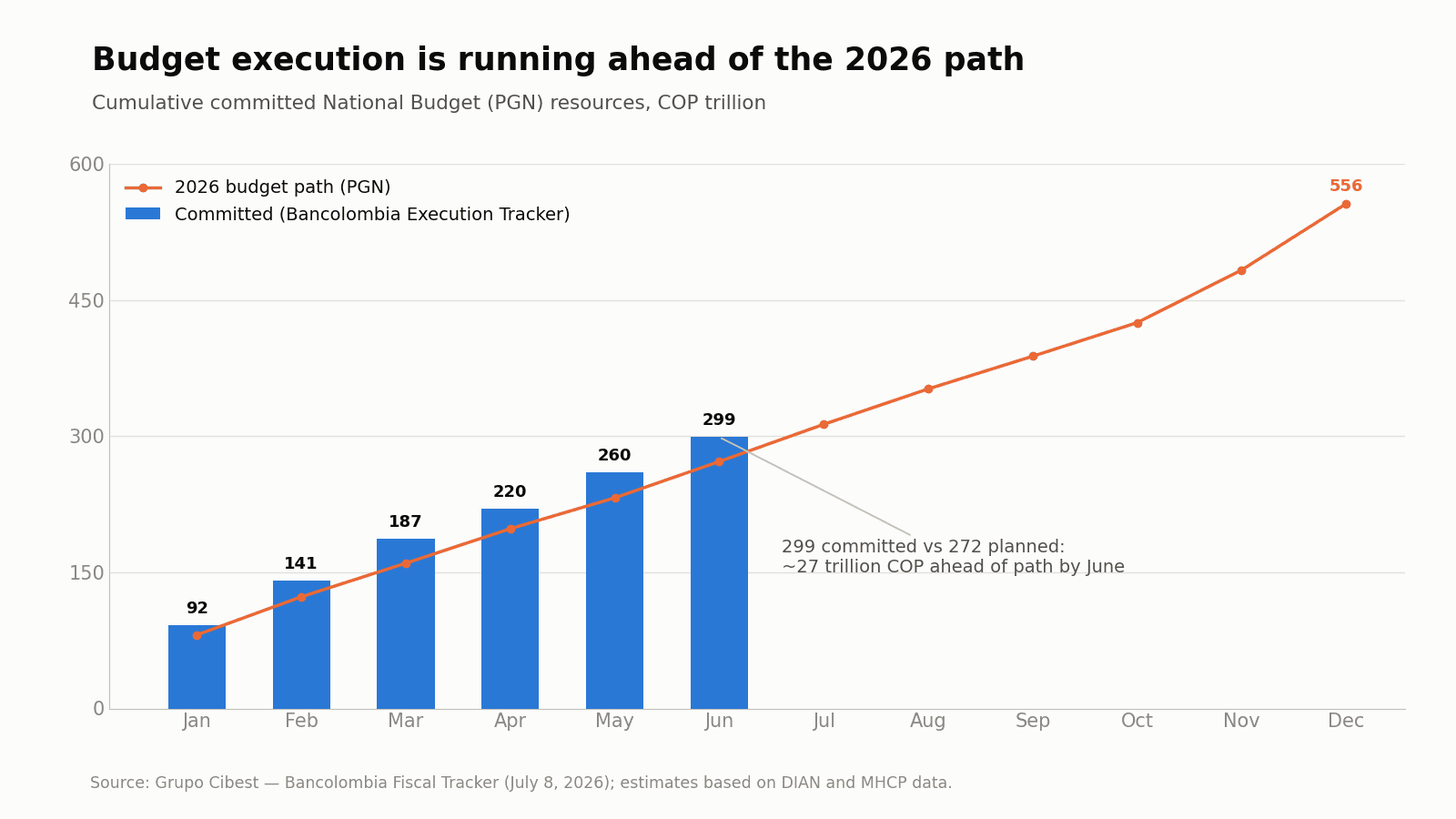
Budget execution is running ahead of the 2026 path.
On the expenditure side, the Bancolombia Execution Tracker estimates that the government committed $39.2 trillion COP in resources from the Presupuesto General de la Nación (National Budget, or PGN) during June, a 9.0% increase over the same month one year earlier. Committed resources for the year through June reached $299 trillion COP, an execution rate of 53.8% of the 2026 National Budget.
Grupo Cibest characterizes that pace as an overperformance relative to the execution path scheduled through the sixth month of the year. To reach the budget’s full-year total of $556 trillion COP, the government would have needed to commit about $272.3 trillion COP by June; the actual figure implies an overshoot of roughly $26.7 trillion COP against the monthly target.
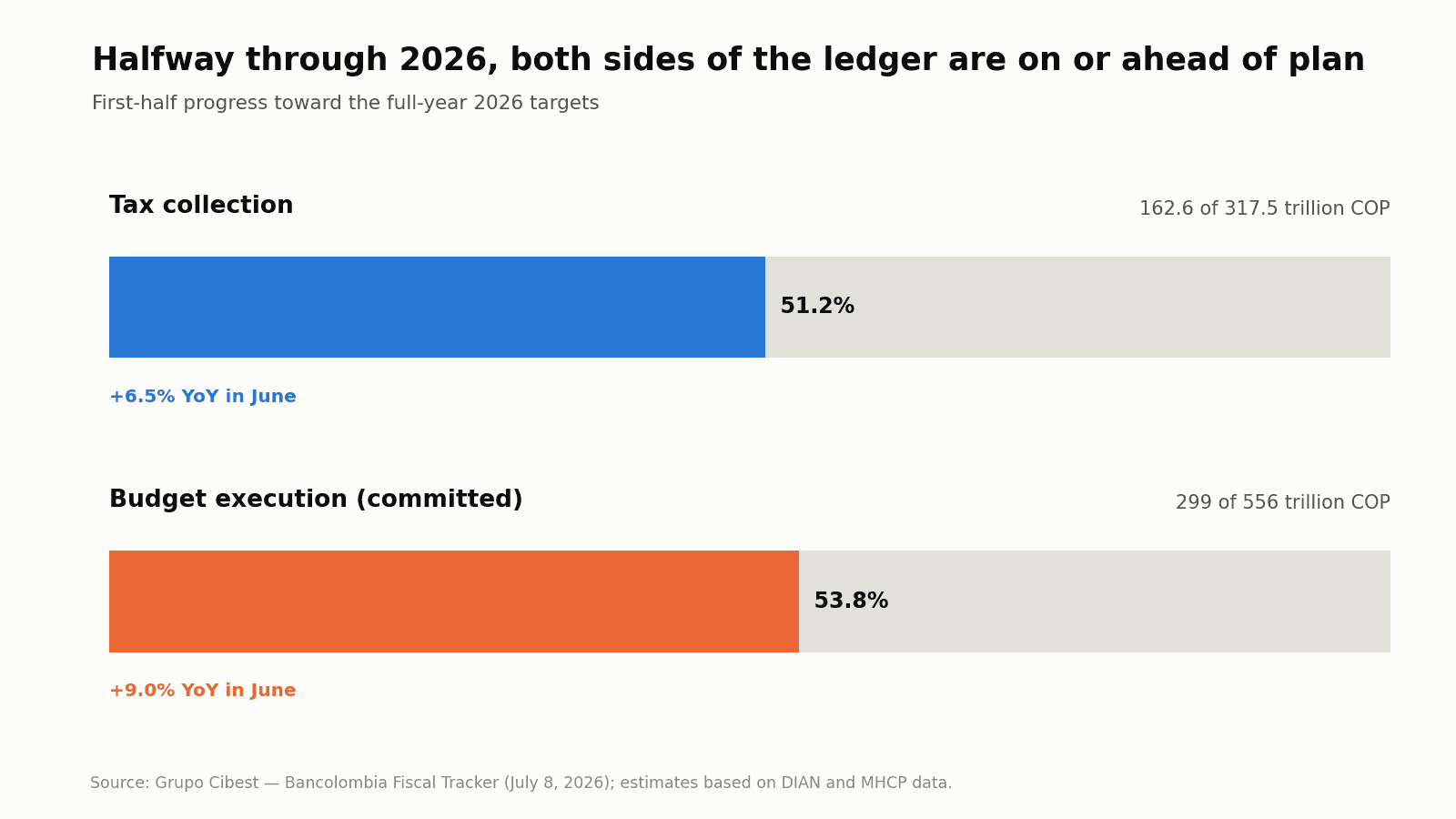
Halfway through 2026, both sides of the ledger are on or ahead of plan.
The group notes uneven performance beneath the aggregate figures. Revenue from domestic VAT, the financial transactions tax, and income tax has been strong through the year, while collection tied to fuel taxes, the wealth tax, and foreign VAT has shown weaker dynamics.
The Bancolombia Fiscal Tracker is an initiative of Grupo Cibest’s Economic, Industry and Market Research area, which describes it as an effort to monitor two variables central to the evolution of the fiscal deficit: tax collection and national-budget execution. The July edition was prepared by Macroeconomic Research Manager Jose Luis Mojica Agudelo, Quantitative Research Manager Arturo Yesid González Peña, and Macroeconomic Specialist Hector Steben Barrios.
Headline image by Csaba Nagy via Pixabay.