Previous Story

Bogotá, Antioquia and Valle del Cauca Concentrate Half of Colombia’s Regional Economy, Bancolombia Data Shows
Posted On September 3, 2026
Comment: Off
Tag: Agriculture, antioquia, arauca, atlantico, bancolombia, Bogotá D.C., bolivar, boyaca, cali, casanare, cesar, coal, colombia, colombian economy, commerce, commodities, competitiveness, Consejo Privado de Competitividad, consumption, cundinamarca, dane, departmental GDP, economic diversification, economic specialization, financial services, Grupo Cibest, Guainía, Hydrocarbons, Índice Departamental de Competitividad, inflation, la guajira, location quotient, Manufacturing, medellin, meta, mining, oil, PIB departamental, regional economy, remittances, san andres, santander, unemployment, universidad del rosario, valle del cauca, Vaupés, vichada
Regional GDP data reveal how commodity dependence shapes growth risk
Colombia’s national gross domestic product figures obscure significant differences among the country’s departments, according to an analysis by the economic research team at Bancolombia, the banking subsidiary of Grupo Cibest S.A. (NYSE: CIB; BVC: CIBEST, PFCIBEST). Based on 2025 preliminary departmental GDP data and departmental economic activity indicators for the first half of 2026 published by Colombia’s Departamento Administrativo Nacional de Estadística (DANE), the analysis shows that a small number of regions account for most of the country’s output while others remain much more exposed to individual industries and commodity cycles.
“Some departments start from a more favorable position to face a cyclical challenge in their most productive sector.” – Bancolombia’s Economic Research team
Colombia’s economy grew 2.2% year over year in the first quarter of 2026, but the national figure masks a wide range of regional outcomes. Santander led departmental growth at 3.1%, followed by Antioquia at 2.9%, Cundinamarca at 2.7%, Bogotá D.C. at 2.5% and Valle del Cauca at 2.3%, according to the Bancolombia analysis. All five outperformed the national economy.
This regional picture comes as Colombia’s broader growth outlook remains constrained by inflation and fiscal pressures. Grupo Cibest previously cut its full-year 2026 growth forecast to 2.6%, while Bancolombia’s more recent consumption data showed real household consumption growth slowing to 1.2% in the second quarter, its weakest pace in more than a year.
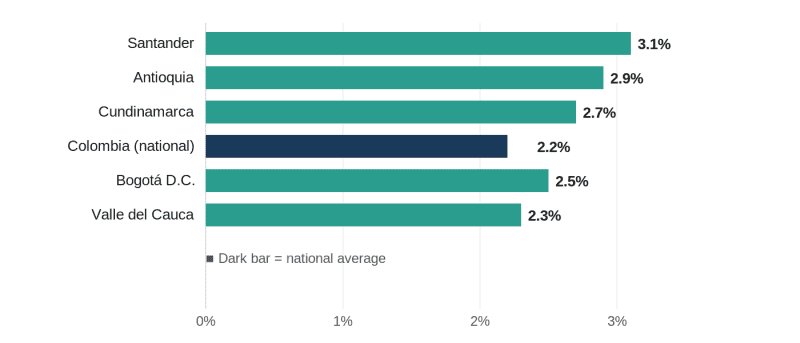
Five of Colombia’s largest regional economies outperformed national GDP growth in the first quarter of 2026. Source: DANE; calculations by Bancolombia / Grupo Cibest.
A small group of departments dominates national output
Bogotá D.C. accounted for 25.4% of Colombia’s national GDP in 2025, according to preliminary DANE figures. Commerce, transportation and lodging, together with financial services, underpin the capital’s economic weight, with Bogotá accounting for roughly half of the country’s financial-sector value added.
Antioquia, whose capital is Medellín, contributed 15.0% of national GDP. Its economy is more diversified, combining manufacturing and agriculture with commerce and services. Valle del Cauca, home to Cali, contributed another 9.8%, with commerce operating alongside a substantial manufacturing base.
Together, Bogotá D.C., Antioquia and Valle del Cauca represented 50.2% of Colombia’s GDP in 2025. DANE independently reports that these three economies accounted for nearly half of national output. Adding Santander, Cundinamarca and Atlántico brings the six largest departmental economies to 67.3% of Colombia’s total GDP.
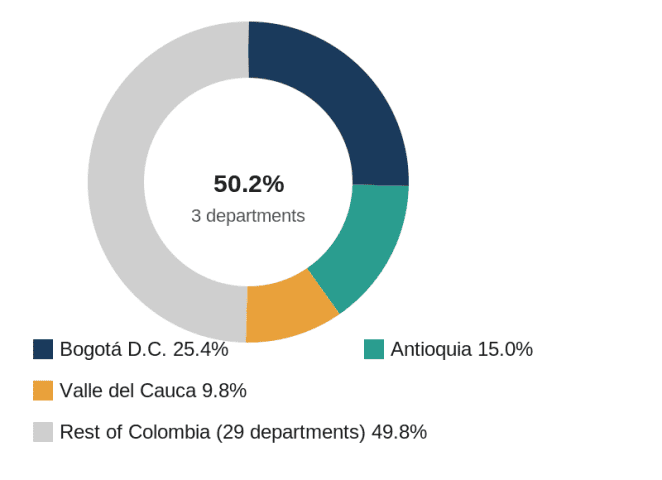
Bogotá, Antioquia and Valle del Cauca together accounted for 50.2% of Colombia’s 2025 GDP. Source: DANE; calculations by Bancolombia / Grupo Cibest. Chart: Finance Colombia.
That concentration is not simply a reflection of population. It also reflects decades of accumulated infrastructure, specialized labor, financial activity and established production chains. DANE’s departmental GDP series shows Bogotá D.C. and Antioquia as the country’s two largest departmental economies, while Vaupés and Guainía remain at the opposite end of the scale.
A consumption-driven model faces a tougher test
Bancolombia’s researchers caution that the strength of commerce and services in the largest departmental economies does not eliminate concerns about the durability of consumption-led growth.
Household income is likely to face pressure from elevated inflation, interest rates, unemployment and weaker remittance inflows, according to the analysis. Bancolombia’s August consumption report provides a similar signal: real consumption grew 1.2% in the second quarter of 2026, the lowest rate in more than a year, with every major region losing momentum compared with the previous quarter.
That makes the performance of other sectors increasingly important. Bancolombia points specifically to mining and construction as activities with greater potential for a rebound as Colombia’s economic cycle develops.
For the country’s departments, however, the implications are very different depending on their underlying economic structure. A slowdown in household consumption can have a relatively broad impact on diversified economies, while a recovery in commodities can have a disproportionately large effect on regions where mining and hydrocarbons dominate.
Where Colombia’s departments specialize
Bancolombia’s researchers use a location quotient to identify the sectors in which individual departments are unusually specialized. The measure compares the weight of a sector in a department’s economy with that sector’s weight nationally.
A location quotient of 1 means that the sector has approximately the same relative importance locally as it does in Colombia as a whole. A figure above 1 indicates that the sector is more important to that department than it is nationally.
The differences can be striking. Meta recorded a location quotient of 9.0 for mining and quarrying, with the sector accounting for 36.7% of the department’s GDP. Casanare recorded a quotient of 8.1, La Guajira 7.3, Arauca 7.0 and Cesar 6.7.
By contrast, Vichada had a location quotient of 3.8 for agriculture, while San Andrés recorded a quotient of 3.0 for commerce, transportation and lodging.
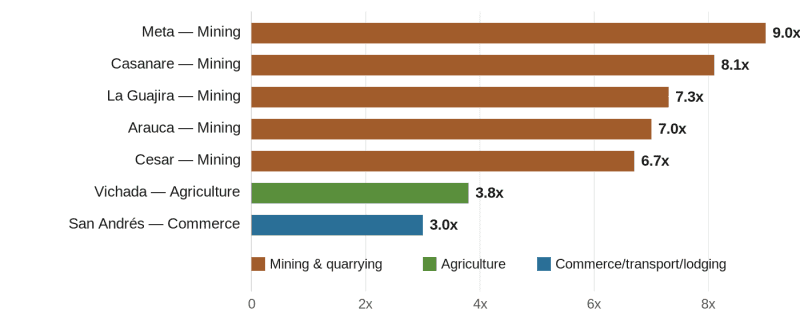
Mining dominates the economic profiles of several commodity-producing departments, while agriculture and commerce dominate elsewhere. Source: DANE; calculations by Bancolombia / Grupo Cibest. Chart: Finance Colombia.
The concentration of mining and hydrocarbons in departments such as La Guajira, Cesar, Casanare and Meta means their economic performance is more closely connected to international commodity prices and production cycles than that of the country’s largest diversified economies.
That exposure was visible in the first quarter of 2026. Cesar and Meta each recorded a 0.3% year-over-year contraction, while Casanare contracted 2.0%.
The pattern does not necessarily mean that specialization is a permanent disadvantage. Instead, it means that regional performance can change sharply when the economic cycle turns. A recovery in mining, housing and infrastructure investment could disproportionately benefit departments that already have the workforce, companies and physical capacity required to expand those activities.
Bancolombia therefore expects some commodity-dependent regions to have greater room for recovery if those sectors regain momentum. Bolívar and Boyacá, meanwhile, could benefit from a recovery in construction given their relatively high specialization in that activity.
Diversification creates a different kind of resilience
The distinction between specialization and diversification becomes clearer when Bancolombia’s production-concentration coefficient is applied to departmental economies.
The coefficient ranges from 0, representing a highly diversified production structure, to 1, representing an economy concentrated in a single activity.
San Andrés recorded the highest concentration coefficient among the departments examined, at 0.39, followed by Vaupés at 0.30, Vichada at 0.25 and Guainía at 0.21.
At the other end of the scale, Antioquia had the lowest coefficient at 0.04, followed by Boyacá at 0.05, Valle del Cauca at 0.06 and Bogotá D.C. at 0.07.
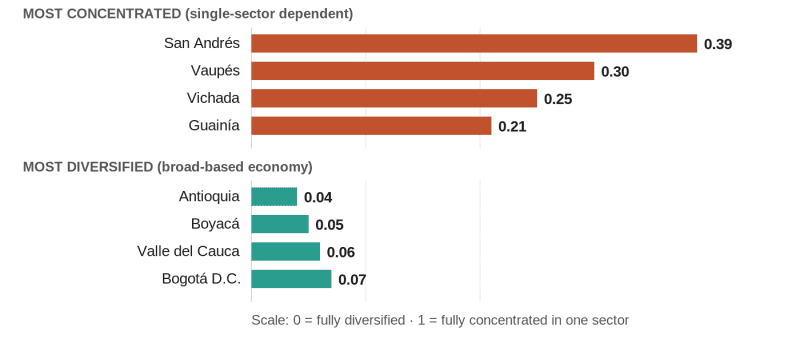
Antioquia, Boyacá, Valle del Cauca and Bogotá have among Colombia’s most diversified regional economies. Source: DANE; calculations by Bancolombia / Grupo Cibest. Chart: Finance Colombia.
The distinction matters because diversification can provide a degree of protection against shocks concentrated in a single industry. Antioquia, for example, combines manufacturing, agriculture, commerce and services rather than depending overwhelmingly on one commodity or activity.
Commodity specialization can work in the opposite direction. When international prices, production volumes or investment conditions move against a dominant sector, the effects can spread through employment, local demand, government revenues and business investment across the department.
At the same time, a specialized economy can benefit rapidly when conditions turn favorable. Bancolombia’s analysis therefore frames specialization less as a weakness in itself than as a structural characteristic that determines how departments respond to different stages of the economic cycle.
Competitiveness follows a similar geographic pattern
The same concentration appears in Colombia’s competitiveness rankings.
The 2026 edition of the Índice Departamental de Competitividad, produced by the Consejo Privado de Competitividad and Universidad del Rosario, ranks Bogotá D.C., Antioquia and Valle del Cauca among the country’s strongest-performing territories. The index measures 32 departments plus Bogotá D.C. using indicators drawn from official sources.
At the opposite end, Vaupés, Vichada and Guainía rank among the weakest-performing territories.
The competitiveness gap reflects many of the same structural advantages visible in GDP data: infrastructure, human capital, institutions, connectivity and established economic networks tend to reinforce one another over long periods.
These advantages are difficult to reproduce quickly. A department cannot easily replicate in a few years the industrial base, universities, financial institutions, transport infrastructure and supplier networks that have accumulated in Bogotá, Antioquia or Valle del Cauca over decades.
That suggests that regional development policies may be more effective when they build on existing capabilities rather than attempting to create entirely new economic ecosystems from scratch.
Colombia’s regional economy is more uneven than the headline GDP suggests
Taken together, the data present two very different pictures of Colombia’s economy.
The first is a relatively small group of large, diversified departmental economies led by Bogotá D.C., Antioquia and Valle del Cauca. These regions account for roughly half of national output and combine commerce and services with manufacturing, agriculture and other activities.
The second is a much larger group of smaller economies with far greater dependence on individual sectors. In commodity-producing departments, international prices and production cycles can matter more than the trajectory of domestic household consumption. In other regions, agriculture, tourism-linked commerce or public-sector activity can play an outsized role.
That distinction matters for investors, businesses and policymakers because a national growth rate does not tell the whole story. Colombia can record moderate expansion while individual departments simultaneously experience very different combinations of growth, contraction, opportunity and risk.
Bancolombia’s latest NowCast estimated that Colombia’s economy grew 2.7% in the second quarter of 2026. The departmental analysis suggests that understanding where that growth is generated, and which sectors are responsible for it, is just as important as the headline national figure.
For regional policymakers, the implication is equally important: diversification can reduce exposure to individual shocks, but existing specialization can also become an advantage when the economic cycle turns in favor of the sectors in which a department already has deep productive capabilities.
Headline picture : Picture of Cali Colombia Cathedral (Courtesy of Cathey Comm)