Previous Story
Colombia’s Mobile Networks Kept Failing for Hours After the August Earthquake, Ookla Data Show
Posted On September 8, 2026
Comment: Off
Tag: Accenture, America Movil, backup power, caldas, chile, chocó, claro, Colombia earthquake, Comisión de Regulación de Comunicaciones, Direct to Cell, disaster recovery, Downdetector, eje cafetero, empresas publicas de medellin, millicom, mintic, Modified Mercalli Intensity, movistar, network outages, Ookla, partners telecom colombia, Quindío, risaralda, San José del Palmar, satellite internet, Speedtest, Starlink, Subtel, telecommunications resilience, telefonica, tigo, ungrd, USGS, valle del cauca, wom, Ziff Davis
Speedtest data show power losses, not shaking, drove the outages
A magnitude 7.4 earthquake struck western Colombia on August 10, 2026, with an epicenter about 20 kilometers from San José del Palmar in the department of Chocó, according to the United States Geological Survey. As of August 25, Colombia’s Unidad Nacional para la Gestión del Riesgo de Desastres (National Disaster Risk Management Unit, UNGRD) counted 331 dead, 4,439 injured and 240 people still missing, with 16 departments and 494 municipalities affected.
Ookla, the company behind the Speedtest and Downdetector network-monitoring platforms, has published an analysis of how Colombia’s mobile networks behaved in the hours and days that followed. Combining Speedtest data, background signal-scanning telemetry and Downdetector’s outage reports with the USGS ShakeMap seismic model, Ookla found that network failures tracked the intensity of the shaking closely, but that the worst of the damage did not arrive during the earthquake itself. It arrived hours later, and in Chocó, more than a day later, as backup batteries at cell sites ran down faster than utility crews could restore electricity.
Outages tracked the shaking, then kept getting worse
Service availability held roughly steady in zones that experienced shaking below 6 on the Modified Mercalli Intensity (MMI) scale, a measure of shaking severity rather than the earthquake’s magnitude, and began deteriorating rapidly above that threshold. In areas that registered MMI 8, severe enough to cause substantial structural damage, 22% of mobile devices lost service in the hours that followed, compared with a normal baseline of about 2%. Ookla’s modeling found that ground-motion intensity accounted for 45% of the variation in service loss, with distance from the epicenter explaining another 34%.
The worst point did not come until four and a half hours after the main shock, when 27% of devices in the most intensely shaken zone were without service. In Chocó, where the earthquake originated beneath San José del Palmar, the share of devices without service kept climbing for a full additional day, reaching 42%.
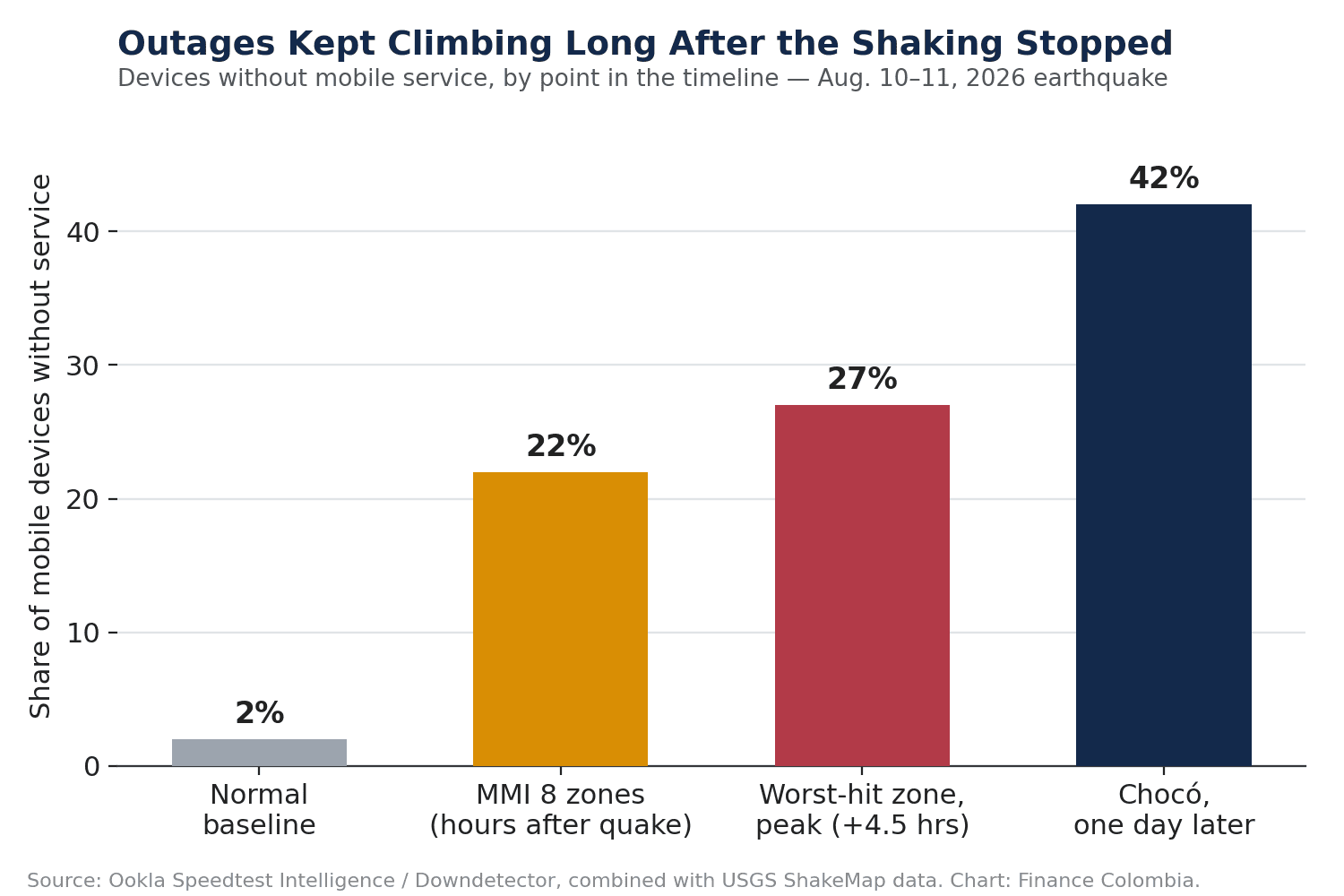
Devices without mobile service kept climbing for hours after the shaking stopped, peaking at 42% in Chocó a day later. (Chart: Finance Colombia)
Power, more than the shaking itself, decided who stayed connected
Colombia’s electrical grid absorbed the earthquake’s second-order damage. Chocó lost essentially all of its electricity supply, while the coffee-growing Eje Cafetero region lost about 80% of demand and Valle del Cauca about 70%, according to Ookla’s analysis of data from grid operator XM. Colombia’s Ministerio de Tecnologías de la Información y las Comunicaciones (Ministry of Information and Communications Technologies, MinTIC) separately counted 3,403 base stations out of service, equivalent to 46% of those it evaluated across seven departments; in Risaralda, the figure reached 77%. XM reported that 86% of electricity demand had been restored by the afternoon of the day after the quake, and mobile-network recovery tracked the pace of that grid restoration closely.
Downdetector registered an anomaly in consumer-submitted problem reports just 34 minutes after the rupture. But reports per million residents were roughly 18 times lower in severely shaken zones than in moderately shaken ones, an inversion Ookla attributes to a simple constraint: residents in the hardest-hit areas needed working connectivity to file a report in the first place.
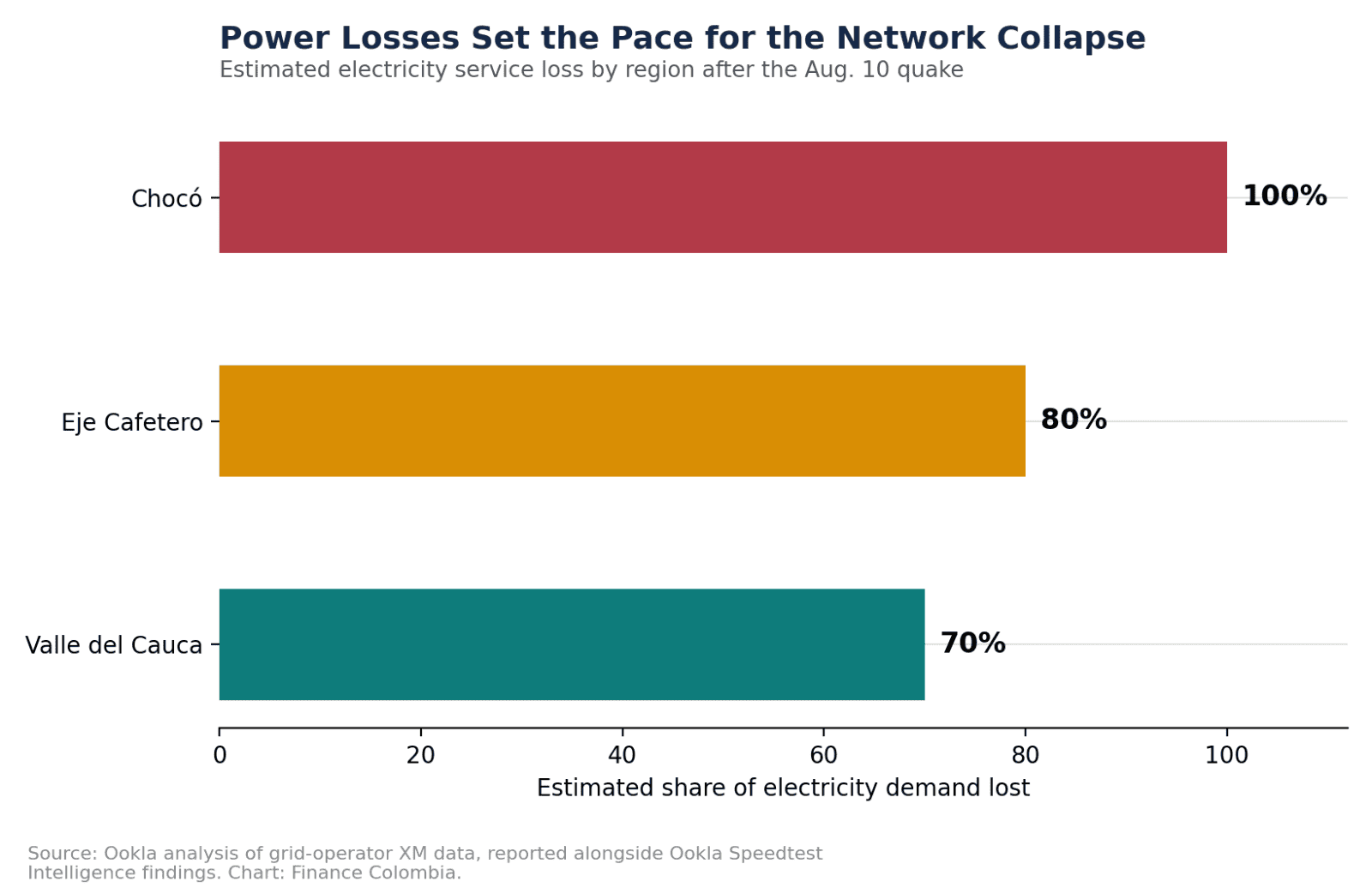
Chocó lost its entire electricity supply, while the Eje Cafetero and Valle del Cauca lost about 80% and 70% of demand. (Chart: Finance Colombia)
Redundancy mattered more than any single site surviving
Claro reported the largest share of downed sites among the four national networks in the hardest-hit areas, roughly one in five, yet held its peak share of users without service to 10%, the lowest of the three operators for which Ookla reported that figure. Movistar recorded the highest peak user unavailability, at 16%, while Tigo reached 13%. Sites that stayed on the air served a wider area than usual and carried signal roughly 3 decibels weaker on average as a result. Devices on the network then marketed as WOM connected to competitors’ networks at a rate that rose from 8% to 13% of its host-network traffic, and observations of Movistar devices roaming onto Tigo’s network more than quadrupled. Ookla did not report a peak user-unavailability figure for WOM itself.
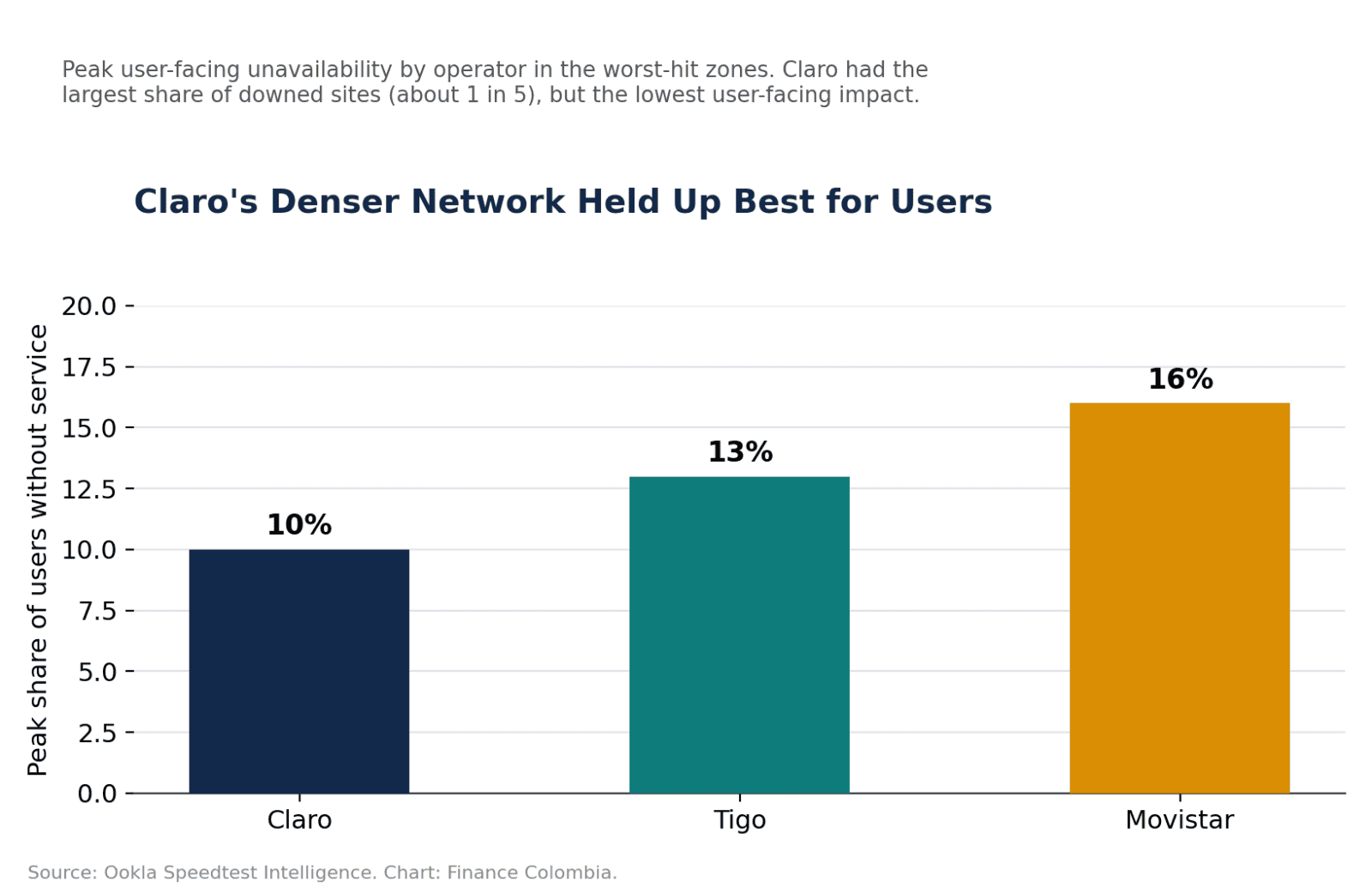
Claro held peak user unavailability to 10%, the lowest of the three operators Ookla measured, despite losing the most sites. (Chart: Finance Colombia)
The roaming shift also reflects a change in market structure that was already in place by the time of the earthquake: two of the four networks Ookla compared were, as of the earthquake, sister brands under a single owner. Millicom International Cellular (Nasdaq: TIGO) completed its purchase of Empresas Públicas de Medellín‘s 50% stake in Tigo-UNE in January for $571 million USD, then closed its purchase of a 67.5% controlling stake in Movistar’s Colombian unit, Colombia Telecomunicaciones, from Telefónica (BME: TEF) the following month for $214 million USD. Millicom completed a second purchase in April, buying the Colombian government’s remaining 32.5% stake in Colombia Telecomunicaciones for approximately $237 million USD to become its sole owner. Claro is operated by América Móvil (NYSE: AMX; BMV: AMX A). The operator Ookla and contemporaneous Colombian press referred to simply as WOM has since been ordered by Colombia’s Superintendencia de Industria y Comercio (Superintendency of Industry and Commerce, SIC) to stop using that brand amid a trademark dispute with its former Chilean licensor, WOM SpA, and now operates as Partners Telecom Colombia.
Demand surged onto a diminished network
Restoring a site to service did not mean restoring its performance. In the hardest-hit departments, latency under load rose from 633 milliseconds to 903 milliseconds and packet loss doubled even as the share of devices without service was falling, a sign that reconnecting users loaded a network that was still running on reduced capacity. In Valle del Cauca, median mobile download speed fell to 8.24 Mbps on the afternoon of the earthquake, compared with 28.99 Mbps on comparable Mondays. Speedtest activity itself fell by about a third on the first day, then more than doubled its normal level on the second day as more users regained enough connectivity to test their own service.
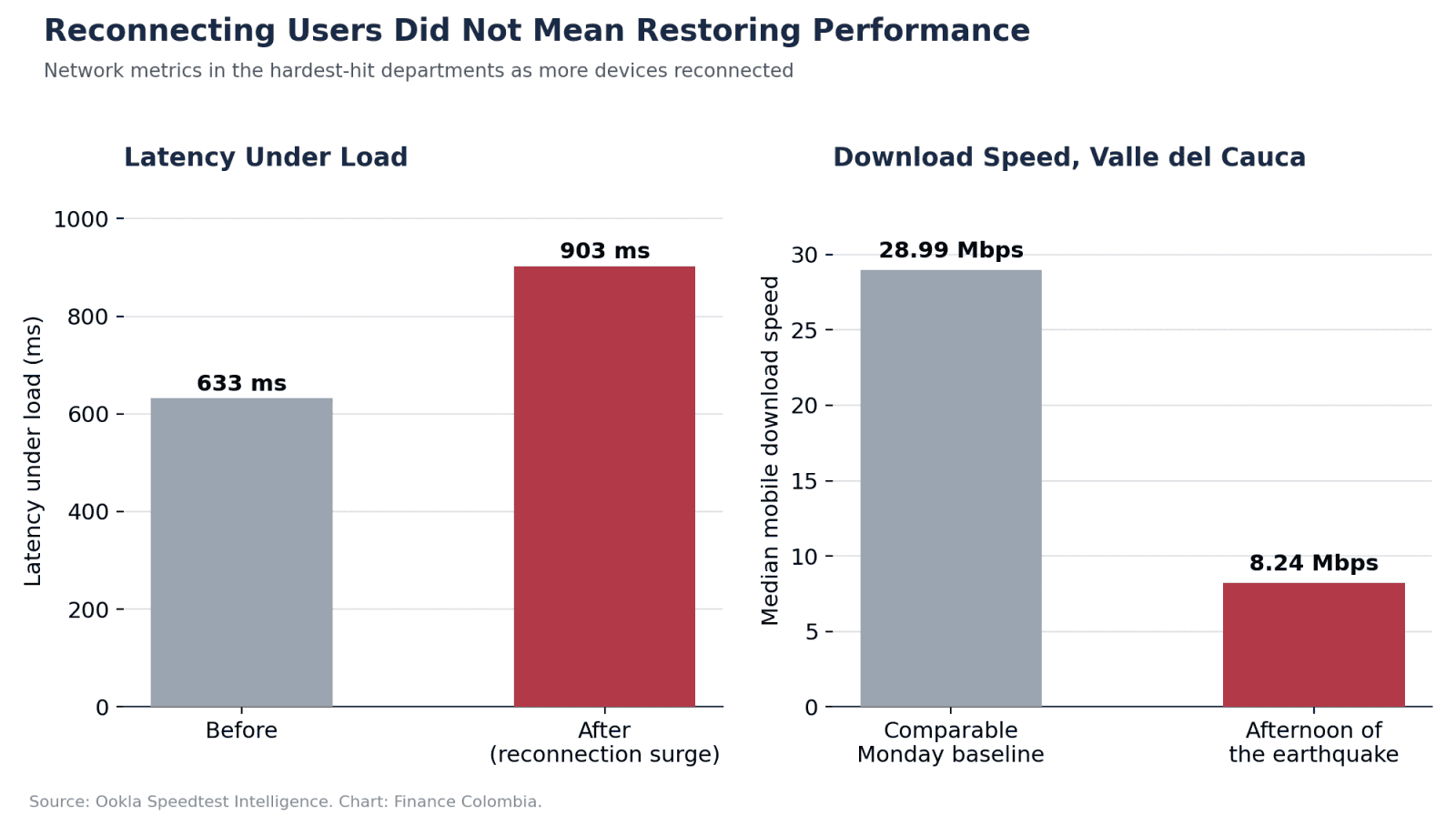
Latency and download speeds worsened in the hardest-hit departments even as more devices reconnected. (Chart: Finance Colombia)
Satellite was the fastest redundancy layer to arrive
In the most affected zones, legacy 2G and 3G connections’ share of cellular activity more than doubled as devices fell back to older networks, and the share of fixed-network speed tests carried over satellite nearly tripled on the day of the earthquake. Starlink offered free satellite internet service in five affected departments — Chocó, Caldas, Valle del Cauca, Risaralda and Quindío — within 30 hours of the earthquake. Ookla recorded roughly a 40% increase in Starlink utilization, with median download speed rising from 86.83 Mbps to 96.81 Mbps despite the additional demand.
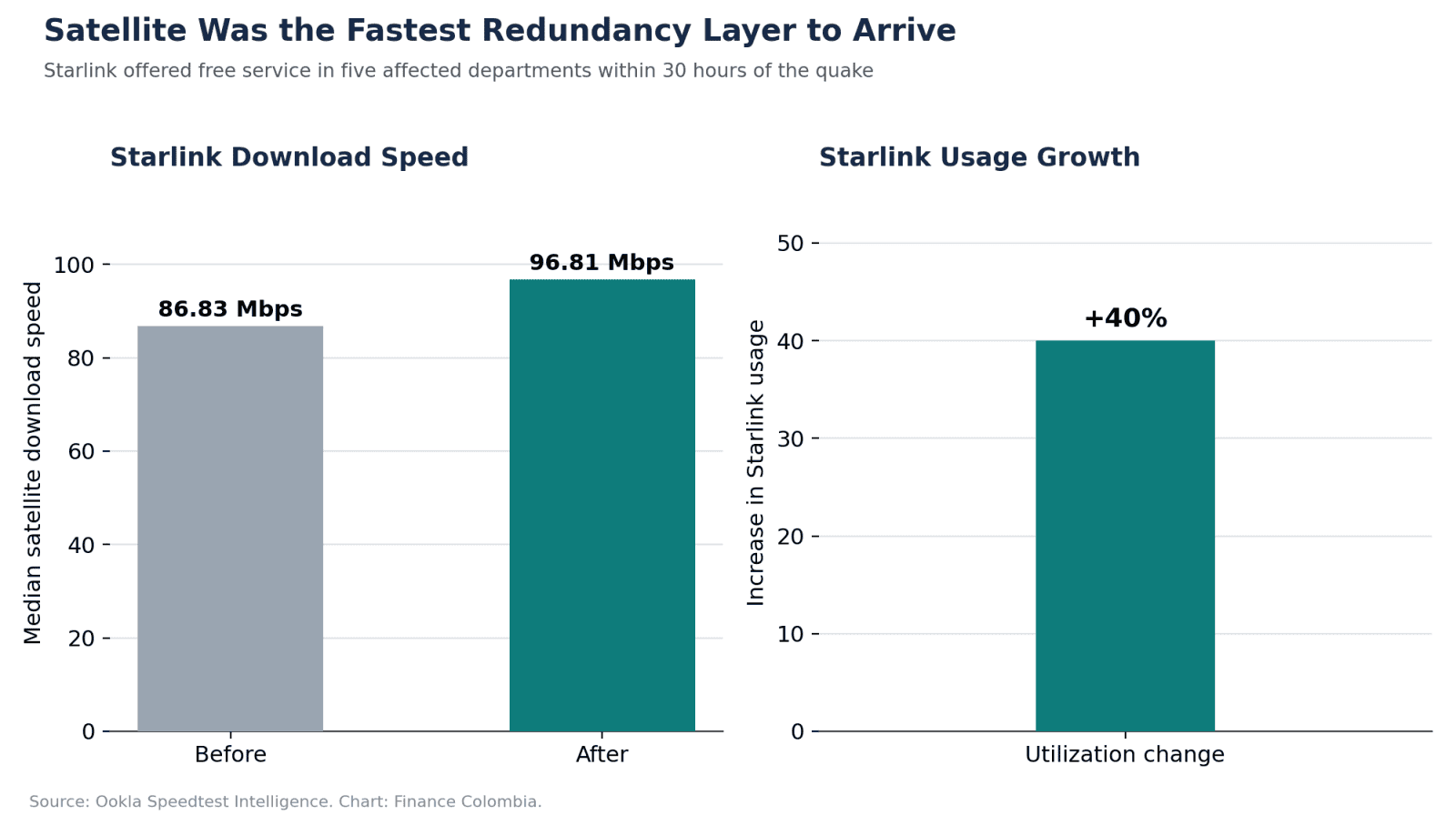
Starlink’s free service in five departments saw usage rise about 40% while median speeds also improved. (Chart: Finance Colombia)
Ookla noted that Colombia had no direct-to-cell satellite network available during the emergency; the only device-to-satellite signals it detected came from Entel’s service operating across the border in Peru. Chile, by contrast, has offered a commercial direct-to-cell service between Entel and Starlink since November 2025, letting compatible phones connect straight to satellites without a dedicated terminal when terrestrial coverage fails.
Bogotá’s response, and the gap Ookla says remains
Colombia’s Ministry of Information and Communications Technologies activated a Sectoral Contingency Plan within days of the earthquake, ordering telecommunications operators under Circular 0028 to keep networks available to emergency authorities at no cost, making calls to the 123 emergency line free even for users without an active balance, and granting the Comisión de Regulación de Comunicaciones (Communications Regulation Commission) temporary power to require operators to share surviving infrastructure. The ministry also said it was evaluating a temporary allocation of spectrum for direct-to-device satellite connectivity. “Connectivity can save lives in the places affected by the emergency,” the ministry said in announcing the measures, as reported by Semana.
Ookla’s own conclusion points at a gap that policy has not yet closed: Colombia currently has no minimum backup-power requirement for network sites, a category of rule that resilience research, including work by the Organisation for Economic Co-operation and Development, identifies as central to keeping networks alive through an extended electrical failure. Chile offers a comparison of what such a rule looks like once regulators write it down. After a nationwide blackout in February 2025 exposed the same vulnerability, Chile’s telecommunications regulator, the Subsecretaría de Telecomunicaciones (Undersecretariat of Telecommunications, Subtel), published a decree in January 2026 raising the mandatory battery-backup requirement for critical cell sites from four hours to six. Chile had already learned a version of this lesson once before: after the country’s 2010 Maule earthquake, researchers found that only about 2% of the base stations that eventually failed had been damaged directly by the shaking, while most failed later, as backup batteries ran out. Claro and Tigo reported having restored more than 90% of their earthquake-damaged infrastructure in Chocó, Valle del Cauca and the Eje Cafetero by August 14, but Ookla’s data suggest the next earthquake will pose the same question this one did: how long the batteries last after the lights go out.
Ookla and Downdetector have been under joint ownership since June, when technology and consulting firm Accenture (NYSE: ACN) completed a $1.2 billion USD acquisition of the connectivity division of Ziff Davis (Nasdaq: ZD), which had previously owned both platforms.