

















Morena is small next to Aguilar, but Outcrop expects it to add ounces
Outcrop Silver & Gold Corporation (TSX: OCG, OTCQX: OCGSF, FSE: MRG) said on August 5, 2026, that six of 14 newly reported holes at the Morena vein returned mineralized intercepts, and that the target should contribute contained ounces to a mineral resource estimate it expects to announce in September 2026. The best of the six holes, DH613, cut 0.71 meters grading 1,646 grams per ton (g/t) silver and 10.35 g/t gold at the company’s Santa Ana project in Colombia’s Tolima department.
Measured as estimated true width rather than downhole length, the DH613 interval narrows to 0.34 meters. Inside it, 0.41 meters — 0.20 meters true width — graded 2,839 g/t silver and 17.72 g/t gold. A second hole, DH601, was wider and lower grade: 1.74 meters, or 1.42 meters true width, at 488 g/t silver and 1.79 g/t gold, including two 0.30-meter subintervals running 974 g/t and 1,464 g/t silver.
Outcrop Silver reports those numbers as silver-equivalent grades of 2,559 g/t for DH613 and 646 g/t for DH601. The conversion assumes $2,760 USD per ounce for gold and $32 USD per ounce for silver, plus metallurgical recoveries of 98.5% for gold and 96.3% for silver from test work the company reported in June 2024.
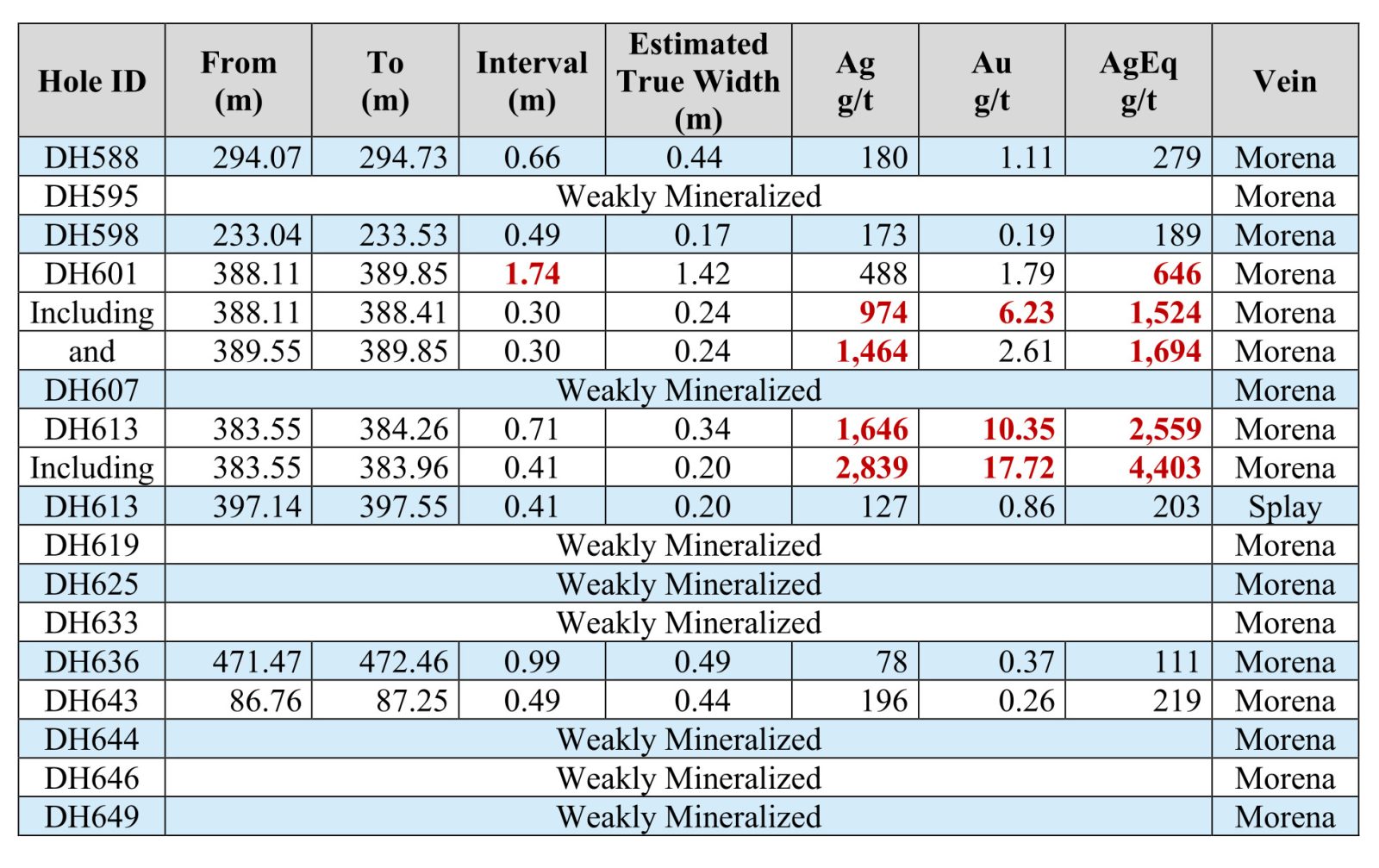
Assay results from the 14 holes reported at Morena, including DH613 and DH601. (Table courtesy Outcrop Silver & Gold)
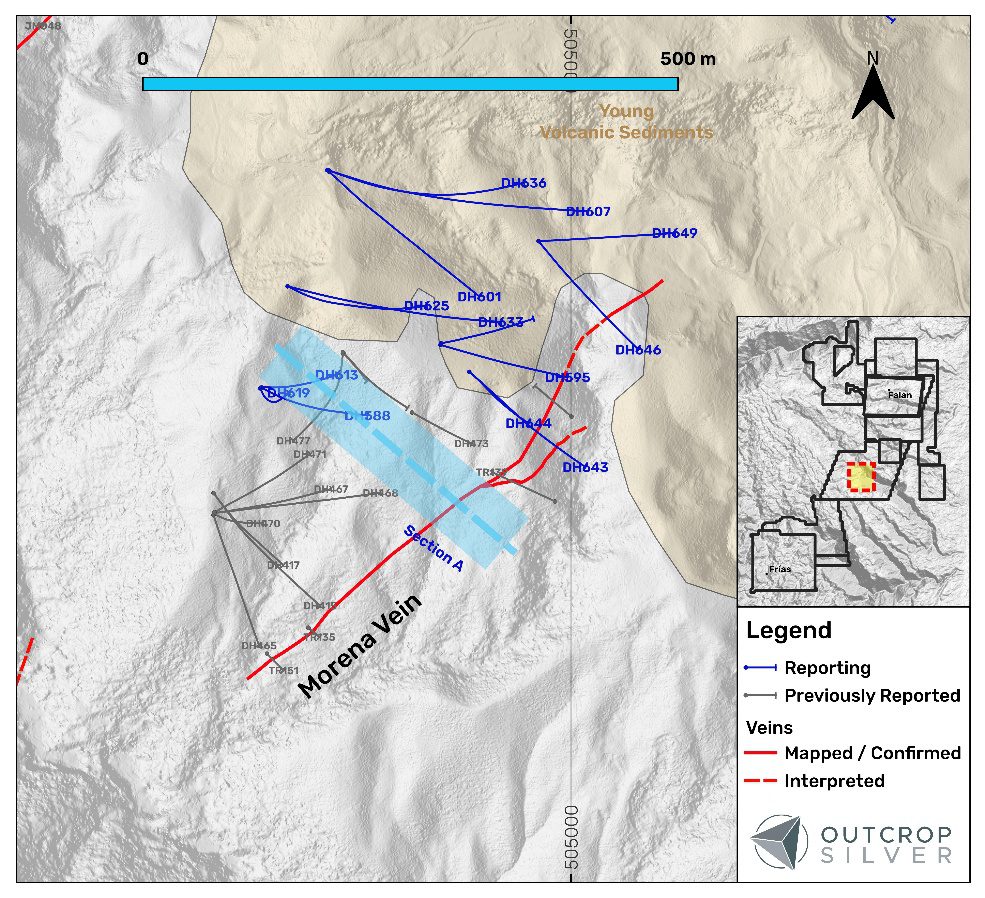
Plan view of the Morena target showing the drill holes reported in the August 2026 release. (Figure courtesy Outcrop Silver & Gold)
The same release covered 12 holes in the northern sector of the Aguilar target, where nine hit mineralization. Hole DH631 cut 0.30 meters (0.19 meters true width) at 1,554 g/t silver and 5.44 g/t gold within the Aguilar N structure. DH628 returned 2.21 meters (1.04 meters true width) at 103 g/t silver and 1.42 g/t gold in the principal Aguilar vein, including 0.30 meters (0.14 meters true width) at 440 g/t silver and 6.73 g/t gold. The Aguilar NEE and Aguilar NEW structures, which the company first disclosed on June 3, 2026, returned mostly weakly mineralized results in this round.
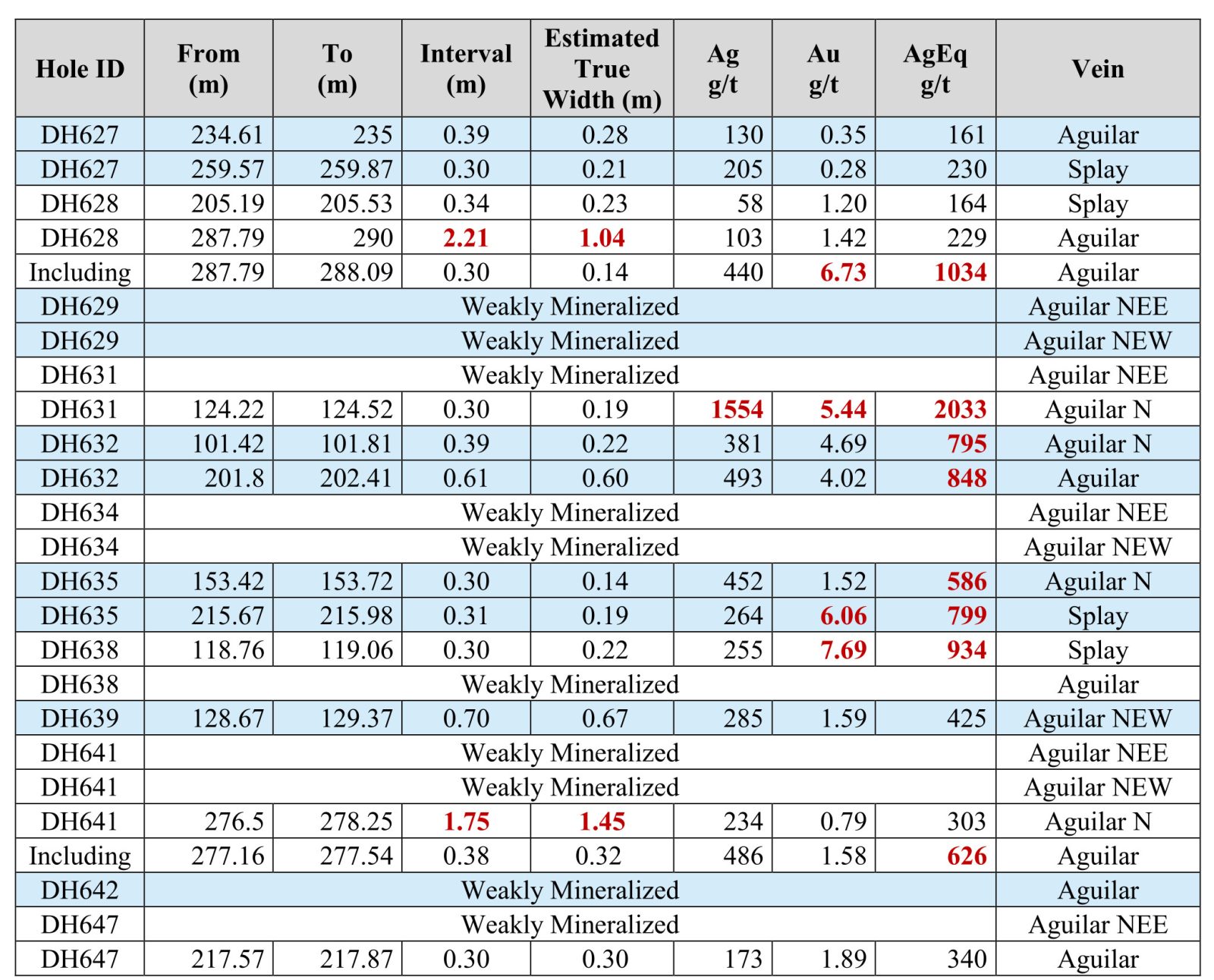
Assay results from the 12 holes reported in Aguilar’s northern sector, including DH631 and DH628. (Table courtesy Outcrop Silver & Gold)
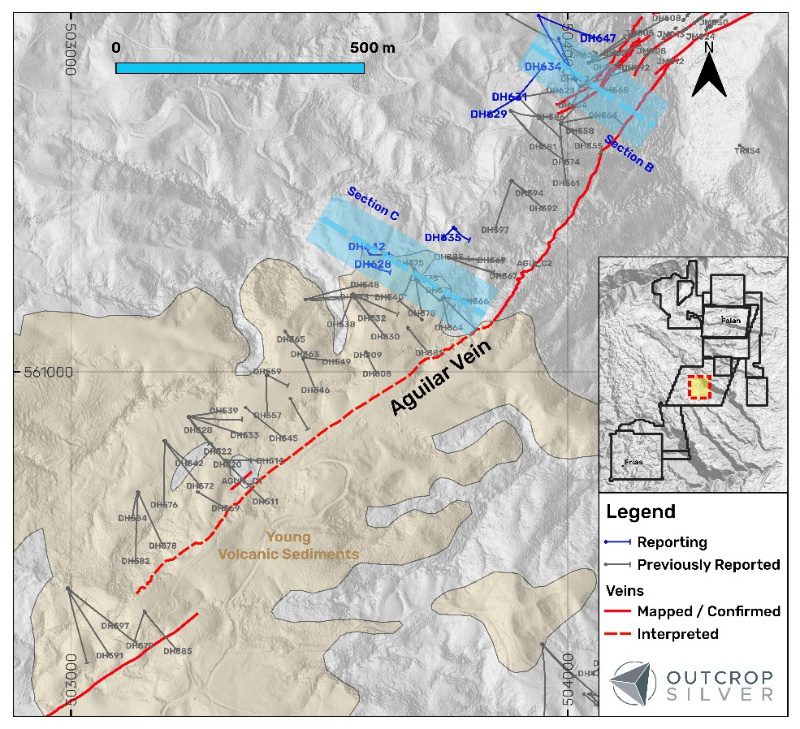
Plan view of the Aguilar target showing the drill holes reported in the August 2026 release. (Figure courtesy Outcrop Silver & Gold)
The other eight holes in the batch fell below Outcrop Silver’s 100 g/t silver-equivalent mineralization threshold. The company said they still intersected the vein structure and confirm its continuity, a pattern it calls consistent with the discontinuous, shoot-controlled mineralization seen elsewhere in the district rather than evidence that mineralization is absent.
Carlos Torres, vice president of exploration, measured the target against Aguilar, which the company says it has traced approximately 1.6 kilometers along strike. “Morena remains a smaller structure relative to the 1.6 km long Aguilar structure, but the results obtained over the past year, including these latest high-grade intercepts, support its inclusion as an additional contributor to our upcoming mineral resource estimate,” he said.
Morena emerged from a regional program focused on the La Ye target, where late-2024 soil sampling and trenching flagged a structural corridor, and the trenching then confirmed the vein at surface. Outcrop Silver announced the discovery on July 22, 2025, after 2,905 meters of drilling confirmed a continuous mineralized footprint of approximately 400 meters along strike and nearly 300 meters down dip. The company interprets the vein as lying southeast of, and parallel to, the Aguilar-Jiménez-Guadual trend. Finance Colombia has previously reported results at the Jiménez vein and Los Mangos.
The company puts Santa Ana at more than 27,697 hectares in northern Tolima, 6,475 of them titled, about 15 kilometers southeast of the town of Mariquita and 190 kilometers from Bogotá, with core logging facilities at Falan. Much of that ground falls inside the Mariquita District, where it dates the earliest mining records to 1585. Outcrop Silver also credits the colonial-era Frías mine, which lies 12 kilometers south of the Royal Santa Ana Mines, with 7.8 million ounces of silver recovered at a grade of 1.3 kilograms per ton, and treats it as an analogue. It has drilled more than 330 diamond drill holes across roughly 17% of its titled surface.
Rob Bruggeman became chief executive officer on April 20, 2026, succeeding Ian Harris, who moved to chair the board. When Outcrop Silver appointed Torres on May 19, 2026, it said it was extending the resource timeline into the third quarter to let new management review and finalize the modeling, and that the updated estimate would form the basis of a potential preliminary economic assessment.
The baseline it will replace is the maiden estimate prepared by AMC Mining Consultants in a technical report titled “Santa Ana Property Mineral Resource Estimate,” dated June 8, 2023, which set out an indicated resource of 1,226,000 tons at 614 g/t silver equivalent, containing 24.2 million silver-equivalent ounces, and an inferred resource of 966,000 tons at 435 g/t, containing 13.5 million silver-equivalent ounces. Outcrop Silver says the current campaign has confirmed mineralization in six vein systems: Aguilar, Jiménez, La Ye, Los Mangos, Guadual and Morena.
Samples were prepared and assayed at the Actlabs facility in Medellín, with multi-element analysis at the laboratory’s Ancaster, Ontario, site. Gold and silver were determined by 30-gram fire assay with a gravimetric finish for over-limits. Outcrop Silver said it inserted about three control samples for every 20 and found no material quality-control issues. Torres, a registered professional geoscientist, is the qualified person for the disclosure under National Instrument 43-101.
A worker inspects drill core with a handheld instrument at Outcrop Silver’s Santa Ana project in Tolima, Colombia. (Photo: Outcrop Silver & Gold)
More than 200,000 pounds move through a Florida relief organization
Goya Foods announced on August 13, 2026, that it has donated more than 200,000 pounds of food to communities in western Colombia struck by the magnitude 7.4 earthquake of August 10, routing the shipment through Global Empowerment Mission, the Doral, Florida-based disaster relief organization running distributions in the affected departments.
The donation totals five truckloads of Goya products and is being made through Goya Gives, the company’s philanthropic program. Global Empowerment Mission, known as GEM, is handling logistics and last-mile distribution. The announcement did not disclose a dollar value for the shipment, a staging point, or the specific municipalities that will receive it.
The earthquake hit at 7:34 a.m. on Monday, August 10, 2026, about three miles south of San José del Palmar, in the department of Chocó, at a depth of 68 miles, according to the United States Geological Survey. The magnitude 7.4 quake was the strongest to hit the country in a decade, said Julio Fierro Morales, director general of the Servicio Geológico Colombiano (Colombian Geological Survey), according to CNN en Español.
The Unidad Nacional para la Gestión del Riesgo de Desastres (National Unit for Disaster Risk Management, or UNGRD) reported that as of 6:30 a.m. on Friday, August 14, the earthquake had killed 285 people, injured 3,975 and left 379 missing, as reported by El Colombiano. The agency counted 12,828 homes destroyed and 73,455 damaged, with 45,523 families — 102,263 people — affected across 15 departments and 426 municipalities. UNGRD had reported 140 collapsed buildings as of August 13. Cali, Pereira, Quibdó, Manizales and Armenia remain under red alert.
In Cali, in Valle del Cauca, the city government reported 104 deaths, 1,401 injuries and 115 people still missing as of 6 p.m. on August 13, along with 45 buildings fully collapsed, 46 partially collapsed and 1,142 structurally damaged, according to El País. Rescuers had pulled 88 people alive from the rubble in the city, and 8,236 tons of debris had been removed.
GEM began daily distributions across the affected departments on August 12, working with the Bogotá-based foundation Solidaridad por Colombia and the volunteer motorcycle group Motorrad Angels. The organization has divided its response into an immediate relief phase covering food, water, hygiene supplies, tents and bedding, and a later early-recovery phase. GEM previously operated in Colombia during the January 2024 wildfires, and its Latin America headquarters is in La Guaira, Venezuela.
“This donation gives GEM the ability to rapidly move essential resources directly into the hands of families impacted by the earthquakes in Colombia,” said Michael Capponi, founder and president of Global Empowerment Mission. “Our model is built around speed, efficiency and strong partnerships, ensuring aid arrives quickly and reaches the communities where it has the greatest impact.”
Peter Unanue of Goya Foods framed the donation in terms of the company’s 90-year history. “For 90 years, Goya has stood with communities in times of need,” he said. “We hope this donation provides nourishment and comfort to families as they recover and rebuild.”
The Colombia shipment follows a similar operation six weeks earlier. On June 29, 2026, Goya announced a donation of 100,000 pounds of food for Venezuela after back-to-back earthquakes of magnitude 7.2 and 7.5 struck west of Caracas on June 24. That shipment also moved through GEM, distributed out of Goya’s warehouse in Miami.
Sovereign and corporate contributions have followed in Colombia. President Abelardo de la Espriella said on August 13 that the United Arab Emirates was donating $10 million USD for relief. The South American Football Confederation and the Colombian Football Federation announced a combined $1 million USD for reconstruction. The United States Department of State deployed two urban search-and-rescue teams to assist Colombian first responders on August 12, the agency said. Vice President José Manuel Restrepo has said multilateral institutions presented cooperation proposals totaling $1.3 billion USD.
De la Espriella has declared a state of economic, social and ecological emergency to speed reconstruction. The government declared a national disaster on the day of the quake, and the Superintendencia Financiera de Colombia (Financial Superintendency of Colombia) has since put draft relief rules for affected borrowers and insurance claimants out for public comment.
Goya Foods is a privately held, family-owned company founded in 1936 and headquartered in Jersey City, New Jersey. It describes itself as the largest Hispanic-owned food company in the United States. Its Goya Gives program works with food banks, churches, shelters, schools and cultural institutions, and has directed food shipments to disasters in the US and abroad.
Goya products at a company warehouse. (Photo courtesy Goya Foods)
Non-dilutive option sharpens Quimbaya’s focus on Segovia drilling
Quimbaya Gold Inc. (CSE: QIM) (OTCQX: QIMGF) (FSE: K05) has granted 37 Capital Inc. (CSE: JJJ) an exclusive 12-month option to acquire its non-core Berrío gold project in Antioquia, Colombia, for total consideration of up to $3.75 million USD in cash and shares if the option is exercised. The agreement, dated August 18, 2026, is structured so that Quimbaya issues no new shares of its own, receiving cash payments plus an approximately 19.9% equity stake in 37 Capital instead. The company said the option lets it concentrate capital and technical staff on its flagship Tahami Project in the Segovia Gold District, where a drill program is already underway.
Under the option, 37 Capital may exercise at any point over the next 12 months and can acquire the property either by taking a direct transfer of the mining concession and related applications or by buying 100% of Golden Pacifico Exploration S.A.S., the Colombian subsidiary that holds the asset. The $3.75 million USD purchase price is split between a $100,000 USD non-refundable deposit and a further $150,000 USD non-refundable deposit due within six months if the deal has not closed by then — both payments contingent on Quimbaya first arranging the minimum private-placement subscription described below — and, if the option is exercised, 7,600,000 common shares of 37 Capital valued at $760,000 CAD (about $542,857 USD) plus the balance of the price in cash. Completion is subject to exercise of the option and to acceptance by the Canadian Securities Exchange.
The Berrío project, in Puerto Berrío, Antioquia, sits in the Minas del Vapor gold district of the Segovia Gold Belt, roughly 110 kilometers east-northeast of Medellín. It covers about 8,746 hectares in total: a granted concession, contract No. 6822, of 1,218.88 hectares, plus roughly 7,529 hectares under five additional applications filed with Colombia’s Agencia Nacional de Minería (National Mining Agency). At least five small-scale mines already operate immediately south of the property, according to 37 Capital’s own disclosure on the transaction, which also discloses that the ground carries a 2% net smelter returns royalty held by AngloGold Ashanti (NYSE: AU) (JSE: ANG).
37 Capital is funding the acquisition through a concurrent non-brokered private placement of up to 5,000,000 units at $0.10 CAD each, for gross proceeds of up to $500,000 CAD; each unit carries one share and one warrant, with two warrants convertible into one additional share at $0.15 CAD for three years. Quimbaya has agreed to use its best efforts to help arrange at least 3,000,000 of those units, a $300,000 CAD minimum subscription; if that minimum is not raised, 37 Capital will not proceed and the option agreement terminates. A finder’s fee of 1,000,000 37 Capital shares is payable to an arm’s-length party in connection with the transaction.
“This transaction is disciplined capital allocation, we are converting a non-core asset into cash and a retained approximately 19.9% interest, partnering with 37 Capital to put our portfolio to work, without issuing a single Quimbaya share, and putting our full focus on the ground we believe in,” said Alexandre P. Boivin, President and CEO of Quimbaya Gold. “That ground is our Tahami Project in Segovia: a copper-molybdenum-gold porphyry system at Tahami Center, and high-grade gold and silver veins at Tahami South, immediately adjacent to Aris Mining’s producing Segovia operations. Quimbaya is a meaningful mining-rights holder in one of Colombia’s most prolific and actively producing gold districts, and a non-dilutive approach lets us advance it on our own terms. Our next chapter is the first drill results from Tahami Center, which we expect in the third quarter of 2026.”
Tahami lies immediately adjacent to Aris Mining Corporation’s (TSX: ARIS) (NYSE: ARIS) producing Segovia Operations, a wholly owned underground mine and one of the highest-grade gold mines in the world, with a reserve grade of about 10.7 grams per ton. Segovia produced 227,762 ounces of gold in 2025, and Aris Mining has said output should rise to between 265,000 and 300,000 ounces annually following the recent installation of a second processing mill that lifted capacity 50%, to 3,000 tons per day, as Finance Colombia previously reported. Antioquia is Colombia’s top gold-producing department, according to the national Unidad de Planeación Minero Energética (Mining and Energy Planning Unit, or UPME).
If the Berrío option is exercised, Quimbaya said net proceeds would go toward continued exploration at Tahami and general working capital. Ricardo Sierra, Quimbaya’s VP Exploration, is the qualified person under National Instrument 43-101 for the technical disclosure in the transaction.
Coffee Region regains air links over two weeks after deadly quake
LATAM Airlines Colombia and Avianca are both resuming flights to Pereira’s Aeropuerto Internacional Matecaña (Matecaña International Airport) on Wednesday, August 26, 2026, after the Aeronáutica Civil (Civil Aviation Authority), commonly known as Aerocivil, certified the terminal’s reopening following the magnitude-7.4 earthquake that struck western Colombia on August 10. Both carriers said service will restart below pre-earthquake levels and expand gradually as repairs to the terminal continue, just over two weeks after the quake forced the airport shut.
The earthquake, centered near San José del Palmar in the department of Chocó, had killed 329 people and left 234 missing as of August 24, according to Unidad Nacional para la Gestión del Riesgo de Desastres (National Disaster Risk Management Unit, UNGRD) figures reported that day by El Tiempo. According to El Espectador, three people died at Matecaña itself when the quake struck, and cracked ceiling panels in the terminal’s waiting areas forced the suspension of commercial operations; the runway and control tower were undamaged, which let the airport keep functioning as a staging point for humanitarian aid and rescue personnel even while commercial flights were suspended. Aerocivil has authorized 20 daily flights for the restart, and with the terminal’s second and third floors still closed, passengers will use two of the airport’s normal six waiting lounges, airport manager Luis Fernando Collazos told Caracol Radio, per El Espectador.
LATAM Airlines Colombia said it will operate two daily flights from Bogotá and one from Medellín to Pereira, for 21 weekly frequencies, with a return to its pre-earthquake schedule of five daily flights tied to the airport’s full recovery. The carrier is also adding two daily flights to Armenia, for three total, while Pereira’s capacity stays limited. LATAM has capped fares at $228,000 COP per segment to Pereira and $234,000 COP to Armenia, plus taxes and fees, and is offering fee-free date, route or cancellation changes, with no fare difference, to passengers with flights booked between August 10 and 31 to or from Pereira, Cali and Armenia; those passengers can rebook trips up to a year out. “With the reopening of Matecaña Airport, we are not only restoring Pereira’s connectivity to our network, but also regaining the ability to put our operation at the service of the region,” said Erika Zarante, chief executive of LATAM Airlines Colombia since January 2025 and a 23-year veteran of the aviation sector. LATAM said it is using the resumed route, along with its Avión Solidario (Solidarity Plane) cargo program, to help move aid and supplies into the Eje Cafetero (Coffee Region).
Avianca is restarting Bogotá service the same day as LATAM, August 26, with Medellín service following on August 27; its initial schedule totals four daily flights, three from Bogotá and one from Medellín. The airline said it plans to expand to 10 daily flights, eight from Bogotá and two from Medellín, as the airport’s infrastructure recovers. Avianca’s rebooking flexibility covers passengers with flights booked between August 10 and 30 to or from Pereira, Armenia, Cali and Quibdó, which the airline named as the four cities affected by the earthquake. “The safety of our passengers and staff is the condition that guides every step of this reactivation, and that is why we are resuming service gradually and in full coordination with the aeronautical authority,” said Ángela María Orozco, Avianca’s senior vice president of corporate affairs and a former Colombian minister of transport. She said the airline would keep expanding capacity toward Pereira “to keep connecting the Coffee Region with the rest of the country and contribute to the recovery of mobility, tourism and economic activity” there.
Avianca is privately held under Abra Group, the Bogotá-based holding company that also owns Brazil’s Gol Linhas Aéreas and holds a stake in Chile’s Sky Airline; Abra has said it intends to list shares in the United States in 2026 but had not done so as of this writing. LATAM Airlines Colombia is a unit of Santiago-based LATAM Airlines Group S.A. (NYSE: LTM; Bolsa de Santiago: LTM), which also operates in Chile, Peru, Brazil, Argentina and Ecuador.
Pereira was not the only city affected: Avianca’s flexibility measures also cover Armenia, Cali and Quibdó, which it listed among the areas hit by the earthquake, and LATAM’s flexibility measures cover Pereira, Cali and Armenia. Matecaña — Risaralda’s main gateway and a hub for the wider Coffee Region — was among the hardest-hit facilities, with its commercial terminal closed for more than two weeks. Both airlines are urging affected passengers to check flight status through their apps or websites, Avianca’s mobile app and LATAM’s Mis Viajes tool, before heading to the airport.
ICT and Justice ministries push Claro, Tigo, WOM on jail phones
Colombia’s Information and Communications Technology Minister, Alexandra Falla Zerrate, and Justice and Law Minister Iván Cancino González met in Bogotá on Monday, August 24, 2026, with representatives from Claro, the Colombian unit of Mexico’s América Móvil (NYSE: AMX), Tigo, the local brand of Luxembourg-based Millicom International Cellular (NASDAQ: TIGO), WOM and other mobile carriers to define measures for blocking unauthorized cell phone communications from the country’s prisons. The meeting is the government’s latest attempt to stop inmates from using contraband phones to order extortion and coordinate other crimes from behind bars.
The talks were convened by the Ministerio de Tecnologías de la Información y las Comunicaciones (Ministry of Information and Communications Technology, or MinTIC) and the Ministerio de Justicia y del Derecho (Ministry of Justice and Law, or MinJusticia) to review measures already in place to restrict illegal signals inside penitentiary facilities and to identify the technical, legal and operational obstacles that remain unresolved.
“Our purpose is clear: authority to shut the door on crime, technology in the service of security, and results that protect the peace of mind of Colombians,” Cancino told La FM after the meeting. He said the working group reviewed what has already been done, the current state of measures restricting unauthorized communications in penitentiary facilities, and the technical and operational challenges still to be resolved.
Representatives of the mobile carriers raised concerns and proposals about the measures under study and said they were willing to work with authorities, according to MinTIC. The ministries have not detailed what a new blocking mechanism would look like; officials said specifics would be announced in the coming days once technical evaluations with the carriers are complete.
The problem long predates Monday’s meeting. In January 2026, Instituto Nacional Penitenciario y Carcelario (National Penitentiary and Prison Institute, or INPEC) director Col. Daniel Gutiérrez told Noticias RCN, in comments reported by Infobae, that none of the 16 nationally run prisons equipped with signal jammers were effectively blocking illegal signals: six were nominally active but not generating a working block because they ran on 12- to 15-year-old GSM-era technology unable to keep pace with 4G and 5G networks, and the other 10 were entirely out of service. Gutiérrez also said a signal-blocking trial at the maximum-security wing in Cómbita, Boyacá, left the state facing more than $50 billion COP in fines after the jamming disrupted legitimate cell service for nearby residents — a preview of the balance regulators must strike between blocking prison communications and protecting service for law-abiding Colombians nearby.
The stakes were underscored in July 2026, when Colombia’s Fiscalía General de la Nación (Attorney General’s Office, or Fiscalía) charged 17 people, including five INPEC guards, with extortion tied to a scheme run from the El Barne maximum-security prison in Cómbita, according to Vanguardia, citing Agencia EFE. Prosecutors said the guards allowed cell phones and other contraband into the prison so inmates could call victims across several departments and demand payment on behalf of armed criminal structures. Finance Colombia has previously reported on the pattern: a scheme run by the Satanás gang, whose imprisoned leader and members kept extorting Bogotá residents with smuggled phones even after signal jammers were installed, since many of the devices had been pulled from service due to obsolescence or court orders won by nearby residents whose own legitimate calls the jammers had blocked.
The National Police and National Army are also taking part in the effort, MinTIC said, working alongside the ministries and carriers to prevent criminal structures from continuing to direct operations from inside penitentiary facilities. The working group left commitments to keep advancing solutions that strengthen communications control in and around Colombia’s prisons, though the government has yet to say when any new blocking mechanism will take effect.
Headline photo: Ministers Alexandra Falla Zerrate and Iván Cancino González meet with mobile carrier representatives at MinTIC headquarters in Bogotá. (Photo courtesy MinTIC)
Company also targets new Trap East greenfield discovery underground
Collective Mining Ltd. (Collective Mining) (NASDAQ: CNL) (TSX: CNL) has finished the access road to the portal site for its planned exploration adit at the Guayabales Project in the department of Caldas, Colombia, and is moving directly into portal-platform and box-cut construction, the company said August 18, 2026. With permits already secured, Collective Mining said the adit remains on schedule to begin construction in the fourth quarter of 2026, with underground drilling set to start in the first quarter of 2027 at Trap East, a newly identified extension of the company’s Trap system.
The update follows a progress report Collective Mining issued June 17, 2026, when it said engineering, permitting and site preparation for the adit were advancing and named former Ecopetrol projects executive Josué Romanos as vice president of projects (Finance Colombia reported on that update). The company first disclosed plans for the exploration adit on March 11, 2026. The August update also comes about a week after Collective Mining completed the transfer of its US listing from the NYSE American to the Nasdaq Global Select Market, a move it announced in late July and completed August 11 under the unchanged CNL symbol; its Toronto Stock Exchange listing was not affected.
The completed roadway is a 1.8-kilometer switch-back route built by upgrading an existing path connecting the Pan American Highway to the portal site, the company said, clearing the way for box-cut and portal-platform work to begin immediately.
Under Collective Mining’s current timeline, drilling of the Trap East target is scheduled for the first quarter of 2027. Drilling of the Trap Main System is expected to follow in the second half of 2027, once the adit has advanced enough to allow construction of a cross-cut, with drilling of the Plutus target and the Ramp Zone to follow in 2028. The company said the portal location and access-road alignment sit within the area anticipated for future project infrastructure, close to both the Pan American Highway and existing power lines.
“We are excited to begin drilling the Trap System from underground, as we will be able to rapidly test the system from suitable drilling angles while testing for extensions to the mineralization,” said Ari Sussman, Executive Chairman of Collective Mining. “Following a recent detailed review with our geological team, I am confident that Trap has all the potential to develop into a second large-scale precious-metal system at Guayabales.” Sussman said the Trap system’s proximity to both the adit portal and the company’s proposed future mining infrastructure is a key advantage: “Should our underground drilling confirm the system as we expect, Trap would provide a second independent working front alongside Apollo, enhancing mill feed flexibility in a future mining scenario.” He added that he is not ruling out the possibility of discovering yet another mineralized system as the adit advances toward Apollo, given the amount of mineralization already found across Guayabales through limited surface drilling to date.
Ned Jalil, Chief Executive Officer, said the company remains on track to meet its milestones. “Once established, the adit will fundamentally expand the way we can explore Guayabales,” Jalil said. “Underground access will enable us to drill-test Apollo’s Ramp Zone, the Trap System and the Plutus Target over more than a vertical kilometer from optimal orientations that are not available from surface.”
Collective Mining said it is prioritizing local employment and procurement for the early-works program, with much of the current workforce recruited from communities in Caldas. The company said the work is being carried out under its own health and safety standards as well as Colombia’s applicable regulatory requirements.
Mineralization at Trap outcrops at surface and has been drill-tested along a 1.4-kilometer northwest-southeast corridor, extending as much as 900 meters below surface and remaining open along strike and at depth; the planned adit is positioned to intersect the currently known southeastern end of that corridor. According to Collective Mining’s own project disclosures, Trap sits about 3.5 kilometers northeast of the Apollo system; the company first announced a discovery there through grassroots drilling in September 2022. The company currently has one rig testing for mineralization up to 200 meters further northwest than any prior drilling, with initial results expected in late September.
Previously reported drilling at Trap has returned both broad, continuous mineralized intervals and narrower high-grade vein zones, including:
- 632.25 meters at 1.10 g/t AuEq from 172.65 meters, including 51.50 meters at 2.73 g/t AuEq and 46.35 meters at 2.41 g/t AuEq (TRC-7A)
- 646.00 meters at 0.81 g/t AuEq from 19.50 meters, including 301.50 meters at 1.01 g/t AuEq (TRC-2)
- 174.45 meters at 1.19 g/t AuEq from 485.15 meters, including 40.85 meters at 3.76 g/t AuEq (TRC-11)
- 30.00 meters at 4.96 g/t AuEq from 11.85 meters (TRC-14)
- 200.85 meters at 1.06 g/t AuEq from 4.55 meters, including 40.50 meters at 4.01 g/t AuEq (TRC-30)
- 2.80 meters at 234.15 g/t gold from 122.00 meters, including 0.80 meters at 816 g/t gold (TRC-26)
- 1.30 meters at 49.30 g/t gold from 18.15 meters (TRC-25)
AuEq figures are presented as originally reported by the company in its respective press releases.
Collective Mining was founded by the team that developed and sold Continental Gold Inc. to Zijin Mining in an all-cash transaction that closed in March 2020, for approximately $1.4 billion CAD in enterprise value, according to Collective Mining. The company explores for gold, silver, copper and tungsten at two projects in Caldas, both located within an established mining district alongside 10 fully permitted and operating mines, and trades on the Nasdaq Global Select Market and the Toronto Stock Exchange under the symbol “CNL.” Management, insiders, a strategic investor, and close family and friends own 45.2% of its outstanding shares.
David J. Reading, an independent consultant, is the qualified person for this release under National Instrument 43-101 and has reviewed and verified the technical information it contains. Reading holds an MSc in economic geology and is a fellow of the Institute of Materials, Minerals and Mining and of the Society of Economic Geology.
Colombia’s Prosecutors Now Suspect the Plot Was Staged
A recording made inside the offices of Colombia’s national intelligence agency in July 2025 has become the center of a dispute over whether the government of then-President Gustavo Petro was negotiating with organized crime for its own protection, or whether two jailed drug traffickers manufactured a fake conspiracy to win their freedom. Semana published fragments of the recording on August 15, 2026, and Colombia’s Fiscalía General de la Nación (Attorney General’s Office) is now investigating whether the underlying plot was real or staged.
According to Semana, Jorge Lemus, then director of the Dirección Nacional de Inteligencia (DNI, National Intelligence Directorate), met on July 18, 2025, with a retired police officer identified as Manuel Antonio Castañeda, who told him, “I’m the one they call the Narcochofer” — the narco-chauffeur. Semana describes Castañeda as having mafia connections and a history as a recurring source for Colombia’s intelligence units. Also in the room were Gustavo Arias, then the DNI’s counterintelligence director, and an analyst taking notes. It was, Semana reports, the first time Lemus had spoken with Castañeda directly.
Castañeda came to sell access to two men: alias Falcon and alias Fortuna, both Clan del Golfo bosses held in a US prison. Falcon is Juan José Valencia, arrested in May 2021 in a mansion in Llanogrande, in Rionegro, Antioquia. Investigators at the time linked him to trafficking routes running from Cartagena to Belgium, Holland, Guatemala and the Dominican Republic, commanding more than 225 men inside the organization run by alias Otoniel. He was extradited, convicted in the United States, and released in late 2025, apparently for cooperating with American prosecutors, though Semana notes he still faces charges in Colombia. Fortuna is Andrés Mauricio Vélez, whom Colombian police classify as a narco invisible — an invisible trafficker who finances operations without direct involvement in trafficking itself. He served four years in the US and was recaptured on his return to Colombia in September 2025 on charges of money laundering, illicit enrichment and criminal conspiracy.
Both men were willing to hand over information, Castañeda told Lemus, in exchange for having some of the property held by the Sociedad de Activos Especiales (SAE, Special Assets Company) — the state body that administers assets confiscated from criminals — signed over to a tercero de buena fe, a third party acting in good faith, to manage on their behalf. Castañeda also said Falcon wanted an arrest warrant covering five members of his immediate family lifted.
The approach had already run through other channels. Castañeda told Lemus the first contact was made with Augusto Rodríguez, then director of the Unidad Nacional de Protección (UNP, National Protection Unit), the agency that assigns state protection details to people under threat. Castañeda calls Rodríguez “el Ingeniero” — the Engineer — on the recording, and said Rodríguez had asked for a first gesture of good faith that produced a weapons seizure in Puerto Boyacá, in the Magdalena Medio region, and that President Petro already knew about the arrangement.
Castañeda also told Lemus he had spoken that same morning with then-Army commander General Luis Emilio Cardozo, through the Presidency’s secretary of transparency, Andrés Idárraga. He said attacks were planned for July 20 — two days after the meeting — and that the traffickers would hand over two cylinder bombs, a mortar, an R-15 rifle with 100 rounds, a grenade-dropping drone and two grenades, all tied to a planned attack on Petro during a visit to the Sierra region, and separately, rifles intended for an attempt on then-Vice President Francia Márquez. The purpose, Castañeda said, was to generate a scandal resembling the assassination of Senator Miguel Uribe Turbay and blame the president for it.
Lemus’s own voice is on the recording responding to Castañeda’s complaints that the government had not delivered after the Magdalena Medio operation: “No, no — but I’m committing that we’ll do it.” When Castañeda raised concerns about creating friction with the UNP director, Lemus told him, “No, no, no, because I can handle things with the SAE itself, relax.”
Semana obtained responses from four of the officials it names. Lemus confirmed that SAE properties were offered to the Narcochofer in exchange for information, telling Semana such meetings happen routinely and that an offer is not the same as a delivery — the government waits for information before acting. He acknowledged that offering state assets for information is not part of his official function, but defended it as necessary given what he characterized as a matter of national security. Rodríguez denied any agreement, saying he only received data, passed it to the president, and had no further contact once the information was verified and the weapons found. Retired General Cardozo said he referred Castañeda’s warning to a Special Forces colonel for corroboration, and that a weapons cache was found in Santa Marta. Idárraga said the matter was routed through Petro to Angie Rodríguez, then head of the presidential administrative department, and to retired General Humberto Guatibonza, the president’s chief of protection, with the SAE’s director, Amelia Pérez, tasked with evaluating the property request.
Once the meeting ended, Lemus warned his own analyst to be cautious about Castañeda’s credibility, according to Semana.
“I’ve been following this kid for a long time. He talks about a reach in the Police he never had. I have my reservations about this kid.”
— Jorge Lemus, then director of Colombia’s DNI, quoted by Semana
The reservation appears to have been warranted. El Tiempo‘s investigative unit first reported the underlying dealings on January 30, 2026, and reported in mid-August where the case has landed. Sources inside the Fiscalía told El Tiempo that the alleged plot against Petro and Márquez, along with the weapons handovers in Puerto Boyacá, Santa Marta and Medellín, are being investigated as possible falsos positivos — manufactured results. One source described the motive: in exchange for staging the plot, the two traffickers wanted their arrest warrants lifted so they could return to Colombia. The Fiscalía has refused both men a principio de oportunidad, the legal mechanism for suspending prosecution in exchange for cooperation, and the SAE denied Fortuna’s property request outright. Both men are now under investigation for possible procedural fraud and illegal possession of weapons restricted to Colombia’s armed forces, and El Tiempo reports the Fiscalía is weighing whether other people belong in the case.
Either reading of the recording reflects poorly on the state. If the plots were real, Colombia’s intelligence service was negotiating its president’s physical safety with two Clan del Golfo bosses, offering confiscated mafia real estate as currency. If the plots were staged — which the Fiscalía is treating as the working theory — two traffickers led the UNP, the Army command, the presidency’s anti-corruption office and the national intelligence service in circles.
The broader record adds context. El Colombiano, citing intelligence figures, reported that Clan del Golfo grew from roughly 4,500 members in 2022 to close to 10,000, and expanded its territorial presence from 165 to 338 municipalities — close to a third of Colombia’s total. El Colombiano put coca cultivation at around 230,000 hectares in 2022; the United Nations Office on Drugs and Crime measured 253,000 hectares in 2023, with potential cocaine production reaching 2,664 metric tons, a 53% increase in a single year. The Petro government ran 12 negotiating tables under its paz total — total peace — policy, and none ended in disarmament, in part because Colombia’s Congress never passed a ley de sometimiento, a submission law that would have given a purely criminal group a legal path to surrender. On October 24, 2025, the US Treasury’s Office of Foreign Assets Control placed Petro himself on its sanctions list on counternarcotics grounds. In April, the Procuraduría General de la Nación (Office of the Inspector General) opened a disciplinary investigation into Lemus over separate recordings in which he allegedly offered judicial benefits to the lawyer of contraband boss Diego Marín Buitrago, alias Papá Pitufo, as a way of bringing Marín into the paz total framework.
Not every assessment of the policy is damning. In a November 2024 report, ACLED, the conflict-monitoring group, described the result as a paradox: Petro’s approach reduced violence even as armed groups grew stronger. The Clan del Golfo eventually came to a negotiating table in Qatar starting in September 2025, and Colombia’s decades of pure militarization never produced a durable peace either. But a drop in violence purchased by the state standing down, while the group across the table roughly doubles in size, amounts to a truce on the cartel’s terms with no legal permanence. The Narcochofer recording exposes the mechanism underneath the policy: not a negotiation with defined limits, but an official offering assets he has since admitted he had no authority to offer, to a source he privately told his own analyst he distrusted, for weapons the Fiscalía now suspects were planted.
The recording’s release comes as Colombia’s new government begins its own campaign against the same armed groups. Abelardo de la Espriella took office on August 7 and moved quickly: his first order transferred 117 high-profile prisoners from paz total negotiating tables into maximum-security prisons. That same day, a vehicle bomb attributed to Iván Mordisco’s FARC dissidents destroyed a newly built toll plaza in Mondomo, in northern Cauca. On the night of August 10, two Kfir fighter jets bombed ELN camps between Tibú and San Calixto, in Norte de Santander. In Algeciras, Huila, an ambush on a Ninth Brigade unit checking a cylinder bomb killed two soldiers and wounded 19. Colombia’s Gaula Militar captured alias Bonito, second-in-command of the Comandos de la Frontera, in Guamal, Meta, and de la Espriella announced Friday night that alias Momo of the Clan del Golfo had been killed in Antioquia.
The Defensoría del Pueblo (Ombudsman’s Office), Colombia’s national human-rights watchdog, reported that four farmers in rural El Tarra were wounded during the August 10 bombing. Semana reports that military counterintelligence is investigating a possible high-level leak that would have allowed the ELN to anticipate the strike, and is separately examining whether the ELN itself dropped explosives from drones onto the civilians to discredit the armed forces.
The same intelligence apparatus now expected to run a national offensive against these groups — and to prevent that offensive from being compromised from within — is the one whose director spent an afternoon in July 2025 offering seized property for tips from a source he privately did not trust. In June, as president-elect, de la Espriella instructed his running mate, now-Vice President José Manuel Restrepo, to file criminal and disciplinary complaints against former High Peace Commissioner Danilo Rueda over a separate set of Clan del Golfo recordings published by Noticias Caracol, and to forward that material to the United States Department of Justice. Those cases will take years to resolve. The offensive against the same armed groups is happening now.
Colombian counternarcotics police arrested a Canadian fugitive wanted in two countries on firearms and drug trafficking charges while he exercised at a gym in Medellín’s El Poblado district, authorities said.
Agents from Colombia’s Dirección de Antinarcóticos (Counternarcotics Directorate), the National Police unit known as DIRAN, working alongside Interpol and the Ontario Provincial Police, took Arif Jhuman, 40, into custody July 8 at a Smart Fit (B3: SMFT3) location inside the El Tesoro shopping mall, in the comuna 14 sector of El Poblado.
Jhuman, who used the alias Gillani, was the subject of an Interpol Red Notice tied to charges in both Canada and the United States. In Tampa, Florida, the US Attorney’s Office for the Middle District of Florida unsealed an indictment on December 10, 2025, charging Jhuman along with four other men — Tyler Corbin, Edward Noel, Alfredo Santana and Omar Singateth — with conspiracy to traffic firearms, trafficking in firearms and dealing firearms without a license. Prosecutors said the group trafficked and conspired to traffic more than 100 firearms from Florida into Canada during 2023 and 2024; of those, authorities recovered 29 at Canadian crime scenes, including homicides. US Attorney Gregory W. Kehoe’s office brought the case under Operation Take Back America, a Justice Department initiative targeting transnational criminal organizations.
🚨‼️Medellín no es refugio de criminales.
En una operación conjunta entre la Dirección de Antinarcóticos de la Policía Nacional, en coordinación con Interpol y agencias internacionales fue capturado en Medellín Arif Jhuman, alias “Gillani”, ciudadano canadiense requerido por… pic.twitter.com/ohjweapEch
— Fico Gutiérrez (@FicoGutierrez) July 9, 2026
Ontario Provincial Police first sought Jhuman in April 2023, when they said he had gone unlawfully at large after breaching parole granted during a nine-year, 11-month sentence for drug trafficking. Jhuman was known to frequent Toronto before he disappeared. Colombian authorities said he entered the country using false documents; he had been living in Medellín since 2025.
Medellín Mayor Federico Gutiérrez announced the arrest, describing it as the product of coordinated intelligence work among Colombian, Canadian and international agencies. “We work hand in hand with national and international authorities to close off routes for transnational criminal structures. There is authority, intelligence and cooperation here to find them and bring them before the law,” Gutiérrez wrote.
Colombian investigators are also examining a possible link between Jhuman and a British organized-crime network dismantled in Medellín in late 2025, according to El Colombiano. Three UK nationals — Christopher Neil Costello, known as Dips; Robert Steven Taylor; and Liam George Anton O’Brien — were captured in the same comuna 14 sector in November and December 2025 on drug trafficking charges tied to a group Colombian authorities have connected to the Clan del Golfo, which allegedly moved narcotics into England, Scotland, Ireland and Wales. Preliminary intelligence suggests Jhuman may have provided logistical support for arms and drug shipments moving through the US and Canada toward that network, Colombian investigators said, though the connection remains under investigation.
Colombian authorities have not disclosed a timeline for Jhuman’s legal proceedings or a possible extradition to the United States, where he faces the firearms trafficking case. His arrest was the 27th capture of a foreign fugitive in Colombia so far in 2026 on narcotics- and weapons-related charges, according to El Colombiano.
Photo courtesy Ontario Provincial Police.
Colombia’s state oil major secures 51% control of Brazilian producer
Ecopetrol S.A. (BVC: ECOPETROL; NYSE: EC) completed the acquisition of a controlling 51% stake in Brazilian oil and gas producer Brava Energia S.A. (B3: BRAV3) on August 18, 2026, closing a transaction the company said in a statement it valued at approximately $1.2 billion USD. The deal, carried out through Ecopetrol’s Brazilian subsidiary, Ecopetrol Investimentos do Brasil Ltda., gives Bogotá-based Ecopetrol control of a producer that reported 459 million barrels of oil equivalent (mmboe) in proved reserves as of December 31, 2025, and averaged 84,400 barrels of oil equivalent per day of production in June 2026.
The transaction closed through two mechanisms on Brazil’s B3 S.A. – Brasil, Bolsa, Balcão exchange. Ecopetrol’s subsidiary settled and paid for a voluntary tender offer, or Oferta Pública de Aquisição Voluntária (OPAV), that it had won at auction on August 5, 2026, acquiring 116,110,717 common shares of Brava — roughly 25% of the company’s outstanding capital — at $23.00 BRL (about $4.49 USD) per share. Separately, it completed a share purchase agreement signed April 23, 2026, with a group of Brava shareholders holding an additional 26% of the company’s stock. That private agreement had been contingent on the tender offer securing the first 25% stake, a condition the August 5, 2026, auction satisfied.
Ecopetrol disclosed in its August 5, 2026, auction-result announcement that it financed the purchase through an intercompany loan: Ecopetrol Capital AG, a Swiss subsidiary, extended the funds to Ecopetrol Investimentos do Brasil under a short-term bridge facility governed by New York law. The company said it intends to refinance the facility later through a combination of long-term debt and equity.
By Ecopetrol’s own accounting, the price implies approximately $8.4 USD per barrel of Brava’s proved (1P) reserves and $6.3 USD per barrel on a proved-plus-probable (2P) basis, which Brava reported at 605 mmboe as of December 31, 2025. On a production basis, the deal values Brava’s output at roughly $45,700 USD per barrel of daily production.
Brava, headquartered in Rio de Janeiro, was formed in September 2024 through the merger of two independent Brazilian producers, 3R Petroleum Óleo e Gás S.A. and Enauta Participações S.A. For the 12 months ended June 30, 2026, the company reported revenue of approximately $2.341 billion USD, EBITDA of approximately $1.05 billion USD, and net income of approximately $122.2 million USD, according to its unaudited financial disclosures. Brazil’s antitrust authority, the Conselho Administrativo de Defesa Econômica (CADE, the Administrative Council for Economic Defense), cleared the transaction without conditions in a decision that became final in mid-June 2026, according to Brazilian financial outlet InfoMoney.
Luis Felipe Henao, president of Ecopetrol’s board of directors, framed the acquisition as a way to diversify into a jurisdiction with more favorable tax treatment than Colombia. “I hope this will be a great deal for Ecopetrol. Brava adds very important reserves for Colombia, but there is something very important here: it consolidates a market Ecopetrol was already working in. Brazil has a better tax rate and better taxes than Colombia does, which is why returns can be higher in that country,” Henao told La República as the transaction neared its close.
The purchase adds to Ecopetrol’s existing exploration and production interests in the United States’ Permian Basin and Gulf of Mexico and in Mexico. Colombia’s national government owns roughly 88% of Ecopetrol; the remainder trades on the Colombian and New York exchanges.
The deal closed weeks into a leadership transition at Ecopetrol that coincided with Colombia’s own change of government: Abelardo de la Espriella was inaugurated president August 7, 2026, succeeding Gustavo Petro. Ricardo Roa Barragán, Ecopetrol’s former president, left the company July 30, 2026. Colombia’s Fiscalía General de la Nación (Attorney General’s Office) had charged Roa in March 2026 with influence trafficking over a Bogotá apartment purchase and filed a formal indictment on that charge in June 2026, according to Infobae; separately, prosecutors charged him in May 2026 with violating campaign-spending limits tied to Gustavo Petro’s 2022 presidential campaign, which Roa managed, according to a separate Infobae report. Roa has denied wrongdoing. Juan Carlos Hurtado Parra has served as Ecopetrol’s interim president since July 31, 2026, while the company’s board searches for a permanent successor.
Photo: Brava Energy (LinkedIn)
Regional GDP data reveal how commodity dependence shapes growth risk
Colombia’s national gross domestic product figures obscure significant differences among the country’s departments, according to an analysis by the economic research team at Bancolombia, the banking subsidiary of Grupo Cibest S.A. (NYSE: CIB; BVC: CIBEST, PFCIBEST). Based on 2025 preliminary departmental GDP data and departmental economic activity indicators for the first half of 2026 published by Colombia’s Departamento Administrativo Nacional de Estadística (DANE), the analysis shows that a small number of regions account for most of the country’s output while others remain much more exposed to individual industries and commodity cycles.
“Some departments start from a more favorable position to face a cyclical challenge in their most productive sector.” – Bancolombia’s Economic Research team
Colombia’s economy grew 2.2% year over year in the first quarter of 2026, but the national figure masks a wide range of regional outcomes. Santander led departmental growth at 3.1%, followed by Antioquia at 2.9%, Cundinamarca at 2.7%, Bogotá D.C. at 2.5% and Valle del Cauca at 2.3%, according to the Bancolombia analysis. All five outperformed the national economy.
This regional picture comes as Colombia’s broader growth outlook remains constrained by inflation and fiscal pressures. Grupo Cibest previously cut its full-year 2026 growth forecast to 2.6%, while Bancolombia’s more recent consumption data showed real household consumption growth slowing to 1.2% in the second quarter, its weakest pace in more than a year.
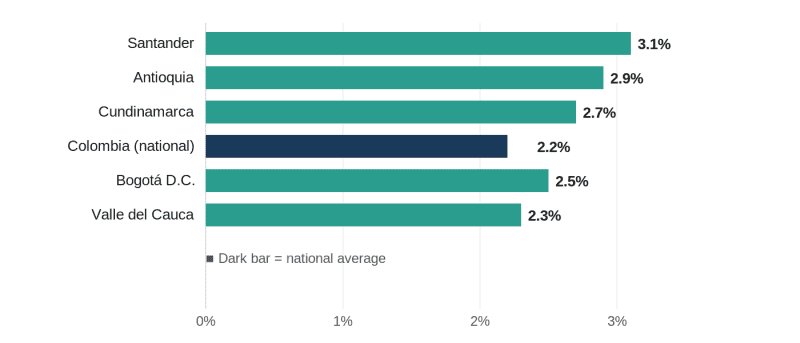
Five of Colombia’s largest regional economies outperformed national GDP growth in the first quarter of 2026. Source: DANE; calculations by Bancolombia / Grupo Cibest.
A small group of departments dominates national output
Bogotá D.C. accounted for 25.4% of Colombia’s national GDP in 2025, according to preliminary DANE figures. Commerce, transportation and lodging, together with financial services, underpin the capital’s economic weight, with Bogotá accounting for roughly half of the country’s financial-sector value added.
Antioquia, whose capital is Medellín, contributed 15.0% of national GDP. Its economy is more diversified, combining manufacturing and agriculture with commerce and services. Valle del Cauca, home to Cali, contributed another 9.8%, with commerce operating alongside a substantial manufacturing base.
Together, Bogotá D.C., Antioquia and Valle del Cauca represented 50.2% of Colombia’s GDP in 2025. DANE independently reports that these three economies accounted for nearly half of national output. Adding Santander, Cundinamarca and Atlántico brings the six largest departmental economies to 67.3% of Colombia’s total GDP.
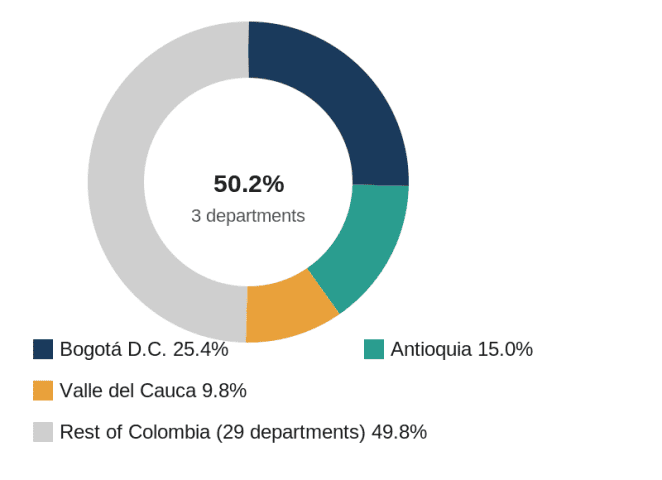
Bogotá, Antioquia and Valle del Cauca together accounted for 50.2% of Colombia’s 2025 GDP. Source: DANE; calculations by Bancolombia / Grupo Cibest. Chart: Finance Colombia.
That concentration is not simply a reflection of population. It also reflects decades of accumulated infrastructure, specialized labor, financial activity and established production chains. DANE’s departmental GDP series shows Bogotá D.C. and Antioquia as the country’s two largest departmental economies, while Vaupés and Guainía remain at the opposite end of the scale.
A consumption-driven model faces a tougher test
Bancolombia’s researchers caution that the strength of commerce and services in the largest departmental economies does not eliminate concerns about the durability of consumption-led growth.
Household income is likely to face pressure from elevated inflation, interest rates, unemployment and weaker remittance inflows, according to the analysis. Bancolombia’s August consumption report provides a similar signal: real consumption grew 1.2% in the second quarter of 2026, the lowest rate in more than a year, with every major region losing momentum compared with the previous quarter.
That makes the performance of other sectors increasingly important. Bancolombia points specifically to mining and construction as activities with greater potential for a rebound as Colombia’s economic cycle develops.
For the country’s departments, however, the implications are very different depending on their underlying economic structure. A slowdown in household consumption can have a relatively broad impact on diversified economies, while a recovery in commodities can have a disproportionately large effect on regions where mining and hydrocarbons dominate.
Where Colombia’s departments specialize
Bancolombia’s researchers use a location quotient to identify the sectors in which individual departments are unusually specialized. The measure compares the weight of a sector in a department’s economy with that sector’s weight nationally.
A location quotient of 1 means that the sector has approximately the same relative importance locally as it does in Colombia as a whole. A figure above 1 indicates that the sector is more important to that department than it is nationally.
The differences can be striking. Meta recorded a location quotient of 9.0 for mining and quarrying, with the sector accounting for 36.7% of the department’s GDP. Casanare recorded a quotient of 8.1, La Guajira 7.3, Arauca 7.0 and Cesar 6.7.
By contrast, Vichada had a location quotient of 3.8 for agriculture, while San Andrés recorded a quotient of 3.0 for commerce, transportation and lodging.
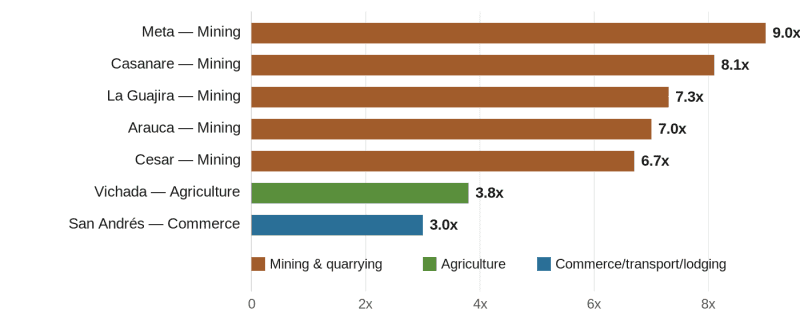
Mining dominates the economic profiles of several commodity-producing departments, while agriculture and commerce dominate elsewhere. Source: DANE; calculations by Bancolombia / Grupo Cibest. Chart: Finance Colombia.
The concentration of mining and hydrocarbons in departments such as La Guajira, Cesar, Casanare and Meta means their economic performance is more closely connected to international commodity prices and production cycles than that of the country’s largest diversified economies.
That exposure was visible in the first quarter of 2026. Cesar and Meta each recorded a 0.3% year-over-year contraction, while Casanare contracted 2.0%.
The pattern does not necessarily mean that specialization is a permanent disadvantage. Instead, it means that regional performance can change sharply when the economic cycle turns. A recovery in mining, housing and infrastructure investment could disproportionately benefit departments that already have the workforce, companies and physical capacity required to expand those activities.
Bancolombia therefore expects some commodity-dependent regions to have greater room for recovery if those sectors regain momentum. Bolívar and Boyacá, meanwhile, could benefit from a recovery in construction given their relatively high specialization in that activity.
Diversification creates a different kind of resilience
The distinction between specialization and diversification becomes clearer when Bancolombia’s production-concentration coefficient is applied to departmental economies.
The coefficient ranges from 0, representing a highly diversified production structure, to 1, representing an economy concentrated in a single activity.
San Andrés recorded the highest concentration coefficient among the departments examined, at 0.39, followed by Vaupés at 0.30, Vichada at 0.25 and Guainía at 0.21.
At the other end of the scale, Antioquia had the lowest coefficient at 0.04, followed by Boyacá at 0.05, Valle del Cauca at 0.06 and Bogotá D.C. at 0.07.
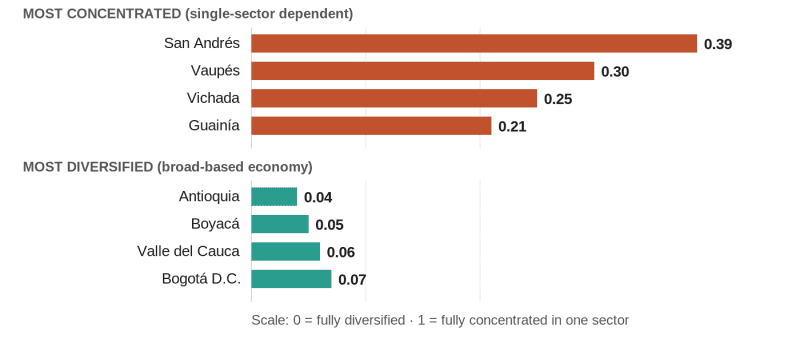
Antioquia, Boyacá, Valle del Cauca and Bogotá have among Colombia’s most diversified regional economies. Source: DANE; calculations by Bancolombia / Grupo Cibest. Chart: Finance Colombia.
The distinction matters because diversification can provide a degree of protection against shocks concentrated in a single industry. Antioquia, for example, combines manufacturing, agriculture, commerce and services rather than depending overwhelmingly on one commodity or activity.
Commodity specialization can work in the opposite direction. When international prices, production volumes or investment conditions move against a dominant sector, the effects can spread through employment, local demand, government revenues and business investment across the department.
At the same time, a specialized economy can benefit rapidly when conditions turn favorable. Bancolombia’s analysis therefore frames specialization less as a weakness in itself than as a structural characteristic that determines how departments respond to different stages of the economic cycle.
Competitiveness follows a similar geographic pattern
The same concentration appears in Colombia’s competitiveness rankings.
The 2026 edition of the Índice Departamental de Competitividad, produced by the Consejo Privado de Competitividad and Universidad del Rosario, ranks Bogotá D.C., Antioquia and Valle del Cauca among the country’s strongest-performing territories. The index measures 32 departments plus Bogotá D.C. using indicators drawn from official sources.
At the opposite end, Vaupés, Vichada and Guainía rank among the weakest-performing territories.
The competitiveness gap reflects many of the same structural advantages visible in GDP data: infrastructure, human capital, institutions, connectivity and established economic networks tend to reinforce one another over long periods.
These advantages are difficult to reproduce quickly. A department cannot easily replicate in a few years the industrial base, universities, financial institutions, transport infrastructure and supplier networks that have accumulated in Bogotá, Antioquia or Valle del Cauca over decades.
That suggests that regional development policies may be more effective when they build on existing capabilities rather than attempting to create entirely new economic ecosystems from scratch.
Colombia’s regional economy is more uneven than the headline GDP suggests
Taken together, the data present two very different pictures of Colombia’s economy.
The first is a relatively small group of large, diversified departmental economies led by Bogotá D.C., Antioquia and Valle del Cauca. These regions account for roughly half of national output and combine commerce and services with manufacturing, agriculture and other activities.
The second is a much larger group of smaller economies with far greater dependence on individual sectors. In commodity-producing departments, international prices and production cycles can matter more than the trajectory of domestic household consumption. In other regions, agriculture, tourism-linked commerce or public-sector activity can play an outsized role.
That distinction matters for investors, businesses and policymakers because a national growth rate does not tell the whole story. Colombia can record moderate expansion while individual departments simultaneously experience very different combinations of growth, contraction, opportunity and risk.
Bancolombia’s latest NowCast estimated that Colombia’s economy grew 2.7% in the second quarter of 2026. The departmental analysis suggests that understanding where that growth is generated, and which sectors are responsible for it, is just as important as the headline national figure.
For regional policymakers, the implication is equally important: diversification can reduce exposure to individual shocks, but existing specialization can also become an advantage when the economic cycle turns in favor of the sectors in which a department already has deep productive capabilities.
Headline picture : Picture of Cali Colombia Cathedral (Courtesy of Cathey Comm)
 Empleobilingue.com

- Director/a de operaciones para hotel, restaurante y discoteca 1626320364.60 - Medellín, Medellin, Antioquia, Colombia
- Coordinador/a de calidad para La Unión 1626483143.1 - La Unión, Antioquia, Colombia
- Desarrollador fullstack - Bogotá, Bogota, Colombia
- Technical Analyst - Remote
- PIM Administrator - Ecommerce - Remote (Bogotá, Bogota, Colombia)
- Auxiliar de gestión humana y bienestar para Girardota 1626060072.28 - Girardota, Antioquia, Colombia
- Marketing Strategist
- Trainer Manager - Bogotá, Bogota, Colombia
- Tolemaida UH- 60 Inspector - Bogotá, Bogota, Colombia
- Virtual Assistant - Team Lead - Remote
Contact Us

