















Bruce Mac Master resigns as head of ANDI amid tensions between the government and business groups
Bruce Mac Master (above, right) has resigned as president of the Asociación Nacional de Empresarios de Colombia (ANDI), the country’s leading business association, after more than a decade at the helm and amid growing tensions between President Abelardo de la Espriella’s government and some representatives of the private sector.
Mac Master announced his decision in a letter to ANDI’s board of directors, citing “unexpected and concerning circumstances” that had made the organization’s environment more complex and could ultimately affect its members and employees.
“Multiple pressures have affected its ability to act freely and carry out its functions autonomously,” Mac Master said.
The business leader had headed ANDI since 2013 and had the organization’s backing to remain in the position until October 2027.
“I cannot allow circumstances external to the association to end up affecting its members, their freedoms or its normal operations,” he said. Mac Master also warned that the situation could affect the organization’s staff and limit ANDI’s ability to represent Colombia’s productive sector.
Allegations of government pressure
The resignation comes amid what some Colombian media outlets have described as a growing dispute between the De la Espriella administration and business associations.
Digital news outlet La Silla Vacía directly attributed Mac Master’s departure to pressure from the government.
“De la Espriella was after his head. He got it. As La Silla reported, it began with the government’s veto of the association. In theory, nothing was in writing. In practice, informal messages on the issue had begun circulating within the Cabinet weeks ago,” the outlet reported.
Mac Master’s departure follows another episode during the new administration’s first weeks in office that raised questions about the relationship between the executive branch and organizations representing the private sector.
Carolina Soto (above left) had been selected to become executive president of the Cámara Colombiana de la Infraestructura (CCI), replacing María Consuelo Araújo, who left the position after being appointed Colombia’s ambassador to the United States. Soto, however, stepped down less than a day after her appointment because of the opposition that, she said, her selection had generated.
“Given the opposition generated by my appointment, I have decided to decline,” Soto said in a statement to the CCI’s board of directors.
In the same message, she stressed the need to maintain a cooperative relationship between the infrastructure sector and public institutions.
“The CCI represents a fundamental sector of the economy that needs to work in coordination with the state; that is, with the national government, territorial authorities and public companies. The challenges facing the sector and the country are many and require greatness,” she said.
Soto also emphasized the importance of “the independence of private-sector decisions and the government’s respect for them.”
The new government’s relationship with business groups
The two episodes have put under scrutiny the relationship De la Espriella intends to maintain with Colombia’s leading business associations during his administration.
The government has been in office for less than two months, but the controversies surrounding the CCI and now ANDI have raised questions about how far it intends to extend its influence over private organizations that, while needing to maintain an ongoing dialogue with the state, operate independently.
In Mac Master’s case, allegations of direct intervention by the executive branch have been attributed to informal messages that reportedly circulated within the government. In his resignation letter, Mac Master referred to “multiple pressures” and “external circumstances,” although in the publicly known excerpts he did not directly identify the president or officials in his administration as responsible.
The distinction is significant because ANDI plays a central role in dialogue between Colombia’s business sector and the state and regularly participates in the country’s major economic, labor and regulatory discussions.
The departures of Soto and Mac Master therefore raise a broader question about the emerging relationship between the new administration and the private sector: whether the government will engage with business associations that maintain their autonomy from its policies, or whether the tensions of its first weeks in office foreshadow a relationship in which greater alignment with the new administration is expected from their leaders.
Complaint Lands on a Gas Import Route Due to Start in November
Ecopetrol (BVC: ECOPETROL; NYSE: EC) has asked Colombia’s Fiscalía General de la Nación (Attorney General’s Office) to investigate how it awarded the contract behind the Regasificadora del Pacífico, a liquefied natural gas (LNG) import project being built to receive LNG in Buenaventura and regasify it in Buga, in the Valle del Cauca department. Ecopetrol filed the complaint on September 2, 2026, according to El Tiempo, whose investigative unit reported it on September 27. The project, which El Tiempo reported is valued at $172 million USD and expected to begin operating around mid-November, was awarded to Puertos, Inversiones y Obras S.A.S. (PIO S.A.S.) during the government of former President Gustavo Petro, while Ricardo Roa was Ecopetrol’s president.
According to El Tiempo, the filing is one chapter of a group of macrocasos (large-scale cases) being pursued by Ecopetrol’s internal audit. It seeks to establish or rule out irregularities in the award, possible tráfico de influencias (influence peddling), conflicts of interest, precontractual or contractual modifications, and a possible failure to apply penalties for delays. El Tiempo reported that the case began to move about six months before its report, when the newspaper revealed a group of companies linked to Bayron Triana, at the time Ecopetrol’s vice president for the energy transition, whom it described as close to Roa. El Tiempo’s report closes by stating that the Fiscalía is investigating. Portafolio, which carried the story the same day, reported that those involved have denied any irregular conduct.
The Contract Under Review
Ecopetrol announced on March 4, 2025, that it had awarded and signed its first regasification services contract with PIO S.A.S., for 60 million cubic feet per day (MMcfd) of capacity, to add a new source of supply for natural gas demand in Colombia’s interior. The company said at the time that the project would enter operation in the second quarter of 2026. In a September 1, 2025, statement, Ecopetrol said it had run “public and competitive processes” since 2024 and that the Pacific process drew 18 expressions of interest and eight binding offers. It said the project would enter operation in August 2026. La República reported that Ecopetrol had planned for operations to begin on August 1, 2026.
The Regasificadora del Pacífico’s financing page lists a February 28, 2025, signing date, a term of five years from the start of operations with an option for three more, and take-or-pay terms for the contracted capacity, with take-and-pay terms for volumes above it.
Conflicting Accounts of the Invitation
Óscar Isaza Benjumea, the owner and founder of PIO S.A.S. and president of the Regasificadora del Pacífico, told El Tiempo that David Riaño, then Ecopetrol’s vice president for the energy transition, called him in 2024, described the project and invited him to take part. Riaño denied making that call. He told El Tiempo that staff in the office of Ecopetrol’s president, then Roa, asked him to meet on August 16, 2024, with a group of businesspeople who had projects on the Pacific and Atlantic coasts: “I didn’t call anyone; I only listened. Two weeks later the process opened. It was assigned to the transition projects management office, where Bayron Triana was in charge, and the logistics vice presidency awarded it.”
Isaza defended the result to El Tiempo: “I beat more than one [competitor]. We offered the best price per million cubic feet, the best technical proposal and the shortest delivery time, with no advance payment.” In an interview with El País of Cali published September 27, he said: “It began in 2024, when Ecopetrol invited us to participate in a closed call. It was a plurilateral invitation.” He added that the company was given six days to decide whether to bid.
Overlapping Roles and Denials
El Tiempo’s report also examined the roles of Einstein Mauricio Gómez Machado, an engineer who has served since 2025 as consejero delegado (delegated board director) of the Regasificadora del Pacífico and whom the newspaper also described as Isaza’s adviser. The newspaper listed his earlier roles as commissioner of the Comisión de Regulación de Energía y Gas (Energy and Gas Regulatory Commission, CREG) in 2012, adviser to PIO in 2018, candidate for Ecopetrol’s commercial vice presidency in 2024 and CREG contractor in 2024, and said the question being raised is whether, in those roles, he may have incurred a conflict of interest. El Tiempo also reported that Gómez was Triana’s boss at the CREG, and that Gómez’s firm, Consultoría Regulatoria, had a 2025 contract with E-Nlighten S.A.S., a company El Tiempo described as linked to Triana. Gómez told El Tiempo that he knew Triana as he knew many other Ecopetrol officials, because the sector is very small, and he noted that the CREG had issued its resolution on the need to import gas through the Pacific and the Caribbean on June 8, 2012, before he joined the commission on July 19. A project summary dated September 16, 2026, which the Regasificadora del Pacífico prepared and Finance Colombia reviewed, lists Consultoría Regulatoria among the project’s advisers, for regulatory work.
Gómez acknowledged to El Tiempo that after what the newspaper called his failed bid to join Ecopetrol, he advised the CREG under a contract worth about $1 billion COP, and that in that work he mentioned the Pacific regasification project. He said he never intervened in decisions tied to the project and joined it after it had been awarded. Isaza told El Tiempo that he had asked Gómez to stay out of the process while Gómez was seeking the Ecopetrol post: “I told Mauricio to stay out of the tender. Later I learned he was not appointed.” Gómez gave a different account of that outcome: “After consulting with friends, I did not accept being at that Ecopetrol.”
Triana has also denied any wrongdoing, according to El Tiempo. He has attributed the anonymous accusations and complaints against him to a smear campaign over his refusal to give in to pressure from the Casa de Nariño, the presidential palace, to sign off on a gas purchase through Ecopetrol’s Houston office as the Petro government was ending. Triana and Roa both left Ecopetrol in a July 30, 2026, leadership reshuffle, Finance Colombia reported, citing El Tiempo. Joaquín Gutiérrez Caballero took over as Ecopetrol’s president on September 28.
El Tiempo’s report did not include comment from Roa or from Ecopetrol. The newspaper also asked Isaza about an account that bribes of 4 cents USD per million cubic feet traded had been demanded from inside Ecopetrol in connection with the award. El Tiempo did not name a source for that account or say whether it forms part of Ecopetrol’s complaint. Isaza rejected it, telling El Tiempo that no one had ever demanded anything from him.
“No one has ever demanded anything from me. I have an impeccable track record. Let them come in and search. There is no shadow of doubt over the project.”
— Óscar Isaza Benjumea, owner and founder of PIO S.A.S., speaking to El Tiempo
Delays and Penalties
The project should have begun operating on August 1 and is running almost two months behind schedule without any penalty having been applied, El Tiempo reported, although the contract sets fines of $200,000 USD per day, deducted from invoices. Isaza told the newspaper that the delay is only 45 days, explaining that the contract gives the company two months’ grace without fines, and he attributed it to factors outside PIO’s control, including the magnitude 7.4 earthquake of August 10: “The war in Iran has disrupted logistics; the earthquake left the port of Buenaventura out of service for five days, there were road closures and a typhoon in China, where ‘Tura’ [the project’s floating storage unit] was. And the ship carrying the tanks was supposed to arrive in May, but it arrived on July 22, and we unloaded on August 19 because of port congestion.” According to El Tiempo’s September 27 report, Ecopetrol has accepted only two of the 45 days, and if PIO cannot justify the rest, fines and arbitration would follow.
Isaza Cites Bank Financing and an Ecopetrol Communication
In his interview with El País, Isaza said: “First I want to make something very clear: there is no Ecopetrol money here. Zero. There isn’t a single peso from Ecopetrol. All the risk is contractor risk and bank risk.” He named the Financiera de Desarrollo Nacional (FDN), BTG Pactual (B3: BPAC11) and Banco de Occidente (BVC: OCCIDENTE) as the project’s lenders, and said that the banks and PIO together are investing about $1 trillion COP. “If we don’t start up, no regasification is billed. Absolutely nothing is billed,” he said. Forbes Colombia reported on February 10, 2026, that the project had closed a $130 million USD senior debt financing with the FDN and BTG Pactual each contributing up to $65 million USD, backed by the long-term take-or-pay contract with Ecopetrol. The Regasificadora del Pacífico’s September 16 project summary lists Banco de Occidente alongside the FDN and BTG Pactual as senior lenders on the $130 million USD facility; the Forbes Colombia report did not mention Banco de Occidente.
Isaza also told El País that “Ecopetrol sent us a communication ratifying that the process was transparent and that all the established parameters were met.” The same summary carries a box headed “Contratación certificada por Ecopetrol” (contracting certified by Ecopetrol). It cites an August 20, 2026, communication from Ecopetrol to the company as stating that the contract resulted from a process Ecopetrol conducted under a plurilateral negotiation methodology, in strict compliance with principles that include efficiency, equality, morality and publicity. Finance Colombia has not seen the Ecopetrol communication itself.
Startup Schedule and Gas Supply
When Finance Colombia visited the regasification plant site in El Vínculo, a rural district of Guadalajara de Buga, on September 29, storage tanks bearing the Regasificadora del Pacífico name stood on concrete supports, and cranes and workers were on site. Nearby stood a white enclosure labeled CIMC Enric (HKEX: 3899), which the same project summary lists as an engineering, procurement and construction contractor for the Buga plant.
The project’s general manager, Jesús Urías, said in September, according to Valora Analitik, that the first phase will deliver up to 90 MMcfd, of which 60 MMcfd is contracted to Ecopetrol and 20 MMcfd to Alcanos. The same summary puts the first phase’s investment at $170 million USD and the total at $290 million USD including a second phase. El País reported on October 1 that the Tura was due in Buenaventura on October 9, and that the company plans to begin commercial operation in the second half of November. In his September 27 interview, Isaza said that he expects operations to begin between November 15 and December 1. El Tiempo reported that Ecopetrol is still negotiating the purchase of the LNG itself.
El País’s October 1 report noted that the startup follows the scheduled gas rationing the government declared in September after a technical failure at the Cartagena regasification terminal. Semana reported on September 25 that the Ministerio de Minas y Energía (Ministry of Mines and Energy) had declared the measure because of a technical problem at the SPEC LNG terminal in Cartagena, and the ministry said the rationing ended at 11:59 p.m. on September 29, after corrective work restored the terminal’s full regasification capacity of 475 MMcfd.
Headline photo: Storage tanks at the Regasificadora del Pacífico regasification plant under construction in El Vínculo, Guadalajara de Buga, on September 29, 2026. (Photo: Loren Moss / Finance Colombia)
Indictment Says Watts Sent Auditors Forged Bancolombia Statements
A federal jury in Utica, New York, has convicted a Colombian man and his New Jersey wife in a scheme that prosecutors said sought more than $13 million USD in federal aid for elderly, disabled and homeless Americans. Luis Pino-Copete, 42, of Bogotá, and Jael Watts, 45, of Alloway, New Jersey, were found guilty of all the charges against them, which included wire fraud conspiracy, making and using a false document and aggravated identity theft. The US Attorney’s Office for the Northern District of New York announced the verdict on October 2, 2026, after a trial of several weeks, and said the evidence showed the couple collected more than $1.6 million USD of the money they claimed.
Watts ran Pearl Transit Corporation, a New Jersey nonprofit that, according to the third superseding indictment on which the jury convicted the couple, claimed to provide transportation, street outreach and charitable dental services to elderly, disabled and economically disadvantaged people in several states. Between July 2019 and October 2025, she billed state and local agencies that distribute federal pass-through funds for services the company never delivered, prosecutors said, and Pearl Transit employed no drivers at all. The payroll and client records behind its invoices used personal information that the defendants obtained without lawful authority, according to the indictment. Prosecutors said evidence at trial showed that some riders on those records had died before the dates of their purported trips, and that one woman listed as a driver held only a learner’s permit at the time.
The Couple Answered a State Audit With Fake Driver Reports and Bank Statements, Indictment Says
According to the indictment, Pearl Transit emailed reimbursement requests to New York State agencies in September and October 2024. Prosecutors said Watts sought nearly $750,000 USD in those late-2024 claims to the New York State Department of Transportation under the Section 5310 program of the Federal Transit Administration (FTA). Formally called Enhanced Mobility of Seniors and Individuals with Disabilities, the program funds transportation for older adults and people with disabilities where existing service is unavailable or insufficient, and the FTA apportioned $443.9 million USD to it nationwide in fiscal year 2025, according to the agency.
The Office of the New York State Comptroller found the invoices suspicious and began auditing them, prosecutors said. By January 2025, its auditors had asked Pearl Transit for the licenses of all drivers it claimed to employ, and the applications of all riders it claimed to transport, during the first quarter of 2022, according to the indictment. The comptroller’s office enlisted the US Department of Transportation Office of Inspector General, whose referral put the matter before federal prosecutors in 2025, according to the US Attorney’s Office. The Office of Inspector General of the US Department of Housing and Urban Development (HUD) joined the investigation later.
Watts and Pino-Copete married in Colombia in 2023, and he joined the scheme in January 2024, according to prosecutors. The indictment, filed September 10, 2026, says the couple lived together in New Jersey and lays out how the pair responded to the comptroller’s audit in early 2025. According to the indictment, Pino-Copete used a data service of TransUnion (NYSE: TRU), under an existing Pearl Transit contract, to look up dates of birth, including those of people whose names then appeared on a fabricated client list. The indictment does not accuse TransUnion of wrongdoing. When the auditors asked which company checked the licenses of Pearl Transit’s purported drivers, Watts told Pino-Copete she would “make up a report” and “a provider as well,” the indictment says. She then used a freelancing service, paid for with his credit card, to create a domain, logo and voicemail for a fictitious firm called Actual Check, whose name appeared on four motor vehicle reports sent to the auditors.
The auditors next asked for proof of driver payroll and vehicle insurance. At Watts’ request, Pino-Copete sent her a January 2025 statement from his own account at Bancolombia and a 2015 Colombian insurance policy in his name. She used them to produce fake Bancolombia statements falsely showing Pearl Transit paying its New York drivers from a Colombian account, along with a fake record of a van insured in Colombia, and sent both to the comptroller’s office in March 2025, according to the indictment. Bancolombia, which since a 2025 corporate reorganization has operated under the holding company Grupo Cibest (NYSE: CIB; BVC: CIBEST, PFCIBEST), is not accused of wrongdoing in the indictment.
Prosecutors said investigators who searched the couple’s phones found many messages about producing paperwork for the auditors. Among the remarks prosecutors attributed to Watts were “one has to be committed to this type of work . . . and I am committed” and “they are not smart . . . we are much smarter.”
Prosecutors Say Four Local Administrators Paid Out More Than $1.6 Million USD
Pearl Transit’s claims also drew on two HUD programs, the Community Development Block Grant (CDBG) and the Emergency Solutions Grants (ESG). Some of the funds were provided during the COVID-19 pandemic under the Coronavirus Aid, Relief, and Economic Security Act, according to prosecutors.
Four local administrators paid Pearl Transit, according to prosecutors. The City of Raleigh, North Carolina, paid $379,149 USD in Section 5310 funds, and Gwinnett County, Georgia, paid $529,500 USD in CDBG funds. In California, the Los Angeles County Metropolitan Transportation Authority paid $429,885 USD in Section 5310 funds, and Kern County paid $283,000 USD in ESG funds.
Bank records showed that the more than $1.5 million USD the couple received from Georgia, North Carolina and California was spent entirely on personal expenses, prosecutors said. Those expenses included more than $100,000 USD on rentals of Porsche (XETRA: P911) cars; more than $100,000 USD at Loro Piana, an Italian luxury clothing brand, in Manhattan; and nearly a year of travel in 2024 that took them to Colombia, Aruba and Europe, including four months in Europe. At trial, prosecutors offered selfies that they said the couple took at a Tuscan spa and while touring a BMW (XETRA: BMW, BMW3) plant.
“These two defendants traded their Tuscan spa robes for his and hers orange jumpsuits.”
— John A. Sarcone III, first assistant US attorney for the Northern District of New York
Prosecutors described another part of the scheme involving dentures. Pearl Transit sought CDBG reimbursement for prostheses that it said homeless people received at no charge. According to prosecutors, the couple in fact produced the dentures at home on an unsanitary 3-D printer and charged homeless people fees to scan their mouths and fit the dentures.

Prosecutors said this video call shows Pino-Copete displaying cash to Watts while she was jailed, and that the money came from a homeless dental client at a flea market in Maryland. (Photo courtesy US Attorney’s Office for the Northern District of New York)
Prosecutors Say Pino-Copete Took a Larger Role After Watts Was Arrested
Pino-Copete, who entered the United States in January 2025 on a visa issued the previous month, took on a larger role after Watts was arrested on a wire fraud complaint in July 2025, prosecutors said. According to the indictment, while Watts was held at the Albany County Correctional Facility in September 2025, she had Pino-Copete email the City of San Bernardino, California, in her name, blaming a family death for her absence and concealing that she had been charged and detained. Prosecutors said the couple was trying to obtain $50,000 USD in federal funds from the city at the time. In October 2025, he signed a CDBG contract with the city in her name, the indictment says. He was charged in December 2025 and held pending trial. The FTA suspended Watts and Pearl Transit from federal procurement and nonprocurement transactions on December 3, 2025, and suspended Pino-Copete on February 17, 2026, according to the transportation inspector general.

Pino-Copete speaks with Watts by video call in September 2025, while she was held at the Albany County Correctional Facility; prosecutors said the image shows the pair conspiring to submit false documents to the City of San Bernardino. (Photo courtesy US Attorney’s Office for the Northern District of New York)
The Defendants Face Sentencing in January 2027
Watts was convicted of 10 counts: the three she shared with Pino-Copete, plus one count of false statement, a second count of aggravated identity theft and five counts of wire fraud. The false-statement count concerned a 2022 Section 5310 application that Watts submitted to the New York State Department of Transportation bearing an attorney’s affirmation, although the attorney had not reviewed or signed it, according to the indictment.
US District Judge Anthony J. Brindisi of the US District Court for the Northern District of New York has scheduled sentencing for January 21, 2027. Each defendant faces between two and 20 years in prison, fines of up to $250,000 USD and as many as three years of supervised release, and the two face a restitution order of at least $1.9 million USD, according to prosecutors. Because Pino-Copete is not a US citizen, he also faces deportation once any prison sentence ends, prosecutors said.
Assistant Attorney General Colin M. McDonald of the Justice Department‘s National Fraud Enforcement Division, which the department created in April 2026, said the defendants “fabricated payrolls and client lists, even using the identities of deceased individuals, to siphon millions meant for the most vulnerable Americans.”
Headline photo: Jael Watts and Luis Pino-Copete pose for selfies at a Tuscan spa and during what prosecutors described as a tour of a BMW plant; both photos were offered at trial. (Photos courtesy US Attorney’s Office for the Northern District of New York; composite: Finance Colombia)
Fed Tightening Narrows the Rate Edge Behind Colombia’s Strong Peso
Higher US interest rates, even on the Federal Reserve’s own projected path, would reduce the room for the dollar to resume its decline against the Colombian peso, according to the latest weekly Radar Bancolombia report from Grupo Cibest (NYSE: CIB; BVC: CIBEST, PFCIBEST), the holding company of Bancolombia. The report, published September 21, 2026, by Bancolombia’s economic, sector and market research unit and led by an editorial titled La Fed sube la tasa: ¿se agota el espacio para un dólar más barato? (The Fed Raises Rates: Is the Room for a Cheaper Dollar Running Out?), follows the US Federal Reserve‘s first rate increase since July 2023. It says the room for further strength in the global dollar will depend less on the increase expected in October than on whether the Fed moves closer to the steeper 2027 path priced by the market.
The peso weakened 3.0% in the week ended September 18, with the dollar closing at 3,177.5 COP, its highest level since August 31, as the Fed’s more restrictive tone strengthened the dollar globally. The DXY dollar index rose 1.1% over the week to 100.2 points, according to the report.
The Hike Was Priced In; the Change Came in the Projections
The Federal Open Market Committee voted unanimously to raise the target range for the federal funds rate by 25 basis points to 3.75%–4.00%, its highest level since November 2025. The report says markets had widely anticipated the move, so the main change came in the Fed’s projections: most members expect at least one more increase in 2026, and the median of the dot plot now has the rate holding at 4.00%–4.25% throughout 2027. The committee raised its 2026 forecast for headline PCE inflation to 3.7% and for core PCE inflation to 3.4%. The report attributes the persistence of inflation above target to the effects of the conflict in the Middle East, in an economy and labor market that remain solid.
Futures markets go further. As of September 18, pricing tracked by the FedWatch tool of CME Group (Nasdaq: CME) assigned a 57% probability to another 25-basis-point increase at the October meeting and 46% to the rate ending 2026 at 4.00%–4.25%, the report says. The most likely range then rises to 4.25%–4.50% in January 2027 and to 4.50%–4.75% by mid-2027. The Fed and the market therefore agree on one more increase in 2026 but differ on 2027, when the committee projects a pause and futures price further increases.
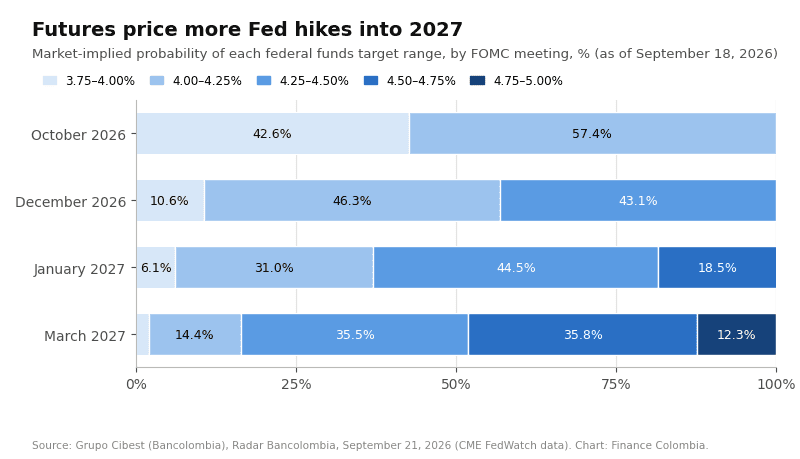
Market-implied probabilities for the federal funds target range at upcoming FOMC meetings, as of September 18, 2026 (Chart: Finance Colombia, based on Grupo Cibest data)
The report ties the outcome of that disagreement to the duration of the Middle East conflict. It cites the US Energy Information Administration (EIA), which expects restrictions on oil exports from the region to persist until the end of 2026, despite a gradual recovery in flows through the Strait of Hormuz and the use of alternative routes, and expects Middle East oil output to stay below pre-conflict levels until the second quarter of 2027. An end to the conflict would remove a significant source of inflation pressure, according to the report, reducing the need for further increases in 2027, although the Fed could keep rates at restrictive levels while it confirms that the moderation in inflation is sustainable.
“Although the Fed’s next rate increase already appears to be incorporated into asset prices, the main uncertainty is whether new increases will be necessary during 2027.”
— Radar Bancolombia, Bancolombia economic, sector and market research
A Narrower Rate Differential
With Banco de la República (Bank of the Republic, Colombia’s central bank) holding its policy rate at 12.00%, the gap with US rates remains wide and has favored carry trades, capital inflows and the peso’s strength, according to the report. If the Fed’s rate reached 4.50%–4.75%, that gap would shrink by another 75 basis points. Colombian assets would still offer attractive returns, the report says, but the differential would have less capacity to contain a further correction in the peso.
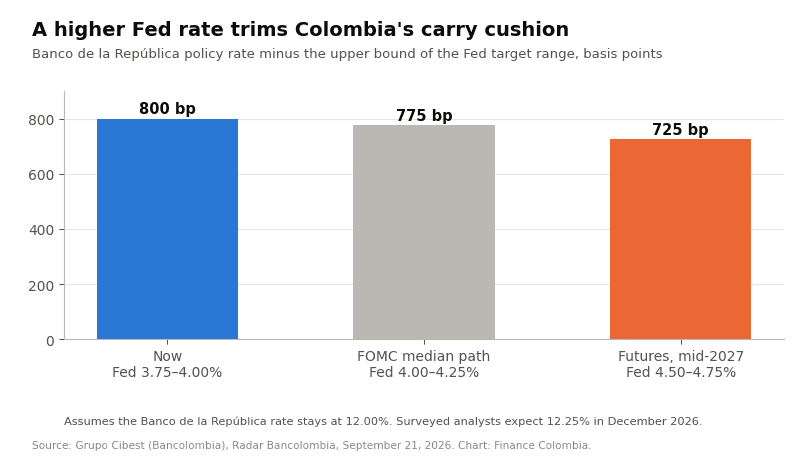
Gap between Banco de la República’s policy rate and the upper bound of the Fed’s target range under three Fed scenarios (Chart: Finance Colombia, based on Grupo Cibest data)
Treasuries and TES Sell Off
Between September 16 and 18, the two-year Treasury yield rose 3.8 basis points to 4.74% and the 10-year yield rose 4.0 basis points to 5.00%. Over the week of September 11 to 18, the Treasury curve bear-flattened, with short-term yields rising an average of 6 basis points and long-term yields 2 basis points, according to the report. The move was reinforced by the Bank of Japan, which raised its policy rate by 25 basis points to 1.25%, its highest level in 31 years. The spread between 10-year and three-month Treasuries stood at 87.8 basis points and has now been positive for more than a year.
Colombian government bonds also sold off. Yields on the fixed-rate curve of Títulos de Tesorería (TES), Colombia’s peso-denominated government bonds, rose an average of 25 basis points: 19 basis points in the short segment (one to four years), 26 in the medium segment (five to nine years) and 28 in the long segment (more than 10 years). The report attributes the move to the Fed decision, higher oil prices tied to the Middle East tensions, the approval of a 2027 Presupuesto General de la Nación (General National Budget) of $634.9 trillion COP, the government’s larger financing needs and the resumption of TES auctions.
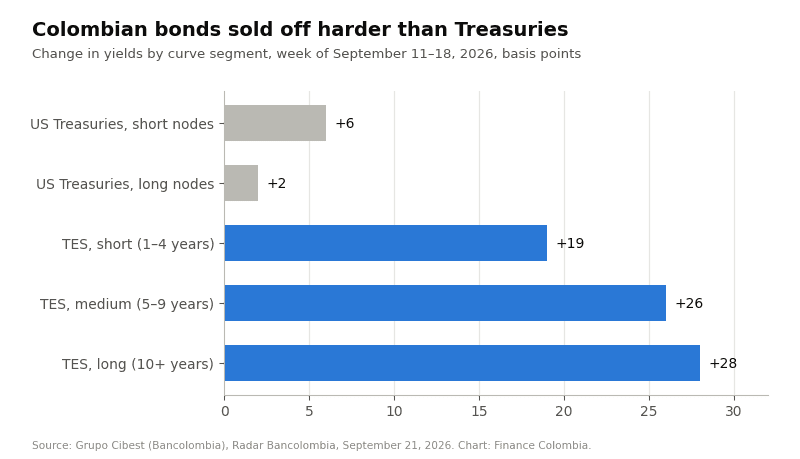
Weekly change in US Treasury and Colombian TES yields by curve segment, September 11–18, 2026 (Chart: Finance Colombia, based on Grupo Cibest data)
Central government gross debt stood at $1,160.6 trillion COP in July, according to Ministerio de Hacienda y Crédito Público (Ministry of Finance and Public Credit) figures cited in the report, up 3.4% from a year earlier but at its lowest level in 11 months. External debt fell 30.7% year on year to $243.5 trillion COP after buybacks of global bonds and the full payment of a total return swap, while domestic debt rose 19.0% to $917.1 trillion COP, with monthly TES placements above $15 trillion COP between May and July.
The report also points to pressure on emerging markets. Net capital flows to emerging economies had been negative for more than six months as of August 17, the report says, citing Institute of International Finance (IIF) data showing cumulative net outflows of $168 billion USD, compared with net outflows of $5 billion USD in the same period of 2025. The report places the outflows in a context of high international interest rates and lower risk appetite; flows into debt instruments have been more resilient than equity flows.
Analysts Expect a Gradually Weaker Peso
The latest Encuesta Mensual de Expectativas de Analistas Económicos (Monthly Survey of Economic Analysts’ Expectations, EME) by Banco de la República puts the average forecast for the Tasa Representativa del Mercado (TRM, the official representative exchange rate) at 3,134 COP per dollar for the end of September 2026, with individual forecasts ranging from 3,046 COP to 3,279 COP. The report says the dispersion of forecasts remains below mid-year levels, when the presidential elections significantly increased local uncertainty.
Surveyed analysts expect the TRM to end 2026 at 3,236 COP, 89 COP below the 3,325 COP projected in the August survey. The report attributes the downward revisions to the peso’s marked appreciation in the months after the presidential elections, “in a context in which market optimism contrasts with the country’s fiscal challenges.” Survey respondents see the rate at 3,333 COP in September 2027, 3,388 COP in December 2027 and 3,455 COP in September 2028. In the same survey, analysts raised their year-end 2026 inflation forecast by 21 basis points to 6.81%, and they continue to expect a policy rate of 12.25% in December.
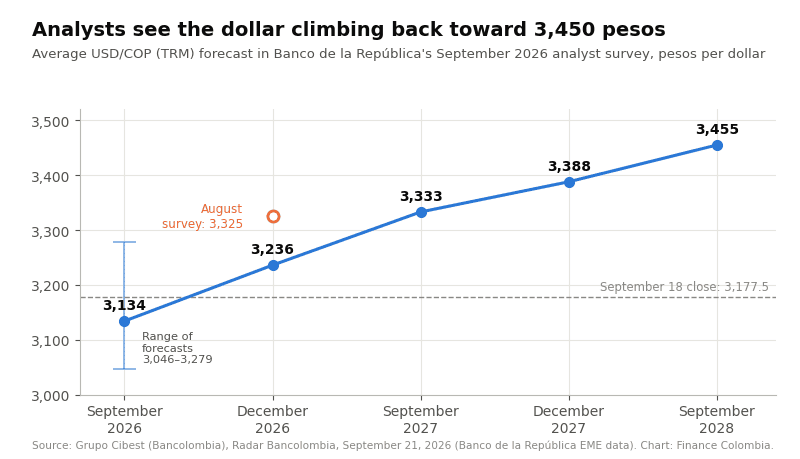
Average USD/COP forecasts in Banco de la República’s September 2026 analyst survey (Chart: Finance Colombia, based on Grupo Cibest data)
Grupo Cibest’s own September 2026 projections, published with its annual outlook Guía 2027: Colombia Resiste (2027 Guide: Colombia Endures), point to a year-end rate of 3,219 COP in 2026 and 3,435 COP in 2027, after 3,757 COP at the end of 2025. That implies a slightly stronger peso than the analyst consensus at the end of 2026 and a slightly weaker one at the end of 2027.
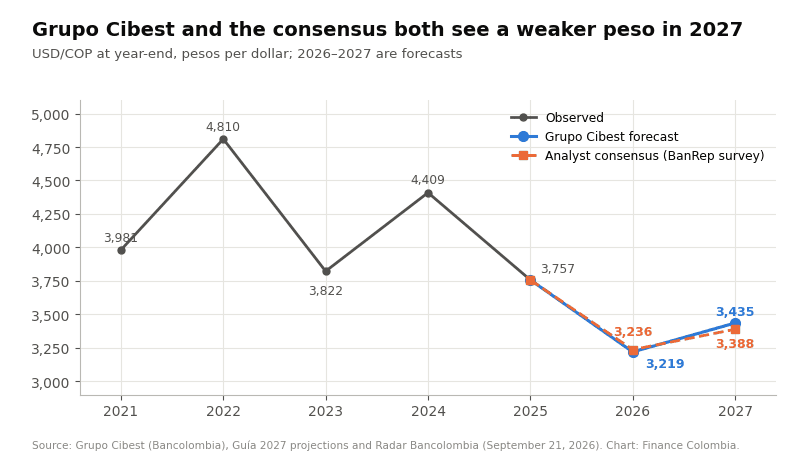
Year-end USD/COP: observed values, Grupo Cibest forecasts and the analyst consensus (Chart: Finance Colombia, based on Grupo Cibest data)
Oil prices remain a factor for both the Fed and the peso. Brent crude closed the week at $103.32 USD per barrel, down 1.23%, while WTI ended at $100.30 USD per barrel, up 0.25%. Concerns about disruptions to Saudi supply eased on higher Saudi oil exports through Oman, rising inventories in the United States, Singapore and Europe, and higher fuel exports from China, according to the report.
Two Paths for the Peso
The report lays out two scenarios. If the end of the conflict reduces energy price pressure, one more increase could be enough, and the Fed could then hold rates at restrictive levels. Markets would have to remove part of the increases they now price for 2027, Treasury yields would fall and the DXY would lose part of its upward pressure even without Fed rate cuts. That would limit the room for further global dollar strength and moderate the pressure on USD/COP.
If the conflict continues, oil stays high and pressure on other prices persists, the global dollar could keep strengthening or remain at elevated levels, and the Fed could move toward the steeper path priced by the market. In that case, the report says, the narrower differential and Colombia’s local vulnerabilities would widen the room for a depreciation of the peso.
Thumbnail photo: Colombian 50,000-peso banknotes. (Photo: Image by caruizp from Pixabay)
Three operators line up for Colombia’s reopening to fracking
GeoPark (NYSE: GPRK) has said it is ready to take part in hydraulic fracturing in Colombia, joining state-controlled Ecopetrol (NYSE: EC; BVC: ECOPETROL) and coal producer Drummond’s energy unit, Drummond Energy, as companies seeking to develop unconventional oil and gas while the government of President Abelardo De La Espriella reopens the door to the technique. Felipe Bayón, GeoPark’s chief executive and a former president of Ecopetrol, made the announcement on September 22 in Bucaramanga at the XXIII Congreso Colombiano de Petróleo, Gas y Energía (23rd Colombian Petroleum, Gas and Energy Congress), organized by the Asociación Colombiana de Ingenieros de Petróleos, Energía y Tecnologías Afines (Colombian Association of Petroleum, Energy and Allied Technologies Engineers, Acipet).
According to Caracol Radio, Bayón named the regions GeoPark is looking at: “We are convinced that in the Middle Magdalena Valley, but also in other regions of the country, Cesar-Ranchería, among others, in Catatumbo, there are possibilities to do unconventionals and to do fracking.”
Of the three companies, Ecopetrol and Drummond have the most concrete routes to drilling Colombia’s first fracking well, while GeoPark has so far only expressed interest, according to a September 27 analysis by Portafolio. Drummond Energy has set 2027 as its target for a first well in the department of Cesar.
GeoPark cites Vaca Muerta but has no defined project
According to Portafolio, GeoPark is concentrating its analysis on the Middle Magdalena Valley and the Cesar-Ranchería basin, where it sees opportunities for both oil and gas from unconventional reservoirs. The outlet reported that the company has not defined blocks, municipalities, investment amounts, schedules or potential production volumes for any fracking operation in Colombia. No environmental license applications, specific contracts with the Agencia Nacional de Hidrocarburos (National Hydrocarbons Agency, ANH) or prior-consultation processes tied to a particular project have been made public.
Bayón told the congress that “energy sovereignty has to do with taking control of our destiny,” according to Valora Analitik. Red+ Noticias reported that Bayón wants to carry the company’s experience in Argentina’s Vaca Muerta shale formation to regions such as the Middle Magdalena Valley and Cesar-Ranchería.
“At GeoPark, I don’t want to speak for the industry, but we are ready. We are ready to accompany this development of unconventionals. We are committed, we believe we can do it in a rigorous way, and above all we believe it will be a very important change for the country.”
— Felipe Bayón, CEO of GeoPark
In October 2025, GeoPark completed its $115 million USD acquisition from Pluspetrol of the Loma Jarillosa Este and Puesto Silva Oeste blocks in Neuquén Province. Bayón said at the congress that production there rose from about 1,400 barrels per day to more than 5,000 between September 2025 and June 2026, Caracol Radio reported. Bayón’s figure of more than 5,000 barrels per day differs from GeoPark’s own second-quarter 2026 operational update, which reported average gross production in Argentina of 1,400 barrels of oil equivalent per day for the quarter, with hydraulic fracturing under way on five wells, 119 of 218 fracture stages completed by the end of June, and production start-up to follow. In the same update, the company said it and provincial partner Gas y Petróleo del Neuquén had applied to Argentina’s Régimen de Incentivo para Grandes Inversiones (Large Investment Incentive Regime, RIGI) to support more than $1 billion USD in investment, targeting growth from 1,500 to 20,000 barrels of oil equivalent per day within three years.
In March 2026, Colden Investments S.A., an affiliate of Jaime Gilinski, invested approximately $107 million USD for about 20% of the company’s shares, becoming its largest shareholder. On September 2, GeoPark announced an entry into Venezuela’s Bare heavy-oil block, to be paid for with new shares issued to Grupo Gilinski that would give the group about 56.3% of GeoPark, according to El Colombiano. The transaction depends on a 25-year contract with PDVSA Petróleo S.A. taking effect, which GeoPark said is subject to approvals and sanctions-related compliance and estimated would take no more than 120 days.
Ecopetrol’s new president promises “responsible fracking”
Ecopetrol’s board unanimously named Joaquín Gutiérrez Caballero as the company’s president on September 24, and he formally takes office September 28, according to an Ecopetrol statement. Gutiérrez, a business administrator who managed De La Espriella’s presidential campaign, comes to the post without prior experience in the hydrocarbons sector, Infobae reported.
At a ceremony in Santa Marta ahead of that date, reported by Infobae on September 26, De La Espriella swore in Gutiérrez and restated his campaign position: “My government fully reopens the path to exploration and to the signing of new contracts, including fracking, a lo que dé [all the way], as I said during the campaign, with absolutely every criterion of environmental responsibility.” Gutiérrez said: “We will advance conventional and unconventional projects, implement responsible fracking and continue exploring offshore deposits.” He also pledged to guarantee consulta previa (prior consultation) with communities without allowing it to be used to delay energy-security projects, according to Infobae. The same report put Ecopetrol’s proven reserves at 1.94 billion barrels of oil equivalent at the end of 2025, equal to 7.8 years of production, with 6.3 years for gas. Finance Colombia reported earlier this month on De La Espriella’s pledge to rebuild Ecopetrol as gas reserves fell to a record low.
The two pilot projects Ecopetrol pursued with ExxonMobil (NYSE: XOM) in Puerto Wilches, Santander, known as Kalé and Platero, were contracted under ANH Contratos Especiales de Proyectos de Investigación (Special Research Project Contracts, CEPI), which permitted pilot studies but not commercial production. Portafolio, citing El Tiempo reporting, said that Kalé was awarded to Ecopetrol in November 2020 and its contract signed on December 24 of that year, while Platero was awarded to ExxonMobil in April 2021 and contracted that June. In March 2021, the ANH said the two pilots contemplated joint investment of about $130 million USD, subject to environmental licensing.
Kalé went furthest. The Autoridad Nacional de Licencias Ambientales (National Environmental Licensing Authority, ANLA) opened its evaluation in November 2021, held a public hearing in Puerto Wilches on February 22, 2022, and granted the environmental license through Resolución 0648 (Resolution 0648) on March 25, 2022. The ANLA opened its evaluation of Platero through Auto 1341 (Order 1341) on March 9, 2022. Portafolio reported that under the Gustavo Petro administration, Ecopetrol withdrew from the Platero licensing process, and that the Corte Constitucional (Constitutional Court) later conditioned the pilots’ continuation on prior consultation with the Afro-descendant community Afrowilches. Ecopetrol and ExxonMobil subsequently agreed with the ANH to terminate the research contracts early.
Drummond targets a first well in Cesar in 2027
Drummond Energy set aside plans for a liquefied natural gas (LNG) regasification terminal in Ciénaga, Magdalena, to concentrate on unconventional gas in Cesar, Alberto García, the company’s country manager, told El Tiempo in an interview published September 1. García said the La Luna formation in the Cesar-Ranchería basin “can hold up to 20 trillion cubic feet of producible natural gas,” which he said would multiply the country’s current reserves more than tenfold. El Tiempo put those reserves at 5.9 years of supply.
Drummond holds four contracts written specifically for shale reservoirs, along with an association contract with Ecopetrol and a conventional contract for coal-bed methane, García told El Tiempo. Portafolio, also citing El Tiempo, reported that Drummond’s contracts include CR-2, CR-3 and CR-4, signed in December 2016 for the Cesar-Ranchería area, and that another contract, also signed in 2016, was suspended by the ANH on April 27, 2018. According to García, the contracts’ area of influence includes the municipalities of Chiriguaná, La Jagua de Ibirico, El Paso, Becerril, Agustín Codazzi and Bosconia, among others in Cesar.
García said the company’s environmental licensing is well advanced, but that Drummond still needs to work out with the ANLA how to modify existing licenses and apply for new ones. He put the initial investment at “hundreds of millions of dollars” that would later scale to billions, and said Colombia would need long-term legal stability and competitive fiscal terms to compete with Argentina and the United States for that capital. He also set limits on where the technique would be used: “Fracking will never be carried out in natural parks or in mountainous areas; it will be carried out exclusively in flat, open areas.”
García estimated that if fracking becomes viable, all operators together, including Ecopetrol, could invest about $10 billion USD during De La Espriella’s four-year term. “What we require now is solid political will,” he said.
Legal footing and objections
Fracking remains possible under the rules in force, Portafolio noted. In 2022, the Consejo de Estado (Council of State) upheld Decreto 3004 de 2013 (Decree 3004 of 2013) and Resolución 90341 de 2014 (Resolution 90341 of 2014), which set the technical criteria for unconventional reservoirs. Infobae reported that the Consejo de Estado and the Procuraduría General de la Nación (Inspector General’s Office) have nonetheless expressed reservations about the technique, arguing that it may not be compatible with the country’s development or with the protection of collective rights. The government has responded that any use of the technique will be subject to environmental-responsibility criteria and technical evaluation, according to Infobae.
Headline photo: A GeoPark drilling rig in Argentina’s Vaca Muerta formation, Neuquén Province. (Photo courtesy GeoPark)
Financing Clears Bogotá’s Autopista Norte Expansion for Construction
The concessionaire behind Accesos Norte Fase II has closed a $1.2 trillion COP loan that clears the way for construction on the Autopista Norte and Carrera Séptima in northern Bogotá and on the perimeter road at Sopó, according to Semana and La República. The lenders are Financiera de Desarrollo Nacional (FDN); J.P. Morgan Securities PLC, a unit of JPMorgan Chase & Co. (NYSE: JPM); and MUFG Bank, the banking arm of Mitsubishi UFJ Financial Group (TSE: 8306; NAG: 8306; NYSE: MUFG). The deal closed on September 10, 2026, according to Holland & Knight, which represented the three lenders.
Concesionaria Ruta Bogotá Norte S.A.S. holds the fifth-generation (5G) road concession, which was structured as a private-initiative (iniciativa privada) public-private partnership. A fund managed by Ashmore Colombia, part of Ashmore Group (LSE: ASHM), holds 50% after an investment the firm completed in July 2023. Colombian infrastructure and industrial group Grupo Ethuss holds 25%, and Spanish construction group OHLA (BME: OHLA) holds the remaining 25%, La República reported. Construction is split equally between Única, Grupo Ethuss’s construction company, and OHLA Construcciones.
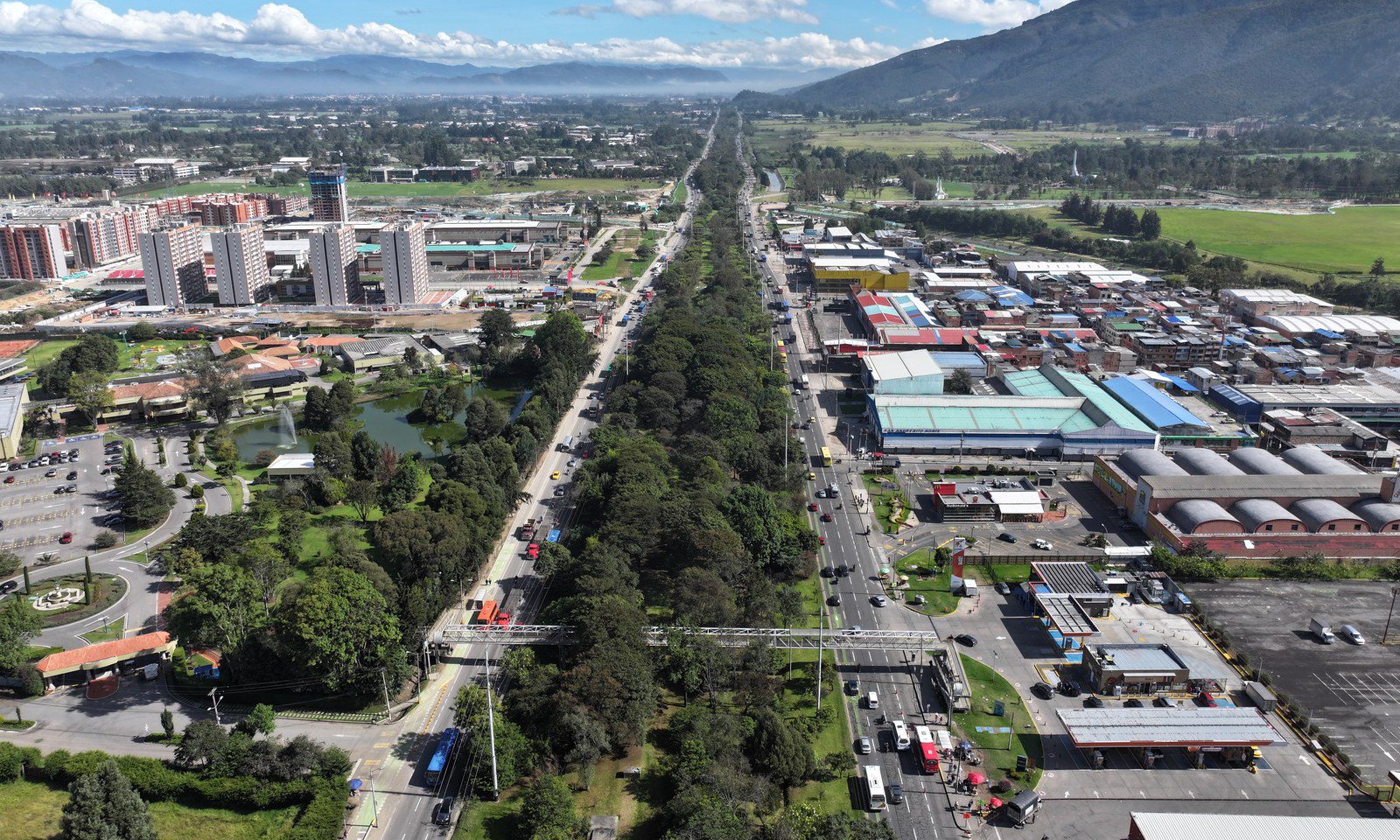
The Accesos Norte Fase II corridor in northern Bogotá. (Photo courtesy OHLA)
How the Debt Is Structured
FDN, a member of the government-linked financial holding company Grupo Bicentenario, will provide 50% of the funds, with J.P. Morgan and MUFG supplying the international portion under what La República described as a synthetic credit structure. Holland & Knight said in a September 25 announcement that the financing was structured in two debt tranches.
Holland & Knight’s announcement gives a larger figure than the $1.2 trillion COP loan amount reported elsewhere: $1.48 trillion COP, or about $480 million USD. The firm’s headline calls that figure the financing, while its text calls it the estimated investment total. Cuatrecasas, which advised the concessionaire and its shareholders, reported a $1.2 trillion COP syndicated financing. OHLA’s own announcement valued the financing at about €325 million EUR and put the total investment in the concession at about €900 million EUR.
The loan is backed by collections from Accenorte‘s existing tolls, and no new toll booths are planned on the corridor, according to La República. OHLA said that Moody’s Ratings, part of Moody’s Corporation (NYSE: MCO), gave the project’s sustainable financing framework an SQS2 (Very Good) Sustainability Quality Score in December 2025.
Sandra Vélez, CEO of Grupo Ethuss, said in remarks reported by La República that clearing the environmental requirements and having the funds actually disbursed allow the concessionaire to move ahead with a project she described as vital to Bogotá’s mobility.
“The financial close of Accesos Norte Fase II demonstrates the confidence of international and local banks in the capability of Colombian engineering.”
— Sandra Vélez, CEO, Grupo Ethuss
What Gets Built
The concession covers 17.96 kilometers divided into eight functional units, according to the concessionaire. On a 5.83-kilometer stretch of the Autopista Norte, it will improve the three existing lanes and widen both carriageways to five and six lanes, including an exclusive bus rapid transit lane for TransMilenio with extra lanes at stations. Cuatrecasas described the Autopista Norte works as running between Calle 191 and Calle 245.
On Carrera Séptima, the concessionaire will improve the existing roadway and build a new two-lane carriageway over 4.93 kilometers. The Sopó perimeter road will get 5.5 kilometers of improvements to the existing bypass and 1.7 kilometers of new two-way roadway. The scope also includes a 6-meter-wide strip of bicycle path and sidewalk along the Autopista Norte and Carrera Séptima, studies and designs for a grade-separated interchange at Calle 201 (Avenida Polo), and the design and construction of two U-turns at Calle 224 and Calle 235. The concessionaire’s timeline sets an 18-month pre-construction phase and a 66-month construction phase, with operation and maintenance running to year 29 from the contract’s start.
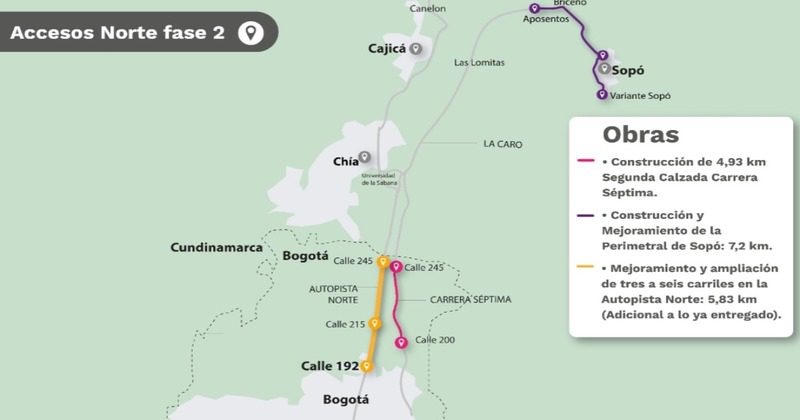
A 2022 IDU map of the Accesos Norte Fase II works, labeled in Spanish: the Autopista Norte widening (yellow), the second carriageway on Carrera Séptima (pink) and the Sopó perimeter road (purple). (Map courtesy IDU)
A Long Road to Financial Close
The Agencia Nacional de Infraestructura (National Infrastructure Agency, ANI) awarded the concession in March 2022 to the Estructura Plural Ruta Bogotá Norte consortium, then held in equal parts by OHLA’s Colombian branch and Termotécnica Coindustrial, a Grupo Ethuss company. The Alcaldía de Bogotá (Bogotá Mayor’s Office) said at the time that the project was part of an agreement between the ANI and the Instituto de Desarrollo Urbano (Urban Development Institute, IDU), with an estimated construction investment of $1.3 trillion COP in December 2021 pesos.
A first financial close of $700 billion COP with FDN followed in May 2024, Forbes Colombia reported, putting total project investment at $2.34 trillion COP in December 2023 pesos. None of the reports on the September 2026 close say how that earlier facility relates to the new loan.
The Autoridad Nacional de Licencias Ambientales (National Environmental Licensing Authority, ANLA) archived the concessionaire’s first application in January 2024 over technical shortcomings in hydrological and ecosystem connectivity with the Torca and Guaymaral wetlands, which are recognized as wetlands of international importance under the Ramsar Convention, El Espectador reported. The agency confirmed that decision in May 2024. The concessionaire filed a new environmental impact study in 2025, and the ANLA granted the license in January 2026 with obligations to protect the wetlands. La República reported that the September close took effect after the ANLA verified compliance with those environmental conditions.
FDN also participated in the Buga–Buenaventura highway financing in 2025, and the development bank has lent to energy projects such as the El Campano solar project in Córdoba.
At Holland & Knight, partner María Juliana Saa (above center) led the representation of FDN, J.P. Morgan and MUFG, supported by associate Juan Felipe Alonso (above left) and law clerk Santiago Osorio (above right). Cuatrecasas’ team was led by Manuel Quinche, managing partner of its Bogotá office, and finance partner Natalia Arango, and the firm also advised TMF Colombia as local security agent and calculation agent for the financing.
Headline photo: The Accesos Norte Fase II corridor in northern Bogotá. (Photo courtesy OHLA)
Eleven Colombian meat plants can now seek Philippine import permits
The Philippines has approved the veterinary health certificates that Colombia negotiated for beef and pork, which allows Colombian meat plants to begin applying for Philippine import permits. The Ministerio de Agricultura y Desarrollo Rural (Ministry of Agriculture and Rural Development) announced the approval on September 30, 2026, according to Valora Analitik, and the Ministerio de Comercio, Industria y Turismo (Ministry of Commerce, Industry and Tourism) followed with its own statement on October 1. The commerce ministry presented the approval as part of President Abelardo De La Espriella’s strategy to widen the destinations for Colombian exports.
The certificates do not by themselves put Colombian meat on Philippine shelves. Each establishment must still obtain import permits from Philippine authorities and show that it meets that country’s sanitary conditions before it can ship, El Espectador reported. The agriculture ministry said it would keep working with the Instituto Colombiano Agropecuario (Colombian Agricultural Institute, ICA), industry associations and producers to turn the sanitary approval into commercial shipments. Neither ministry’s statement gives a date for a first shipment.
Agriculture Minister Indalecio Dangond described the Philippines as “a market of more than 115 million consumers,” Portafolio reported. Commerce, Industry and Tourism Minister Mauricio Gómez Amín said in the ministry’s statement: “This is a national achievement that we celebrate, and it is the product of coordinated work between the public and private sectors.”
“It represents an important step for the diversification of Colombia’s exportable supply and the opening of new commercial opportunities in Asia.”
— Mauricio Gómez Amín, Minister of Commerce, Industry and Tourism
Eleven plants already cleared
The certificates complete a process that advanced in June 2026, when the Philippines’ Department of Agriculture authorized 11 Colombian plants, seven for beef and four for pork, according to Valora Analitik and El Tiempo. The authorization followed an audit that Philippine inspectors carried out in Colombia from October 25 to November 9, 2025, in a process that involved the ICA and the Instituto Nacional de Vigilancia de Medicamentos y Alimentos (National Food and Drug Surveillance Institute, Invima). The authorization runs for an initial three years, El Tiempo reported.
The beef plants belong to Alimentos Cárnicos, the meat-processing business of Grupo Nutresa (BVC: NUTRESA); Friogan; Camagüey S.A.; Frigotún; Frigosinú; and Red Cárnica, which has two approved plants. The pork plants belong to Agropecuaria Aliar, Frigotún, Supercerdo Paisa and Central Ganadera, according to El Tiempo and El Colombiano.
Two different measures of the Philippine market
The commerce ministry said the Philippines bought about 750,000 tons of beef and pork from the rest of the world over the last four years, worth roughly $2.2 billion USD, citing UN Comtrade data. Figures from the US Department of Agriculture’s Foreign Agricultural Service, cited by El Tiempo, put Philippine imports in 2025 alone at about 851,800 tons of pork and 207,400 tons of beef. The commerce ministry’s release does not explain how its four-year Comtrade figure was measured. Brazil is the largest outside supplier to the Philippine market, with more than 40% of shipments, El Tiempo reported.
Colombian beef exports are falling this year
The opening comes as Colombian beef shipments contract. Data from the Departamento Administrativo Nacional de Estadística (National Administrative Department of Statistics, DANE), cited by El Espectador, show beef exports worth $77.8 million USD from January through July 2026, down 28.4% from $108.6 million USD in the same period of 2025. Volume fell 44.6%, from 24,853 tons to 13,775 tons.
The commerce ministry’s release reported much smaller figures for the same seven months: 474.1 tons of beef worth $3.3 million USD, shipped to Algeria, Chile, Lebanon, El Salvador, the United Arab Emirates, Curaçao and Venezuela, and 199.9 tons of pork worth $583,159 USD, all of it to Venezuela. The release does not explain which products those figures include or why they differ from DANE’s totals.
The decline follows growth in 2025. Beef exports reached $148.5 million USD that year, up 39.4% from $106.5 million USD in 2024, while volume rose from 24,768 tons to about 30,456 tons, according to Analdex, the Colombian foreign-trade association, as reported by Valora Analitik. China took 61.6% of that volume, followed by Russia, Algeria, Chile and El Salvador. Colombia gained access to China after the two countries agreed on a health protocol in 2023, based on Colombia’s status as free of foot-and-mouth disease with vaccination.
On the pork side, Colombia produced 663,875 tons in 2025, an increase of 9.1%, according to the pork producers’ association Porkcolombia, as cited by Valora Analitik. Colombia does not yet rank among the world’s large pork exporters, Valora Analitik noted, and the commerce ministry’s figures show only Venezuela buying Colombian pork in the first seven months of 2026.
Headline photo: Cuts of Colombian beef. (Photo: Loren Moss)
Colombia Drew 92,884 Tourists From France in 2025, Up 5.5%
A delegation of 10 Colombian companies generated $11,064,000 USD in expected business from 208 meetings with buyers at IFTM Top Resa in Paris, held September 15-17, 2026, according to an announcement from Colombia’s Ministerio de Comercio, Industria y Turismo (Ministry of Commerce, Industry and Tourism). The ministry, which reported the figure as business expectations, did not say how many contracts were signed.
The buyers came from countries on five continents, according to the ministry, which described IFTM Top Resa as France’s main tourism trade fair. The delegation was accompanied by the Colombian Embassy in France and by ProColombia. ProColombia is the organization that promotes tourism, foreign investment, non-mining and non-energy exports and the country’s image.
IFTM reported in a September 21, 2026, statement that 34,638 tourism professionals attended its 48th edition at Porte de Versailles in Paris, up from 32,022 in 2025. The organizer also counted 1,625 exhibiting brands, 180 destinations and 18,592 confirmed business meetings.
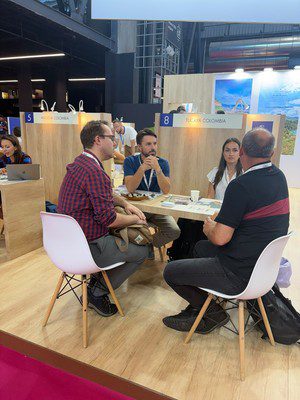
Participants meet at the Colombian delegation’s business-meeting tables during IFTM Top Resa in Paris. (Photo courtesy ProColombia)
Seven of the companies describe themselves on their websites as tour operators, travel agencies or destination management companies in Colombia: Macondo DMC, Tucaya Colombia, Aventure Colombia, Colombia Memories, Magelia Colombia, Kiubo Colombia and True Colombia Travel. The delegation also included the airline Avianca, the Corporación Turismo Cartagena de Indias (Cartagena de Indias Tourism Corporation) and Inspira AYC.
France as a Source Market

People gather at the Colombia stand’s coffee counter at IFTM Top Resa in Paris. (Photo courtesy ProColombia)
France remains the second-largest European source market for tourists to Colombia, according to the ministry. It said 92,884 tourists from France arrived in Colombia in 2025, an increase of 5.5% over 2024, and that Bogotá, Medellín, Cartagena de Indias and Santiago de Cali were among the main destinations for French travelers.
Avianca resumed direct Bogotá-Paris service in July 2024 with five weekly flights, returning to the route after 20 years, La República reported at the time. In May 2026, Avianca said its Bogotá-Paris route would continue operating seven weekly frequencies during the 2026 summer season, according to Semana.
The Colombian stand at IFTM Top Resa received more than 2,200 visitors and served an average of 500 cups of Colombian coffee a day, according to the ministry. Commerce, Industry and Tourism Minister Mauricio Gómez Amín said the results open opportunities for Colombian businesspeople and for regions for which tourism is a source of growth, jobs and development.
“These results show the interest that exists in our priority markets in getting to know what the country offers.”
— Mauricio Gómez Amín, minister of commerce, industry and tourism
Results at FITUR 2026
Colombia also exhibited at FITUR in Madrid earlier this year. ProColombia reported business expectations of about $42.4 million USD and 940 business meetings at that fair, with more than 9,000 visitors to the Colombian stand. ProColombia described the FITUR group as the largest business delegation Colombia has brought to the fair.
Headline photo: People gather at the Colombia stand’s coffee counter at IFTM Top Resa in Paris. (Photo courtesy ProColombia)
Organizers Build ColombiaPlast 2026 Around the Circular Economy
The 13th edition of ColombiaPlast opened September 28, 2026, at Corferias (BVC: CORFERIAS) in Bogotá with more than 320 exhibitors from 15 countries showing machinery, raw materials and recycling systems for the plastics, rubber, petrochemical and packaging industries. The fair, organized by Corferias, the Asociación Colombiana de Industrias Plásticas (Acoplásticos, Colombia’s plastics industry association) and Messe Düsseldorf North America, runs through October 2 in the Gran Salón and pavilions 11 through 22, alongside the 35th Feria Internacional Industrial de Bogotá (Bogotá International Industrial Fair, FIB).
Colombian exports of plastic products totaled $778 million USD in 2024, up 15% from the previous year, according to figures from the Dirección de Impuestos y Aduanas Nacionales (National Tax and Customs Directorate, DIAN) and the Departamento Administrativo Nacional de Estadística (National Administrative Department of Statistics, DANE) cited by the organizers. Imports of plastic raw materials exceed 1 million tons a year, up 20%, while imports of machinery, parts and molds average $136 million USD annually.
Daniel Mitchell, president of Acoplásticos, pointed to those figures in the organizers’ opening announcement: “The plastics industry arrives at ColombiaPlast with numbers that speak to its strength: we exported more than $778 million USD in 2024, and we continue to grow.”
“The challenge is no longer just to produce more, but to produce better. The recycling technologies, recycled resins and eco-design at this fair show that plastic can be part of the solution.”
— Daniel Mitchell, president, Acoplásticos
The fair takes place as Colombia phases in Ley 2232 de 2022 (Law 2232 of 2022), which gradually bans certain single-use plastic products. Under Articles 5 and 6 of the law, which took effect in July 2022, a first group of items, including checkout bags, drinking straws and cotton-swab sticks, has been prohibited since July 2024, and a second group, including disposable plates, cutlery and takeout food containers, will be prohibited starting in July 2030.
The 2024 edition of ColombiaPlast, which Finance Colombia previewed ahead of its opening, drew 297 exhibitors, 159 of them international, across 6,000 square meters of exhibition space, and projected business of $41.2 million USD, according to the organizers.
Acoplásticos is the plastics industry trade association in Colombia.
International Delegations and Suppliers
Multinational exhibitors include Borealis, Syensqo (Euronext Brussels, Euronext Paris: SYENS), Arkema (Euronext Paris: AKE), Krones (Frankfurt Stock Exchange: KRN) and Wittmann, alongside Colombian recycling and plastics-processing companies. According to the organizers, the Chinese delegation includes about 80 companies, while Brazil is represented by 28 companies through the Think Plastic Brazil export program and by machinery manufacturers from the Brazilian Machinery and Equipment Industry Association (ABIMAQ).
Italy is exhibiting as a national delegation for the first time, with the Italian Trade Agency (ITA) grouping eight companies at a single stand in pavilion 17, according to the organizers. Rosella Difrancesco, director of the ITA office in Bogotá, said: “This is the first time Italy has come to ColombiaPlast as a country, with eight companies on a single stand and technology for the entire plastics chain. Colombia and the Andean region are a strategic market, and we want to be close to the converters who are modernizing their plants.”
Themed Zones and Business Matchmaking
The show floor includes four themed zones: GoPlastic, for sustainability solutions; 3DFest, for 3D printing and additive manufacturing; a composite materials area of the Latin American Composite Materials Association (ALMACO); and Ruta Pintando Colombia (Painting Colombia Route), which brings together 16 suppliers to the paint and coatings industry. The academic program runs in pavilion 22 and six additional meeting rooms, and ProColombia and Corferias are hosting a rueda de negocios (business matchmaking session) on September 29 and 30.
Ana Garibello, ColombiaPlast project manager at Corferias, said the edition was planned around visitors’ time: “We designed this edition so that visitors can make the most of every minute: in a single tour they will find suppliers from around the world, machinery in operation, a top-level academic program and business appointments. And with the same ticket they can visit the Bogotá International Industrial Fair, which multiplies the opportunities for those who make purchasing decisions.”
Exhibitor Product Showcases
US-based Ampacet, which also operates in Colombia, is presenting PFAS FREE, a processing aid for food packaging that the company describes as fluorine-free and free of per- and polyfluoroalkyl substances (PFAS) and says complies with new US and European regulations. Ampacet introduced a PFAS-free polymer processing aid for blown-film extrusion in January 2023. Ampacet is also showing Gastop-Flex, a masterbatch for polyethylene films that the company says reduces oxygen and water-vapor transmission by up to 60%, allowing single-material packaging that is easier to recycle. Mauricio Mejía, technical service supervisor for the Andean region at Ampacet, said: “PFAS, the so-called forever chemicals, have their days numbered in food packaging. With PFAS FREE, Colombian manufacturers can produce with the same efficiency and meet the requirements of the United States and Europe in order to export. And with Gastop-Flex, we show that a package can protect food and, at the same time, be easy to recycle.”
Colombia’s Industrias Prime is presenting Safe-Grip, a tamper-evident cap with a degassing function that the company says is patented. Maura Villalobos Farelo, commercial manager of Industrias Prime, said: “The cap is a product used all over the world, and Safe-Grip shows that packaging innovation is also designed and patented in Colombia. It is a solution that protects the consumer and the product, and one we want to take to new markets from this fair.”
Other exhibitors are showing recycling equipment, recycled resin, container technology and a biodegradation process. China’s Zhejiang Boretech Environmental Engineering, part of BORETECH Resource Recovery Engineering (Taiwan Stock Exchange: 6887), is showing a modular PET bottle washing system that, according to the company, uses about 25% less floor space, a third fewer staff and 13.3% less energy per ton than conventional systems, along with a compact prewasher that it says removes up to 95% of labels with less than 1% material loss. Japan’s Nissei ASB Machine (Tokyo Stock Exchange: 6284) is exhibiting cans made of PET, specially shaped containers and its Zero Cooling technology, which the company says shortens production cycles. Ecuador’s NUTEC is showing 100% post-consumer recycled material that the company says replaces 20% to 30% of virgin plastic, and Colombia’s Grobma is presenting a biodegradation technology it calls RAWS (Return to Air, Water and Soil), which the company says allows plastic to biodegrade completely without leaving microplastics.
Admission and Hours
Admission is free for visitors who complete the professional pre-registration. General admission tickets cost $75,000 COP for visitors over 18 and include entry to both ColombiaPlast and FIB; they are sold at the Corferias box offices and on the ColombiaPlast website. The fair opened at noon on September 28 and runs from 10 a.m. to 8 p.m. from September 29 through October 2. Box offices open one hour before the fair and close at 7 p.m. Because it is a trade fair, the organizers advise against bringing minors.
Headline photo: Daniel Mitchell, president of Acoplásticos, and Ana Garibello, ColombiaPlast project manager at Corferias, in front of Acoplásticos signage at Corferias in Bogotá. (Photo courtesy ColombiaPlast)
Central Bank Says It Has Few Tools to Curb the Peso’s Appreciation
The Colombian peso’s rally this year reflected factors specific to Colombia rather than global weakness in the US dollar, Leonardo Villar, general manager of the Banco de la República (Bank of the Republic), Colombia’s central bank, said in remarks opening the 60th Convención Bancaria (Banking Convention) of Asobancaria, Colombia’s banking association, in Cartagena on August 26, 2026. Villar linked the appreciation in significant part to the financing of the fiscal deficit, reinforced by improved risk perception following the new government’s fiscal announcements, high domestic interest rates, and a rule requiring pension funds to bring investments home from abroad.
Villar said the market had closed the previous day at 3,090 pesos per dollar, which he put at more than 18% below its level at the start of the year, and that unlike in 2025, a generalized dollar depreciation does not explain the move, Valora Analitik reported. The peso has also appreciated more than 18% against the euro, Villar said, and by similar percentages against the currencies of countries such as Chile and Perú.
Two days before the speech, on August 24, the dollar touched an intraday low of 3,021.50 pesos, a level not seen since October 2018, before closing at 3,056.44, El Colombiano reported.
Deficit financing and capital inflows
Villar described the link to the deficit as a paradox, since a large deficit would normally push a currency toward devaluation. Colombia, he said, has a good record of meeting its obligations and access to financing, including international bond sales and purchases of peso-denominated public debt by investors abroad.
“Paradoxically, I believe this phenomenon is significantly related to the large fiscal deficit that the Colombian public sector has today.”
— Leonardo Villar, general manager, Banco de la República
“The financing involves capital inflows that feed the supply of foreign currency, and in that way it becomes an important source of appreciation of the peso,” Villar said, according to Infobae. The effect is reinforced when the country’s risk perception improves, he said.
Villar credited the “healthy announcements” of the new government of President Abelardo de la Espriella about its intention to carry out a significant fiscal adjustment and pursue an economic policy “friendlier to the private sector.” The resulting improvement in risk perception, he said, is “precisely what has happened in the last three months.”
Rates and repatriated pension savings
Villar said the appreciation is also reinforced when inflationary pressures force the central bank to raise interest rates and hold them well above international levels. He noted that the bank raised its policy rate by 275 basis points in the first half of the year. The benchmark has stood at 12% since July 1.
Added to that, Villar said, is “the obligation established by the previous government for pension funds to bring back to the country a significant portion of their investments abroad.” Under Decreto 0369 (Decree 0369), issued April 7, 2026, by the administration of former President Gustavo Petro, mandatory pension fund managers were required to reduce their foreign investments to a ceiling of 30%, with a transition period of up to five years and an intermediate limit of 35% within three years, Infobae reported at the time.
Andrés Velasco, president of Asofondos, the pension fund industry association, warned in April, in the same Infobae report, that forced repatriation would mean selling profitable assets abroad, “in many cases hastily.” He added: “Then those dollars would come in to push the currency toward revaluation, which means receiving fewer pesos for each dollar.”
On September 10, the Ministerio de Hacienda y Crédito Público (Ministry of Finance and Public Credit) published for public comment a draft decree that would eliminate the 30% cap, La República reported. The 30% cap remains in force until a final decree is issued; as of September 10, the proposal was open for public comment before the government would decide whether to adopt it. Velasco welcomed the proposal, according to La República: “A portfolio that is diversified will always be better; it will always be able to deliver greater returns, better risk management and better liquidity.”
The Superintendencia Financiera de Colombia (Financial Superintendency of Colombia) told the Unidad de Proyección Normativa y Estudios de Regulación Financiera (URF, Financial Regulation Projection and Studies Unit), which prepared the draft’s supporting technical document, that as of September 7 no fund manager had submitted the required adjustment plan, Infobae reported. The plans are due October 7; the draft would also eliminate that requirement. Foreign investments fell from 48.4% to 44.5% of the funds’ total portfolio between March 31 and July 31, but the funds’ dollar-denominated positions rose by about $5.73 billion USD, or 8.6%. The drop in share reflected the peso’s appreciation, not asset sales, according to Infobae.
The cost to exporters
Villar said the appreciation “takes competitiveness away from our exports” and makes it very difficult for goods produced in Colombia to compete with imports. The hourly wages that tradable-goods sectors pay low-skilled workers have risen about 28% in pesos, counting the minimum wage increase and the reduction in the legal workweek, and more than 50% when measured in dollars, he said.
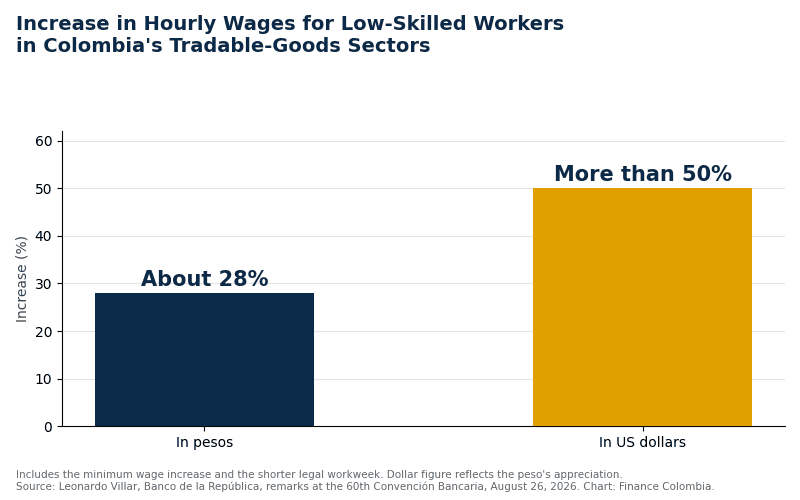
Hourly wages for low-skilled workers in Colombia’s tradable-goods sectors rose about 28% in pesos and more than 50% in dollars, according to Leonardo Villar. (Chart: Finance Colombia, with data from Banco de la República)
Measured with consumer price indices, Colombia’s real exchange rate peaked in the second half of 2022 and has since fallen about 33%, reaching levels in July “similar to the historical lows observed about 15 years ago,” Villar said. He said that “there is not much the Banco de la República can do to prevent these phenomena.” Instead, he said, “the fiscal adjustment and the government’s commitment to income and wage policies consistent with low and stable inflation are indispensable” for inflation to fall amid sustainable growth “without generating variations in the real exchange rate as dramatic as those we are observing in the current situation.”
Felipe Campos, investment and strategy manager at Alianza Valores y Fiduciaria, said on August 24 that attributing the dollar’s fall exclusively to drug trafficking or to the interest rate differential has little basis, according to El Colombiano. In his view, “the movement responds in large part to the entry of investors who are betting on an eventual shift toward greater economic orthodoxy in Colombia and Latin America.”
Where the peso and rates stand now
The peso weakened sharply in late August after the government’s revised 2027 budget disclosed a deeper fiscal deterioration, as Finance Colombia reported. On September 28, the official exchange rate certified by the Superintendencia Financiera stood at 3,306.86 pesos per dollar, down from 3,329.61 pesos for September 25, according to Infobae.
On the US side, the Federal Reserve‘s Federal Open Market Committee voted 12–0 on September 16 to raise the federal funds target range by a quarter percentage point to 3.75% to 4%. At its most recent monetary policy meeting, on July 31, the Banco de la República‘s board held its benchmark rate at 12% in a 4–3 vote. Its next rate decision is scheduled for September 30.
Headline photo: Leonardo Villar, general manager of the Banco de la República, speaks at Asobancaria’s Convención Bancaria in Cartagena on August 26, 2026. (Photo courtesy Banco de la República)
 Empleobilingue.com

- Director/a de operaciones para hotel, restaurante y discoteca 1626320364.60 - Medellín, Medellin, Antioquia, Colombia
- Coordinador/a de calidad para La Unión 1626483143.1 - La Unión, Antioquia, Colombia
- Desarrollador fullstack - Bogotá, Bogota, Colombia
- Technical Analyst - Remote
- PIM Administrator - Ecommerce - Remote (Bogotá, Bogota, Colombia)
- Auxiliar de gestión humana y bienestar para Girardota 1626060072.28 - Girardota, Antioquia, Colombia
- Marketing Strategist
- Trainer Manager - Bogotá, Bogota, Colombia
- Tolemaida UH- 60 Inspector - Bogotá, Bogota, Colombia
- Virtual Assistant - Team Lead - Remote
Contact Us

