Previous Story
Earthquake and Wildfires Push Colombia’s Food Inflation to 5.7% in August, Grupo Cibest Estimates
Posted On September 8, 2026
Comment: Off
Tag: Agriculture, banco de bogota, banco de la republica, bancolombia, Beef, caldas, chocó, colombia, consumer price index, dane, earthquake, el niño, food inflation, Grupo Cibest, IDEAM, oxford economics, perishable food, potatoes, Quindío, risaralda, servinformacion, SIPSA, Tolima wildfires, ungrd, valle del cauca
Grupo Cibest (NYSE: CIB; BVC: CIBEST) — the financial holding company Bancolombia created through a corporate reorganization in 2025 — estimates that Colombia’s food inflation accelerated to 0.31% month over month in August 2026, lifting the annual rate to 5.7%, as a magnitude-7.4 earthquake, wildfires in Tolima and an intensifying El Niño weather pattern squeezed the country’s perishable food supply. The estimate comes from the group’s Food Prices Monitor, published September 4, 2026, by its Economic, Industry and Market Research Area.
The monitor is built to anticipate Colombia’s official inflation reading before the National Administrative Department of Statistics, or DANE, publishes it. Grupo Cibest’s analytics team blends daily purchasing data from Servinformación, a company that tracks sales activity in neighborhood stores and small grocery outlets, with wholesale price information collected through DANE’s Sistema de Información de Precios y Abastecimiento del Sector Agropecuario (Agricultural Sector Price and Supply Information System), known by its acronym SIPSA. The report is signed by Laura Clavijo, Grupo Cibest’s chief economist and head of research; Arturo Yesid Gonzalez, quantitative and analytics manager; and Sebastian Ospina, data controller.
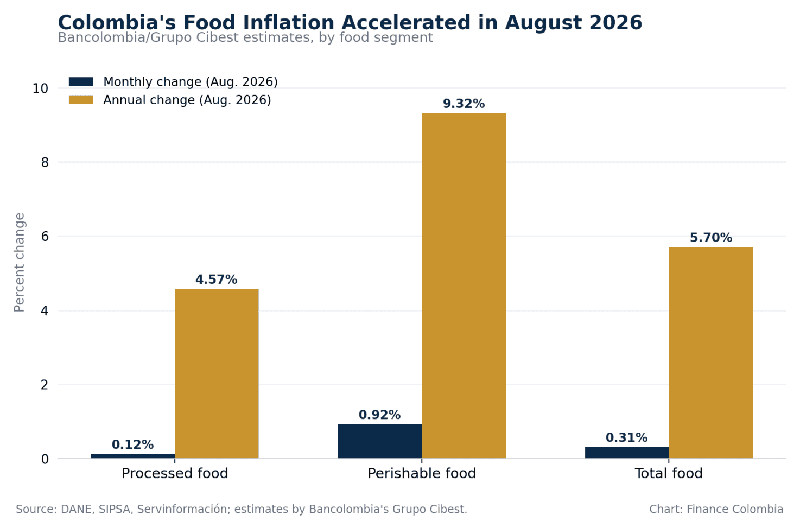
Perishable food prices drove Colombia’s food inflation in August 2026, rising 9.32% year over year versus 4.57% for processed food. (Chart: DANE, SIPSA, Servinformación; estimates by Grupo Cibest)
Perishable food prices rose 0.92% for the month and 9.32% year over year, more than double the pace of processed foods. (Chart: Finance Colombia, based on Grupo Cibest data)
Perishable food prices, the more volatile half of Colombia’s food basket, swung from a 0.83% monthly decline in July to a 0.92% increase in August, pushing their annual rate to 9.32%, Grupo Cibest said in the report. Processed food prices, packaged and industrially prepared goods that are less exposed to weather and harvest cycles, rose a comparatively modest 0.12% for the month, which Grupo Cibest said was two basis points above July’s reading, implying a July increase of roughly 0.10%; the annual rate for processed food stood at 4.57%.
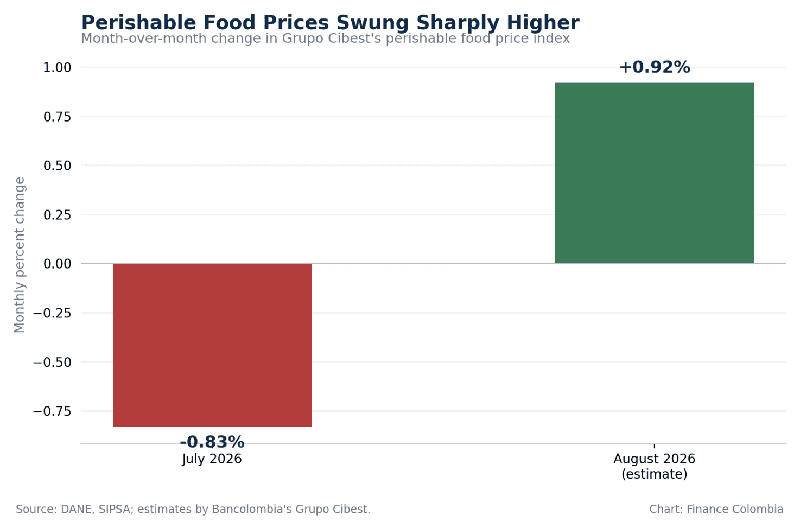
Perishable food prices swung from a 0.83% monthly decline in July to a 0.92% increase in August 2026. (Chart: DANE, SIPSA, Servinformación; estimates by Grupo Cibest)
Perishable food prices reversed course within a single month. (Chart: Finance Colombia, based on Grupo Cibest data)
Grupo Cibest attributed the swing in perishables to “a combination of adverse factors,” naming wildfires in the department of Tolima, the advance of El Niño, and damage from the earthquake that struck Valle del Cauca and Armenia, in Quindío department. On August 10, a magnitude-7.4 earthquake centered near San José del Palmar, in Chocó department, struck a wide swath of western Colombia. As of August 24, Colombia’s disaster relief agency, the Unidad Nacional para la Gestión del Riesgo de Desastres (National Unit for Disaster Risk Management), had confirmed 331 deaths and 240 people still missing, with damage reported across 16 departments and 494 municipalities, including Valle del Cauca, Chocó, Quindío, Risaralda and Caldas, according to newspaper Vanguardia.
At around the same time, a wildfire season in Tolima burned more than 20,000 hectares of vegetation across 13 municipalities during August, according to reporting by El Tiempo. Colombia’s meteorological institute, IDEAM, has confirmed that El Niño arrived roughly three months earlier than initially projected and is on track to reach one of the strongest intensities recorded since 1950 by the fourth quarter of 2026.
Nearly every item in the fruits and vegetables segment got more expensive in August. Potatoes led the group with an 8.5% monthly jump, and prices for vegetables and legumes climbed 7.1%. Oranges were up 6.0%, rounding out the largest gains Grupo Cibest recorded for the category.
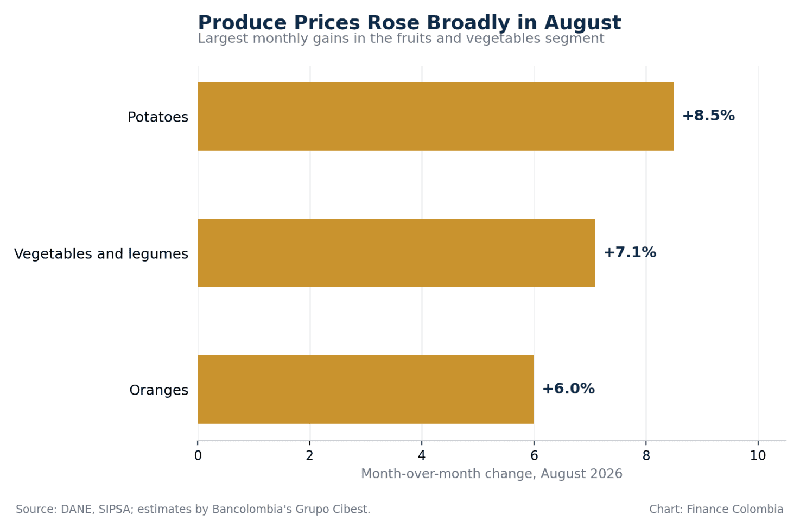
Potatoes, vegetables and legumes, and oranges led monthly produce price gains in Colombia in August 2026. (Chart: DANE, SIPSA, Servinformación; estimates by Grupo Cibest)
Potatoes led monthly gains in the fruits and vegetables segment. (Chart: Finance Colombia, based on Grupo Cibest data)
The picture was less uniform for animal protein. Processed meats climbed 1.15% for the month, the largest gain in that group, while beef added 0.4%. Pork moved the opposite direction, down 0.7%, and poultry slipped 0.3%. Grupo Cibest did not explain what is driving pork and poultry lower while beef and processed meats rise.
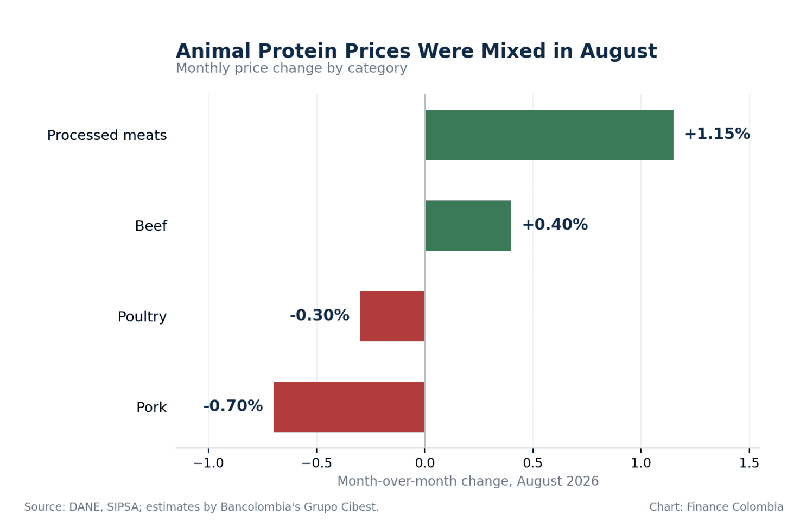
Protein prices were mixed in August 2026, with processed meats, beef, poultry and pork posting divergent monthly changes. (Chart: DANE, SIPSA, Servinformación; estimates by Grupo Cibest)
Processed meats and beef rose in August while pork and poultry prices fell. (Chart: Finance Colombia, based on Grupo Cibest data)
The estimate marks a sharp reversal from Colombia’s most recent official reading. DANE reported that consumer prices for food and non-alcoholic beverages fell 0.13% in July, a below-average reading in a month when the country’s overall annual inflation rate eased to 6.03% from 6.14% in June. If Grupo Cibest’s August estimate holds once DANE publishes its own figure, food would go from subtracting from monthly inflation to adding to it within a single month.
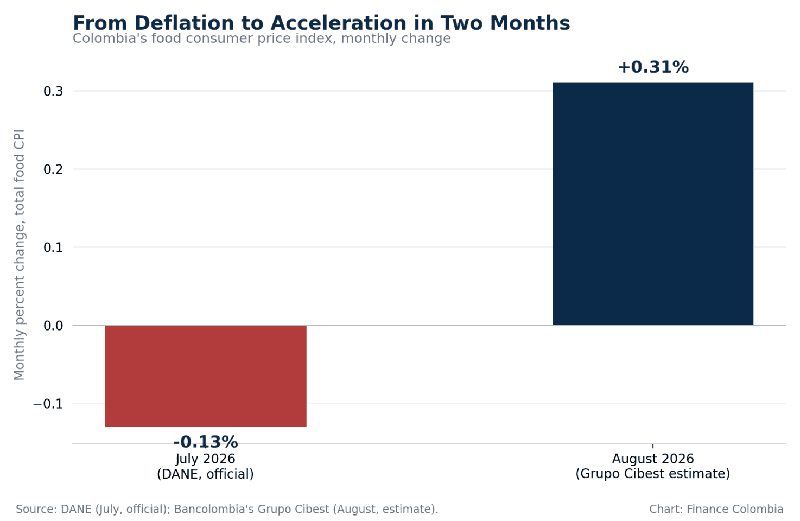
Grupo Cibest estimates food prices rose 0.31% in August 2026, reversing DANE’s official -0.13% reading for July. (Chart: DANE; estimates by Grupo Cibest)
Colombia’s food consumer price index went from an official monthly decline in July to an estimated increase in August. (Chart: Finance Colombia, based on DANE and Grupo Cibest data)
Other economists are also revising their outlooks upward because of the earthquake. Citing the risk of supply restrictions, higher demand for emergency relief goods, and damage to transportation infrastructure, Banco de Bogotá‘s economic research team projected monthly inflation of 0.2% in August and 0.3% in September, with the annual rate closing 2026 at 6.8%, according to reporting by Semana. Oxford Economics offered a more measured view, noting that the Colombian peso’s appreciation of nearly 15% during 2026 has been helping offset both El Niño and the earthquake’s impact on food costs, and it expects overall inflation to hold near 6% through year-end.
Beef and beef products carry the single heaviest weight of any food category in Colombia’s consumer price index, at 1.9%, followed by poultry meat at 1.2%, milk at 1.0% and rice at 0.9%, according to the weighting Grupo Cibest published alongside its report. That concentration means price swings in cattle and poultry markets carry an outsized effect on the overall food inflation reading compared with lower-weighted items such as coffee or sugar, even when those categories move by a larger percentage.
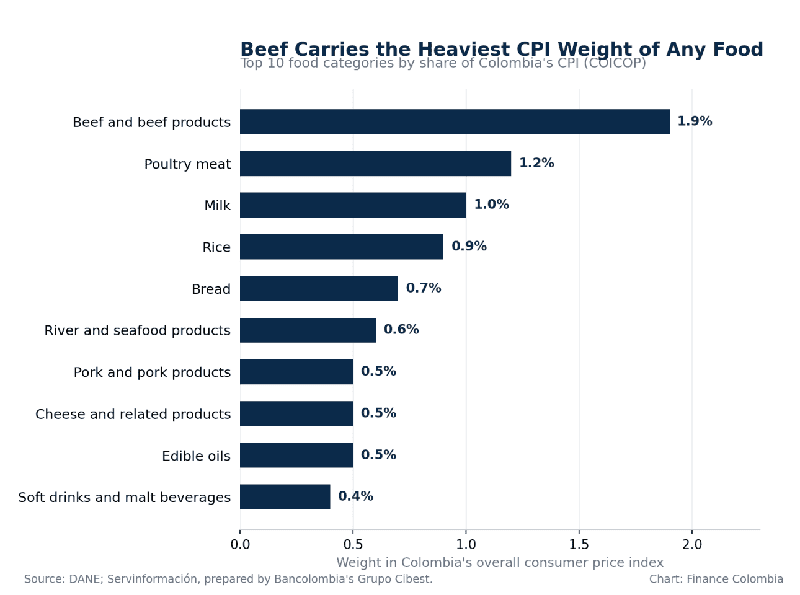
Perishable and processed food categories carry different weights in Colombia’s consumer price index, shaping how segment-level swings feed into the headline number. (Chart: DANE)
Beef carries nearly double the CPI weight of the next-largest food category. (Chart: Finance Colombia, based on DANE and Servinformación data prepared by Grupo Cibest)
DANE is expected to publish its official August consumer price index reading in the coming weeks, providing the first confirmation of whether food prices accelerated at the pace Grupo Cibest is projecting. The reading will also feed into deliberations at Banco de la República, Colombia’s central bank, which has been working to bring annual inflation back toward its 3% target from the 6.03% recorded in July.