Previous Story
Collective Mining Steps Out 340 Meters and Hits High-Grade Gold on Apollo’s Untested Northwest Margin
Posted On October 21, 2026
Comment: 0
Tag: apollo deposit, ari sussman, aris mining, caldas, CBM veins, cnl, collective mining, colombia, Colombian mining, continental gold, copper, david reading, diamond drilling, gold, gold exploration, Guayabales Project, Latin America mining, marmato, mineral resource, NI 43-101, ramp zone, silver, tungsten, visible gold, zijin mining
Collective Mining Ltd. (NASDAQ: CNL) (TSX: CNL) has reported assay results for four diamond drill holes on the western side of the Ramp Zone at its Apollo deposit, part of the Guayabales Project in Caldas, Colombia. Two of the four holes tested the northwestern margin of the Apollo breccia body for the first time, extending the Ramp Zone roughly 340 meters to the northwest into ground that had not previously been drilled.
The two step-out holes, collared about 120 meters apart, each cut high-grade gold. Hole APC164-D4 returned 12.10 meters grading 11.33 g/t gold-equivalent (10.85 g/t gold, 22 g/t silver and 0.04% copper) from 1,091 meters below surface, along with a second interval of 10.80 meters at 3.92 g/t gold-equivalent. Hole APC164-D3 returned 54.00 meters at 2.84 g/t gold-equivalent (2.51 g/t gold, 17 g/t silver) from 1,202 meters below surface, including a higher-grade core of 23.65 meters at 4.54 g/t gold-equivalent.
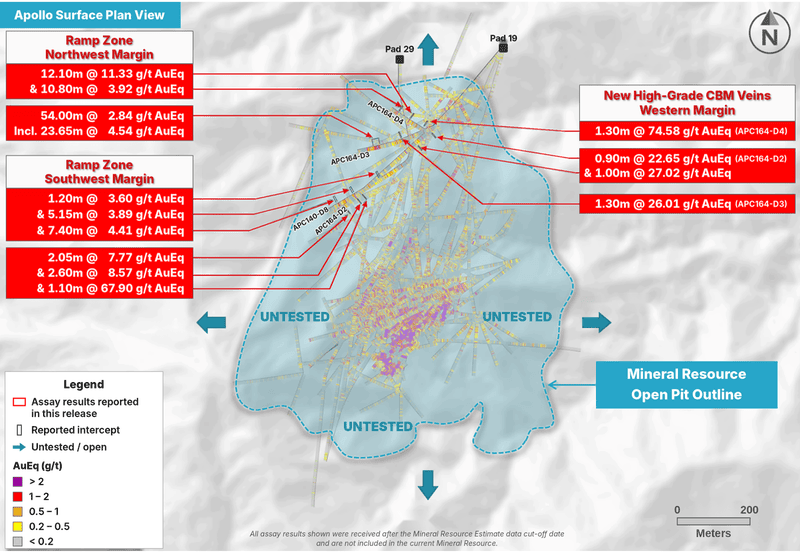
Surface plan view of the Apollo deposit, with the drill holes reported in this release along the Ramp Zone’s northwest and southwest margins. (Figure courtesy Collective Mining)
A third hole on the northwest margin, APC180-D4, was drilled approximately 80 meters below the two step-out holes. Collective reported that it intersected Ramp Zone-style sulphide mineralization with 19 separate occurrences of visible gold logged across 62 meters of core, the most the company has recorded in any hole on the northwest side of the Ramp Zone. Assays for that hole are pending. The company cautioned that visible gold is a visual observation only and is not a substitute for assay results, which are required to establish grade.
Collective’s geologists interpret APC164-D3 and APC164-D4 as having reached only the upper part of the Ramp Zone on the northwest margin, with the heavier sulphide content and visible gold logged deeper in APC180-D4 taken as support for that reading. The interpretation is consistent with the system dipping to the northeast, which the company says could place higher grades at greater depth.
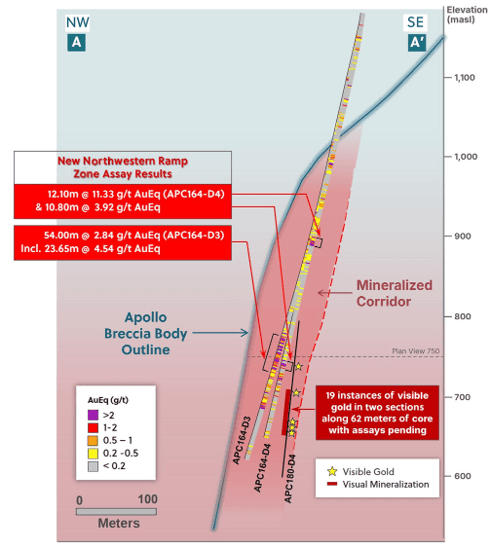
Section view of the Ramp Zone, outlining the new high-grade results along the northwest margin of the Apollo breccia body. (Figure courtesy Collective Mining)
New veins outside the modeled deposit
The program also cut high-grade veins in ground that sits outside the Apollo breccia body and was not included in any geological or block model. Hole APC164-D4 returned 1.30 meters at 74.58 g/t gold-equivalent (73.40 g/t gold, 61 g/t silver) from 946 meters below surface, and APC164-D3 returned 1.30 meters at 26.01 g/t gold-equivalent from 1,063 meters below surface.
Separately, every hole drilled on the western margin cut carbonate base metal (CBM) veins between roughly 1,000 and 1,180 meters elevation, in an area with no prior drilling. Results there included 1.00 meter at 27.02 g/t gold-equivalent and 0.90 meters at 22.65 g/t gold-equivalent in APC164-D2, and 1.50 meters at 12.13 g/t gold-equivalent in APC140-D8. The company said these veins lie outside the current mineral resource and that follow-up drilling is planned in 2027 to test their extent and continuity.
Two additional holes on the western margin of the Ramp Zone, APC164-D2 and APC140-D8, cut narrower intervals, including 1.10 meters at 67.90 g/t gold-equivalent from 1,288 meters below surface in APC164-D2. Collective interprets the southwestern portion of the Ramp Zone to begin deeper than the levels those holes tested.
How much of the system has been drilled
The Ramp Zone is a high-grade gold zone that runs along the outer margin of the Apollo breccia body and begins at roughly 1,000 meters above sea level. Mineralization there occurs with pyrite and pyrrhotite, with minor bismuth, tellurium and locally arsenopyrite-bearing sulphides, hosted in veinlet stockworks and cavities within the breccia. Three areas around the body’s interpreted 1.5-kilometer circumference have now been drill tested: the southeastern margin, the western margin and the newly drilled northwestern margin.
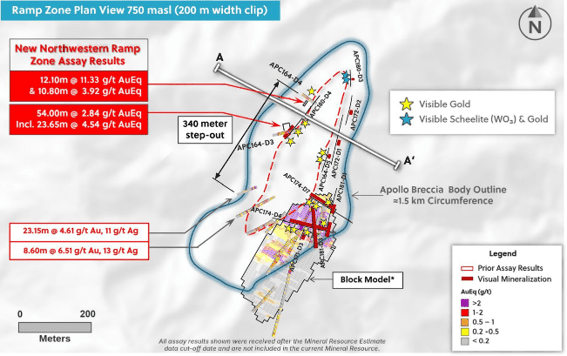
Plan view of the Ramp Zone, showing the holes drilled into the northwest portion of the Apollo breccia body. (Figure courtesy Collective Mining)
Including earlier drilling, about 590 meters of that 1.5-kilometer circumference has now been tested for Ramp Zone mineralization. By comparison, only about 315 meters, or roughly 21%, had enough drilling density to be included in the deposit’s maiden mineral resource. Collective noted that the wider drilling coverage does not, on its own, establish an extension of the resource, and that the intervals reported in this release sit outside the Ramp Zone block model and are not included in it. Assays are pending for 19 holes from the Ramp Zone.
The maiden mineral resource for Apollo, which anchors the Guayabales Project, stands at 2.58 million ounces gold-equivalent indicated (37.0 million tons grading 2.17 g/t gold-equivalent) and 2.83 million ounces gold-equivalent inferred (48.2 million tons at 1.83 g/t). Within that total, the southeastern segment of the Ramp Zone accounts for 0.20 million ounces indicated and 1.04 million ounces inferred, and is the only part of the Ramp Zone drilled densely enough to be included.
“The same mineralizing process that formed the high-grade Ramp Zone on the southeastern margin is now evident on the west and northwestern side of the breccia body.” — Ari Sussman, Executive Chairman, Collective Mining
The Marmato comparison
Collective interprets the Ramp Zone as a reduced, intrusion-related vein system with mineralogical similarities to the nearby Marmato Lower Mine, owned by Aris Mining Corporation (NYSE: ARIS) (TSX: ARIS) and previously referred to as Marmato Deeps. The two systems sit about 1.75 kilometers apart, begin at broadly similar elevations and host comparable gold- and silver-bearing sulphide assemblages. Collective attributes the locally higher gold grades it reports at the Ramp Zone mainly to the greater porosity of its host rock, a crackle breccia matrix that it says is more permeable to metal-bearing fluids than the porphyry host at Marmato.
The company cautioned that the two deposits are not equivalent, and that information on the Marmato Lower Mine has not been independently verified by Collective or its qualified person under National Instrument 43-101. Collective cited a 2022 NI 43-101 technical report on the Marmato lower mine expansion, available on Aris Mining’s Marmato project page. Aris Mining’s Marmato project is in construction, with first gold pour expected in late 2026.
Drilling, funding and timeline
Collective held $93.7 million USD in cash as of June 30, 2026, and says it is fully funded for a 2026 program of up to 90,000 meters. The company has 13 diamond drill rigs operating across the Guayabales Project and has taken delivery of the first track-mounted rig for deep drilling, with more expected. It intends to drill the Ramp Zone down to sea level, about two kilometers depth, in 2027. A 3-kilometer underground exploration adit, designed to reach the top of the Ramp Zone, is scheduled to begin construction in the fourth quarter of 2026; Collective detailed that adit earlier this year.
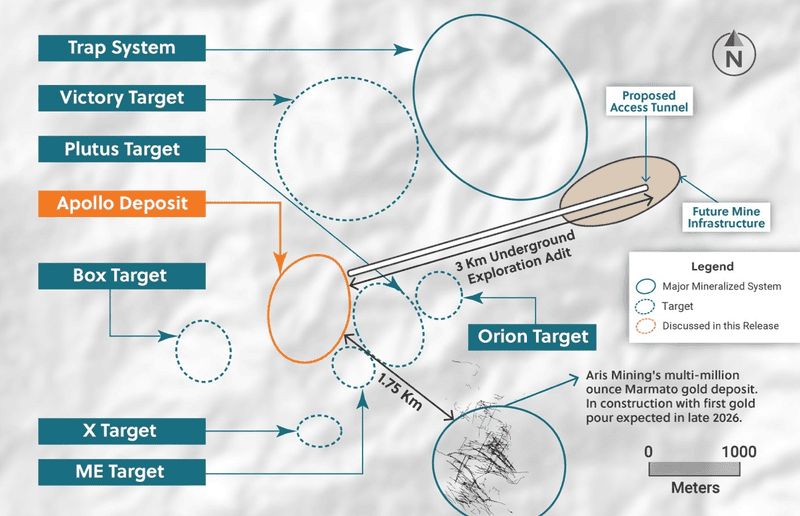
Plan view of the Guayabales Project, showing the Apollo deposit, the planned underground exploration adit and surrounding targets. (Figure courtesy Collective Mining)
To date, Collective has received assays for 200,500 meters of diamond drilling across the Guayabales and San Antonio projects, including 137,500 meters at Apollo. Assays are outstanding for 95 holes at Guayabales, covering about 36,000 meters, of which 19 are from the Ramp Zone. The company reported that roughly 47 kilometers of drilling has been completed at Guayabales since the March 31, 2026 database cut-off for the maiden resource. An updated mineral resource incorporating about 100,000 meters of additional drilling is expected between the fourth quarter of 2027 and the first quarter of 2028, followed by a preliminary economic assessment.
Gold-equivalent figures in the release use metal prices of $3,000 USD per ounce for gold, $60 USD per ounce for silver and $5.25 USD per pound for copper, with assumed recoveries of 95%, 92% and 85% respectively. Reported intervals are down-hole lengths; the company estimates true widths at 60% to 100% of the reported intervals.
Collective Mining holds two projects in Caldas, within a mining camp that contains ten permitted and operating mines. The company was founded by the team that built and sold Continental Gold to Zijin Mining Group (SSE: 601899) (SEHK: 2899) for about $1.4 billion USD in enterprise value in 2020. Management, insiders, a strategic investor and close family and friends hold 45.2% of the company’s shares. Collective trades on the NASDAQ and the TSX under the symbol CNL, and secured new mining titles at Guayabales earlier in 2026.