Previous Story
Antioquia Researcher Wins L’Oréal-UNESCO Backing to Clean Water With Palm Waste
Posted On October 21, 2026
Comment: 0
Tag: agro-industrial waste, Ainhoa Rubio Clemente, Andrea Katherine Orellana Manzano, antioquia, Augura, banana, biochar, Circular Economy, colombia, Colombian research, ecuador, Emerson Aguirre Medina, environmental engineering, epm, Escuela Superior Politécnica del Litoral, Fedepalma, For Women in Science, green hydrogen, Ipsos, L'Oréal, lima, medellin, oil palm, Palm Oil, panama, peru, Rafael Alberto Méndez Romero, research funding, Sheena Sangay, spain, STEM, UNESCO, universidad de antioquia, universidad del rosario, Universidad Nacional Agraria La Molina, urabá, wastewater treatment, water treatment, women in science
Colombia’s Agro-Industrial Waste Draws International Research Money
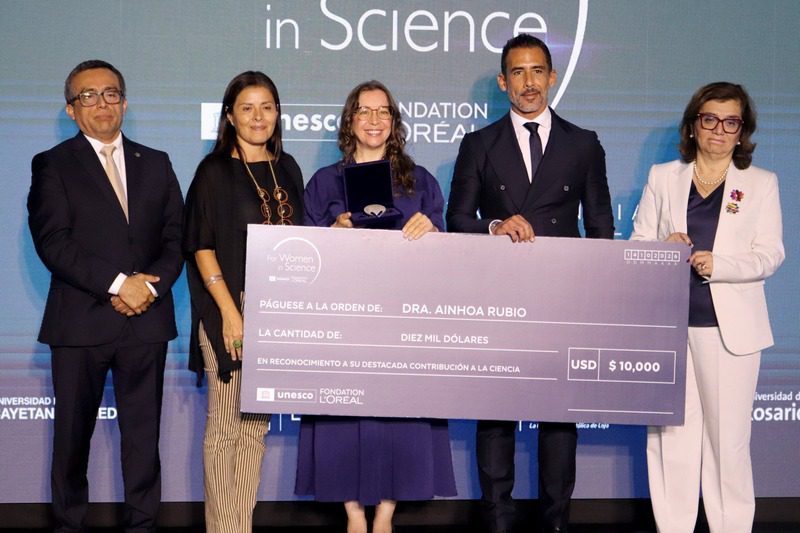
Ainhoa Rubio Clemente, a professor at the Universidad de Antioquia‘s Multicampus Urabá, has won $10,000 USD from L’Oréal (Euronext Paris: OR) and UNESCO to test whether residue from oil palm cultivation and processing can be converted into a material that strips contaminants out of water. She was named the Colombian winner of the 2026 edition of the L’Oréal-UNESCO For Women in Science regional program for Central America and the Andean Region at a ceremony in Lima on October 14, 2026.
Evaluators chose her from 92 applications submitted across Colombia, Ecuador and Peru. Universidad del Rosario is the program’s academic partner in Colombia and contributes to evaluating the entries, El Tiempo reported when the call for applications opened in February 2026.
The project will evaluate biochar — a carbon-rich solid produced by heating organic matter in a low-oxygen environment — as an adsorbent for contaminated water, according to the award announcement. Rubio Clemente will design and optimize a treatment system at laboratory scale and then validate the results against a real wastewater matrix. She told El Tiempo that she and other women professors at the university proposed turning the residue into cellulose as well as biochar.
“Science cannot limit itself to recognizing women’s talent; it must also create the conditions for them to develop it and advance without having to prove more than everyone else.” — Rafael Alberto Méndez Romero, Universidad del Rosario
According to the project, those residues can represent roughly 75% of the oil palm’s total weight, El Tiempo reported. Rubio Clemente said the biochar is already being used on wastewater: “The biochar, for example, is helping us treat the wastewater generated at businesses and in homes.” She said the project is not finished and has produced only preliminary results, but that it is going well so far, with high removal rates for turbidity and organic matter.
Colombia produced a record 1.93 million tons of palm oil in 2025, up 12% on 2024, with export sales of crude palm oil rising 53% from 382,000 tons to 583,000 tons, Fedepalma, the national oil palm growers federation, reported in its journal El Palmicultor. Local sales held steady near 1.3 million tons, and the federation credited a sustained recovery across all producing regions.
Oil palm is one residue stream among several in Urabá. Banana occupied 32,465 of the subregion’s hectares in 2025 and yielded 82 million boxes, figures the Asociación de Bananeros de Colombia (Colombian Banana Growers Association), known as Augura, presented and El Colombiano reported in April 2026. Nationally, Colombia exported roughly 133 million boxes of banana that year, Augura president Emerson Aguirre Medina told the newspaper, for export earnings El Colombiano put at $1.309 billion USD.
Urabá’s residues have drawn commercial interest before. EPM, the utility owned by the city of Medellín, has contracted the Universidad de Antioquia to lead studies on producing green hydrogen from the biomass left by the subregion’s banana, cocoa and palm operations, an effort reported in August 2025.
Rubio Clemente was born in Extremadura, Spain, studied environmental sciences in Salamanca, and moved to Colombia in 2012 to pursue a doctorate in environmental engineering at the Universidad de Antioquia, El Espectador reported. She told El Tiempo in October that she had won her faculty post in Urabá through a public merit competition almost four years earlier.
The For Women in Science program dates to 1998 and, according to its organizers, has recognized more than 5,000 women, counting laureates alongside doctoral and postdoctoral fellows, seven of whom went on to receive Nobel Prizes. More than 140 evaluators screened this year’s regional entries before a six-member grand jury assessed six finalists, two from each participating country. The other two winners, who each receive $10,000 USD as well, are Andrea Katherine Orellana Manzano of the Escuela Superior Politécnica del Litoral in Ecuador, for work on epigenetic markers associated with B-cell lymphoma, and Sheena Sangay of the Universidad Nacional Agraria La Molina in Peru, for research on ectomycorrhizal fungi and their response to human activity in Amazonian and Peruvian Yungas ecosystems.
Women accounted for 33.3% of researchers worldwide by head count in UNESCO Institute for Statistics data covering 107 countries for 2015 through 2018, figures that exclude North America and China. A survey across Colombia, Peru and Panama conducted by L’Oréal Groupe with Ipsos Napoleón Franco — the Colombian firm Napoleón Franco & Cía., acquired in 2005 by Ipsos (Euronext Paris: IPS) — identified labor market access, working conditions and advancement opportunities as the principal obstacles for women. UNESCO reported that the study found only one in three women who graduate in STEM fields goes on to a doctorate, and that 53% of women believe their compensation reflects their talent and individual contribution, against 69% of men.
The project also budgets for training undergraduate and graduate students and for outreach with communities in Urabá, aiming to produce methods that transfer elsewhere in Colombia and the region. Rubio Clemente told El Tiempo the approach could also be applied to other agro-industrial, forestry and household residues.
Headline photo: Ainhoa Rubio Clemente, center, receives the Colombian award at the L’Oreal-UNESCO For Women in Science regional ceremony in Lima on October 14, 2026. (Photo courtesy Universidad de Antioquia)