Previous Story
Tecnoglass Posts Record Third-Quarter Revenue as a Stronger Peso and Aluminum Tariffs Compress Margins
Posted On November 5, 2026
Comment: 0
Tag: adjusted EBITDA, aluminum windows, architectural glass, Asobancaria, backlog, banco de la republica, barranquilla, building products, capital expenditures, cartagena, christian daes, colombia, Colombian Exports, colombian minimum wage, colombian peso, commercial construction, Consejo de Estado, Decree 1469 of 2025, Decree 159 of 2026, Decree 636 of 2026, effective tax rate, Exchange Rate, fenalco, float glass, florida, full year 2026 guidance, gross margin, interest rates, inventory revaluation, jose manuel daes, leonardo villar, London Metal Exchange, Midwest premium, multi-family construction, operating income, peso appreciation, record revenue, Saint-Gobain, Santiago Giraldo, Section 232 tariffs, single-family residential, St. Lucie County, tecnoglass, Tecnoglass Holdings, tgls, third quarter 2026 earnings, US aluminum tariffs, US manufacturing, vinyl windows
Revenue Outlook Up, Adjusted EBITDA Down on Eight-Year Peso High
Tecnoglass Holdings (NYSE: TGLS) reported record third-quarter revenue of $310.6 million USD on November 5, 2026, up 19.2% from $260.5 million USD a year earlier. The Barranquilla manufacturer of aluminum and vinyl windows and architectural glass earned less on that revenue than it did on last year’s smaller base. Adjusted EBITDA fell to $47.7 million USD from $79.1 million USD, and as a share of revenue it dropped to 15.3% from 30.4%. Gross profit fell in absolute terms, to $106.0 million USD from $111.3 million USD. The company raised its full-year revenue guidance and cut its full-year Adjusted EBITDA guidance the same day.
The Adjusted EBITDA bridge in the company’s earnings presentation accounts for the roughly $31.5 million USD decline this way: volume, price and mix added $27.0 million USD and operating leverage $3.3 million USD. Against those, tariffs took $15.5 million USD, peso-denominated costs $15.1 million USD, US aluminum prices $13.5 million USD, a non-cash inventory revaluation $8.4 million USD, and selling, general and administrative expense a further $8.6 million USD, which the bridge shows separately from the tariff and currency items, with the glass joint venture accounting for $0.7 million USD. The two currency lines together, the peso-denominated costs and the revaluation, account for $23.5 million USD of the decline. Through nine months, revenue rose 15.8% to $854.9 million USD while Adjusted EBITDA fell 29.8% to $160.9 million USD.
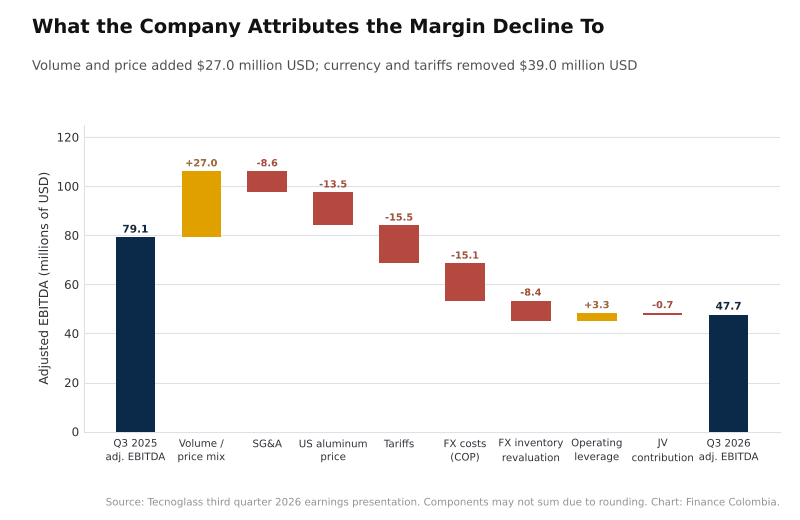
What the company attributes the Adjusted EBITDA decline to, by component. Source: Tecnoglass third quarter 2026 earnings presentation. (Chart: Finance Colombia)
Currency Accounts for Most of the Margin Decline
The peso appreciated 20.3% year over year and 11.6% against the second quarter, according to the presentation, reaching roughly $3,100 COP per US dollar and its strongest level since September 2018. Tecnoglass earns about 95% of its revenue in the United States but carries roughly 25% of its total costs and expenses in pesos, most of them labor, and the presentation estimates that a 5% move in the currency shifts margins by about 120 basis points. The presentation also says the company is hedging a portion of its exposure for 2026 and 2027.
Gross margin fell 860 basis points, to 34.1% from 42.7%. Tecnoglass attributed roughly 580 basis points of that to the peso. About 250 basis points came from a non-cash revaluation of approximately $8.4 million USD on inventory the company said was bought about 100 days earlier, before the currency strengthened, and sold afterward at a higher reported cost. The presentation puts the other roughly 330 basis points on higher peso-denominated costs. The company said that excluding the revaluation, gross margin was roughly in line with the second quarter. Tecnoglass also cited aluminum bought at peak prices, a higher share of installation revenue in the mix and higher labor costs, partly offset by operating leverage, the price increase it implemented in May 2026 and automation initiatives that the presentation says included a 10% headcount reduction completed during the second quarter.
Exchange rates worked the other way on the top line, adding $2.4 million USD to revenue. On a currency-neutral basis, growth was 18.3% rather than the reported 19.2%.
The appreciation is not specific to Tecnoglass. As Finance Colombia reported, Leonardo Villar, general manager of the Banco de la República (Bank of the Republic), told Asobancaria‘s banking convention in Cartagena in August 2026 that the rally reflected factors specific to Colombia rather than a weak US dollar, describing it as significantly related to the financing of the fiscal deficit, alongside high domestic interest rates and a rule requiring pension funds to bring part of their foreign investments home. He put the peso at $3,090 COP to the US dollar at that point, more than 18% stronger than at the start of the year. La República reported that the central bank left its rate at 12.25% on October 30, against the majority of analysts in a Citigroup survey who had expected a 25 basis point increase. Portafolio reported that four directors voted to hold and three for a 25 basis point increase.
The higher labor costs reflect a statutory increase the presentation puts at 23%. Colombia’s monthly minimum wage rose to $1,750,905 COP for 2026 under Decree 1469 of 2025. As El Colombiano recounted on October 20, the Consejo de Estado (Council of State) provisionally suspended that decree, the government preserved the same percentage through Decree 159 of 2026, and the court later revoked the suspension; the legality of the increase remains pending a final ruling, in a challenge brought by business groups including the retail federation Fenalco.
Where the Tariff Cost Lands
Selling, general and administrative expense rose to $74.0 million USD from $47.3 million USD, reaching 23.8% of revenue against 18.2%. The $26.7 million USD increase primarily reflected approximately $15.5 million USD of expenses associated with Section 232 tariffs on finished aluminum window imports, the release said, along with higher transportation and commission costs tied to revenue growth and the stronger peso. The presentation adds higher personnel costs from annual wage increases, and notes that the expense was flat against the second quarter on 5% higher sales. Operating income fell 51.2% to $31.9 million USD from $65.4 million USD.
On the input itself, the presentation reports that the average all-in US aluminum price rose 52.2% from a year earlier to $6,065 USD per ton, with the London Metal Exchange (LME) average up 25% to $3,375 USD per ton and the Midwest premium up 110% to $2,691 USD per ton. It says the company has secured aluminum for the fourth quarter of 2026 and the first quarter of 2027 at approximately $3,150 USD per ton on the LME benchmark, which covers the LME component of that all-in price; the presentation does not say whether the Midwest premium is similarly fixed. Finance Colombia reported in April 2026 that the company cut its 2026 Adjusted EBITDA guidance after the tariffs were extended to derivative products, and in August that it had absorbed a tariff shock alongside record second-quarter revenue.
Net income was $22.8 million USD, or $0.51 USD per diluted share, against $47.2 million USD and $1.01 USD a year earlier. That comparison includes a non-cash foreign exchange loss of $3.3 million USD this year against a $1.9 million USD gain last year, and a far lighter tax charge: the income tax provision fell to $2.4 million USD from $20.8 million USD, an effective rate of 9.6% against 30.6%. Neither the release nor the presentation explains the lower rate. Cash income taxes paid through nine months rose to $66.1 million USD from $59.1 million USD. Adjusted net income was $27.3 million USD, or $0.61 USD per diluted share, against $46.7 million USD and $1.00 USD a year earlier.
“Third quarter margins were pressured by costs outside of our control, including elevated aluminum costs, ongoing tariffs and a Colombian Peso at its strongest level since 2018.” — José Manuel Daes, chief executive officer, Tecnoglass
The Two Segments Diverge
Multi-family and commercial revenue grew 30.9% to a record $192.4 million USD, which the company attributed to execution on a record backlog as projects moved into more advanced stages. Single-family residential revenue grew 4.1% to $118.1 million USD, held back by orders customers had placed in the second quarter ahead of the May price increase, roughly $15 million USD of volume according to the presentation. Chief Executive Officer José Manuel Daes said single-family residential revenues “grew 17% year-over-year excluding the previously disclosed pre-buy activity in the second quarter, reflecting continued market share gains as we expand outside of Florida.” Single-family orders, which the presentation reports separately, grew 4.5%.
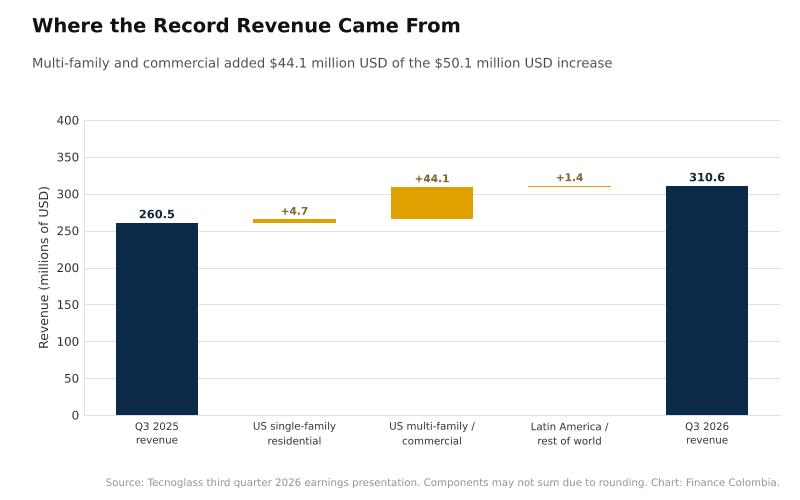
Multi-family and commercial added $44.1 million USD of the $50.1 million USD increase. Source: Tecnoglass third quarter 2026 earnings presentation. (Chart: Finance Colombia)
Guidance Moves in Two Directions
Tecnoglass raised its full-year 2026 revenue guidance to a range of $1.10 billion USD to $1.14 billion USD, from the $1.08 billion USD to $1.12 billion USD range issued with second-quarter results in August. It cut Adjusted EBITDA guidance to $210 million USD to $220 million USD, from $220 million USD to $230 million USD. Chief Financial Officer Santiago Giraldo said the change in the Adjusted EBITDA outlook “mainly reflects the approximately $8.4 million non-cash inventory revaluation in the third quarter,” and that the company is “committed to fully offsetting the impact of tariffs in 2027, as automation savings and full-year pricing are realized.” The cut is $10 million USD at both ends of the range. According to the outlook presented with the results, the high end assumes the peso depreciates gradually through year end and the low end assumes its strength persists.
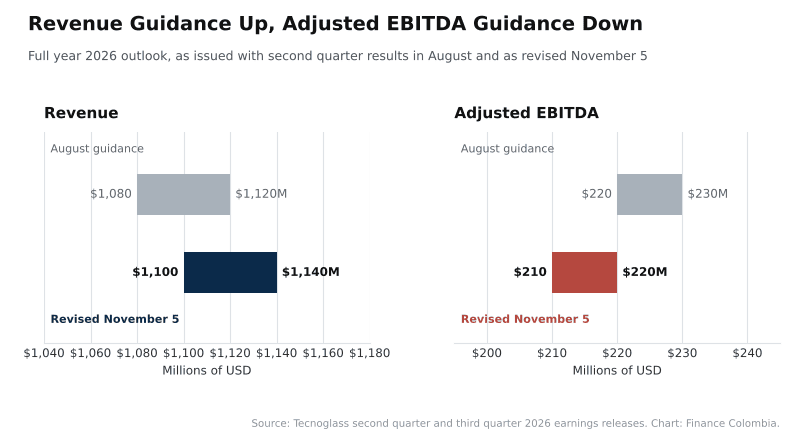
Revenue guidance rose while the Adjusted EBITDA range fell. Source: Tecnoglass second and third quarter 2026 earnings releases. (Chart: Finance Colombia)
Backlog Reaches a Record
Backlog expanded 13.2% to a record $1.43 billion USD, which the presentation describes as roughly 1.3 times trailing 12-month revenue. The presentation puts 97% of the backlog in the United States. Chief Operating Officer Christian Daes said Tecnoglass “continued to book large projects within the luxury lodging and condo market, and subsequent to quarter end signed our largest project to date, which continues to provide strong visibility for the next few years.” The company did not name the project or disclose its value. Christian Daes said the May pricing will reach multi-family and commercial revenue as projects booked after the increase move through the backlog, starting with shorter-cycle work late this year and larger projects in 2027.
Tecnoglass ended the quarter with total liquidity of approximately $380 million USD, of which $97.7 million USD was cash and $280 million USD undrawn revolving and other credit, against total debt of $293.6 million USD. The presentation puts net debt at 0.88 times trailing Adjusted EBITDA, up from 0.57 times three months earlier, which the company attributed to land and capital expenditure financing. The presentation’s net debt reconciliation shows net debt of $196.0 million USD against net cash of $12.1 million USD a year earlier, with gross debt up from $111.9 million USD. Cash from operations was $21.5 million USD in the quarter and $32.6 million USD through nine months, down from $104.7 million USD in the same nine months of 2025; over the same nine months the company spent $118.7 million USD on property and equipment and drew $131.0 million USD in new debt. Third-quarter capital expenditures of approximately $66.1 million USD included the completion in August of a previously announced $23 million USD land purchase in St. Lucie County, Florida, where Tecnoglass said a feasibility study for a potential plant remains active and carries no commitment to build.
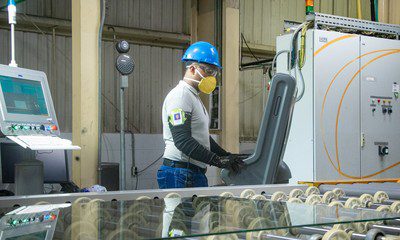
A glass production line at Tecnoglass in Barranquilla. (Photo courtesy Tecnoglass Inc.)
Tecnoglass sources glass partly through a joint venture with Compagnie de Saint-Gobain (Euronext Paris: SGO), whose proportional contribution is included in Adjusted EBITDA and was $0.7 million USD lower than a year earlier. Separately, Colombia imposed a 35% tariff in June 2026, for a five-year term, on colorless float glass imported from countries with which it has no free trade agreement. Decree 636 of 2026 states that the measure is intended to protect national float glass production. Neither the release nor the presentation addresses its effect on Tecnoglass. Full results appear in the company’s third quarter 2026 earnings release.
Headline photo: Workers handle aluminum window profiles at a Tecnoglass plant in Barranquilla. (Photo courtesy Tecnoglass Inc.)