Previous Story
inDrive’s Juan Sebastián Uribe Tells Finance Colombia How Driver Lending and Safety Anchor Its Colombian Superapp Plan
Posted On November 5, 2026
Comment: 0
Tag: abelardo de la espriella, Alexander Kurchin, Alianza In, Arsen Tomsky, barranquilla, bogotá, colombia, cucuta, dane, datacredito, Decreto 0991 de 2026, delivery couriers, driver loans, embedded finance, Financial Inclusion, fintech, gig economy, hugo ospina, indrive, inDrive Delivery, indrive money, Ipsos Napoleón Franco, José Daniel López, Juan Sebastián Uribe, Julio Elías Vidal, labor reform, Ley 2466 de 2025, Mauricio Toro, medellin, Mercado Libre, ministerio de transporte, Ministerio del Trabajo, mobility platforms, personalized pricing, Por allá sí voy, r2, Ride Hailing, RTaxi, RUNSTIP, soat, superapp, superintendencia financiera, Taxi Drivers, Truora, uber, uber eats, usury cap
Driver loans up 88% as inDrive maps its Colombian superapp
Juan Sebastián Uribe is the first country manager for Colombia at inDrive, according to Portafolio, which reported the hire on September 24, 2026. inDrive is a mobility and delivery platform founded by Arsen Tomsky in Yakutsk and now headquartered in Mountain View, California. Uribe says in the interview that he had been in the role three months when it was recorded. He arrived from Mercado Libre (NASDAQ: MELI), where he spent seven and a half years leading the vehicle marketplace and the TuCarro brand in Colombia. Loren Moss, Executive Editor of Finance Colombia, spoke with Uribe during the week of October 20. The conversation was conducted in Spanish and has been translated and lightly edited for clarity.
inDrive entered Colombia through Cúcuta in 2018 and now operates in more than 45 cities, with more than 300,000 monthly active drivers, according to the company. The platform uses a peer-to-peer fare model in which the passenger names a price, drivers counter, and the passenger chooses, rather than an algorithm setting the fare.
What inDrive.Money Is, and What It Is Not
The lending vertical at issue is inDrive.Money, which inDrive launched in Colombia in September 2024 with the Latin American fintech R2. Finance Colombia covered that launch, which began in 17 cities with loans of up to $1 million COP and repayment terms of three to five months. Uribe describes the product as newly launched in Colombia; the company dates the Colombian launch to September 2024, and its October announcement reported growth rather than a launch.
Finance Colombia asked whether the product is supervised by the Superintendencia Financiera (Financial Superintendency). The company said it is neither a lender nor a financial institution in Colombia. “In Colombia, inDrive does not lend money and is not a financial institution,” it said in written responses. “inDrive.Money is a technology platform that connects drivers with our lending partner. In Colombia, our partner is the fintech R2, which grants loans, sets the terms, handles credit decisions, and operates in full compliance with Colombian law.” R2 describes itself as an embedded finance platform operating in Mexico, Brazil, Chile, Colombia and Peru. The company did not say whether R2 is supervised by the Superintendencia Financiera.
Click above to watch the video!
Loans still run up to $1 million COP, with the amount offered depending on each driver’s activity and earnings in the app, according to the company. It said all loans are granted by R2 and comply with Colombian law, including the usury cap, and that the rate, fees and total cost appear in the app before a driver accepts. The Superintendencia Financiera certified the interés bancario corriente (current bank interest rate) for consumer and ordinary credit at 19.06% effective annual for October, the month of the interview, in Resolución 1472 de 2026 (Resolution 1472 of 2026), which puts the usury ceiling at the statutory 1.5 times that rate, or 28.59%. The ceiling fell to 28.34% for November. The company did not provide an effective annual rate inclusive of fees and insurance, and did not say whether the three-to-five-month terms it launched with still apply.
Repayments are built into the app and come out of a share of each fare, the company said, and borrowers may also repay the lender directly outside the app if they choose. The company also said that “as inDrive is an intermediary, in Colombia inDrive doesn’t report repayment history to any credit bureaus.” It did not say whether R2, as the lender of record, reports to Datacrédito or any other bureau. The company did not address how delinquency has performed.
Uribe described the credit model as resting on platform data rather than a bank file.
“Traditional banking does not take into account all the information that we have as a platform.” — Juan Sebastián Uribe, country manager, inDrive Colombia
The Lending Numbers
inDrive said in an announcement at the start of October that loans taken through inDrive.Money across Latin America rose 118% year over year in the first half of 2026. Demand grew 128% in Peru, 88% in Colombia and 71% in Mexico, while Brazil, where the vertical launched in August 2025, grew more than 400%. Alexander Kurchin, general manager of inDrive.Money, said in that announcement that the growth shows clear and expanding demand for what he called fairer, more transparent access to personal loans among participants in the sharing economy.
More than 67,000 drivers in Colombia have used the service since its September 2024 launch, the company told Finance Colombia, and in the first eight months of 2026 alone they took more loans than in all of 2025. The company did not give the number of loans outstanding, the number of current borrowers, or the share of its active drivers who have taken one.
The company attributed Colombia’s slower growth than Peru’s to the maturity of each market rather than to demand. Colombia launched in September 2024, so the first half of 2025 was already a period of steady lending, while Peru launched in April 2025 against a much smaller first-half base.
Asked for the Colombian figure on repeat borrowing, the company put the share of first-time Colombian borrowers who go on to take a second loan at around 50% in its written responses. In Mexico, an impact report developed by the Asociación de Internet MX and published in February 2026 found that more than 11% of active drivers in that country had used an inDrive.Money loan, and that close to half of those who applied for one went on to take another, according to inDrive.
The company listed several limits it says guard against over-indebtedness. Loan payments are capped at 15% of a driver’s average monthly earnings. Only drivers with steady activity and several months of earnings in the app receive offers. Each new loan is underwritten against current earnings and repayment history, and a driver qualifies for a larger amount only after a record of on-time payments. A study inDrive commissioned from Ipsos Napoleón Franco found that 75% of surveyed drivers are the main or only income earner in their household.
The company said its next focus is growing inDrive.Money in Colombia, that drivers who repay well unlock larger amounts over time, and that it is examining how to extend the product to people earning through other inDrive services, including Delivery. It did not commit to vehicle financing, insurance, savings products, payments through Bre-B, the interoperable instant payment system run by the Banco de la República (Bank of the Republic), or lending to riders.
The Economic Footprint
inDrive commissioned Ipsos Napoleón Franco to measure the economic activity its platform enables in Colombia, and said the firm carried out the work independently using its own methodology, combining economic impact modeling with surveys of drivers and riders. The study put that activity at $7.45 trillion COP in 2025, or 0.4% of national gross domestic product, and associated it with more than 51,900 indirect jobs in sectors such as repair shops, service stations, insurers and retail, excluding the drivers themselves, according to inDrive’s account of the study.
The study measures the economic activity the app enables, not inDrive’s revenue. Ipsos built the estimate on an input-output model using official matrices from the Departamento Administrativo Nacional de Estadística (National Administrative Department of Statistics, DANE), with values expressed in 2026 prices. Fieldwork ran from February 10 to March 24, 2026, and covered 1,145 online surveys, 945 of them with users and 200 with drivers, plus 22 in-depth interviews. The survey findings describe those respondents, not the whole driver base.
For 2027, the company said it will keep growing its driver base and develop as a superapp. Its other verticals in Colombia include inDrive Delivery, inDrive City to City and inDrive Ads. Delivery grew more than 90% in 2025 over the prior year, driven by Medellín, Bogotá and Barranquilla, El Tiempo reported.
Regulation on Two Fronts
Two separate regulatory questions were open at the time of the interview.
The first is the attempt to regulate platform-intermediated transport. Proyecto de Ley 347 de 2026 (Bill 347 of 2026), filed by the Ministerio de Transporte (Ministry of Transport) and the Superintendencia de Transporte (Transport Superintendency), would have created a sanctions regime for the platforms. Alianza In, the guild inDrive belongs to, said its practical consequence would be the absolute prohibition of mobility platforms. The government then withdrew the bill, saying it was doing so to adjust the articles, El Universal reported on February 3, 2026, adding that the text would be modified before any eventual new filing.
In the interview, Uribe says that “a week ago, the first bill was passed to regulate apps.” Finance Colombia names it as Por allá sí voy (I do go that way), and he agrees. That bill, Proyecto de Ley 430 de 2026 Cámara, was filed in the Cámara de Representantes (Chamber of Representatives) on Tuesday, October 13, 2026, by Representative Mauricio Andrés Toro Orjuela of Alianza Verde and six other members from five parties, rather than approved.
Its text recognizes digital mobility platforms as providers of a technological intermediation service, and states that they are not comparable to transport companies. It creates the Registro Único Nacional del Servicio de Transporte Intermediado por Plataformas Digitales (National Single Registry for Platform-Intermediated Transport Service, RUNSTIP) inside the Registro Único Nacional de Tránsito (National Single Traffic Registry, RUNT), a registry the Ministry of Transport would regulate. Inspection and oversight of the platforms themselves would fall to the Ministry of Information and Communications Technologies. Article 18 sets a non-tax contribution of 1.5% of an intermediary platform’s net revenue from each trip, and the platform may not pass it on to the driver. The bill’s explanatory statement notes that the Estatuto General de Transporte (General Transport Statute, Ley 336 de 1996) recognizes only public and private service, leaving platform-intermediated transport without a category of its own, and that the regulatory debate has moved into the courts rather than Congress.
The organized taxi sector has objected. Hugo Ospina, who represents the taxi drivers’ guild, told Semana that public and private transport share neither characteristics nor obligations, and that the bill cannot disregard the constitutional provisions governing public services.
A separate measure from Senator Julio Elías Vidal of Partido de la U, Proyecto de Ley 136 de 2024 Senado, titled Por medio de la cual se regula el servicio de transporte privado intermediado por plataformas digitales (regulating the private transport service intermediated by digital platforms), cleared first debate in the Senate’s Comisión Sexta (Sixth Committee) after being filed in Congress close to 19 times, as the Senate recorded. That vote was in December 2024. Finance Colombia reported in October 2024 on a congressional proposal to regulate the platforms.
The second front is delivery, and the rule is already on the books. Decreto 0991 de 2026 (Decree 0991 of 2026), signed in Bogotá on August 4, 2026, three days before the end of Gustavo Petro’s term, is executive regulation issued under the 2025 labor reform, Ley 2466 de 2025 (Law 2466 of 2025), and governs social security contributions for independent platform couriers.
Its financing rules turn on what a courier earns. Health and pension contributions are funded concurrently, 60% by the platform and 40% by the courier. For couriers earning less than one monthly minimum wage, no contributory-regime health contribution is assessed on either party, pension contributions remain mandatory, and the platform assumes and pays 100% of the occupational-risk contribution. For couriers earning one monthly minimum wage or more, affiliation to contributory health, pension and occupational-risk coverage is mandatory, and contributions are calculated on a base of 40% of actual earnings, or on one monthly minimum wage where that 40% comes out lower.
Its obligations are not yet being collected. Article 2 provides that the contribution, withholding, reporting and collection duties become enforceable only after the 12-month period set in Article 67 of Ley 2466 de 2025, and that the clock starts once the Ministerio de Salud y Protección Social (Ministry of Health and Social Protection) certifies in an official communication that the required adjustments to Colombia’s integrated contribution-filing system are fully operational.
Alianza In rejected the decree. Its executive president, José Daniel López, said in a post on X that the decree destroys what had been achieved on social security for couriers who work through apps. In August the guild called on the then-incoming government of Abelardo De La Espriella and Vice President José Manuel Restrepo to repeal it, as El Tiempo reported.
inDrive’s own position, as given in its written responses, is that its commissions run below the industry average and that couriers choose how many requests to accept, at what price and for how long. The company said it is in open conversation with the Ministerio del Trabajo (Ministry of Labor), arguing that the August decree does not reflect the months of tripartite dialogue that preceded it, and that as a member of Alianza In it is aligned with the industry’s position.
Uribe’s account of safety runs beyond Seguro Obligatorio de Accidentes de Tránsito (Mandatory Traffic Accident Insurance, SOAT). He says inDrive carries coverage on every trip, screens drivers through the Colombian verification company Truora, and has built more than 25 in-app safety features. He puts the share of incident-free trips at 99.99%.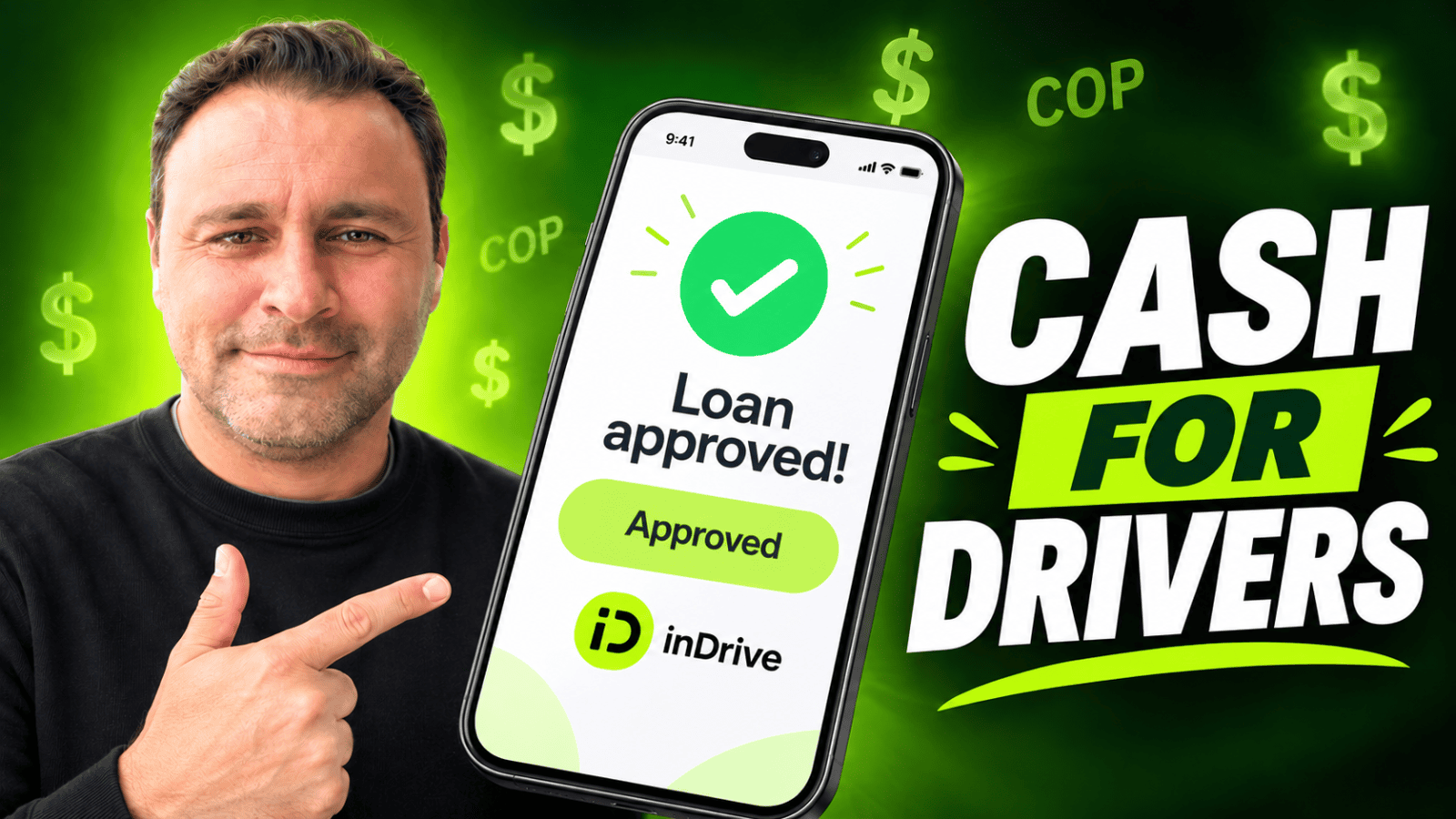
Finance Colombia: I am here with Juan Uribe. Thank you very much for your time. I know that you must be very busy, so thank you for your time with us. So, as I understand, you are the new country manager of inDrive for Colombia, right?
Juan Sebastián Uribe: Hello Loren, good morning. Greetings to everyone. Thank you for having us here on your channel. Yes, it is a new role at inDrive in Colombia. I have been a country manager for three months for the operation in Colombia. And I am here to create the superapp in the country.
Finance Colombia: Excellent. And as I understand, as the first country manager of inDrive in Colombia, after, if I am not mistaken, seven and a half years in Mercado Libre, why did the company decide to create this role now? And what would your mission be for the next 12 or 18 months, the next year or couple of years?
Juan Sebastián Uribe: Of course, Loren. My philosophy has been to connect two strangers by making a transaction through technology. As you say, I came from Mercado Libre, I had Marketplace, where the buyer and seller connected to make the transaction of a vehicle. Now in inDrive it is the same, but with millions of transactions. So I am here connecting. Connecting the driver and passenger users through a safe ecosystem. What is important and what is going to be my priority for the first 24 months, as you ask? One, the construction of a superapp that allows us to improve the experience that an inDrive user has in the application. Today we already have inDrive Delivery, we have inDrive Ads, we have inDrive City to City and we have inDrive Money, which we are going to talk about later. Also part of the creation of this superapp would not be possible without an environment of security. Security is the most strategic pillar for inDrive in Colombia. Let me tell you, Loren, today 99.99% of the trips are incident-free trips. So we have a very safe operation, but it has to continue to grow. Part of the efforts is that we already have over 25 features to improve security, both for drivers and for customers. So, those are the two biggest priorities: build a very strong ecosystem, connected to a security rail that allows everyone to interact well in our ecosystem.
Finance Colombia: I understand. And yes, as a user, inDrive does have a good reputation in security, but as I mentioned before, I am surprised that there are still many people, many passengers in Colombia who still haven’t heard about inDrive. And that is surprising to me. And there is even less awareness among foreigners who come to Colombia, who would be tourists or businessmen. And I’ve seen, since we publish in English, that there are many who use other platforms by default. And they simply do not look for it. And when you mention there’s inDrive and others, there isn’t so much awareness. And what are you doing to gain participation, not only in the cities, but in the regions? I think you guys started in Colombia, in Cúcuta, in 2018. But what is the challenge? And what would be your strategy to gain participation in Colombia with your model, which is very different? Because your model gives a voice not only to the passenger, but also to a driver. And they don’t make you either take it, accept it or reject it. No, it gives the power to the driver and the passenger. And not to an AI in San Francisco, for example.
Juan Sebastián Uribe: And I think that to explain all this that you are asking me, I am going to start from where inDrive was born, to tell everyone. inDrive was born in Yakutsk. Yakutsk is the coldest city in the world. It is less than minus 45 degrees Celsius. And it was born from an injustice. That injustice was, in the Christmas season, regular taxis would go up the prices of the trips from 2x to 3x. From here, a group of students sat down and created, through a technology platform, a peer-to-peer model where the passenger and the driver agree on a price. From there, from the coldest city in the world, we arrived in Colombia. We arrived in Cúcuta in 2018. We arrived from the regions to the capitals. And it is a very interesting story because Cúcuta, in particular, has been a negotiation city. Colombians, in their DNA, like to negotiate. And our model of live negotiation between passenger and driver allowed us to have a very strong impact in the region and allowed us to start growing. From Cúcuta we arrived today to 45 cities in Colombia. We are the number one platform of the country in trips. This makes us very proud, but as you say, we have to continue building this. According to our calculations, more or less 12% of the people — I mean, the penetration of mobility in the total penetration of transport is 12%. That means that there is still an 88% of people that have yet to use the services. So we are on that line of growth. We are faithful to our model. Our model brought us here. Our model has allowed us to reach audiences that are sensitive to price. And that is why today I can tell everyone that we operate in more than 47 countries. Many of these countries are these visitors who arrive in Colombia and use our application. But above all, Colombia is an opportunity for those foreigners who arrive in Colombia to know the product. And from there on, every trip they make is a fair trip. That is the philosophy of inDrive. And that gives power to the driver, but it also gives power to the passenger to choose.
Finance Colombia: I laugh because while you were talking, there was a notification on my phone from inDrive saying that “Wait and Save” is back. Like, you guys keep adding things. I remember, and I think that was before your time, but there were inDrive Services. And I used that to look for electricians and plumbers. And you keep building. And talking about that, you already have the inDrive Money service. And that is not so much something that the passengers have in mind, but it is new for drivers, right? Explain this innovation of inDrive Money. What is it?
Juan Sebastián Uribe: Perfect. In our ecosystem, we have the actors, the passengers and the drivers. We want justice for both. And we started to see that there was a financial gap for drivers to access traditional banking. Traditional banking does not take into account all the information that we have as a platform. So, having all the information as a platform, how many trips do you make? How long are the trips? How much money do you generate through the trips? Well, we can build a score that gives you tools to access loans through inDrive Money. So, we are using our own database, connecting it with technology. Because a very important part of this, Loren, is that everything is done directly in the app. You don’t have to go to offices. You don’t have to do paperwork. So, we created an ecosystem so that drivers can access new loans without having to stop their vehicle, which is how they generate income. So, those are the two pillars of inDrive Money. And we are very happy with the results we have had in Colombia. And it is a product that has just been launched here in Colombia.
Finance Colombia: We are in the third week of October. If I’m not mistaken, it was the first day of October when you announced this. How many drivers have received this loan so far? Or are they just starting the system and all that?
Juan Sebastián Uribe: inDrive Money was born in 2024. We started in Mexico. Mexico was our first test country. From there, we started in Mexico — and in Latin America, we are operating in Peru, Colombia and Brazil. This has allowed us to have different data of different geographies, but also to bring this philosophy of inDrive Money to other countries. Since its launch, and I’m talking more about the first part of this 2026 that has been in Colombia, the growth in the region has been 118%. It is a growth that gives us confidence. Because we are not only giving drivers access to new loans, but 40% of them come back and take a loan after they finish paying for one. That is a confidence indicator of the product in the region. So this 118%, I can break it down; in Peru we grew to 128%. In Colombia, which is where I am directly, we grew to 88%. And in Mexico, we are growing to 71%. You probably know a lot of industries, but businesses that grow to more than 70% are businesses that have an exponential impact. And that is a product that is generating confidence through technology.
Finance Colombia: I think in Mexico you guys work with R2. Are they your credit partners in Colombia? Do you have other partners, or is it out of your own pockets or what’s the structure of that?
Juan Sebastián Uribe: Yes, very good question. We in Colombia continue to work with R2, just like in Mexico. R2 is our strategic legacy with which we are giving drivers access to this type of credit. All the experience to have a loan is done through the app. This is from the app. If you are a driver, you have access to the credit. You apply in a few minutes. In the same minutes we answer you. We tell you how much money we are going to lend you. What are your monthly payments. And you can see the status of all your payments, which is done in the same way as you work. It is discounted through the service commission. So, the entire ecosystem that you see for the realization of the credit is done within the app. But the financial partner that emits the credit and puts the income is R2.
Finance Colombia: Ok. In January, the Ministry of Transport, which has obviously now changed everything due to the government and all that, had a project that would prohibit the service with private vehicles. Did that risk, that initiative disappear with the change of the government, or does this continue?
Juan Sebastián Uribe: Well, first of all, inDrive in Colombia is independent of the government. We are an app of Colombians for Colombians. And our philosophy is to grow our own business. But on that note, we are a company that wants an active regulation. We are part of Alianza In, which is the digital platform alliance. And through this alliance and with the review of some senators, a week ago, the first bill was passed to regulate apps. In that project, we have a voice and a very active role. Because we want to be in the best condition for the market. With the experience that we have from other countries, we have been able to contribute so that this first regulation draft covers all the points that we believe are relevant to have a good regulation in Colombia. A good regulation that allows us to match the conditions that taxi drivers have and the conditions that private vehicles have so that everyone can operate in harmony. So we believe that this draft is a great step for the next step towards a regulation. But obviously, we have to wait for it to go through the whole process that requires this draft to become a law.
“I’ll tell you that 25% of the vehicles that work in inDrive are taxi drivers. Taxi drivers have been with inDrive since day one.” – Juan Sebastián Uribe of InDrive
Finance Colombia: Yes, I think that’s the project “Por allá sí voy,” if I’m not mistaken.
Juan Sebastián Uribe: Yes.
Finance Colombia: And it’s good to know that the platforms have a voice in what you are participating in. Because there are many that… Someone asked me about five years ago when there was friction with the taxi drivers, and I remember that when they closed the offices of another platform and there was a lot of drama and a lot of mess, it was a soap opera. But even though I’m a client and I have a car, and sometimes when I’m driving… I saw once here in… I was in Medellín and there was a guy on a motorcycle, not of you guys, but of Rappi, who was doing a delivery. And he was between the cars and boom! And he crashed into a car. And the first thing I thought was that he was not going to have insurance to pay for any of that damage to the car. And if the lady doesn’t have a super-wow policy, what then? There is no reimbursement of a single peso. And so I think there would be less resistance to the platforms when there is knowledge that someone who is operating is going to have insurance, aside from SOAT, like for some damages, at least up to a point, for security. So I think that’s going to contribute to the reputation in general to the drivers. Up until now, beyond SOAT, is there any kind of coverage or insurance, whether optional or mandatory for drivers? How does it work today?
Juan Sebastián Uribe: Well, I think that everything… before we move on to regulation, I’ll tell you that 25% of the vehicles that work in inDrive are taxi drivers. Taxi drivers have been with inDrive since day one. Because we don’t segregate. We believe that mobility has to be democratized. And it’s for everyone. So the line is very important of what our role is in the issue of regulation with taxi drivers. Then, going to the issue of security, which is a very important issue, and as I told you, the pillar of what I want to build in Colombia, I’ll tell you that 100% of inDrive’s trips already have insurance. It is an insurance that inDrive takes. It is an insurance that, in fact, all the allied platforms have. Because it has been part of the agreements on how to protect the ecosystem in which we are operating. So, since the driver receives the trip, until the driver leaves the person, the whole journey is secured by us. So you have all the security that, first of all, everything that happens inside the vehicle will have a backup. But also, sometimes, what happens next to the vehicle by the people with whom you can interact. That added to the fact that, to be a driver, you have to go through all the life verification between those — as you mentioned, license verification, SOAT, criminal record. And we do this through a company called Truora. You have probably heard of it. It is a Colombian startup of verification of people. It is our strategic partner to do all this. So, that is our focus, security. One, that you are insured. Two, that they take you with the best standards. And three, that you have all the support from us throughout the trip.
Finance Colombia: You mentioned something that fascinates me. And it is the truth. It is a difference that inDrive has in comparison to other options. And that is that in many cases, when you are using inDrive, a taxi driver arrives. And one thing that fascinates me, especially when I have to travel to Bogotá, the taxi driver’s behavior is totally different when you use inDrive or not. If you use inDrive, it is very gentle. There are no tricks. And everything is super kind. But if you stop on the street and you have to — My wife asks me, “Why are you always in a bad mood when you call a taxi in Bogotá?” And I suppose it is because there is insecurity, on one hand. And if there’s bad behavior of the passenger or the driver, apart from the rating system, if it is something more serious, there is a way that someone can claim or make a complaint or something like that. And it is something interesting because you have been friends with taxi drivers. It is not that I am going to call a taxi driver or use a platform because maybe a taxi driver arrives. That has helped you to have a way of peace with the unions because there are unions that are very aggressive, let’s say, right? And then I imagine that because you are not excluding the taxi drivers that has led to a truce, a way of having better relationships, let’s say.
Juan Sebastián Uribe: Yes. As I told you at the beginning, they have always been included in our platform. From day one, we do not differentiate them. They have access to the same functionalities that any other vehicle can have. So, first of all, set the conditions. Second, the app is built to generate trust between two strangers. So, as you said, there is a qualifying system. You choose the driver and the driver chooses you because there has to be an agreement. So, if we both agree that you are going to take me from point A to point B because of the indicated price, there is already a first line of trust that is built. After that, throughout the trip, you have access from both sides. One, the drivers have panic buttons, they can share the trip. We have an alliance with Hunter, which Hunter is a GPS that helps them to locate their vehicle if they get robbed. But on the passenger side, there are more than 25 features such as panic button, share the trip, record the conversation of the trip live and a SOS button with the authorities. So, all this that I tell you builds trust. A trust that makes the platform have 99.99% of trips without incidents. When using the platform, what makes the service better? That you are exposed to be rated. You have the support from us that if something happens, you can report it. We are always willing to collaborate, not only with the users, but also with the authorities. So, I am very happy, Loren, that every time you get on an inDrive, you get the best service because it is practically the standard that we expect from all the driver users. And on that note, as we have built this very good trust, the relationship that we have with all the taxi drivers is very good. In Bogotá we have an alliance with RTaxi, which are more than 4,000 vehicles that work directly with us. And with them we have built this one system of trust, an ecosystem where you have the best benefits on both sides and you have an app that can be considered as the safest.
Finance Colombia: You have been very generous with your time. I want to finish with two questions. One is, well, what are the goals that we can expect from inDrive here in Colombia? And we are already in the last quarter of this year, but what can we expect in 2027? And is there anything that you wanted to mention that I forgot to ask, or is there anything we haven’t touched upon?
Juan Sebastián Uribe: Thank you for the question. I think that for next year, and as I told you, the focus is security. So we have to continue building security. We have to continue evolving with the technology. And here I come with a very important topic that you told me. While other applications have artificial intelligence at the service of how to set the best price to earn the most from a trip, we invest in artificial intelligence for security. Why? Because as we do not control prices, prices are given in a live negotiation. We focus all our efforts on having a safer ecosystem. So today we have different algorithms with machine learning, with agents understanding behaviors, being preventive in the face of any security case that allows us to have tools that are to protect passengers but also drivers. So this is going to be our focus on security for 2027. The other thing that will surely come will be the development of a superapp. We already have inDrive Money, we have inDrive Ads, we have inDrive Delivery, we have inDrive City to City and this is only the beginning. We have different pilots that have been done in other countries. The important thing is that we are learning from the business of our users, what works for them and what adjusts better to each area. So surely this superapp will evolve and you will have news from me. Surely next year we will meet in another interview where I can be giving you more details of what is coming. And something that I could not mention to you, Loren, that I think it is very important for all your audience, is about inDrive Money.
inDrive Money is a company, as I told you, that comes with very good indicators: Colombia is growing by more than 88%, Latin America by more than 118%, but the success of this is that 40% of the drivers that make a loan as soon as they finish paying it renew it. So this is working very well, this has become a tool because 40% of the drivers have this loan to maintain their vehicle. You do not know, you get hit, you get hurt, some issue with the engine you have to solve quickly, you have to continue generating income. So that is super important. The other 30% are for personal expenses, to pay rent, for education. So this is our contribution. First, to close that financial gap, generating justice and using our algorithms so that they have access to credits, but also helping them to have a better quality of life. All of that within an app that has everything integrated and that today 72% of the people who have taken the credit option with inDrive Money recommend it for the next one. So what do we expect? To get to 100%, and we are going to work towards that.
Finance Colombia: Something that is very impressive is that it is like a win-win-win, because it is not like we are going to see — because now in the United States there is a scandal because one of the platforms is charging… Like, they did a study and there was a table of like six people and each person called to the same destination, and each person received like a different price and it was, how much do we think is the maximum that they are going to pay. So you can view it like they are scamming their own users. But that doesn’t exist because it’s something that… I make my offer, the driver makes his offer, and everything has to be in agreement. And aside from that you guys take less from the driver, so there are many drivers that have told me, if I use both, I prefer inDrive, because they charge me less. And so each party, each side is winning, obviously the company too, and I see that now that they are growing, the last time I was in the United States I saw that I could use inDrive and wow, I always check when I am traveling if there is inDrive here and I have been in Africa, it works, in Asia it works, so it is good to see your growth. I hope to see more news and more developments on your part.
Juan Sebastián Uribe: Thank you very much Loren for the space and to all the readers, welcome to inDrive. It’s an invitation to all of you to give us a try, to negotiate and to feel that every trip is fair.