Previous Story
Outcrop Silver Links Alaska Vein to Santa Ana System and Outlines Parallel Cascada Vein in Tolima
Posted On October 21, 2026
Comment: 0
Tag: Actlabs, Alaska vein, amc mining consultants, Ancaster, APEX Geoscience, Carlos Torres, Cascada vein, colombia, Colombian mining, drilling results, Falan, Frankfurt Stock Exchange, gold mining, high-grade silver, los naranjos, mariquita district, medellin, mineral resource estimate, mining exploration, NI 43-101, ontario, otcqx, outcrop silver, Outcrop Silver & Gold Corporation, Santa Ana, SEDAR+, Shoot 7, silver equivalent, Silver Mining, Tolima, tsx, vancouver, Warren Black
Outcrop Says Alaska Vein, Absent From September MRE, Joins Santa Ana
Outcrop Silver & Gold Corporation (TSX: OCG, OTCQX: OCGSF, FSE: MRG) said on October 21, 2026, that new drilling and geological interpretation at the northern end of its Santa Ana silver project in Tolima, Colombia, indicate that the Alaska vein, which the company had interpreted as a separate structure, is the northern continuation of the Santa Ana vein system. The Vancouver-based company said the connection extends the system’s known strike length to nearly 3 kilometers. The same program delineated a second mineralized structure, the Cascada vein, which the company says runs subparallel to Alaska in its footwall and where hole DH687 intersected 1.37 meters (0.74 meters estimated true width, or ETW) grading 1,084 grams per ton silver equivalent (g/t AgEq).
Alaska was not part of the updated mineral resource estimate (MRE) that Outcrop Silver published on September 14, in which the Santa Ana vein area accounts for 2.5 million ounces AgEq in the indicated category and 4.4 million ounces AgEq in the inferred category. The 2023 maiden estimate by AMC Mining Consultants included an Alaska vein wireframe and estimated grades within it, but reported no Alaska tonnage in its resource statement. Four diamond drill rigs remain active at Santa Ana, and multiple assays are pending, the company said.
Outcrop Silver describes the current 35,000-meter drill campaign as testing targets within a 17-kilometer, fully titled mineralized corridor on a land package of approximately 28,000 hectares, including titles and applications, in the Mariquita District, where the company says mining records date to 1585.
Alaska tied to the Santa Ana structure, company says
Among the Alaska intercepts the company highlighted, hole DH665 returned 3.43 meters (1.26 meters ETW) grading 307 g/t AgEq, including 0.95 meters (0.35 meters ETW) at 646 g/t AgEq, and hole DH685 returned 8.39 meters (3.61 meters ETW) grading 241 g/t AgEq. Within the DH685 interval, a 0.32-meter section (0.14 meters ETW) assayed 4,621 g/t silver and 1.44 g/t gold, or 4,735 g/t AgEq.
Holes DH672 and DH687 also cut the Alaska structure. DH672 returned 2.25 meters (0.80 meters ETW) at 197 g/t AgEq, including 0.45 meters (0.16 meters ETW) grading 33 g/t silver and 10.34 g/t gold (853 g/t AgEq), and DH687 returned 3.23 meters (1.52 meters ETW) at 187 g/t AgEq. DH672 also intersected a splay structure that returned 0.31 meters (0.11 meters ETW) grading 21 g/t silver and 8.91 g/t gold (728 g/t AgEq).
Of the 10 holes reported for Alaska and Cascada, four (DH663, DH668, DH676 and DH683) returned only weakly mineralized intervals, which Outcrop Silver defines as intercepts below 100 g/t AgEq. Two more, DH658 and DH679, were weakly mineralized on Alaska and returned their significant intercepts on Cascada.
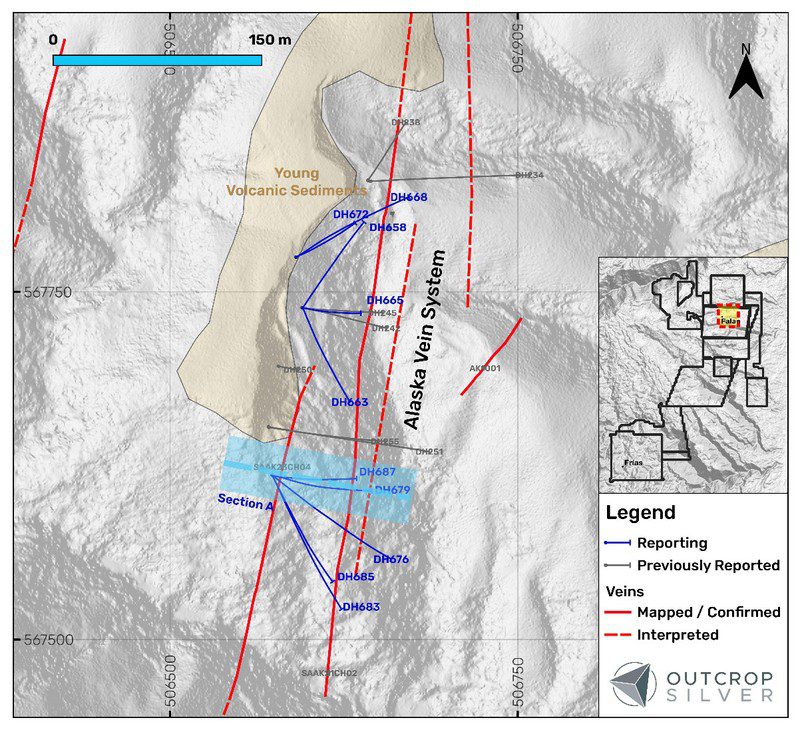
Figure 1. Plan view of the Alaska vein showing the drill holes reported in Outcrop Silver’s October 21, 2026, release. (Image courtesy Outcrop Silver)
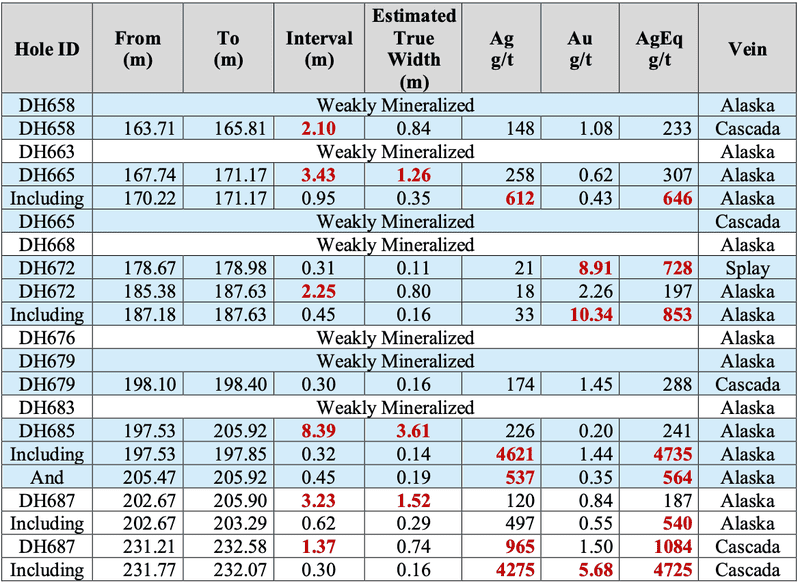
Table 1. Drill hole assay results for the Alaska and Cascada veins; weakly mineralized means an intercept below 100 g/t AgEq. (Image courtesy Outcrop Silver)
“By confirming the northern continuity of the Santa Ana vein system and establishing its connection with Alaska, we are advancing a previously unmodeled area toward becoming a potential contributor to future MRE updates.” — Carlos Torres, vice president of exploration, Outcrop Silver
Cascada, a subparallel footwall vein, company says
In addition to its Alaska interval, DH687 cut Cascada farther down the hole, returning 1.37 meters (0.74 meters ETW) at 1,084 g/t AgEq, including 0.30 meters (0.16 meters ETW) grading 4,275 g/t silver and 5.68 g/t gold, or 4,725 g/t AgEq. Hole DH658 returned 2.10 meters (0.84 meters ETW) at 233 g/t AgEq on Cascada, and hole DH679 returned 0.30 meters (0.16 meters ETW) at 288 g/t AgEq.
Outcrop Silver said the Cascada intercepts point to the potential for more than one mineralized structure in the northern corridor beyond the main Alaska vein. Further drilling will focus on Cascada’s geometry, the continuity of its mineralization and its exploration potential, the company said.
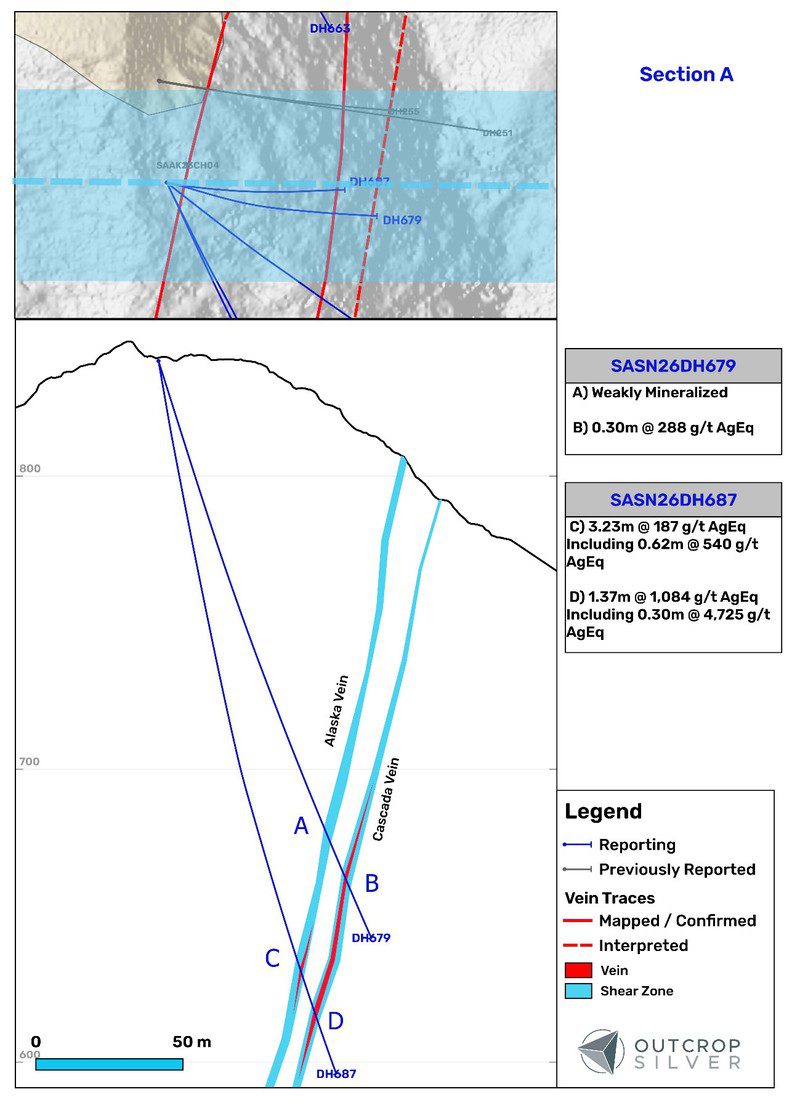
Figure 2. Geological cross-section A showing the Alaska and Cascada veins; lengths are downhole and do not represent estimated true widths. (Image courtesy Outcrop Silver)
Company sees possible repeat of shoot pattern north of Shoot 7
On the Santa Ana vein itself, hole DH670 returned 1.90 meters (1.02 meters ETW) grading 270 g/t AgEq, including 0.30 meters (0.16 meters ETW) at 1,017 g/t AgEq, about 300 meters north of Shoot 7, an ore shoot on the Santa Ana vein that the company reported on September 3. Nearby hole DH666 returned 2.88 meters (1.56 meters ETW) at 134 g/t AgEq, including 0.66 meters (0.36 meters ETW) at 358 g/t AgEq.
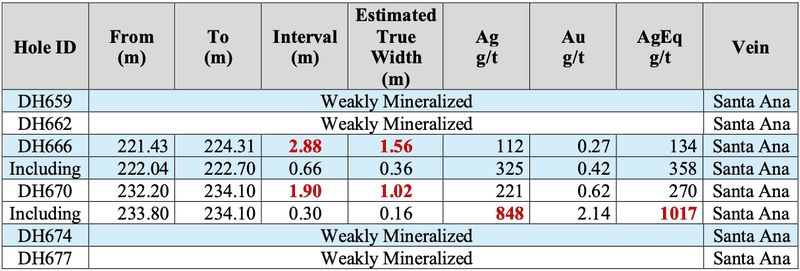
Table 2. Drill hole assay results for the Santa Ana vein. (Image courtesy Outcrop Silver)
The company said in September that Shoot 7 was the fourth shoot identified along the Santa Ana structure and that it had targeted the location on the basis of a roughly 300- to 400-meter spacing between shoots along strike, as Finance Colombia reported at the time. The company said the DH670 intercept sits at a distance from Shoot 7 consistent with that spacing, and Carlos Torres, Outcrop Silver’s vice president of exploration, said the result “reinforces our confidence in the evolving geological model and its ability to guide exploration toward prospective areas.”
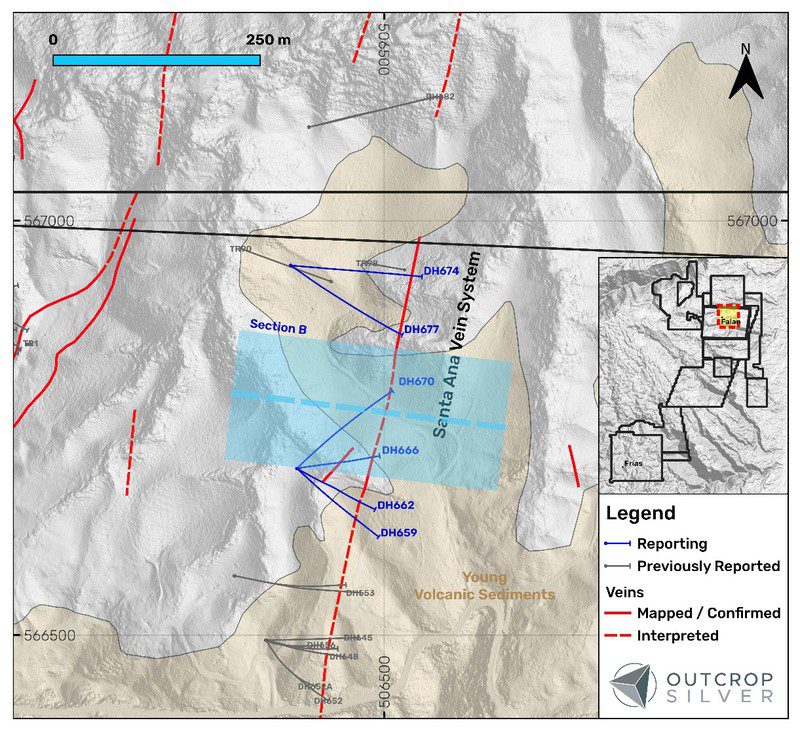
Figure 3. Plan view of the Santa Ana vein showing the drill holes reported in Outcrop Silver’s October 21, 2026, release. (Image courtesy Outcrop Silver)
Both DH666 and DH670 intersected mineralization at elevations comparable to Shoot 7, according to the company. The company cautioned, however, that drilling in this sector has so far covered a narrow elevation range, with no deeper holes and too few intercepts to evaluate whether a shoot has developed there or what its geometry and vertical continuity might be, and said the possibility of an additional high-grade shoot remains open. Four of the six Santa Ana holes in the release (DH659, DH662, DH674 and DH677) were weakly mineralized, and Outcrop Silver described the distribution of silver-gold mineralization along the vein’s northern extension as variable.
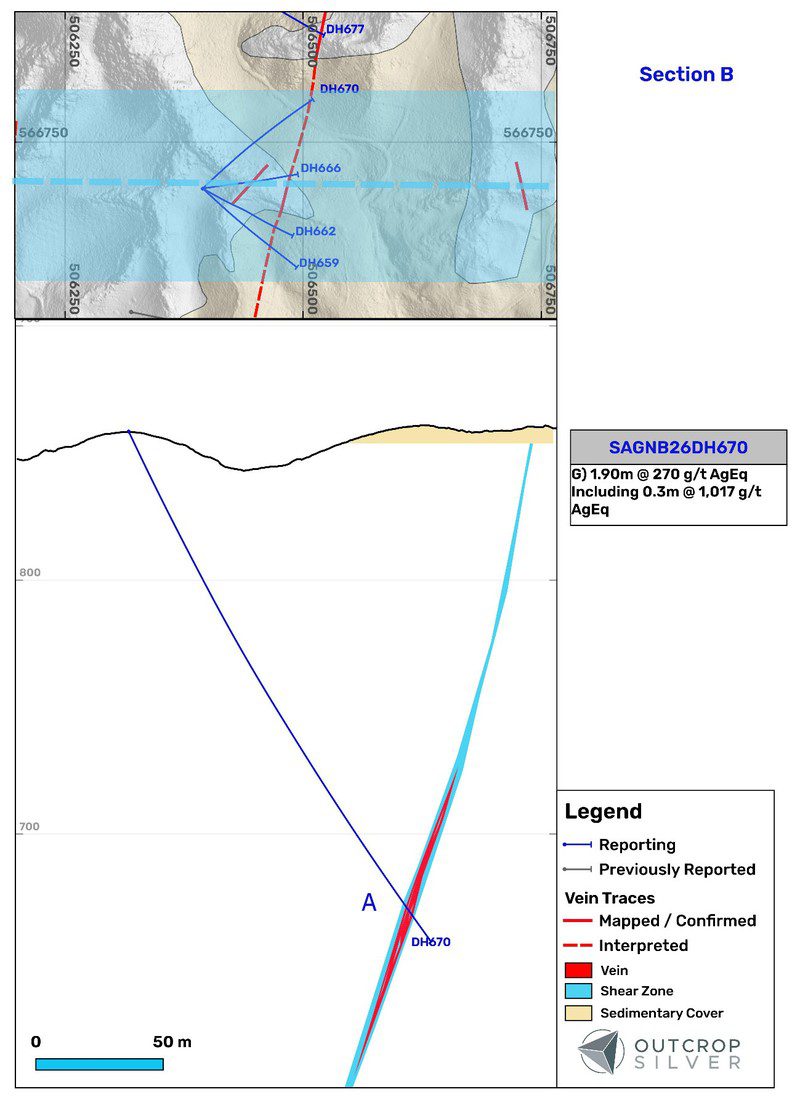
Figure 4. Geological cross-section B showing the Santa Ana vein system; lengths are downhole and do not represent estimated true widths. (Image courtesy Outcrop Silver)
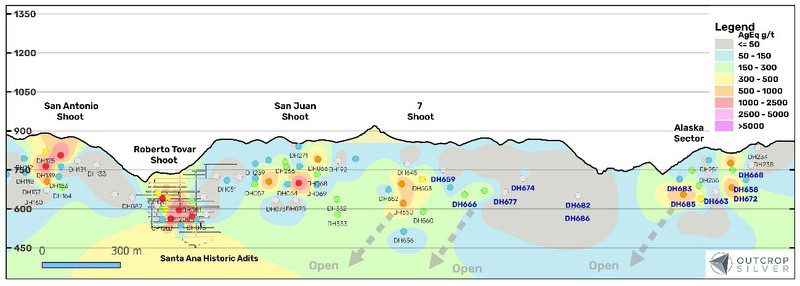
Figure 5. Longitudinal section of the Santa Ana vein showing drill pierce points; grade-thickness (AgEq g/t × ETW) contours are for visualization only and do not represent a mineral resource estimate. (Image courtesy Outcrop Silver)
The September resource estimate
The September estimate, prepared under the supervision of Warren Black, senior consultant for mineral resources and geostatistics at APEX Geoscience Ltd., put the project’s indicated resource at 1.79 million metric tons grading 518.7 g/t AgEq and containing 29.9 million ounces AgEq, and its inferred resource at 2.35 million metric tons grading 368.5 g/t AgEq and containing 27.9 million ounces AgEq, across 13 vein systems. Outcrop Silver said contained ounces rose 23.5 percent in the indicated category and 106.3 percent in the inferred category compared with the maiden estimate in AMC’s technical report dated June 8, 2023. The two estimates rest on different inputs. Outcrop Silver’s September 14 release says the 2026 estimate applied a more rigorous classification standard and used cutoff grades of 95 g/t AgEq for the Santa Ana and Los Naranjos veins and 130 g/t AgEq for the others, metal prices of $40 USD per ounce of silver and $3,100 USD per ounce of gold, and metallurgical recoveries of 96.3 percent for silver and 98.5 percent for gold. AMC’s 2023 report used a cutoff grade of 158 g/t AgEq, prices of $25 USD and $1,800 USD, and recoveries of 93 percent and 96 percent. Outcrop Silver said the APEX technical report will be filed on its website and on SEDAR+ by the end of October.
Methods and assumptions
Drill core was logged at the company’s facility in Falan, Tolima, and samples were assayed at an Actlabs facility in Medellín, with multi-element ICP analysis at Actlabs’ laboratory in Ancaster, Ontario. Blanks, duplicates and certified reference materials were inserted at a rate of about three control samples per 20 samples. Torres, a professional geoscientist (P.Geo.), reviewed and approved the technical information in the October 21 release as the qualified person for exploration at Santa Ana under National Instrument 43-101 (NI 43-101).
Silver equivalent grades in the October 21 release are calculated with the same metal prices and metallurgical recoveries used in the September estimate. The recoveries come from test work the company reported in June 2024. Interval lengths reported by the company are downhole lengths, with estimated true widths given in parentheses.

Silver equivalent (AgEq) formula used by Outcrop Silver. (Image courtesy Outcrop Silver)
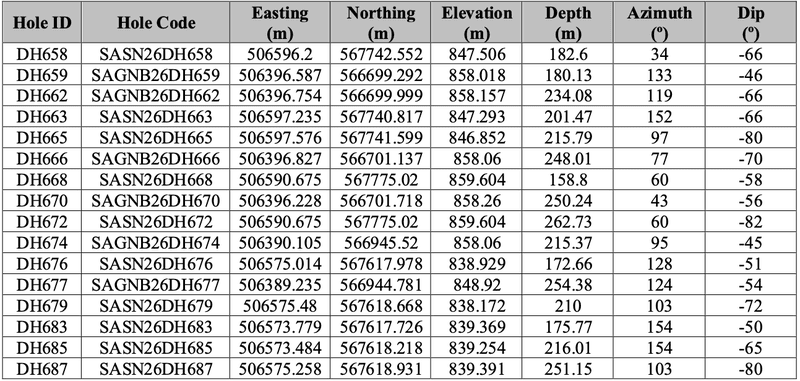
Table 3. Collar and survey table for the drill holes reported in Outcrop Silver’s October 21, 2026, release. (Image courtesy Outcrop Silver)
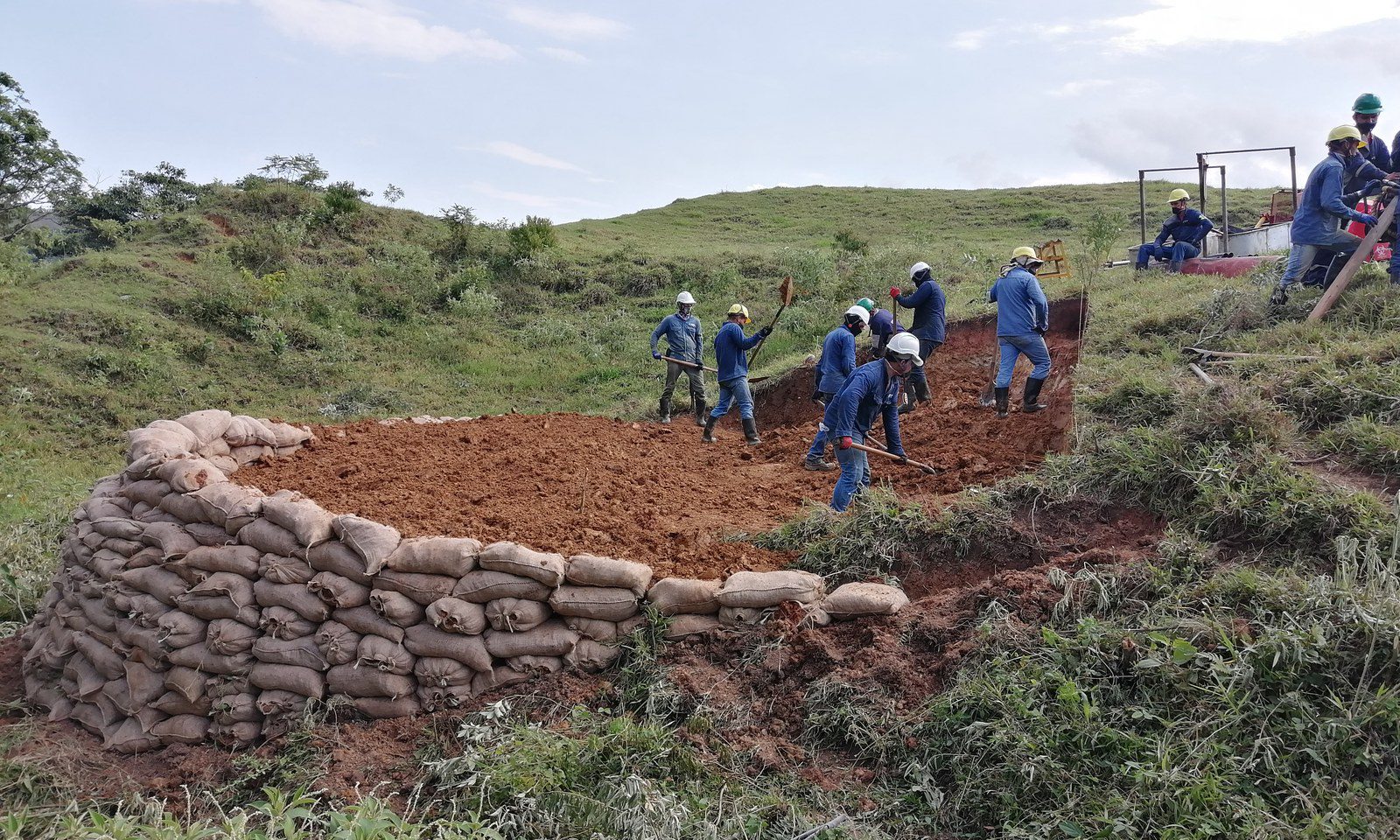
Headline photo: Field crews work at a site on Outcrop Silver’s Santa Ana project in Tolima, Colombia. (Photo courtesy Outcrop Silver)