Previous Story
Grupo Cibest Sees Colombian Inflation Peaking at 7.3% as Indexed Services Keep Prices Sticky
Posted On October 21, 2026
Comment: 0
Tag: 2027 outlook, analyst survey, arracacha, banco de la republica, bancolombia, bank of the republic, banrep, Beef, Camila Caballero, cib, CIBEST, colombia, colombia inflation, colombian peso, condominium fees, consumer price index, core inflation, cpi, dane, Departamento Administrativo Nacional de Estadística, el niño, electricity, Exchange Rate, food prices, Grupo Cibest, hydroelectric power, imported goods, imputed rent, indexation, inflation, inflation forecast, interest rates, Laura Clavijo, meals away from home, minimum wage, monetary policy, PFCIBEST, potatoes, PPI, producer price index, producer prices, Radar Bancolombia, regulated prices, Rent, services inflation, urban transportation, Valentina Guáqueta
A Narrow, Slow-Moving Set of Prices Is Holding Inflation Up
Colombia’s 6.29% annual inflation rate is being sustained by a small group of heavily weighted prices that adjust slowly, mainly services and regulated tariffs, rather than by a broad-based rise across the consumer basket, according to an October 13 editorial in Radar Bancolombia, the weekly macroeconomic and markets report from Bancolombia, the Colombian banking subsidiary of Grupo Cibest (NYSE: CIB; BVC: CIBEST, PFCIBEST). The bank’s economists forecast that inflation will end 2026 at 6.7%, peak at 7.3% in the first half of 2027 and ease to 5.5% by the end of 2027, a level still above the central bank’s target range of 2% to 4%.
“Inflation is not widespread, but it is persistent.” — Valentina Guáqueta and Camila Caballero, Grupo Cibest, Radar Bancolombia
The editorial, titled “Una inflación más persistente que generalizada” (An Inflation More Persistent Than Widespread), was written by Valentina Guáqueta, a central banking and inflation analyst, and Camila Caballero, a student intern, and edited by Laura Clavijo, director of the bank’s Dirección de Investigaciones Económicas, Sectoriales y de Mercado (Economic, Sector and Market Research Department).
Annual inflation rose five basis points in September to 6.29% on a monthly increase of 0.37%, according to the September consumer price bulletin published October 7 by the Departamento Administrativo Nacional de Estadística (National Administrative Department of Statistics, DANE). Grupo Cibest’s report noted that the rate was the highest since July 2024. Finance Colombia covered the full September breakdown on October 12.
Only a Third of the Basket Runs Above the Headline Rate
Only 68 of the 188 subclasses in Colombia’s consumer price index, or 36.2%, posted annual inflation above the headline rate in September, according to Grupo Cibest’s calculations from DANE data. That share was unchanged from August and stood 4.8 percentage points below its average of the past 12 months, which the authors said shows that inflation is still being explained by a limited portion of its components. The diffusion measure counts how many prices are rising faster than the total, but it does not account for each item’s weight in the basket.
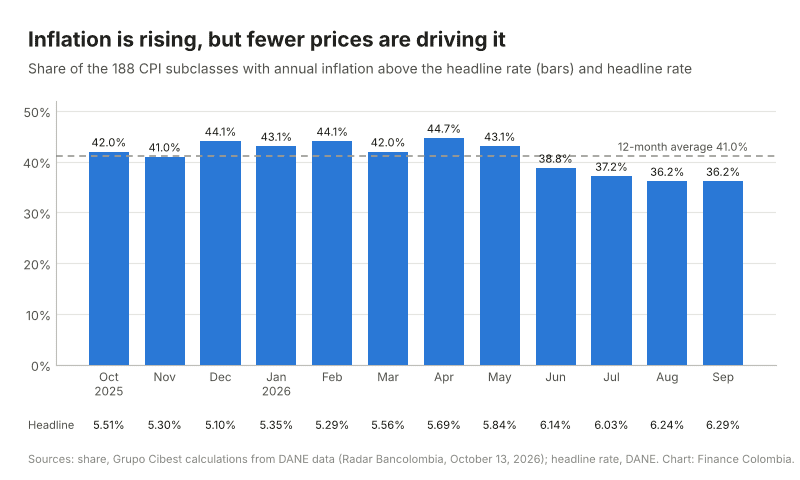
Only about a third of Colombia’s 188 CPI subclasses are running above the headline rate, even as headline inflation has climbed. (Chart: Finance Colombia, based on Grupo Cibest calculations from DANE data)
Contributions, by contrast, combine each item’s price change with its weight in the basket, the authors noted. The 15 subclasses that contributed the most to annual inflation accounted for 4.45 percentage points, or 70.9% of the total, and eight of them were services, four were foods and three were regulated prices. By broad group, services explained 52% of annual inflation, food 20% and regulated prices 20%, while goods contributed only 8%, according to the report. The authors concluded that the pressure comes from three fronts rather than from a generalized increase in prices, and that two of those fronts, services and regulated prices, tend to correct slowly.
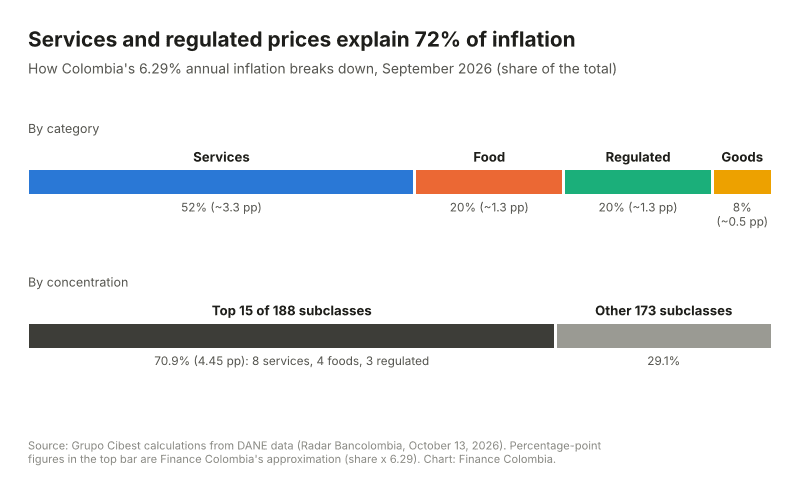
Services and regulated prices explain 72% of annual inflation, and 15 subclasses account for 70.9% of it. (Chart: Finance Colombia, based on Grupo Cibest data)
The Biggest Price Jumps Are Not the Biggest Contributors
The largest annual increases were in perishable foods, according to the report: potatoes rose 78.2%, arracacha (an Andean root vegetable) and other tubers 64.3%, tomate de árbol (tree tomato) 29.7%, oranges 26.9% and blackberries 24.6%. Almost all of those items carry little weight in the basket, with the exception of potatoes, which ranked among the 15 largest contributors. The authors linked those prices to weather and harvests now exposed to El Niño, which consolidated in June and is expected to last until the first quarter of 2027, and said the increases could intensify.
Beef was the exception among foods. Its 14.2% annual increase was smaller than the jumps in perishables, but beef weighs about 1.9% of the basket, and it contributed 0.34 percentage points to inflation, more than any other food. Fresh fruit rose 16.6% with a weight of 0.7% and contributed 0.24 percentage points. Together, beef, fresh fruit and potatoes accounted for about 0.8 percentage points of annual inflation, according to Grupo Cibest.
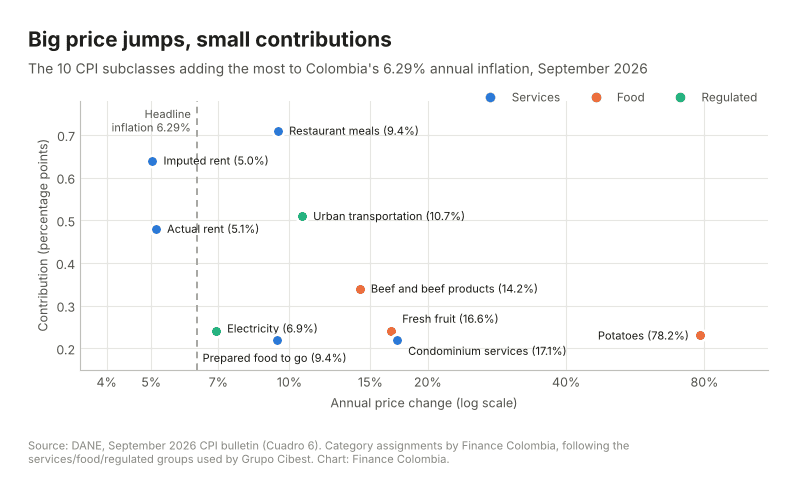
Potatoes posted the largest price increase among the top contributors but added less to inflation than rent. (Chart: Finance Colombia, based on DANE data)
Indexation Keeps Services Sticky
Services do not always post the largest increases, but they weigh more in the basket and their prices take longer to correct, the report said, because many of them are adjusted once a year on the basis of past inflation or the increase in the minimum wage. Meals away from home and rents alone contributed about 1.8 percentage points, close to 30% of annual inflation, according to the report. Rents are adjusted using the previous year’s inflation, which closed 2025 at 5.1%. Labor-intensive services, such as meals away from home, domestic service and hairdressing, reflect the 2026 minimum wage increase and higher labor costs, according to the authors. The minimum wage rose 23% this year to $1,750,905 COP a month, according to Bancolombia’s analysis of the decree. Condominium and building administration services rose 17.1%.
Among regulated prices, urban transportation and electricity made the largest contributions to annual inflation. Electricity is also a second channel for El Niño, the report said: hydroelectric plants usually generate about 82% of Colombia’s power, and the drought has cut their share to 59%.
Producer Prices Point Away From Goods
Colombia’s producer price index for domestic supply, which measures the prices of agricultural, mining and industrial goods at their first stage of commercialization, rose just 1.1% in the 12 months through September, according to Grupo Cibest, compared with 6.29% for consumer prices. The report attributed the gap in large part to the fact that the producer index excludes services and therefore captures less of the pressure from indexation and the minimum wage. Because it includes imported goods, the index is also sensitive to the exchange rate, and the Colombian peso’s appreciation over the past year has made those goods cheaper; their prices fell 6.6% year over year. Grupo Cibest’s economists estimated in September how much the peso’s rally has restrained inflation.
Apart from food, the producer index shows that the pressure is not coming from the cost of goods but from services and from prices set through tariffs, contracts and wages, the authors wrote.
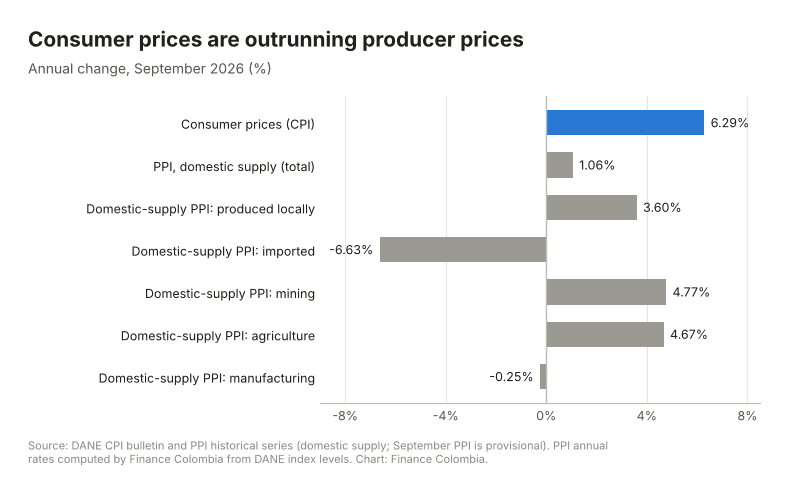
Producer prices for domestic supply rose 1.06% in the year to September, against 6.29% for consumer prices. (Chart: Finance Colombia, based on DANE data)
The Central Bank’s Board Splits on a Rate Hike
The board of the Banco de la República (Bank of the Republic), Colombia’s central bank, raised its benchmark interest rate by 25 basis points to 12.25% on September 30, with four directors voting for the increase, two voting to hold and one voting for a 50-basis-point increase, a decision that ran counter to the market consensus for a hold. Core inflation, which excludes food and regulated prices, rose to 6.1% in August, according to the minutes of that meeting. According to Grupo Cibest’s reading of the minutes, the majority judged that the pressures remain broad rather than limited to food and regulated items, and pointed to signs of excess demand in the strength of imports and the external imbalance. One of the directors who initially favored a 50-basis-point increase supported the final decision after the discussion, the report said. The directors who voted to hold argued that the combination of currency appreciation, a more restrictive monetary stance and the fiscal adjustment under way could produce a sharper slowdown in economic activity.
The median analyst in the central bank’s September survey expected inflation to end 2026 at 6.8% and 2027 at 5.1%, with the policy rate at 12.25% at the end of 2026 and 10.75% at the end of 2027, according to figures compiled in the report.
Inflation Is Expected to Peak in 2027
The authors, who described the outlook as challenging, expect inflation to peak at 7.3% in the first half of 2027. They expect El Niño to keep pressuring food and energy prices at least through that period, and next year’s minimum wage adjustment to weigh on services again. The composition of inflation changes how the headline figure should be read, they wrote, because the most visible increases, such as those in perishable foods, can reverse when weather conditions improve, while the components that dominate the total are slower to respond. The editorial closed with this assessment: “In this context, the challenge for the Banco de la República is not only to bring inflation down, but to do so when its pressures are increasingly rigid.”
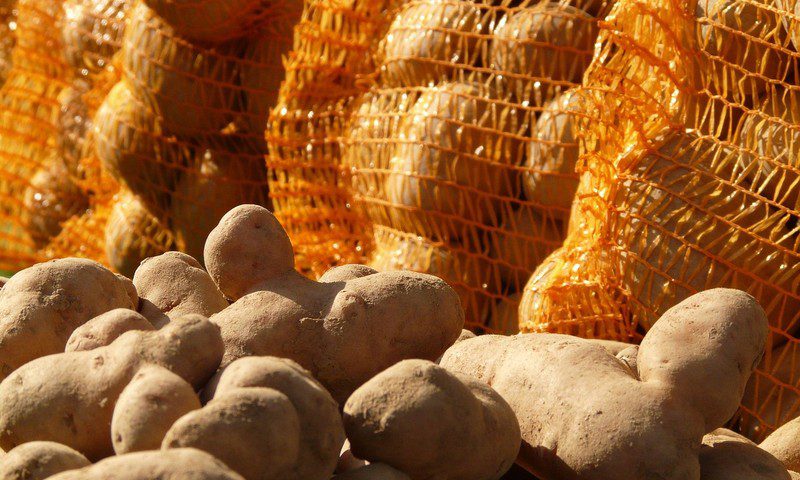
Headline photo: Potatoes are piled in front of mesh sacks; potato prices in Colombia rose 78.2% in the 12 months through September. (Photo: Image by Hans from Pixabay)