Previous Story
Inflation Climbs Across Latin America as El Niño and a Fed Hike Keep Most Central Banks Cautious
Posted On October 21, 2026
Comment: 0
Tag: 2027 outlook, banco de la republica, bancolombia, Bank of Guatemala, Bank of Mexico, bank of the republic, Banxico, basic grains, brazil, bvc, Camila Caballero Mercado, central america, Central Bank of Brazil, Central Bank of Chile, Central Bank of Costa Rica, Central Reserve Bank of Peru, chile, cib, CIBEST, Climate Prediction Center, coastal El Niño, colombia, colombian peso, consumer prices, Corredor Seco, costa rica, currency depreciation, deflation, Dry Corridor, el niño, el salvador, electricity prices, energy prices, Fed, Fed rate hike, federal funds rate, Federal Open Market Committee, Federal Reserve, fishing, FOMC, food prices, Grupo Cibest, guatemala, hydroelectric generation, INEC, inflation, inflation forecast, inflation targets, Instituto Nacional de Estadística y Censos, interest rates, Jose Luis Mojica, latin america, Latin America inflation, Laura Clavijo Muñoz, Mexican Peso, mexico, monetary policy, national oceanic and atmospheric administration, noaa, nyse, peru, PFCIBEST, regional inflation report, Selic, united states, us dollar, Valentina Guáqueta Sterling
Broad-based Price Pressures Delay the Return to Inflation Targets
Inflation rose in most of the eight Latin American economies tracked by Grupo Cibest (NYSE: CIB; BVC: CIBEST, PFCIBEST) in September 2026, with Guatemala posting the sharpest increase and Chile the only country where the annual rate eased, according to the group’s third-quarter regional inflation report, released in October. The report, prepared by the Dirección de Investigaciones Económicas, Sectoriales y de Mercados (Economic, Sector and Market Research Department) of Bancolombia, Grupo Cibest’s Colombian banking subsidiary, covers Colombia, Brazil, México, Chile, Perú, Guatemala, El Salvador and Costa Rica. Unlike in the previous quarter, upward price pressures spread to nearly the entire region in September, largely because of fuel, energy and food, according to the report. The authors said this is delaying convergence toward inflation targets and explains the caution of most of the region’s central banks.
Guatemala Leads the Increase
Guatemala’s annual inflation rate jumped 132 basis points to 4.69% in September, its highest level since October 2023, according to Grupo Cibest. In El Salvador, inflation rose 41 basis points to 3.60%, driven by transportation and food. In Brazil, inflation rose 36 basis points to 4.58%, exceeding the ceiling of the country’s target range, mainly because of a 7.98% monthly increase in electricity prices. México’s annual rate rose 19 basis points to 3.45%, which remains within the tolerance range set by the Bank of Mexico (Banxico), while Perú’s rate rose 11 basis points to 4.55%.
Colombia’s annual rate rose five basis points to 6.29%, pushed by services, and remains the highest of the eight economies in the report. Finance Colombia reported on the details of the September reading.
Costa Rica returned to positive territory with annual inflation of 0.34% after 16 months of negative readings. Annual inflation stood at -0.17% in August, according to Instituto Nacional de Estadística y Censos (National Institute of Statistics and Census, INEC) data reported by the Costa Rican newspaper La República, so September’s reading marked a 51-basis-point swing.
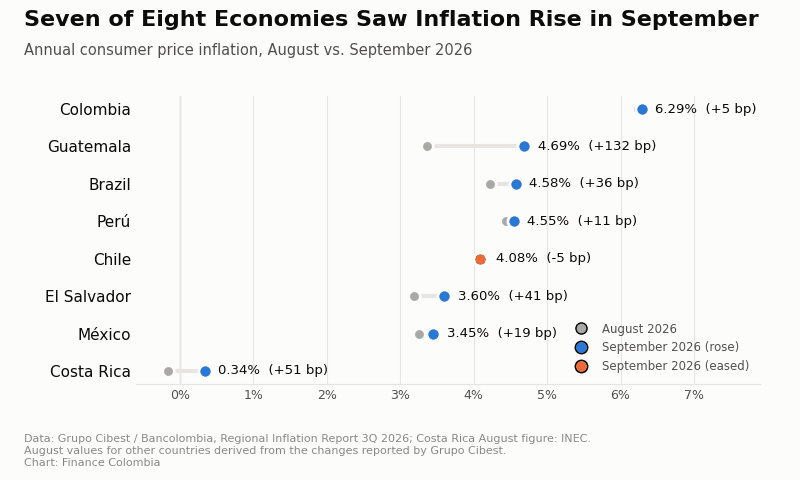
Annual inflation rose in seven of the eight economies tracked by Grupo Cibest in September 2026. (Chart: Finance Colombia, based on Grupo Cibest and INEC data)
Chile: The Exception
Chile was the only country where annual inflation slowed, easing to 4.08% in September from 4.13% in August. Monthly inflation of 0.4% matched the September 2025 figure and came in below the 0.5% the report said had been expected. Food and transportation prices rose, but a 5.9% decline in insurance and financial services offset part of those increases, and weaker domestic demand is restraining prices, the report said.
Most Central Banks Pause; Colombia Hikes, Brazil Cuts
According to the report, the Bank of Mexico, the Bank of Guatemala, the Central Bank of Chile and the Central Reserve Bank of Peru left their policy rates unchanged at their two most recent meetings. The Central Bank of Costa Rica held its rate in September after a 25-basis-point cut in July.
Perú’s October decision surprised the market, which had anticipated an increase, according to Grupo Cibest. The central bank held its reference rate at 4.25% for the 13th consecutive month, while nine of 13 analysts in a Bloomberg survey had expected a hike, Infomercado reported, adding that Perú’s inflation is running above the central bank’s 1% to 3% target range.
Colombia was the only country in the group to tighten monetary policy. The Banco de la República (Bank of the Republic) raised its benchmark rate by 25 basis points to 12.25% in September. Brazil moved in the opposite direction: the Central Bank of Brazil cut its benchmark Selic rate by 25 basis points at each of its last two meetings, to 13.75%, even though inflation has exceeded the ceiling of its target range, Grupo Cibest said.
El Niño Threatens Food and Energy Prices
Grupo Cibest identified El Niño as one of the main inflation risks for the region. Citing the US National Oceanic and Atmospheric Administration (NOAA), the report said the event began in June and is expected to last until April 2027, which means its effects on prices have not yet been fully reflected. The authors expect the pressures to vary by country and to be transmitted through food and energy prices.
Colombia is among the most exposed economies, according to the report, because it would be hit on both fronts: its harvests are vulnerable, and the country depends on hydroelectric generation. Brazil and Perú also face high risks, and in Perú, the coastal El Niño’s effect on fishing adds to food price pressures. In Central America, drought in the Corredor Seco (Dry Corridor) would affect production of basic grains. Chile, México and Costa Rica are less vulnerable, the report said, because their food production has less climate exposure and, in Costa Rica’s case, because inflation is close to zero.
NOAA’s Climate Prediction Center said in its October 8 monthly discussion that a strong-to-very strong El Niño is likely to persist through January-March 2027. The agency estimated the chance that the event becomes historic, exceeding the strength of any El Niño since 1950, at 54% for September-November and 83% for October-December.
The Federal Reserve Adds a Layer of Caution
The US Federal Reserve raised the federal funds target range by 25 basis points to 3.75% to 4.00% on September 16, in a 12-0 vote. The Federal Open Market Committee said in its statement: “Inflation remains elevated.” The committee added that the increase “will support a timelier return to the Committee’s 2 percent goal.” Grupo Cibest said the increase, together with signals of further hikes before year-end, added a reason for caution among Latin American central banks. The decision strengthened the dollar and interrupted the appreciation of Latin American currencies, which had helped contain inflation in imported goods, according to the report.
The Colombian peso depreciated more than 3% in the week after the Fed’s announcement, according to the report, and the Bank of Mexico included the depreciation of the Mexican peso among the upside risks to inflation. After weak US employment data, the probability of another Fed increase in October fell to about 20%, easing currency pressure in the short term, according to Grupo Cibest, which cited Investing.com data. The market still expects an increase before the end of the year, so the risk of currency depreciation and its pass-through to prices remains, the report said. Finance Colombia reported the peso’s 2.9% decline for September as a whole in a separate article.
“In Colombia, we project inflation will close 2026 at 6.7% and reach a peak of 7.3% in the first half of 2027, before falling to 5.5% at the end of that year.” — Grupo Cibest / Bancolombia Economic, Sector and Market Research Department, Regional Inflation Report, third quarter of 2026 (translated from Spanish)
Outlook: Pressure Through 2026, Easing in 2027
The authors summarized their regional view: “We expect the region’s inflation to remain under pressure for the rest of 2026 and to resume a downward path in 2027, although at different paces across countries.” El Niño and the possibility of currency depreciation keep the balance of risks tilted to the upside, the report said.
Under Grupo Cibest’s projections, Colombia’s inflation would stay above the Banco de la República‘s target range of 2% to 4% through the end of 2027.
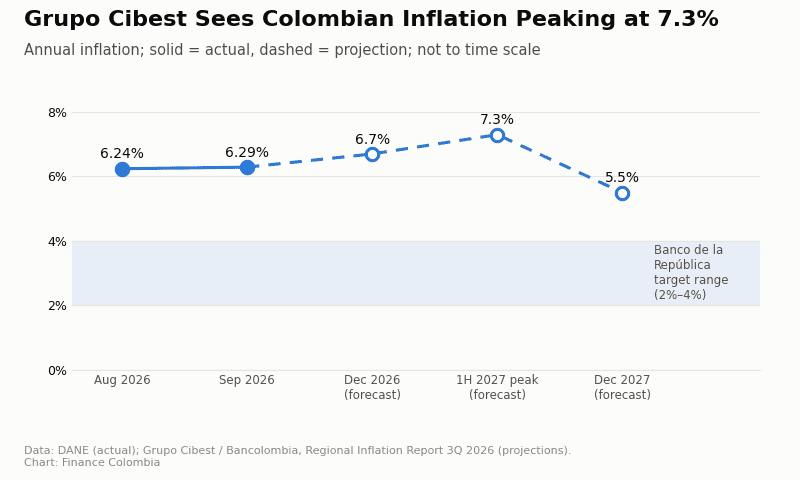
Grupo Cibest’s projected path keeps Colombia’s inflation above the central bank’s 2% to 4% target range through the end of 2027; the horizontal axis is not to time scale. (Chart: Finance Colombia, based on DANE and Grupo Cibest data)
According to analyst expectations cited in the report, Brazil (5.0%), Chile (4.4%) and Perú (4.2%) would end 2026 above their target ranges, while México (3.9%) and Guatemala (3.9%) would finish within their tolerance ranges. In Costa Rica, inflation would remain below the central bank’s target, at about 1.7% a year after the report’s October release, and in El Salvador, transportation and food would keep inflation under pressure, the report said. Against that backdrop, Grupo Cibest expects most of the region’s central banks to maintain a cautious stance. The group’s broader economic outlook for Colombia was the subject of a Finance Colombia report in September.
The report was signed by Valentina Guáqueta Sterling, inflation and central bank analyst; Camila Caballero Mercado, intern; Laura Clavijo Muñoz, director; and José Luis Mojica, macroeconomic manager.
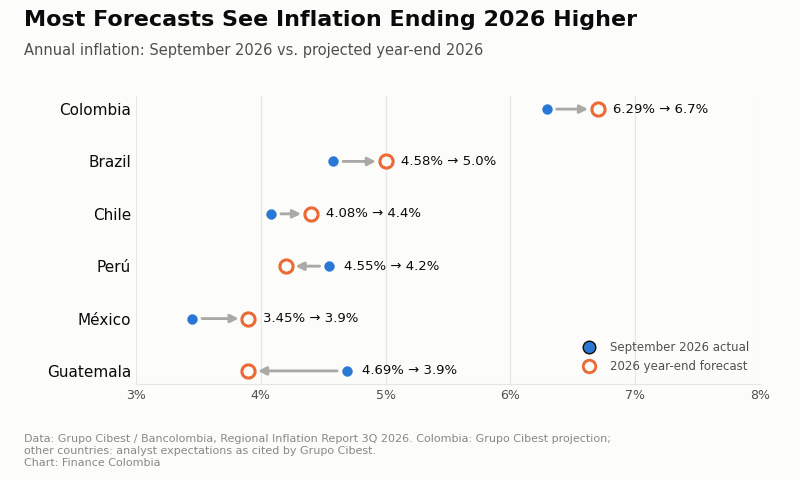
The chart compares September 2026 inflation with Grupo Cibest’s own year-end projection for Colombia and the analyst expectations it cites for five other economies. (Chart: Finance Colombia, based on Grupo Cibest data)
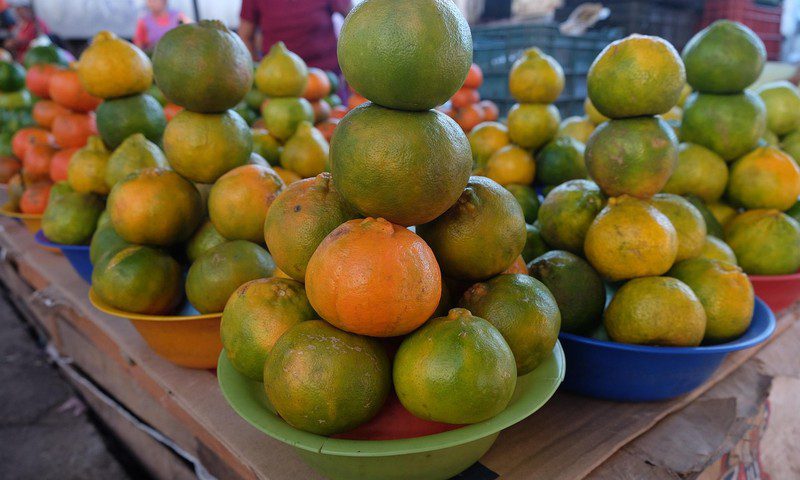
Headline photo: Oranges are stacked in bowls for sale at a market. (Photo: Image by rakel_pazthel from Pixabay)