Previous Story
Colombian Peso Slides 2.9% as Hawkish Fed Lifts the Dollar and Central Bank Surprises With a Hike
Posted On October 12, 2026
Comment: 0
Tag: abelardo de la espriella, banco de la republica, bancolombia, brazil, Brazilian real, Brent Crude, carry trade, Central Bank of Colombia, Chilean peso, colombia, Colombia Economy, Colombia fiscal deficit, colombian peso, credit default swaps, dane, dxy, Exchange Rate, Extended Fund Facility, Federal Reserve, Flexible Credit Line, FocusEconomics, FOMC, gold prices, Grupo Cibest, Gustavo Petro, imf, inflation, inflation expectations, interest rates, international monetary fund, Jose Luis Mojica, jose manuel restrepo, Laura Clavijo, leonardo villar, Manuela Bernal, Mexican Peso, mexico, Middle East conflict, Miguel Gómez, Ministerio de Hacienda, ministry of finance, monetary policy, Nigel Clarke, oil prices, peso depreciation, Precautionary and Liquidity Line, real interest rates, saudi arabia, Superintendencia Financiera de Colombia, united states, us dollar, USDCOP, washington, wti
Carry Trade and IMF Talks May Cap a Dollar-Driven Peso Sell-off
The Colombian peso weakened 2.9% against the US dollar in September 2026, closing the month at 3,307.50 COP per dollar, 92.50 COP above its August close, according to the Monthly Foreign Exchange Market Report published October 6 by Bancolombia‘s Economic, Industry & Market Research Area. Bancolombia is the Colombian banking subsidiary of Grupo Cibest (NYSE: CIB; BVC: CIBEST, PFCIBEST), the holding company formed in 2025. The report, signed by Manuela Bernal, regional analyst; José Luis Mojica, macroeconomic manager; and Laura Clavijo, chief economist, attributed most of the depreciation to a more hawkish stance from the US Federal Reserve, which strengthened the dollar against most of the world’s currencies. The peso’s losses were concentrated in the second half of the month.
September extended a reversal that began in late August. The peso surged 7.5% in July, then weakened 1.8% in August to close at 3,215 COP after the government of President Abelardo de la Espriella disclosed a sharply wider fiscal deficit in its 2027 National Budget. In September, the exchange rate’s lowest daily close was 3,085 COP, in the first half of the month, and its highest was 3,362 COP, in the final week, according to closing-rate data in the report.
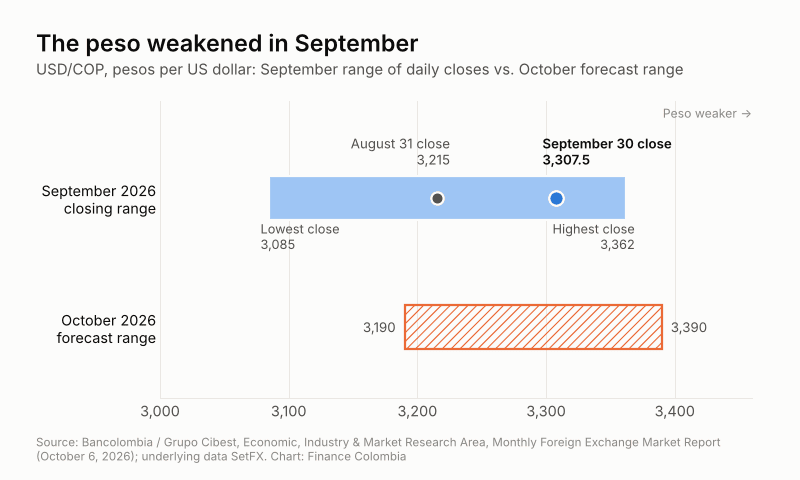
USD/COP range of daily closes in September 2026 and Bancolombia’s forecast range for October. (Chart: Finance Colombia, based on Grupo Cibest data)
A Rate Increase in Washington and a Stronger Dollar
At its September 16 meeting, the Federal Reserve raised the target range for the federal funds rate by a quarter percentage point to 3.75% to 4.00%, in a 12-0 vote, its first increase since July 2023, as Finance Colombia reported after the decision. The Federal Open Market Committee said in its statement: “Inflation remains elevated. Today’s policy action will support a timelier return to the Committee’s 2 percent goal.” The statement also cited geopolitical developments as a source of elevated uncertainty, and Bancolombia’s analysts tied the persistence of US inflation to the conflict in the Middle East. The report also cited revised US data. First-quarter growth was revised up from 2.1% to 2.5% at a seasonally adjusted annual rate and second-quarter growth from 1.5% to 2.2%, while the September Composite PMI came in at 58.4, its strongest reading since July 2021. As a result, the probability of another 25-basis-point Fed increase in October rose above 70%, the report said.
The US Dollar Index (DXY), which tracks the dollar against a basket of major currencies, gained 2.0% in September. In Bancolombia’s comparison of selected currencies, the Mexican peso depreciated 6.4% against the dollar, the Swedish krona 4.5% and the Chilean peso 4.1%. The Colombian peso’s decline measured 2.2% in that comparison, which draws on a different data source from the 2.9% figure, according to the report’s source notes, and was roughly in line with the euro and the British pound. The Brazilian real and the Japanese yen were the only currencies in the comparison to gain ground.
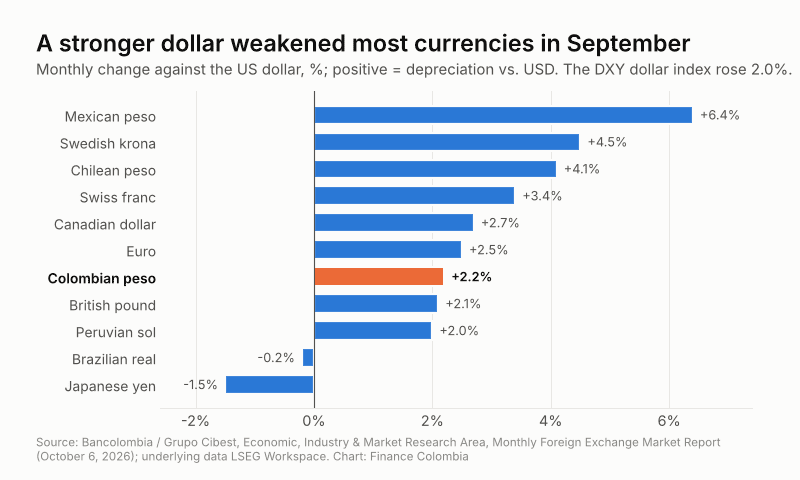
Monthly change of selected currencies against the US dollar in September 2026; positive values indicate depreciation. (Chart: Finance Colombia, based on Grupo Cibest data)
Lower local dollar liquidity added to the pressure, according to the report. The net spot foreign currency position of Colombia’s foreign exchange market intermediaries turned negative on September 9 for the first time this year and stood at -$634 million USD as of September 13, according to data from the Superintendencia Financiera de Colombia (Financial Superintendency of Colombia) compiled by Grupo Cibest. Bancolombia estimates the position stayed negative through the second half of the month and approached -$810 million USD, which the analysts said suggests liquidity pressures persisted.
A Split Vote at the Central Bank
On September 30, the board of the Banco de la República (Bank of the Republic), Colombia’s central bank, raised its benchmark interest rate by 25 basis points to 12.25%, according to the bank’s statement. Four directors voted for the increase, two voted to hold the rate unchanged and one voted for a 50-basis-point increase. The decision ran counter to both Bancolombia’s forecast and the market consensus, which had anticipated a hold, according to the report; earlier in September, Bancolombia’s economists had expected the rate to stay at 12%. The meeting was the first rate decision in which the De la Espriella government participated, through Miguel Gómez, head of the Ministerio de Hacienda y Crédito Público (Ministry of Finance and Public Credit), Vanguardia reported. At the bank’s post-meeting press conference, Gómez explicitly backed the majority position and a continued commitment to the inflation target, according to Bancolombia.
The board’s minutes set out the three positions. The directors in the majority cited several factors, among them: “headline inflation has continued to rise, reaching levels more than twice the inflation target,” and “expectations continue unanchored from the 3% target, even over longer horizons.” The two directors who favored a hold argued that monetary policy was already highly contractionary, with an ex post real interest rate close to 6%, and they warned: “a considerable interest rate differential relative to advanced economies still encourages carry trade operations that contribute to pressure for peso appreciation.” The director who sought a larger increase argued: “waiting does not eliminate the cost but rather shifts it, and may ultimately increase it.”
Annual consumer inflation reached 6.24% in August, according to the Departamento Administrativo Nacional de Estadística (National Administrative Department of Statistics, DANE), and inflation excluding food, one of the central bank’s traditional core measures, reached 6.30%, according to Bancolombia. Analysts’ forecasts for year-end 2026 inflation cited in Bancolombia’s report have climbed to 6.77%, and expectations for 2027 stand at 5.10%, both well above the central bank’s 2% to 4% target range. After the report was published, DANE reported on October 7 that annual inflation rose to 6.29% in September, according to Portafolio.
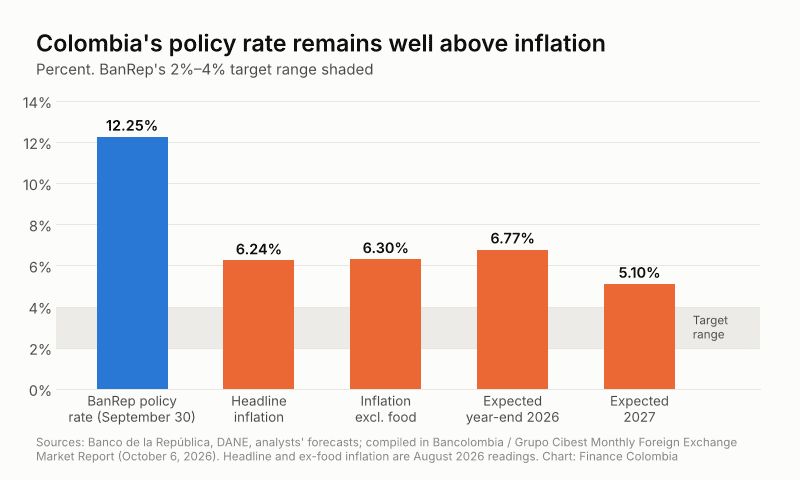
Banco de la República’s policy rate against current and expected inflation, with the 2% to 4% target range shaded. (Chart: Finance Colombia, based on Grupo Cibest data)
Colombia Opens Talks With the IMF
In a presidential address on September 27, President De la Espriella said the country’s fiscal situation was the most critical in its history, Publimetro reported. He said he had instructed Gómez and the economic team to lead talks with the International Monetary Fund (IMF) in search of a negotiated way out of the crisis his government inherited.
“Public finances, my fellow citizens, can’t take any more. The balance is in the red.”
— President Abelardo de la Espriella, September 27, 2026
The announcement came during a September 25-28 visit to Colombia by IMF Deputy Managing Director Nigel Clarke, who met with Vice President José Manuel Restrepo, Gómez, Banco de la República Governor Leonardo Villar and members of the central bank’s board, according to the IMF’s statement at the end of the visit. The government asked the fund to begin an assessment of the economy and of the new administration’s macroeconomic plans, Bloomberg Línea reported. Clarke wrote in a post on X: “The IMF stands ready to support Colombia and looks forward to continuing our close and constructive dialogue in the weeks ahead.” The IMF said in the statement that prompt and credible steps to narrow fiscal imbalances can bolster confidence, cut borrowing costs and improve conditions for private investment and hiring. The IMF also said a Ministry of Finance delegation would visit Washington the following week to continue the dialogue.
Bancolombia’s report noted that several former finance ministers have suggested an Extended Fund Facility or a Precautionary and Liquidity Line could be appropriate, and that Colombia could potentially access between $15 billion USD and $20 billion USD. Colombia signed a $2.7 billion USD Extended Fund Facility in 1999 and later had Stand-By Arrangements approved in 2003 and 2005, according to Bloomberg Línea. More recently, the IMF suspended Colombia’s access to its Flexible Credit Line in April 2025, and Colombia canceled the credit line in September 2025, under former President Gustavo Petro.
Ministry of Finance figures compiled by Grupo Cibest show the central government deficit at 6.4% of gross domestic product in 2025, with projections of 7.2% in 2026 and a peak of 7.9% in 2027 before narrowing to 3.7% by 2030. Colombia’s five-year credit default swap spread stood at 168 basis points at the end of September, compared with an average of 87 basis points for its regional peers, according to the report.
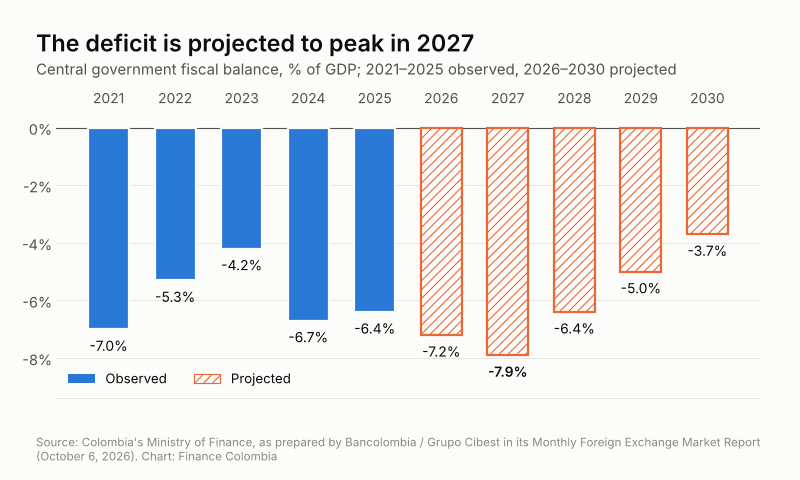
Central government fiscal balance as a share of GDP, observed and projected, from Ministry of Finance figures compiled by Grupo Cibest. (Chart: Finance Colombia, based on Grupo Cibest data)
Oil Rises and Gold Falls
Brent crude rose 14.4% in September to close at $103.53 USD per barrel, while West Texas Intermediate ended the month at $90.42 USD per barrel, up 5.4%, according to the report. Bancolombia attributed much of the move to escalating tensions in the Middle East, including Saudi Arabia’s closure and subsequent partial reopening of the East-West pipeline following drone attacks originating from Iraq. The report also cited a late-month announcement of a potential ban on US diesel exports intended to contain domestic fuel prices, which it said placed further pressure on international fuel markets. Gold fell about 6.0% as rising US Treasury yields reduced the appeal of non-yielding assets, the report said.
The October Outlook
Bancolombia expects the exchange rate to trade between 3,190 COP and 3,390 COP in October, against a backdrop of dollar strength, fiscal adjustment announcements and negotiations with the IMF. The bank sees a risk of a weaker peso from further global dollar strengthening, citing a US economy that has proven more resilient than expected and Fed officials’ growing concern about inflation, and it expects both the DXY and Treasury yields to remain elevated during the month. On the technical side, the exchange rate broke above its 50-day moving average in mid-September and reached its 100-day moving average (3,348 COP at month-end) before retreating, leaving that level as key short-term resistance, according to the report. A death cross, with the 50-day average below both the 100-day and 200-day averages, remains in place, although the 50-day average began to flatten in the final sessions of the month, a pattern the analysts said could signal stronger upward pressure on the exchange rate if it continues.
Bancolombia’s analysts wrote that the central bank’s decision could offset part of that pressure: “The hawkish surprise should preserve the attractiveness of carry trade strategies.” They added that investor sentiment toward Colombia could improve as negotiations with the IMF progress. Grupo Cibest’s calculations, based on FocusEconomics forecasts, put Colombia’s real monetary policy rate at about 6.0% at the end of 2026, second only to Brazil’s 8.3% among the six economies in the comparison and well above Mexico’s 2.2%.
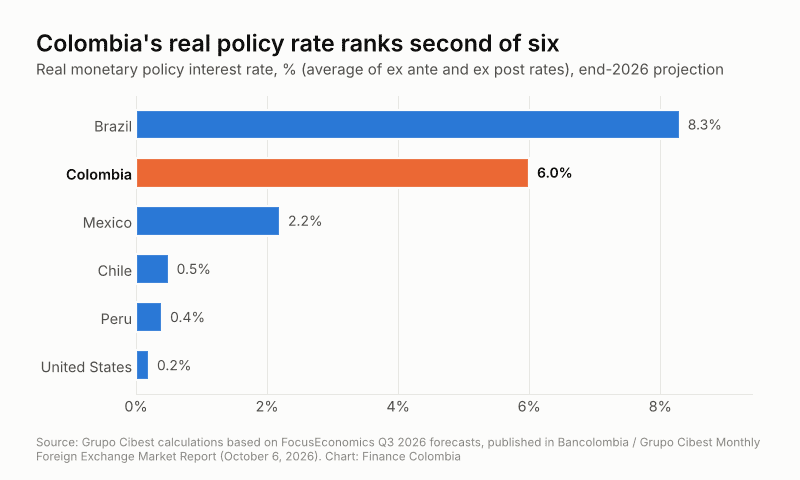
Projected real monetary policy interest rates at the end of 2026, from Grupo Cibest calculations based on FocusEconomics forecasts. (Chart: Finance Colombia, based on Grupo Cibest data)
Over the longer term, Grupo Cibest forecasts an average exchange rate of 3,417 COP per dollar for 2026 and 3,331 COP for 2027, below the 4,053 COP average recorded in 2025, before a gradual depreciation to 3,756 COP by 2030.
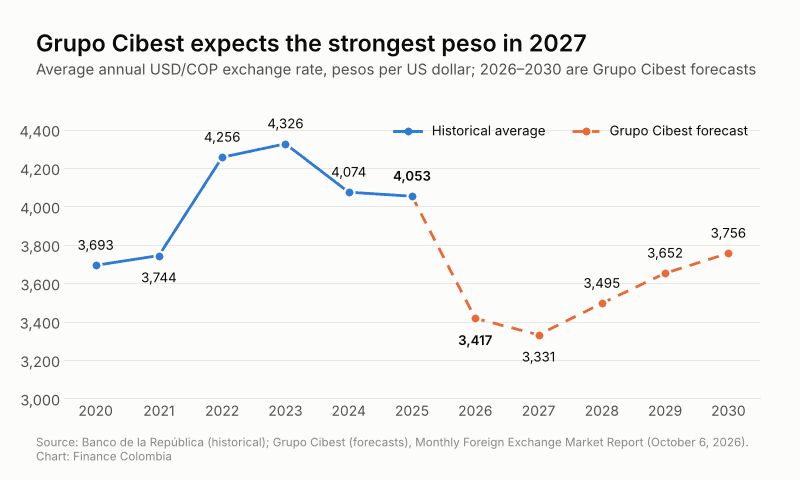
Average annual USD/COP exchange rate, with Grupo Cibest forecasts for 2026 through 2030. (Chart: Finance Colombia, based on Grupo Cibest data)
Headline photo: US dollar, euro and other banknotes. (Photo: Image by FilipFilipovic from Pixabay)