Previous Story

Colombia’s Peso Rally Curbs Inflation Less Than a Selloff Would Fuel It, Bancolombia Finds
Posted On September 14, 2026
Comment: 0
Tag: banco de la republica, bancolombia, Brent Crude, China inflation, colombia, colombian economy, colombian peso, consumer confidence, currency markets, dane, emerging markets bonds, european central bank, exchange rate pass-through, Federal Reserve, fedesarrollo, fixed income, Grupo Cibest, inflation, interest rates, Latin America inflation, monetary policy, oil prices, tes, US inflation, USDCOP, WTI crude
The Colombian peso closed last week at 3,084.9 pesos per US dollar, an appreciation of roughly 18 percent since the start of the year. Standard economic theory holds that a stronger currency should lower the cost of imported goods and, eventually, ease consumer prices. New research from Grupo Cibest (NYSE: CIB; BVC: CIBEST), the holding company that owns Bancolombia, finds that the relief has been far more limited than the size of the rally would suggest.
The bank’s economists estimate that each percentage point of peso appreciation reduces annual goods inflation by 0.16 percentage points over twelve months. On the consumer price index as a whole, the effect is considerably smaller. A previous Grupo Cibest analysis found that a 1-point currency depreciation drives a 0.12-point rise in headline inflation over a year; this report finds that an appreciation of the same size lowers headline inflation by no more than 0.04 points over the same horizon — roughly a third of the force. The exchange rate’s pass-through into prices, in other words, works much harder on the way up than it does on the way down.
Grupo Cibest’s own conclusion is blunt about what that means for consumers.
“The strength of the peso has contained inflation, but it does not correct it.”
— Grupo Cibest, economic research team
Why a stronger peso doesn’t show up at the register
Goods are the main channel through which the exchange rate reaches Colombian consumers, since their production and distribution depend heavily on imported inputs and finished products. Grupo Cibest’s model — an asymmetric autoregressive distributed-lag specification that controls for the business cycle, monetary policy and global oil prices — points to three factors that keep the pass-through incomplete.
The first is inventory rotation: much of what is on store shelves today was bought months ago under exchange rates that no longer apply, so a lower dollar takes time to show up in available merchandise. The second is asymmetry in firms’ pricing incentives — companies are reluctant to cut prices in response to currency moves they see as transitory, even as they raise prices quickly when the dollar rises. The third, and the most relevant to the current moment, is margin recomposition: during Colombia’s prior depreciation cycle, firms absorbed part of the shock instead of passing the full cost of a pricier dollar on to consumers, sacrificing a share of their profit per unit sold. The recent strength of the peso has let them restore those margins instead of passing the lower cost on to shoppers. Resilient household demand has reinforced the pattern — consumption remains one of the main drivers of Colombia’s economic activity, giving firms room to sustain prices even as import costs fall.
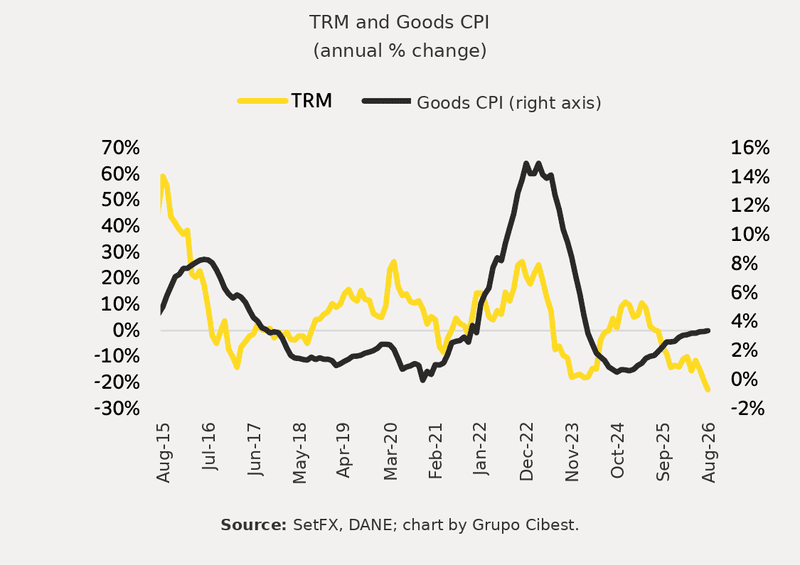
Colombia’s benchmark exchange rate (TRM) against goods inflation, annual percent change, August 2015 to August 2026. (Chart: Grupo Cibest; source: SetFX, DANE)
A shrinking share of a larger basket
Goods carry a weighting of just 18.56 percent in Colombia’s consumer price index, so even a full pass-through would have a modest effect on the headline number. Services and regulated prices, which make up most of the rest of the basket, respond mainly to domestic drivers — wages, indexation and local demand for services, and tariff-setting decisions for regulated prices — with limited exposure to the dollar. Food prices sit in between: they use some imported fertilizer and grain, but their behavior is driven mostly by weather and other agricultural conditions.
Even within an imported good, the final price a consumer pays layers on costs that have nothing to do with the exchange rate: rent, domestic transportation, staff salaries, advertising and taxes. Those links in the chain cushion the shock as it travels down the supply chain — a lower exchange rate reduces the cost of bringing merchandise into the country, but that savings represents only a small share of what a shopper ultimately pays.
The size of the currency move matters too. International evidence shows pass-through loses strength as an exchange-rate swing gets larger, since firms absorb a growing share of the shock in their margins and space out price adjustments to avoid revising them too often. That dynamic explains the current disconnect: despite an appreciation of nearly 20 percent over the past year, goods inflation has been rising for seven straight months, and the headline index has not delivered the relief the size of the currency move would imply. The pass-through operates with a lag, transmits only partially, and competes against cost pressures pulling in the opposite direction.
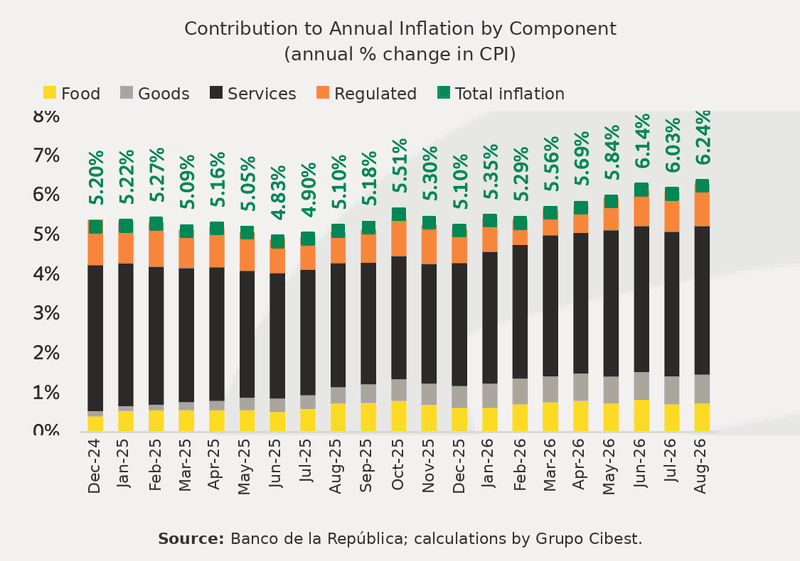
Contribution to annual inflation by basket component, December 2024 to August 2026. Services have driven the bulk of the rise to 6.24 percent in August. (Chart: Grupo Cibest; source: Banco de la República)
A reversal would hurt more than the rally has helped
The asymmetry carries a warning for what comes next: if the peso gives back part of its recent strength, Grupo Cibest expects the effect on prices to be larger than what the appreciation has delivered, because firms pass along cost increases faster than they pass along cost reductions. The ongoing fiscal debate and external financing conditions will be the key drivers of where the dollar-peso rate goes from here. The exchange rate’s contribution to moderating inflation is therefore likely to stay limited: a stronger peso has held down goods prices, but its reach over the total inflation rate is narrow, and it competes with pressures of a different origin, including wage adjustments and food-supply shocks. The peso’s strength has contained Colombia’s inflation, in short, but it has not corrected it — further disinflation will depend on domestic factors rather than the dollar.
Colombia’s inflation accelerated again in August
The backdrop for that debate is an inflation rate still moving the wrong way. DANE, Colombia’s Departamento Administrativo Nacional de Estadística (National Administrative Department of Statistics), reported annual inflation of 6.24 percent in August, up 20 basis points from July, its highest level since July 2024 and just above Grupo Cibest’s own forecast of 6.19 percent. The monthly print of 0.39 percent far exceeded the average analyst forecast of 0.27 percent and was the highest print for the month of August since 2023. Services explained 57 percent of the month’s inflation, contributing 22 of the 39 basis points of the increase, largely on the pass-through of wage indexation. Inflation excluding food hit its highest level since October 2024, the sixth consecutive monthly increase. Grupo Cibest expects the upward pressure to persist on continued indexation, rising labor costs, regulated-tariff adjustments and the impact of the El Niño weather pattern in the back half of the year.
Other gauges of the Colombian economy showed a mixed picture for July. Retail sales are estimated to have grown 13.0 percent year over year, driven by a 19.9 percent jump in vehicle sales, even as vehicle sales showed signs of moderating from the 45.7 percent average pace recorded so far in 2026. Manufacturing output is estimated to have contracted 1.0 percent over the same period, a decline Grupo Cibest links to lower industrial-input imports and softer energy demand, partly offset by improving business confidence; the peso’s 19.2 percent annual appreciation has also cut the cost of imported inputs, even as it makes finished goods made abroad more competitive against local production.
Colombia’s Economic Tracking Index, the Índice de Seguimiento a la Economía (ISE), is estimated to have grown 2.8 percent year over year in July, below its four-month average of 3.7 percent, reflecting an uneven performance across sectors. Primary activities faced climate-related risks and the effect of the stronger peso on export competitiveness, particularly for coffee, even as mining outperformed on favorable oil and non-monetary gold output. Construction showed a mixed picture, with civil works offsetting persistent weakness in housing, while services — including entertainment, public administration, and trade, transportation, accommodation and food services — stayed dynamic.
Consumer sentiment offered a brighter note. Grupo Cibest projects Fedesarrollo‘s Consumer Confidence Index reached 21 points in August, a 0.3-point monthly gain and a 23.4-point jump from a year earlier, which Grupo Cibest attributes to sustained declines in unemployment, strong durable-goods consumption and the stronger peso, alongside favorable signals from economic activity and nominal income growth — though persistent inflation and international geopolitical uncertainty could temper the index in coming months. Separately, Fedesarrollo’s Economic Policy Uncertainty Index fell to 194 points in August, down 42 points from July and 77 points from a year earlier, though still above its 2000-2019 historical average of roughly 100 points — a decline the think tank tied to the removal of electoral uncertainty and stronger-than-expected second-quarter GDP.
A global backdrop of renewed inflation pressure
Colombia’s story is unfolding against a global economy where inflation risk is resurfacing rather than fading. In the United States, the Bureau of Labor Statistics reported that annual consumer inflation ticked up 0.03 percentage points to 3.4 percent in August, in line with market expectations and the highest reading since June, as energy prices climbed on a 0.40 percent monthly increase. Core inflation, which excludes food and energy, eased 0.03 percentage points to 2.45 percent, also in line with consensus. Markets now assign better than 60 percent odds to a 25-basis-point increase at the Federal Reserve‘s September 15-16 meeting, which would lift the target range to 3.75-4.00 percent; the Fed is likely to take a cautious stance as it weighs whether easing core prices offset renewed energy-driven pressure.
Producer prices accelerated more sharply: the annual Producer Price Index jumped to 5.4 percent in August from 2.7 percent in July, driven largely by a 1.1 percent monthly rise in final-demand goods prices, a sign that the run-up in energy costs tied to the escalation of the Middle East conflict is beginning to feed into US production costs.
US consumer confidence sent a starker signal. The University of Michigan‘s consumer sentiment index fell to 47.8 in September from 51.7 in August, well below the 51.0 the market had expected, as households’ views of both current conditions and the outlook deteriorated on the back of Middle East tensions and rising fuel prices. Sentiment has now fallen 16.0 percent since February, before the conflict began, and 13.0 percent from a year earlier; one-year inflation expectations rose 0.6 percentage points to 4.6 percent, the highest since June.
The European Central Bank raised its deposit rate by 25 basis points to 2.50 percent, its third increase this cycle, citing sustained inflationary pressure tied to the Middle East conflict and projecting inflation will stay above its 2 percent target through at least 2028 — even as it revised its 2026 and 2027 growth forecasts upward, to 0.9 percent and 1.4 percent, respectively. In China, the National Bureau of Statistics reported consumer inflation accelerated to 0.8 percent annually in August, its fastest pace since May and in line with market expectations, while producer prices rose 3.8 percent, beating analyst forecasts on higher energy costs, commodity prices and technology-sector demand. Inflation across Latin America showed similar upward pressure in August, with Peru accelerating to 4.44 percent on higher food prices — its highest since April — and Chile rising to 4.13 percent on energy and services costs. Mexico’s rate climbed to 3.26 percent, its first acceleration since March, on stronger goods and food prices. Brazil was the exception, with inflation easing to 4.22 percent from 4.44 percent on softer food and fuel costs.
Bond markets reprice for a longer tightening cycle
Fixed-income markets moved to reflect the firmer inflation outlook. The US Treasury curve sold off between September 4 and September 11, with yields on two- to seven-year notes rising an average of 24 basis points and ten- to thirty-year maturities climbing 14 basis points; the 10-year yield rose 16 basis points to 4.94 percent. Emerging-market sovereign bonds were mixed: Colombia and Malaysia led increases with yields up 33 basis points, followed by Poland (30 basis points) and Peru and the Czech Republic (22 basis points each), while China, Romania and Indonesia posted modest declines and Brazil and Turkey rallied, with yields falling 46 and 52 basis points, respectively. JPMorgan‘s pricing shows markets now assign roughly 90 percent odds to a 25-basis-point Fed increase at the September meeting, with traders pricing further gradual increases beyond that as persistent inflation pushes out the expected length of the tightening cycle.
Colombia’s peso-denominated government bonds, known as TES, sold off in sympathy: yields on the fixed-rate curve rose an average of 16 basis points across short-, medium- and long-dated maturities following August’s inflation surprise. Locally, markets watched proposals from Colombia’s Director of Public Credit, an office within the Ministerio de Hacienda (Finance Ministry), aimed at strengthening liquidity and access to the public debt market. Pension funds, known by the Spanish acronym AFP, led net purchases of TES in the secondary market during August at $4.9 trillion COP, followed by trust companies at $3.1 trillion COP and the Banco de la República — Colombia’s central bank — at $1.5 trillion COP; commercial banks were the largest net sellers at $5.3 trillion COP, followed by foreign funds at $2.2 trillion COP and the Finance Ministry itself at $1.4 trillion COP. The total outstanding stock of Class B TES reached $800.6 trillion COP at the end of August, up 19.8 percent from a year earlier and 0.3 percent from July.
The average coupon on the government’s Class B TES debt rose to 10.08 percent in August, its highest level since October 2023, up 9 basis points from July and 143 basis points since the end of 2025 — reflecting bonds issued earlier in the year at financing rates higher than those seen in 2025. The increase was driven in part by UVR-linked debt, whose average coupon climbed to 10.82 percent amid persistent inflation, while the coupon on fixed-rate TES rose to 9.72 percent, up 150 basis points for the year.
Peso gains alongside a spike in oil prices
The peso’s weekly gain came as Middle East tensions intensified further. Brent crude closed at $104.73 USD per barrel, up 8.78 percent for the week, while West Texas Intermediate settled at $102.48 USD per barrel, up 12.02 percent, as the conflict between the United States and Iran escalated and Iran-aligned Houthi rebels advanced on the Red Sea city of Mocha, threatening control of the Bab-el-Mandeb strait. Production by the Organization of the Petroleum Exporting Countries also fell in August after a collapse in Saudi Arabian output amid threats to the Strait of Hormuz and Red Sea shipping routes, while China’s own oil purchases increased, pushing up premiums on African and Latin American crude as buyers looked beyond the Persian Gulf amid the supply scarcity there. Markets have begun pricing the conflict extending beyond 2026, despite comments from US President Donald Trump suggesting a possible resolution tied to the November 3 legislative elections.
Banco de la República saw $296.3 million USD exercised of the $400 million USD awarded in its second reserve-accumulation options auction this month. Colombia’s theoretical devaluation curve showed mixed movement: the one-month tenor fell 1 basis point and the twelve-month tenor fell 4 basis points, while tenors between three and nine months rose an average of 3 basis points. The market-implied devaluation curve, by contrast, retreated across its full structure, reversing the prior week’s upward trend on sustained forward sales from offshore and institutional agents — even as the implied odds of a 25-basis-point Fed increase at its September 15-16 meeting rose to 86.5 percent by September 11, from 59.4 percent a week earlier.