Previous Story

Colombia’s Sociopolitical Momentum Climbs to Best Levels in Nearly Two Years, Bancolombia Finds
Posted On September 4, 2026
Comment: Off
Grupo Cibest Index Signals Easing Political Risk for Investors
Colombia’s sociopolitical environment is at its most stable point in nearly two years, according to a monthly indicator published by Bancolombia’s macroeconomic research team, part of Grupo Cibest (NYSE: CIB; BVC: CIBEST, PFCIBEST), the financial holding group into which Bancolombia was restructured in 2025. The Sociopolitical Momentum Indicator closed August at 0.50 points, up 0.01 point from July and 0.03 point above its year-to-date average of 0.47, crossing the threshold the bank defines as the boundary between “uncertain” and “fluid” sociopolitical conditions.
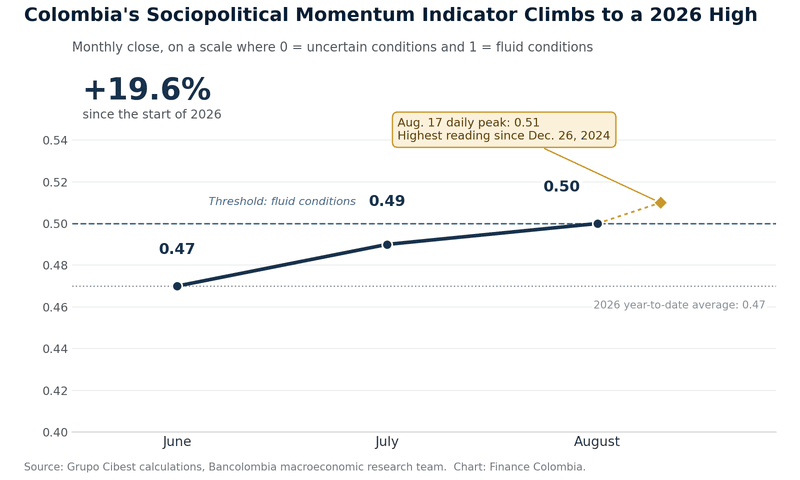
Colombia’s Sociopolitical Momentum Indicator rose to 0.50 in August 2026, crossing the threshold Grupo Cibest defines as the boundary between uncertain and fluid conditions. (Data: Grupo Cibest calculations; chart: Finance Colombia)
The indicator has risen 19.6% since the start of the year, Grupo Cibest’s macroeconomic research team said, despite a slight pullback in early August. The bank described the second half of the year’s evolution as the most favorable on record, meaning the seasonal correction the indicator typically shows at the start of the third quarter has this year been steeper than in recent years. Grupo Cibest said momentum has since stagnated, dating from August 19, but that 2026 could still finish as one of the years with the greatest cumulative improvement in Colombia’s local sociopolitical environment — a change in the indicator that the bank said would rank second only to years such as 2007, which was marked by a positive international perception of Colombia and improving domestic security conditions.
Day-to-day, the indicator has held above the 0.5-point “fluid conditions” threshold continuously since August 14, a level that also matched the month’s closing figure. It peaked at 0.51 points on August 17 — the highest daily reading since December 26, 2024, one of the last days in nearly two years the index spent more than a single day in fluid territory, according to Grupo Cibest. The bank said the past two weeks of data point to what could be the start of a more sustained shift toward favorable conditions.
The reading follows a change of government in Bogotá. Abelardo de la Espriella was inaugurated president on August 7, 2026, El Tiempo reported, after he defeated Pacto Histórico’s Iván Cepeda in a June 21, 2026, runoff, beginning a four-year term that de la Espriella has said will prioritize public security. Grupo Cibest’s report does not attribute August’s reading to any single event.
Grupo Cibest builds the indicator using the Global Database of Events, Language, and Tone (GDELT), which monitors media outlets worldwide in real time and automatically classifies the tone and intensity of sociopolitical events affecting Colombia. The bank treats each news item as a distinct event, categorizes it as cooperative or conflictive, and weights it for relevance to Colombia; the daily indicator then measures the share of that sociopolitical activity dominated by uncertainty-related events against total interactions, on a scale where 0 represents fully uncertain conditions and 1 represents fully fluid conditions.
The August report was signed by Manuela Bernal, regional analyst; José Luis Mojica, macroeconomic manager; and Laura Clavijo, chief economist and head, all of Bancolombia’s macroeconomic research department.
Headline photo: A mother and her young son share pastries at breakfast. (Photo: Image by OleksandrPidvalnyi from Pixabay)