Previous Story

Indicted Health Superintendent Daniel Quintero Turns Oversight Powers Against Candidate De la Espriella Days Before Colombia’s Runoff
Posted On June 16, 2026
Comment: Off
Tag: 2026 Colombian presidential election, abelardo de la espriella, Aguas Vivas, alianza verde, antioquia, Carlos Carrillo, Cathy Juvinao, Centro Democratico, Colombia runoff, daniel quintero, Daniel Quintero Calle, eps, Fiscalía General de la Nación, Gustavo Petro, health system corruption, ivan cepeda, medellin, pacto historico, Salud Vida EPS, superintendencia nacional de salud, supersalud, ungrd
A health-sector watchdog becomes an election-eve campaign weapon
Three developments over a single week in June have braided together to expose how Colombia’s health-oversight apparatus has become an instrument in the final stretch of the presidential race. At the center of all three is Daniel Quintero, the former mayor of Medellín who took office as National Superintendent of Health — head of the Superintendencia Nacional de Salud (National Health Superintendence) — in May despite facing more than 40 criminal and disciplinary investigations of his own. Within days, the office he now runs has been pointed squarely at the opposition’s presidential candidate, and the maneuver has split the very coalition it was meant to help.
An appointment the left now concedes “backfired”
The first thread surfaced on June 9, when Carlos Carrillo — who had just resigned as director of the National Unit for Disaster Risk Management (Unidad Nacional para la Gestión del Riesgo de Desastres, or UNGRD) — told Blu Radio that Quintero’s appointment had been “basically a shot in the foot for the campaign” of leftist candidate Iván Cepeda. Carrillo argued the decision — taken “a month before the elections” — cost Cepeda decisively in Antioquia, where, he said, “they beat us by almost 30 points.” Without that result, in his telling, “the winner of the elections is Iván Cepeda.” He said the Pacto Histórico (Historic Pact) “owes the people of Antioquia an apology,” and called handing the Superintendence to “those presumably crooked gentlemen, with all the investigations they carry,” an “enormous strategic error.”
That an ally would say so out loud underscores how exposed the appointment always was. As Finance Colombia reported in May, Quintero became the fifth health superintendent of President Gustavo Petro’s administration while carrying more than 40 criminal and disciplinary complaints tied to his 2020–2023 tenure in Medellín. The watchdog group Transparencia por Colombia (Transparency for Colombia) called the designation “inappropriate,” and Carrillo himself was quoted at the time noting that the Pacto Histórico “has no reason to bear the political cost of his legal troubles.”
“The charged official who left Medellín in intensive care now wants to pose as an anti-corruption defender by doing political favors for Cepeda.” — Centro Democrático
The most serious of those cases is the “Aguas Vivas” scandal, in which prosecutors at the Fiscalía General de la Nación (Attorney General’s Office) charged Quintero — alongside nine former officials and three private parties — with embezzlement (peculado), undue interest in public contracts, and malfeasance (prevaricato) over the reclassification of a 142,000-square-meter forest-reserve plot in Medellín’s El Poblado that allegedly inflated the land’s value. No conviction has been issued, and Quintero maintains his innocence. It is from this position — charged, awaiting trial, and his appointment under a nullity challenge admitted by the Consejo de Estado (Council of State) — that Quintero now wields one of the most powerful financial-oversight offices in the Colombian state, with authority over the EPS health insurers and the public funds that flow through them.
An election-eve probe aimed at the opposition candidate
The second thread arrived on June 15. That day, Cepeda announced a criminal complaint against his runoff rival, Abelardo de la Espriella, alleging the right-wing lawyer’s involvement in the “plundering of the health system” in the Caribbean region through the now-liquidated Salud Vida EPS. Within hours, Quintero announced that the Superintendence would “investigate the transfers made by these EPS to Joaquín Gutiérrez, his companies, and Abelardo de la Espriella,” framing it as a response to Cepeda’s allegations about “a group of EPS related to paramilitary leaders.”
Quintero put specific numbers on the claim. He described contracts “signed with health parafiscal resources for more than $18 billion COP” (about $4.5 million USD), set against what he called more than $160 billion COP (about $40 million USD) “diverted from Salud Vida EPS toward a front company in Panama.” He said the contract awarded to De la Espriella was not reported to the comptroller the Superintendence had designated at the time, citing the designated official’s statement that she “had no knowledge of the content and scope of the terms,” and asserted that records on the origin of those funds had been “extracted or eliminated” from the Superintendence’s databases in prior years. After reviewing more than 10,000 documents, Quintero said, the agency was forwarding copies to the Fiscalía, the Contraloría (Comptroller General’s Office), and the Procuraduría (Inspector General’s Office).
De la Espriella rejected the accusations outright, calling them a “smokescreen” driven by the proximity of the vote, insisting the contracts corresponded to “legitimate legal services” and that he would cooperate with the authorities. His campaign stressed — accurately — that opening an investigation “does not constitute a sanction” but a preliminary stage to gather information.
The timing did not escape the opposition. On June 16, the Centro Democrático (Democratic Center), the party of former president Álvaro Uribe that is backing De la Espriella, accused Quintero of weaponizing his office: “The charged official who left Medellín in intensive care now wants to pose as an anti-corruption defender by doing political favors for Cepeda,” the party said, pinning the system’s distress on the Petro government and citing “more than 2 million complaints, 313,000 tutelas [constitutional rights claims], medicine shortages, and a debt of more than $25 trillion COP owed to hospitals and clinics.”
The optics are conspicuous: an official who is himself charged, installed by the incumbent president weeks before the vote and whose own appointment is being litigated, has used the oversight powers of that appointment to open — and publicize — an investigation into the candidate running against the incumbent’s chosen heir, four days before the runoff.
A fight that spilled inside the left
The third thread shows the strategy turning inward. Also on June 15, Alianza Verde (Green Party) representative Catherine “Cathy” Juvinao criticized Cepeda’s decision to take the health fight to the courts, arguing that the way to win over independents and the center — the voters likely to decide June 21 — was “to recognize the mistakes of this government in health, withdraw the reform, and guarantee the negotiation of a new project,” not to move the programmatic debate “to the courts.”
Carrillo answered not by engaging the argument but by digging up Juvinao’s social-media posts from 2011 to 2013, when she was a fierce critic of the EPS and of Ley 100 (Law 100, the statute that created the current insurance-based system), and accusing her of having flipped: “She has made it sufficiently clear that between Iván and the EPS, she sides with the EPS… how power changes people.” The episode is telling on two counts. It places Carrillo — the same figure who days earlier had branded Quintero a crook and called his appointment a self-inflicted wound — in the position of defending the Cepeda camp’s health offensive against criticism from within his own ideological neighborhood.
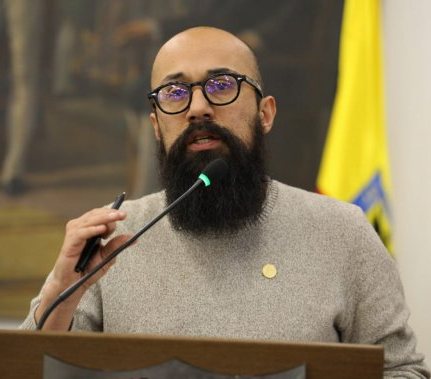
Carlos Carrillo, director of the UNGRD under the later part of the Petro administration.
And it confirms that Juvinao’s misgivings are not the opposition’s talking points but a live anxiety inside the center-left: that judicializing the campaign in its final days may repel precisely the undecided voters both sides are chasing.
Why it matters
Taken together, the three developments trace a single arc. The appointment that Carrillo concedes already cost the left votes in Antioquia has now produced an official willing to deploy his office against the opposition candidate on the eve of the vote — and that deployment has, in turn, opened a rift between those on the left who see the health card as a winning attack and those who fear it alienates the middle.
For Quintero, the calculus carries real risk. The investigation he has launched is preliminary, and the underlying allegations against De la Espriella — which the candidate denies — remain to be tested by the Fiscalía and the courts, not by a Superintendence headed by a man awaiting his own trial. Should De la Espriella, a combative litigator who built his fortune defending the accused and who has never been shy about using the courts himself, prevail in the runoff he led after the first round, the man who turned a state oversight office into a campaign instrument days before the election would find himself uniquely exposed — still charged in Medellín, his appointment still contested, and now on record having targeted the incoming president. Quintero’s tenure was always expected to be temporary; a new head of state takes office on August 7 with the power to replace him. Whether the gambit damages De la Espriella or merely deepens Quintero’s own jeopardy is a question the June 21 runoff will begin to answer.
Headline image: Daniel Quintero and President Gustavo Petro during the swearing-in ceremony of the new health superintendent. Photo courtesy of the Presidency of Colombia.