Previous Story
Colombian President Elect Promises Conciliation at Home, a Crackdown on Crime, and an Open Door to Investors
Posted On June 22, 2026
Comment: Off
Tag: abelardo de la espriella, but still carefully add all necessary tags (just don't leave these out!) Abelardo de la Espriella, Colombia 2026 election, Colombia politics, Defensores de la Patria, Foreign Investment., Gustavo Petro, ivan cepeda, jose manuel restrepo, pacto historico, presidential runoff, registraduria, rule of law, security, You must include these tags
Abelardo de la Espriella won Colombia’s June 21 presidential runoff, narrowly defeating leftist senator Iván Cepeda in one of the closest contests in the country’s history. According to the preliminary count (preconteo) published by the Registraduría Nacional del Estado Civil, with virtually all polling tables reported the conservative lawyer took 12,959,542 votes (49.66 percent) to Cepeda’s 12,708,712 (48.70 percent) — a margin of about 250,800 votes, or 0.96 percent — on turnout of roughly 63.6 percent. The Registraduría’s preliminary count is not legally binding, and the official judicial count (escrutinio) that certifies the result was still under way; Cepeda himself noted that the preconteo “is not yet official or binding.”
The geography of the vote split along familiar regional lines. De la Espriella ran strongest in the Andean interior and the eastern plains, winning the departments of Antioquia, Santander, Cundinamarca, Meta, Casanare and Arauca, and posting lopsided margins in cities such as Medellín (819,285 to 421,839), Cúcuta (306,536 to 76,069) and Bucaramanga (229,851 to 117,895). Cepeda carried Bogotá (2,235,514 to 1,933,243), the Pacific and southern departments of Chocó, Cauca, Nariño, Caquetá and Putumayo, and the major Caribbean coastal cities — including Cali, Cartagena, Santa Marta and Barranquilla (375,178 to 309,652), the very city where de la Espriella delivered his victory speech.
Speaking before supporters at Barranquilla’s “Ventana al Mundo,” the president-elect used that address to pivot quickly from the language of the campaign to the language of governing — framing his win less as a partisan triumph than as a national mandate, and laying down early markers on security, the economy, and Colombia’s posture toward the rest of the world.
“This victory does not belong to one man, it does not belong to a party, it does not belong to a region,” he told the crowd. “This victory belongs to all of Colombia.”
A message of conciliation
The most insistent theme of the speech was reconciliation. De la Espriella repeatedly addressed Colombians who did not vote for him, presenting unity as a constitutional obligation rather than a courtesy.
“I am going to govern for all Colombians — for those who voted for me and for those who chose another candidate,” he said. “There will be no victors and no vanquished, there will be no retaliation, there will be no persecution, because in a democracy there are no irreconcilable enemies; there are compatriots who think differently, who think differently, but who have exactly the same rights as we do.”
Citing Article 188 of the Constitution, which holds that the president symbolizes national unity, he said he would assume that role “as a sacred mandate.” To those who opposed him, he added: “This is your victory too, because democracy works precisely when the people decide freely… Your rights, even if you did not vote for me, will be respected. Your opinions will be heard. You will never have to fear for thinking differently.”
He also pledged to earn trust through performance: “My purpose will be to earn your trust with results, not with speeches; with deeds and works, not with promises; with consistency and not with excuses.”
Inclusion across regions and groups
De la Espriella wove a deliberately inclusive geography through the speech, invoking Colombia’s regions and communities one by one. He described a homeland “of all religions… of all ancestral communities, of all young people, of all grandparents, of all entrepreneurs, of all journalists, of all peasant farmers” — “one homeland of all, for all, and built by all.”
In a passage that named nearly every corner of the country, he reached explicitly toward historically peripheral regions: “We are all the lullaby of the Pacific. We are all the grandeur of the Andes. We are all the strength and magic of the Caribbean. We are all the vastness of the plains… We are all the majesty of the Orinoco region… We are all the life of the Amazon. We are all the beauty of our island region.”
His closing call to action was addressed to “the young, the peasant farmers, the women, the business owners, the workers, the soldiers, the police, the mothers, the grandparents, Colombians in general, inside and outside our land” — a list that paired rural and working-class Colombians with the diaspora, whom he singled out elsewhere as “decisive” to the result.
“I am going to govern for all Colombians — for those who voted for me and for those who chose another candidate. There will be no victors and no vanquished.” – Abelardo de la Espriella, president-elect
Crime, security, and the rule of law
The speech’s hardest edges were reserved for crime and security — the area where de la Espriella signaled the sharpest break with the outgoing government. He vowed to restore state authority across the whole of the national territory.
“There will be no zones off-limits to the State. There will be no criminals who are immune and untouchable. There will be no organizations above the Constitution and the law,” he said. Addressing “the drug traffickers, the terrorists, the kidnappers, the extortionists, the corrupt who steal the people’s resources,” he declared: “I notify you tonight that Colombia once again has a government and a State.”
Crucially for the rule-of-law framing, he placed that crackdown inside constitutional limits: offenders “will be pursued without respite within the framework of the Constitution and the laws of the Republic… Because true peace is not born of impunity. True peace is born of justice.” He promised the armed forces and police a president who would back and protect them from his August 7 inauguration onward, arguing that “there is no liberty without security.”
A plan of action built on institutional restraint
On governance, de la Espriella presented himself as “a man formed in the law, respectful of the independence of the branches of power, of the Congress and of the high courts,” and promised “an absolutely democratic government and a guarantor of liberty and of our institutions.”
He sketched a “new order” defined by self-imposed limits on executive power: a Congress “able to legislate without pressure from the government,” mayors and governors steering their territories “with the national government as an ally,” and a judicial branch “respected and its decisions obeyed without hesitation, in its full autonomy.” For investors accustomed to weighing institutional stability, the emphasis on predictable, rules-based government was among the speech’s clearest signals.
The economy: recovery without “magic solutions”
De la Espriella was candid about the fiscal inheritance, describing “a nation that is divided, battered, in debt” and one “that demands reconstruction.” He pointedly declined to over-promise: “I am not going to promise miracles, I am not going to deceive the people with magic solutions. Colombia’s national recovery will demand work, sacrifice, discipline, and perseverance.”
He named the health system as a specific priority — “a health system that does not let our people die” — and tied anti-corruption to economic credibility, pledging to “govern with zero corruption, with no room for petty politics, to become again what we ought to be: a respected nation.” The broader economic vision he had invoked earlier was one of “a nation of property owners, of opportunities, of progress for all.”
Foreign relations: a values-based realignment
De la Espriella’s foreign-policy signals pointed toward a clear realignment with democratic and Western partners. “Colombia is once again a firm, reliable, and respectable democracy,” he said. “We will once again take our place among the free nations.”
He drew an explicit line on partnerships: “We are going to strengthen our relations with all the countries that respect democracy. We will not have relations with countries that do not respect liberty and the rule of law.” Colombia, he said, would be “a serious partner, a loyal ally, and a firm voice in defense of liberty on this continent” — language that suggests warmer ties with the United States and like-minded democracies and a cooler stance toward authoritarian-leaning governments in the region.
A pro-growth agenda
For a business audience, the speech bundled several reassuring signals: respect for the independence of Congress and the courts, an explicit anti-corruption and rule-of-law commitment, a security agenda framed as restoring state authority, sober acknowledgment of the debt burden rather than populist spending promises, and a foreign policy oriented toward stable democratic partners. Set against the conciliatory tone toward opponents, the overall message was one of continuity of institutions paired with a change of direction on security and governance.
De la Espriella closed on the note that ran through the address — unity as the country’s path forward: “Today a single Colombia is born, determined to be greater, more joyful, more prosperous, more secure.”
Quotations from the president-elect are drawn from his victory address as delivered in Barranquilla and translated from the original Spanish. Vote totals reflect the Registraduría Nacional’s preliminary count (preconteo) as of the morning of June 22, 2026, and remained subject to the official escrutinio.
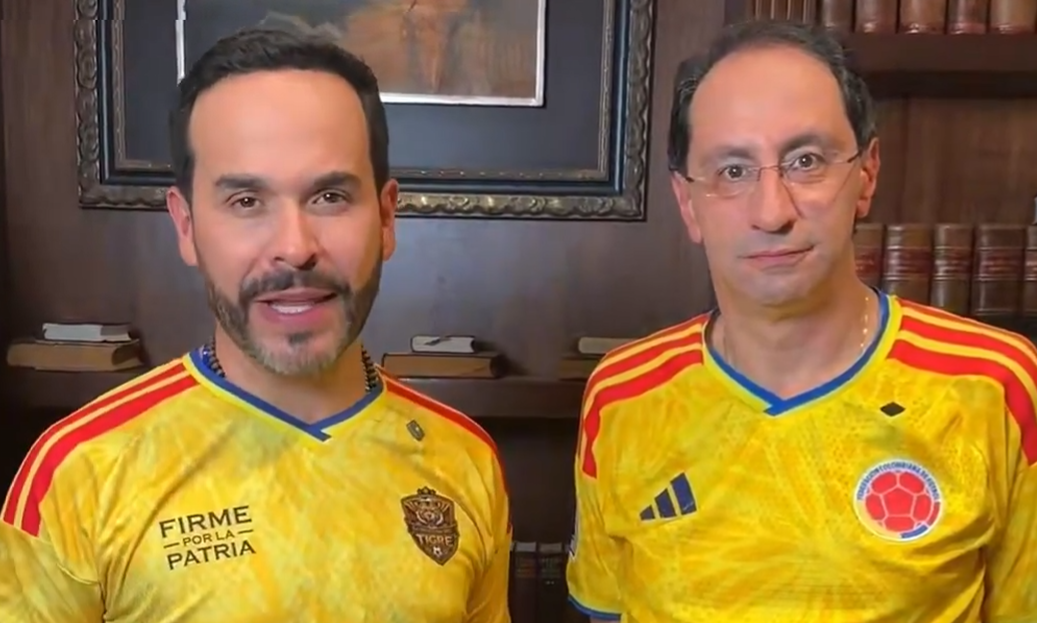
Headline photo: Colombian President Elect Abelardo de la Espriella (left) and Vice President Elect José Manuel Restrepo (photo: Twitter screen capture)