Previous Story
Who are the Five Candidates Most Likely to Become Colombia’s Next Vice President After the Upcoming Elections?
Posted On May 9, 2026
Comment: Off
Tag: 2026 presidential elections, abelardo de la espriella, Aida Quilcué, Centro Democratico, claudia lopez, Colombia´s Presidential Elections, cric, Edna Bonilla, Indigenous Nasa, ivan cepeda, juan daniel oviedo, juan manuel restrepo, Leonardo Huerta, National Indigenous Organization of Colombia, onic, pacto historico, paloma valencia, Regional Indigenous Council of Cauca, Sergio Fajardo, Vice Presidential Elections
Despite 13 campaigns underway, only five candidates’ poll above 2.5% in voter intention
Colombia is heading toward the first round of presidential elections on May 31, 2026, with 13 candidates in the race, in a scenario marked by political fragmentation and a strong concentration of voter support among a few contenders.
The next president will take office on August 7, following the end of President Gustavo Petro’s term, marking the transition from the country’s first left-wing government in recent history.
According to pre-election polls, only five candidates exceed 2% in voter intention, leaving most with limited chances of reaching the presidential palace. Among the leading contenders are Iván Cepeda, the candidate of the ruling Pacto Histórico, who leads polls with between 35% and 43% support; right-wing candidate Abelardo de la Espriella, with between 16% and 24%; and Paloma Valencia of the Centro Democrático party, with between 14% and 21%.
A second group includes centrist candidates Claudia López, polling between 3% and 4%, and Sergio Fajardo, at around 2.5%, reflecting a fragmented vote within that political segment.
Vice presidential picks shape campaign strategies
As the campaign unfolds, candidates have selected their running partners as a key strategy to broaden their electoral appeal.
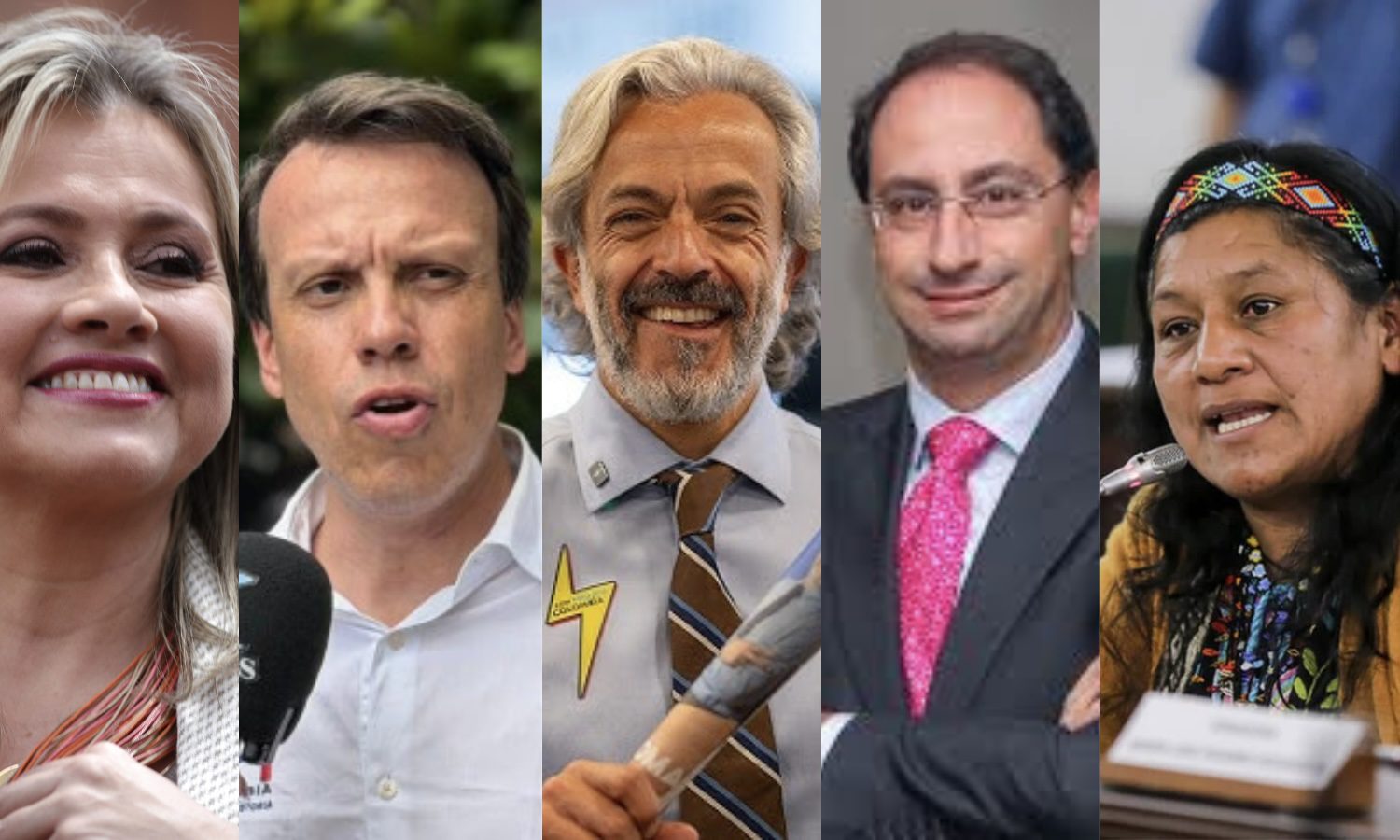
Iván Cepeda has chosen Aida Quilcué, an Indigenous Nasa leader from southwestern Colombia, reinforcing the campaign’s leftist profile and its emphasis on including historically marginalized communities in political decision-making.
Quilcué has served as a governor and Indigenous authority in her community and, like Cepeda, is a victim of Colombia’s armed conflict: her husband was killed by state agents in 2008. She has been affiliated with the Regional Indigenous Council of Cauca (CRIC) and the National Indigenous Organization of Colombia (ONIC). She presents herself publicly as an Indigenous leader, human rights defender and senator (2022–2026), without reporting formal higher education credentials.
Abelardo de la Espriella has selected former Finance, and Commerce, Industry and Tourism Minister, Juan Manuel Restrepo, as his running mate, forming a ticket focused on security and economic strengthening. “That is a capability I have because I understand productivity, competitiveness and economic development,” Restrepo told La Silla Vacía during his registration.
Restrepo is an economist with a specialization in finance from Rosario University, a master’s degree in economics from the London School of Economics, a specialization in senior management from INALDE Business School, and a doctorate in higher education leadership from the University of Bath. He has also served as rector of three major universities in Colombia.
Juan Daniel Oviedo, a former Bogotá city councilor, is running alongside Paloma Valencia of the Centro Democrático party. As economist from Universidad del Rosario, Oviedo holds a master’s degree in mathematical economics and econometrics and a Ph.D. in economics from the University of Toulouse in France.
He previously served as head of Colombia’s National Statistics Agency (DANE) during the Iván Duque administration and ran for mayor of Bogotá in 2023.
His vice presidential bid gained momentum after securing more than 1.2 million votes in the March 8 inter-party primary, finishing second. His selection aims to attract centrist and center-right voters and strengthen Valencia’s chances of advancing to a potential runoff.
However, his nomination has sparked controversy, as it marks the first time the right-wing party has chosen a candidate with liberal positions on issues such as women’s rights and LGBTQ+ rights.
Claudia López selected Leonardo Huerta, a university professor of law and philosophy, as her running mate. According to Spain’s El País, he comes from “a working middle-class family,” is the youngest of four siblings, and is married with two children.
Huerta is a lawyer from Universidad Libre and holds a degree in philosophy from the Technological University of Pereira. He has a master’s degree in administrative law and is a doctoral candidate in law. His public sector experience includes serving as education secretary in Pereira and as a deputy ombudsman for health issues during the COVID-19 pandemic in 2020.
Sergio Fajardo selected Edna Bonilla as his running mate, reinforcing a campaign centered on education and dialogue. Bonilla previously served as Bogotá’s education secretary during Claudia López’s administration (2020–2023).
She is a public accountant from the National University of Colombia, holds a tax specialization from Externado University and a doctorate in political studies. During the campaign launch, Fajardo said: “We will work together to deliver the serious and safe change Colombia needs. To move beyond polarization and build bridges instead of trenches.”
Voter participation
According to Registraduría Nacional del Estado Civil, which oversees elections, a total of 41,421,973 citizens are eligible to vote in Colombia and abroad in the first round of the presidential election. Of these, 21,298,492 are women and 20,123,481 are men.
If no candidate secures more than 50% of the vote, a runoff election will be held on June 21, 2026, between the top two candidates.