

















Move follows Ricardo Roa’s scandal-clouded exit as president
Ecopetrol S.A. (Ecopetrol) (BVC: ECOPETROL; NYSE: EC) is replacing five vice presidents, the company said in a statement, continuing an executive overhaul that has moved in step with Colombia’s change of government and the corruption-clouded exit of former President Ricardo Roa Barragán. The Board of Directors adopted the changes at a meeting on Thursday, August 27, 2026, and all five outgoing executives will hand off their duties by August 30, with internal candidates from the same divisions taking over on an acting basis starting August 31.
Sandra Lucía Rodríguez Rojas, corporate vice president of Territorial Transformation and HSE since August 2024, will be succeeded on an acting basis by Miguel Ángel Cortés Angarita, a senior environmental management professional in the same area. Jaime Andrés García Cuello, vice president of Administration and Services since September 2024, will be replaced by Álvaro Iván Saavedra Barón, the unit’s hydrocarbons supply manager. Diana Marcela Jiménez Rodríguez, corporate director of Institutional Relations and Communications, hands the role to Juliana Perdomo Valencia, a senior communications specialist in the same office. Julián Fernando Lemos Valero, corporate vice president of Strategy and New Business, gives way to Adrian Santiago Coral Pantoja, the area’s hydrocarbons new business manager. And Felipe Trujillo López, vice president of Refining and Industrial Processes since January 2025, is succeeded by Ana Carolina Ríos Junco, a senior process engineer in the same vice presidency.
Ecopetrol said the arrangements are temporary assignments while it runs formal selection processes for each position, and that it will announce permanent appointments “in due course.” In its statement, the company thanked the departing executives for their leadership and results and wished them success in their next professional steps.
The reshuffle is the latest step in a broader leadership turnover that began with Roa’s July 30 exit as Ecopetrol’s president after more than three years in the job. Colombia’s Fiscalía General de la Nación (Attorney General’s Office) said in February it would charge Roa over two separate matters: violating campaign spending limits during Gustavo Petro’s 2022 presidential campaign, which Roa managed, and trafficking in influence tied to his purchase of a Bogotá apartment prosecutors say cost $1.8 billion COP. Colombia’s Consejo Nacional Electoral (National Electoral Council) had already ratified a $5.922 billion COP sanction against the 2022 campaign in April for spending-limit violations exceeding $5.3 billion COP combined across both election rounds, ordering Roa, the campaign’s treasurer and its internal auditor to pay it, and referring the matter to prosecutors. The Fiscalía filed a formal accusation over the apartment purchase on June 9, alleging the payments moved through a company controlled by a retired police colonel, Juan Guillermo Mancera, to a seller linked to oil and gas investor Serafino Iacono. Roa has denied wrongdoing and has said he intends to remain in Colombia to answer the proceedings.
In farewell remarks on July 30 reported by Infobae, Roa apologized to Ecopetrol’s staff, saying he “deeply regretted that the personal matters of the human being that is Ricardo Roa had been the focus of this organization’s attention.” He added that the controversy had “kept us from showing the real achievements and results we accomplished during this time.”
Juan Carlos Hurtado Parra has served as Ecopetrol’s acting president since July 31 while a headhunting firm runs a formal search for a permanent successor. Martín Ravelo, a leader of the Unión Sindical Obrera (USO), Ecopetrol’s main oil workers’ union, told Semana that President Abelardo De la Espriella told union leaders his close adviser, Joaquín Gutiérrez, was a strong candidate for the post, though the choice formally rests with the board.
De la Espriella took office August 7, days after narrowly winning a June 21 runoff against left-wing Senator Iván Cepeda, and has moved quickly to reshape Ecopetrol’s governance, which his government has called a priority. Luis Felipe Henao now chairs the nine-member board, and six governors of oil-producing departments recently backed the continued board membership of Ricardo Rodríguez Yee, a holdover from the previous administration, according to El País. The government plans to propose a new board slate on September 15 alongside a bylaw reform that would let it replace most of the board’s remaining seats while keeping Henao, Rodríguez Yee and worker representative César Loza in place, Infobae reported.
The Colombian government holds about 88.5% of Ecopetrol’s shares, which is why the fight over its board and leadership carries weight well beyond the company itself. Ecopetrol employs more than 19,000 people, produces more than 60% of Colombia’s oil and gas, and controls most of the country’s pipeline, logistics, and refining network, alongside major petrochemical and gas-distribution businesses. Its 51.4% stake in ISA extends its reach into power transmission, Colombia’s real-time grid operator, XM, and the Barranquilla-Cartagena highway concession, while its own upstream operations reach the United States’ Permian Basin and Gulf of Mexico, Brazil, and Mexico, and, through ISA, power transmission in Brazil, Chile, Peru, and Bolivia, road concessions in Chile, and telecommunications.
Headline photo: Ricardo Roa during his inauguration as President of Ecopetrol, April 2023. Photo courtesy of Ecopetrol.
Results Signal Near-Mine Gold Growth Potential in Antioquia
Soma Gold Corp (TSXV: SOMA) (OTC: SMAGF) reported the first drill result and new underground channel sampling from its Escondida Project in Antioquia, Colombia, indicating that the gold-bearing Escondida Vein continues beyond the boundaries of the small underground mine the company has operated since acquiring it in July 2025.
The result is the first from a 21-hole, 2,790-meter Phase 1 drill program that Soma Gold began at Escondida in May 2026 to test the vein’s extent up to 500 meters along strike and 250 meters below the mine’s deepest level. La Escondida Mine has produced mineralized material on a small scale since 2013; Soma Gold has held it for just over a year.
The lead hole, designated EZDDH-26-001, was drilled to intercept the vein 25 meters northeast of the mine’s current workings and about 100 meters below surface, near level 10 of the underground operation. It intersected a 2.7-meter-wide fault zone with strong clay alteration and a 0.65-meter quartz vein hosted in a granodiorite-to-diorite intrusive body, similar in style to the mineralization already mined at Escondida. The composite result was 4.25 g/t Au over 1.85 meters, including a higher-grade section of 12.10 g/t Au over 0.65 meters.
“The first assay results from the Escondida Mine have met our expectations and demonstrated near-mine continuity of the vein,” said Chris Buchanan, Soma Gold’s vice president of exploration. “The vein intersection and tenor of gold mineralization are consistent with mineralized material that has been mined from this area.”
A second hole, EZDDH-26-002, aimed to intercept the vein 50 meters down-dip of the first but was lost to drilling difficulties about 25 meters above the target depth. A third hole, EZDDH-26-003, reached the target zone 50 meters down-dip and 65 meters southwest of the first intercept; its core has been shipped to Actlabs’ Medellín facility and assays are pending. A fourth hole, EZDDH-26-004, has been collared to retest the point the lost hole was meant to reach.
Underground channel sampling, conducted as crews pumped out and rehabilitated the mine’s lowest workings, returned higher grades than the drill hole. Workers collected 29 channels comprising 81 samples from areas developed since the company’s last underground sampling campaign in 2022. Three of the highest-grade results were CHU600005, at 15.40 g/t Au over 1.0 meter, including 38.22 g/t Au over 0.40 meters; CHU600006, at 16.61 g/t Au over 1.0 meter, including 36.72 g/t Au over 0.45 meters; and CHU600008, at 19.24 g/t Au over 1.0 meter, including 38.26 g/t Au over 0.5 meters.
The Escondida Vein has been traced 800 meters along strike to the northeast and about 135 meters down-dip, dipping steeply at 70 to 80 degrees to the northwest. The mine’s previous operator worked 200 meters of that strike length to a vertical depth of 105 meters, developing five-meter levels that are now mostly backfilled. Soma Gold describes the vein’s style, alteration and sulphide mineralization as consistent with an intermediate sulphidation epithermal system.
La Escondida Mine holds a permiso de trabajo de obra (small-scale mining work permit), an environmental permit and an explosives permit, and is developed through two internal winzes feeding a small on-site mill. Soma Gold recently repaired the access road linking the project to an all-season route from Zaragoza or Cáceres, Colombia, making the roughly 90-minute drive to the company’s El Limón mill passable for trucks. The previous operator produced 10 tons per day at a diluted grade of about 9.0 g/t Au from a vein 15 to 65 centimeters thick, accompanied by a wider clay-altered zone that is also variably mineralized. Soma Gold is now extending the mine’s main decline by 10 meters to open four working faces on two new levels, targeting production of 20 to 30 tons per day.
Beyond Escondida, Soma Gold continues exploring across its broader Antioquia land package. At the Cordero Deposit, two surface rigs are testing targets down-dip of the Cordero, Atenas and Cordero Viejo zones, and two underground rigs at the Cordero Mine are focused on infill drilling to support mine planning. Regional teams are also running surface geochemistry programs at the company’s El Bagre and Machuca projects.
Drill core and channel samples are split, tagged and shipped under documented chain of custody to Actlabs Colombia SAS in Rionegro, where pulps are prepared and gold is assayed by fire assay with an atomic-absorption finish; overlimit samples are re-assayed with a gravimetric finish. Pulps are then sent to Actlabs’ laboratory in Ancaster, Ontario, for a 51-element analysis. Soma Gold said its quality-control program includes regularly inserted blanks, duplicates and certified OREAS reference standards, checked against certified values and standard deviations. Buchanan, a professional geologist and the qualified person under National Instrument 43-101, reviewed and approved the technical disclosures in the release.
Soma Gold Corp’s flagship operation, the Cordero Mine, feeds two mills in Antioquia — the El Bagre mill, with a capacity of 450 tons per day, and the El Limón mill, with a capacity of 225 tons per day — for a combined 675 tons per day, permitted for up to 1,400 tons per day. Escondida, the smaller, separately permitted operation Soma Gold acquired in July 2025, has its own small on-site mill and also feeds ore to the El Bagre and El Limón complexes. Internally generated funds are financing the company’s regional exploration program. Soma Gold also holds an exploration property near Tucumã, in Brazil’s Pará state, that it has optioned to Ero Copper Corp (TSX: ERO) (NYSE: ERO).
Financing, offtake and board changes advance Putumayo copper project
Copper Giant Resources Corp. (TSX Venture Exchange: CGNT) (OTCQB: LBCMF) (Frankfurt: 29H0) has signed a binding term sheet for a $30,999,996 CAD non-brokered private placement led by Denarius Metals Corp. (Cboe Canada: DMET) (OTCQX: DNRSF), alongside a separate 10-year offtake agreement with commodities trader Trafigura covering copper and molybdenum concentrate from Copper Giant’s Mocoa Project in the Putumayo department of southern Colombia. Both companies announced the transactions on August 6, 2026.
Under the financing, Copper Giant will issue 43,055,550 common shares at $0.72 CAD per share. Denarius Metals is subscribing for 40,000,000 of those shares for $28.8 million CAD, giving it a 15.6% equity interest in Copper Giant on closing. Frank Giustra, already a significant shareholder in Copper Giant, is subscribing for 2,777,775 shares, resulting in a 15.8% stake on a partially diluted basis, while Ian Harris, Copper Giant’s president and chief executive officer, is subscribing for 277,775 shares. On closing, Copper Giant will have 256,429,248 common shares issued and outstanding. Because Giustra and Harris are insiders, their participation is classified as a related-party transaction under Multilateral Instrument 61-101, though Copper Giant said it expects the participation to be exempt from that instrument’s formal-valuation and minority-approval requirements, as the value of the insiders’ subscriptions is not expected to exceed 25% of the company’s market capitalization. Denarius, Giustra and Harris have each agreed to two-year lock-up arrangements, and the financing is expected to close on or about August 21, 2026.
A separate offtake, and a related financing at Denarius
Separately, Trafigura has agreed to purchase 20% of the copper concentrate and 20% of the molybdenum concentrate produced at Mocoa for 10 years from the start of commercial production, under arm’s-length market terms that include minimum delivered volumes; Trafigura may elect to extend the term if those minimums are not met.
“This transaction changes the trajectory of Mocoa. Denarius’s investment gives us the capital to move through the PEA and accelerate the next phase toward a construction decision, while Trafigura provides a long-term route to global markets. Together, these partners bring Colombian operating experience, market reach and long-term alignment at a pivotal moment for copper and for Colombia.”
— Ian Harris, President and Chief Executive Officer, Copper Giant Resources Corp.
The Copper Giant financing runs alongside a related but separate transaction at Denarius: Trafigura has agreed to acquire 67,000,000 Denarius common shares at $0.43 CAD per share, plus 12,500,000 warrants exercisable at $0.60 CAD per share for three years, raising approximately $28.8 million CAD for Denarius and giving Trafigura an approximate 14.9% stake in the company. That financing is also expected to close on or about August 21, 2026, and its proceeds fund Denarius’s investment in Copper Giant.
Serafino Iacono, Denarius’s executive chairman, said the company was investing in Copper Giant for the long term: “We know Colombia and we know what it takes to move a project from resource to operation. Mocoa stands out for its scale, its copper-molybdenum endowment and its potential importance to Colombia’s mining future. We are investing as a long-term partner because we believe Copper Giant has the asset and the team to advance it responsibly.”
Edmundo Vidal, Trafigura’s director for Latin America, linked the offtake to Colombia’s push to develop copper as a strategic mineral: “Colombia has the geological conditions and the opportunity to become an important copper producer. We are pleased to see projects like Mocoa develop, especially given the country’s recognition of copper as a strategic mineral. Our long-term offtake at Mocoa reflects both our confidence in the project, and our strategy of working with producers to bring new supply to customers around the world.”
Colombia’s Agencia Nacional de Minería (National Mining Agency, or ANM) has designated copper among the minerals it considers strategic for the country’s energy transition, a designation Vidal referenced in his remarks.
Board changes and the Mocoa resource
Copper Giant is also appointing Carlos Augusto Suárez Rojas to its board of directors, effective on closing of the financing and subject to approval of the TSX Venture Exchange. Suárez is a Colombian attorney and political strategist and the founder and chief executive officer of Bogotá-based public affairs firm Estrategia & Poder S.A.S., which led strategy for the presidential campaign of Colombian President Abelardo De La Espriella and advises several Colombian state governments. Separately, Copper Giant is appointing Federico Restrepo-Solano, Denarius’s chief executive officer, to its advisory board. Restrepo-Solano has more than 25 years of experience in the oil and mining sectors across Latin America and leads Denarius’s operations in Colombia and Spain. The board move follows Copper Giant’s 2025 prior consultation agreement with the Inga Condagua Indigenous Nation, a prerequisite the company cleared before advancing exploration permitting at Mocoa.
Mocoa, located in Putumayo department, holds an Inferred Mineral Resource of 1,120 million tons at an average grade of 0.51% copper-equivalent, comprising 7.6 billion pounds of copper at 0.31% and 1.0 billion pounds of molybdenum at 0.039%, according to the resource estimate Copper Giant filed with Canadian securities regulators. Copper Giant holds more than 132,000 hectares of district-scale tenure around the deposit, which the company says was first identified in 1973 through a regional geochemical survey conducted by the United Nations and the Colombian government, followed by exploration campaigns from 1978 to 1983 and further drilling by B2Gold in 2008 and 2012. The mineral resource estimate was prepared by Kevin Hon and Warren Black of APEX Geoscience, with an effective date of November 18, 2025, and peer-reviewed by APEX president and chief executive Michael Dufresne; a full technical report incorporating the estimate, also naming APEX Geoscience‘s Dufresne, Black and Hon alongside Chester de Leon of Consultec Limited, carries an effective date of December 23, 2025, and was filed January 8, 2026. The estimate’s economic assumptions include copper priced at $4.00 USD per pound and molybdenum at $20.00 USD per pound, copper and molybdenum recoveries of 90% and 95%, respectively, and a cutoff grade of 0.25% copper-equivalent. Copper Giant has continued drilling at Mocoa since that estimate was filed, including a third mineralized breccia corridor confirmed below the current conceptual pit, which the company has said points to a larger resource than the current estimate captures.
Copper Giant, part of the Vancouver-based Fiore Group, has focused on advancing Mocoa toward a preliminary economic assessment and eventual construction decision. Denarius Metals, based in Toronto, is producing gold and silver at its Zancudo Project in Colombia’s Cauca Belt, near Medellín, while completing construction of a processing plant there, and holds mineral projects in Spain, including the Aguablanca project, which the European Union has designated a Strategic Project. Trafigura, founded more than three decades ago and employee-owned, trades and moves commodities including metals, energy and minerals across a network operating in more than 150 countries.
Neither company has disclosed a timeline for the preliminary economic assessment the new capital is meant to fund.
Headline photo: Copper Giant field geologists during exploration work at the Mocoa copper-molybdenum project in Putumayo. (Photo courtesy Copper Giant Resources Corp.)
US private lender takes on land with approvals still pending
Cocoa & Company SAS has raised $1.26 million USD in working capital against an undeveloped tract on the Cartagena-Barranquilla corridor, closing a cash-out refinance with Kennedy Funding, a private direct lender based in Englewood, New Jersey. The lender said it reached the borrower through commercial mortgage brokers in Colombia, disclosed the transaction on July 28, 2026. The property lies near Cartagena, off the route to Barranquilla.
Kennedy Funding said subdivision approvals are still in process and the project remains at the feasibility stage. The collateral is a roughly 20-hectare parcel — nearly 50 acres — with direct access to National Route 90A-01. Cocoa & Company plans a residential subdivision there.
The board of the Banco de la Républica (Bank of the Republic), the country’s central bank, voted on July 31, 2026, to hold the monetary policy rate at 12%. Four directors backed the hold and three voted for a 50-basis-point increase. Analysts at Bancolombia (NYSE: CIB) had forecast in April 2026 that the rate would climb to 12%, Finance Colombia reported at the time.
National Route 90A-01 is the Vía al Mar (Road to the Sea). It forms the Cartagena-Barranquilla leg of a 146-kilometer toll road concession signed with the Agencia Nacional de Infraestructura (National Infrastructure Agency), or ANI, as Contract 004 on September 10, 2014. The concession pairs 109.3 kilometers between the two cities with the 36.7-kilometer Circunvalar de la Prosperidad (Prosperity Ring Road) linking Malambo, Galapa, Puerto Colombia and Barranquilla. The concessionaire, Concesión Costera Cartagena Barranquilla, which trades as Ruta Costera, brought the full corridor into service in December 2021. Colombian transmission and infrastructure group ISA (BVC: ISA) acquired all of its shares through its Chilean roads unit, closing in October 2020.
Developers sold 3,965 homes in the department of Bolívar, which contains Cartagena, in the first half of 2026, started 3,012 units and launched 3,557, according to Camacol Bolívar, the regional chapter of the Colombian construction chamber, in figures reported by El Universal. Only the subsidized tier grew: social-interest housing accounted for 2,452 of those sales, up 26.6% year over year, while the mid- and upper-tier segment fell 28.8%, to 1,513 units from 2,126. Irvin Pérez, manager of Camacol Bolívar, told the newspaper that recent months have been challenging for the construction sector, citing macroeconomic conditions, difficulty accessing credit and the need to strengthen housing policy instruments.
Kennedy Funding has operated since 1987 and moved into its Englewood headquarters in January 2022. It announced in April 2022 that it had passed $4 billion USD in closed loans.
“International lending isn’t just about financing a property—it’s about understanding the market behind it,” said Edwin Urrego, executive loan officer at Kennedy Funding. “Every country has its own legal, regulatory, and cultural landscape. Our experience allows us to navigate those differences and provide financing solutions for borrowers pursuing opportunities that many lenders simply aren’t equipped to handle.”
“International lending has been part of Kennedy Funding’s DNA for decades,” said Kevin Wolfer, the firm’s chief executive officer. “Our experience, creativity, and willingness to think beyond traditional lending boundaries allow us to help borrowers move projects forward where others may not.”
Edwin Urrego, executive loan officer at Kennedy Funding. (Photo: Kennedy Funding handout)
MinTIC shifts its yardstick from coverage to productivity and jobs
Colombia’s technology minister, Alexandra Falla Zerrate, used the opening of ANDICOM 2026 in Cartagena on September 2, 2026, to ask operators, technology companies, universities and regional governments to help write a new national technology plan for 2026 through 2030, one that the Ministerio de Tecnologías de la Información y las Comunicaciones (Ministry of Information and Communications Technologies, or MinTIC) says will be judged on jobs, income and business productivity rather than only on the number of connections it delivers.
The Plan TIC Colombia 2026–2030, subtitled “Colombia: el milagro tecnológico” (Colombia: the technological miracle), was presented as an invitation rather than a finished document. According to the ministry, its stated goal is to make Colombia the technology hub of the Americas, and the process will involve the national government, regulators, departments and municipalities, operators, companies, startups, universities, research centers and civil society, following a sequence the ministry describes as listen, diagnose, prioritize, design, validate, execute and measure.
“Colombia has the position, it has the cables, it has the talent, it has the energy, and now it has the direction,” Falla said. “Together, we are going to build the Technological Miracle 2026–2030.”
The minister addressed the conference by video link from a television studio in Bogotá rather than in person, according to Infobae, which reported that she apologized for her absence because she was touring the areas hit by the earthquake of August 10, 2026. Falla took office with the administration of President Abelardo de la Espriella, which was inaugurated on August 7, 2026, and is managing reconstruction after the earthquake.
Seven Questions for the Industry
Falla listed the operators, infrastructure providers, universities, entrepreneurs, trade associations, multilateral banks, international cooperation agencies, civil society and the members of Congress present in the hall as the parties she wants at the table, Infobae reported. She put seven questions to them, ranging from the main problem the government should solve and the decision it most needs to take to what each organization is prepared to contribute, with answers collected through a form on a MinTIC microsite that the ministry said would remain open only during ANDICOM, after which it would announce a sector-wide consultation phase. Falla told attendees the call was for commitments rather than commentary, Infobae reported.
“This invitation is not an invitation to offer opinions from the stands. It is to make a commitment on the field.”
— Alexandra Falla Zerrate, Colombia’s minister of information and communications technologies
The First 100 Days
MinTIC says it will start several lines of work during the first 100 days. Among them, the ministry plans to reorganize the Fondo Único de Tecnologías de la Información y las Comunicaciones (Single Fund for Information and Communications Technologies, or FUTIC), the fund consolidated under Law 1978 of 2019 that finances universal access programs and public television; design a new connectivity policy; review the policy for spectrum use and assignment; establish a strategy for computing and data centers; and design a national cybersecurity architecture.
The list also includes a national roadmap for applied artificial intelligence, a national digital talent mission, the identification of the 20 government procedures whose digitalization would have the greatest impact, a portfolio of ICT projects with high regional impact, and a proposal for a permanent coordination mechanism linking government, industry, academia and the regions.
Falla said MinTIC works with the Departamento Nacional de Planeación (National Planning Department) and the ministries of science, education, labor and finance, and on the regulatory side with the Comisión de Regulación de Comunicaciones (Communications Regulation Commission), the Agencia Nacional del Espectro (National Spectrum Agency) and the Superintendencia de Industria y Comercio (Superintendency of Industry and Commerce), according to Infobae.
New Metrics for Digital Progress
The ministry says the proposal changes how digital transformation is understood. For years, according to MinTIC, digital progress has been tracked through coverage, connections, speed, devices delivered and people trained. The new plan proposes to measure what changed in people’s lives after they were connected: reductions in digital poverty, technology adoption, employability, income, business productivity and the productive use of artificial intelligence. In the ministry’s framing, “connectivity of the future” will be defined by quality, speed, stability, affordability, devices, skills and purpose rather than by coverage alone.
Falla offered one example, according to Infobae: 22,000 people have been trained in artificial intelligence, and the ministry’s question now is what that training produced in terms of productive development, employability and living conditions. “We cannot keep counting how many diplomas we hand out,” she said.
Falla also presented figures on the gaps the plan is meant to close, according to Infobae. Internet use in Colombia rose from 58% to 87% between 2020 and 2025, but only 35.7% of households own a computer, 10 of the country’s 32 departments remain below 50% connectivity, and 45% of Colombians without internet access lack it because they cannot afford it. On artificial intelligence, 24% of Colombians already use AI tools, and Colombia ranks fourth among 19 countries in the 2025 Latin American Artificial Intelligence Index published by the Comisión Económica para América Latina y el Caribe (Economic Commission for Latin America and the Caribbean, or CEPAL). “If we do not close this gap today, AI will not be a leveler of opportunities but an amplifier of inequalities,” Falla said.
Five Missions and a 2030 Target
The plan is organized around five national missions, according to the ministry: connecting Colombia with universal, relevant, high-quality connectivity; preparing Colombia through talent, education, STEM and artificial intelligence; making Colombia produce through AI, data, business digitalization and the digital economy; transforming the state through interoperability, GovTech, data and public-sector AI; and protecting Colombia through cybersecurity, digital sovereignty and digital trust. In her remarks, as reported by Infobae and Valora Analitik, Falla summarized the plan as five pillars: connect, enable, produce, protect and transform. The ministry says it wants Colombia to create, adapt and export technology rather than only consume it, in areas including applied AI, AI agents, GovTech, FinTech, cybersecurity, data infrastructure and exportable digital services.
The ministry’s stated 2030 targets include connectivity as an effective right, technology training that translates into jobs and income, and a state that operates as a digital platform. Falla proposed what MinTIC calls a new Colombian digital compact, under which the government leads and enables, companies invest and transform, universities research and train, regions adapt and adopt, and citizens use, participate and demand results.
“Colombia’s technological future cannot be designed from a single office,” Falla said. “We have to listen to one another, understand the needs of the regions, and work together with those who are part of the country’s technological and productive ecosystem.”
The Venue
ANDICOM is organized by CINTEL, the Centro de Investigación y Desarrollo en Tecnologías de la Información y las Comunicaciones (Center for Research and Development in Information and Communications Technologies), founded in 1991. The 2026 edition, the 41st, ran from September 1 to September 4 at the Las Américas Convention and Exhibition Center and the Faranda Collection hotel under the theme “Unleashing the Power of AI,” with the European Union as guest of honor. El Universal reported that the organizers expected more than 6,000 attendees, 180 speakers and participants from 40 countries. Finance Colombia previewed this year’s agenda in August.
Headline photo:Minister Alexandra Falla Zerrate delivers her ANDICOM 2026 address from a television studio in Bogotá. (Photo courtesy MinTIC)
Bylaw rewrite would clear the way for a mostly new nine-member board
Ecopetrol S.A. (BVC: ECOPETROL; NYSE: EC) will hold an extraordinary shareholders’ meeting on September 15, 2026, at which the Colombian government, acting through the Ministerio de Hacienda y Crédito Público (Ministry of Finance and Public Credit) as holder of 88.49% of the company’s shares, intends to elect a new nine-member board of directors and amend the bylaw that has limited how many sitting directors can be replaced in a single vote.
Ecopetrol reported on August 28 that all corporate procedures required to formalize the Nation’s slate of candidates have been completed and that the slate will be put to shareholders at the meeting. The government’s request arrived in a letter dated August 26 from Finance Minister Miguel Gómez Martínez to Juan Carlos Hurtado Parra as Ecopetrol’s acting president, answering communications the company sent on August 4, 10 and 14 reporting director resignations and asking that an assembly be convened to fill the vacancies.
Three of the board’s nine seats have been empty since July 31. According to the ministry’s letter, Juan Gonzalo Castaño Valderrama resigned as a non-independent director on May 12, 2026, and Ángela María Robledo Gómez, who chaired the board, and Lilia Tatiana Roa Avendaño resigned effective July 31. The letter also notes that Ricardo Roa Barragán remained at the head of the company through July 30 and that Hurtado Parra has held the acting presidency since July 31, one week before President Abelardo de la Espriella was inaugurated on August 7. Hurtado Parra, the company’s executive vice president of hydrocarbons, had already been running Ecopetrol on an interim basis since April 7, the day after the board approved Roa’s request for vacation followed by unpaid leave, according to Portafolio. Roa’s exit followed months of controversy, including the leak in March of an internal report pointing to a possible $42 million USD payment to a company in the British Virgin Islands.
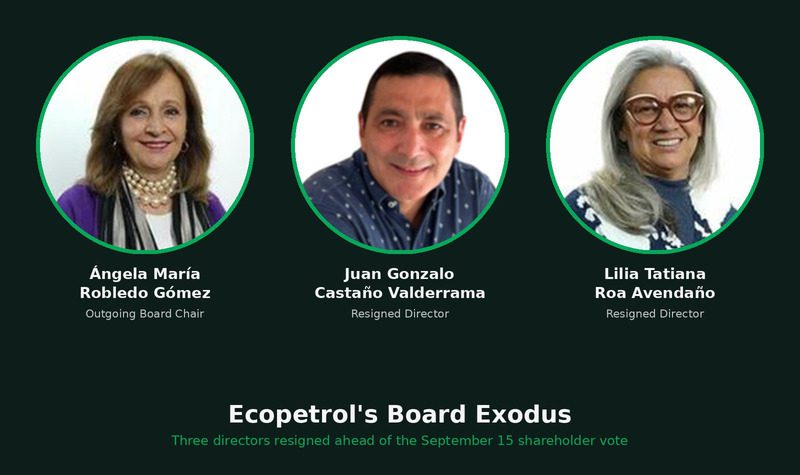
The first substantive item on the agenda is a reform of Article 20 of Ecopetrol’s bylaws. The current text requires that any slate presented to the assembly include at least three sitting directors, not counting the candidates for seats eight and nine. The ministry proposes replacing that requirement with language under which the slate “will seek to” retain at least three current members, without making it a condition of the slate’s validity or a bar to a full renewal of the board. A second change to the same article would allow the Nation to renominate the employee representative already elected for the current period without repeating the employee vote.
The ministry argues that the existing rule makes the composition and validity of a slate depend on whether a set number of directors agree to be renominated, so that a decision belonging to shareholders is conditioned on the individual will of the administrators themselves, which it describes as an unjustified risk of blocking the electoral process. “The continuity of current members would remain a relevant corporate governance criterion, but not an absolute condition that could prevent the recomposition of the body when the company’s circumstances, the vacancies that have arisen or the profiles required call for its renewal,” Gómez Martínez wrote.
Shareholders will then elect all nine directors by the electoral quotient system for the remainder of the 2025–2029 institutional period. Six of the nine names on the Nation’s slate are new to the board: Carlos Augusto Suárez Rojas, Jorge Alberto Jaller Jaramillo, José Camilo Manzur Jattin, Ludmila del Carmen Vergara Rosales, Betzy Patricia Martínez Zapatero and Claudia Margarita Lafaurie Taboada.
According to the candidate profiles Ecopetrol published, Suárez Rojas is a lawyer who founded and heads Estrategia & Poder and previously served as secretary general and operations director of the Contraloría General de Cundinamarca (Cundinamarca comptroller’s office); El Tiempo describes him as the president’s political communications strategist. Jaller Jaramillo was vice president of retail and vice president of Éxito and Carulla at Almacenes Éxito S.A., which trades as Grupo Éxito (BVC: EXITO). Manzur Jattin has been president of the Asociación Colombiana de Distribuidores de Energía Eléctrica (Colombian Association of Electric Power Distributors, Asocodis) since 2006 and previously served as an expert commissioner of the Comisión de Regulación de Energía y Gas (Energy and Gas Regulatory Commission, CREG). Vergara Rosales was named head of the Superintendencia de Transporte (Superintendency of Transportation), the agency announced on August 14. Martínez Zapatero is a lawyer who has held several public-sector advisory posts and currently manages the Fundación Sé Valiente. Lafaurie Taboada is a former head legal adviser and vice president of hydrocarbon contracts at the Agencia Nacional de Hidrocarburos (National Hydrocarbons Agency, ANH) and is now legal vice president of CNE Oil & Gas. El Tiempo also reported that Jorge Mario Velásquez, the former president of Grupo Argos (BVC: GRUPOARGOS) whom de la Espriella had named in July as a prospective director, was left off the slate.
The remaining three seats are filled under procedures set out in Article 20 rather than chosen directly by the ministry. Seat seven belongs to a representative elected by Ecopetrol’s employees; the company reports that César Eduardo Loza Arenas, a former president of the Unión Sindical Obrera (Workers’ Trade Union, USO), was previously elected under that procedure and has been nominated again. For seat eight, the governors of the hydrocarbon-producing departments where Ecopetrol operates reaffirmed Ricardo Rodríguez Yee in a communication received August 26. For seat nine, the minority shareholders with the largest holdings reaffirmed Luis Felipe Henao Cardona, the board’s current chairman and a former housing minister, in a communication received August 21.
The agenda also asks shareholders to instruct the board, including the one elected at the meeting, to bring the company’s director succession policy into line with the amended Article 20 and provides that any internal rule still requiring a minimum number of continuing directors will not apply to this election. Ecopetrol stated that its board and Corporate Governance and Sustainability Committee completed the verification of all candidates, so no dispensation from the succession policy’s review procedures will be needed.
The board reshuffle is unfolding alongside a turnover in senior management. At its August 31 meeting, Ecopetrol’s board accepted the departure of Sergio Andrés Moreno Acevedo as corporate vice president of science, technology and innovation and named Diana Marcela Acero Rojas, who manages that portfolio, to the post on an acting basis from September 1. The same meeting formalized the appointment of Henryk Manuel Porras Villamil, until then a project leader in the energy transition projects department, as acting executive vice president of energy transition from August 31, succeeding Ernesto Alfonso Gómez Cabarcas, who had held the job on an interim basis through August 30 and will take statutory leave before pursuing other opportunities. The company said permanent appointments will be disclosed when made.
Four days earlier, at its August 27 meeting, the board had approved five other interim replacements covering the vice presidencies of territorial transformation and health, safety and environment; administration and services; strategy and new business; and refining and industrial processes, as well as the corporate directorate of institutional relations and communications, with outgoing executives leaving August 30 and internal replacements taking over the next day. La República also reported management changes at the Ecopetrol subsidiary Hocol, where general manager Luis Eduardo Parra left on August 25.
Ahead of the vote, Ecopetrol published the measures it will apply to shareholder representation, as required by the Circular Básica Jurídica (Basic Legal Circular) of the Superintendencia Financiera de Colombia (Financial Superintendency of Colombia). Proxies that do not meet the legal minimums or that fail to name the representative will be rejected, and none may be granted to Ecopetrol employees or to anyone tied to its management. Managers and employees are barred from suggesting proxy names, recommending a vote for any slate, or coordinating with shareholders on proposals or votes; the Corporate Legal Vice Presidency and the General Secretariat will review the powers of attorney.
The meeting is scheduled for 11 a.m. at Ecopetrol’s main building at Carrera 13 No. 36-24 in Bogotá, in person and streamed live on the company’s website, according to the convocation notice the company published on August 28. Registration of shareholders and proxies opens at 9 a.m. Meeting documents, candidate profiles and acceptance letters are posted on the company’s investor site.
Ecopetrol says it accounts for more than 60% of Colombia’s hydrocarbon production and holds 51.4% of the power transmission company ISA (BVC: ISA). Finance Colombia reported in May that the company’s first-quarter results were weighed down by lower crude prices and reduced output even as refining margins recovered.
Headline image: The six new nominees on the Nation’s slate for the Ecopetrol board, to be voted on September 15. (Photos courtesy Ecopetrol; composite: Finance Colombia)
Relief Flight Carries Shelter Supplies to Colombia Earthquake Zone
Colombia’s earthquake death toll had reached at least 273, with 3,824 injured and 377 missing, according to an August 13, 2026, update from the country’s Unidad Nacional para la Gestión del Riesgo de Desastres (National Disaster Risk Management Unit), three days after a magnitude-7.4 quake struck the department of Chocó near San José del Palmar. Samaritan’s Purse, a Boone, North Carolina-based disaster relief organization, dispatched a Boeing 767 cargo plane from Greensboro, North Carolina, before dawn Thursday carrying more than 48 tons of relief supplies for survivors.
The aircraft’s cargo included hygiene kits, solar lights and shelter materials, aimed at families left without safe housing. The earthquake destroyed thousands of homes and damaged tens of thousands more, according to the disaster risk management unit, which has recorded 12,584 homes destroyed and 74,873 damaged nationwide as of August 13, along with widespread damage to schools, health centers and roads. Samaritan’s Purse said its teams on the ground, working through local churches, would begin distributing the supplies to affected communities as quickly as possible.
The earthquake and its aftershocks caused significant damage in Pereira, Manizales, Cali and Quibdó, the capital of Chocó department. Search-and-rescue crews continue working through collapsed buildings as the Colombian government coordinates additional international assistance, and Samaritan’s Purse said the death and injury figures are expected to keep rising as the response continues.
“Although we don’t know the full extent of the destruction in Colombia yet, so many families are in need of immediate assistance,” said Franklin Graham, president of Samaritan’s Purse.
Samaritan’s Purse operates in more than 100 countries and says it provides aid to people affected by war, disaster, disease, poverty and famine. It already had a presence in Colombia before this week’s earthquake: in June 2026, the organization dispatched a team from its Colombia country office to respond to a separate pair of earthquakes in neighboring Venezuela. Those existing field offices, the organization said, will support distribution of the newly arrived supplies across the earthquake-affected region.
Headline photo: Samaritan’s Purse staff load pallets of relief supplies onto a cargo aircraft bound for Colombia. (Photo courtesy Samaritan’s Purse)
More Than 100 Turn Out as Organizers Plan a 2027 Return
Cinemotion Labs closed its debut Medellín edition on August 16, wrapping a week of workshops, an academic conference and an equipment showcase at Telemedellín with a public conversation between Colombian director Víctor Gaviria and cinematographer Rodrigo Lalinde before more than 100 people. Organizers said they are already planning a second edition for 2027.
The event was organized by Latin Press Inc., the trade-media company behind broadcast-industry publications including TV y Video Latinoamérica, and ran August 10 to 16, 2026, at Telemedellín’s studios in the El Poblado district. Cinemotion Labs describes itself as the first event in Colombia and Latin America built specifically around film production and post-production, pairing an exhibition floor of camera, lighting and editing equipment with an academic program on trends including artificial intelligence, virtual production and streaming platforms. Sponsors and exhibitors at the debut edition included Sony (NYSE: SONY; TSE: 6758), Riedel Communications and Vidiexco.
The week opened with Volumen XVII of the Asociación de Directores de Fotografía Cinematográfica de Colombia’s (Association of Cinematographic Directors of Photography of Colombia, or ADFC) Salón Internacional de la Luz, alongside workshops from Congo Films, the Bogotá-based virtual-production and equipment-rental company. An academic conference program followed, along with hands-on labs staged in Telemedellín’s Studio 2 and a Filminutos contest that challenged production teams to shoot short pieces during the event.
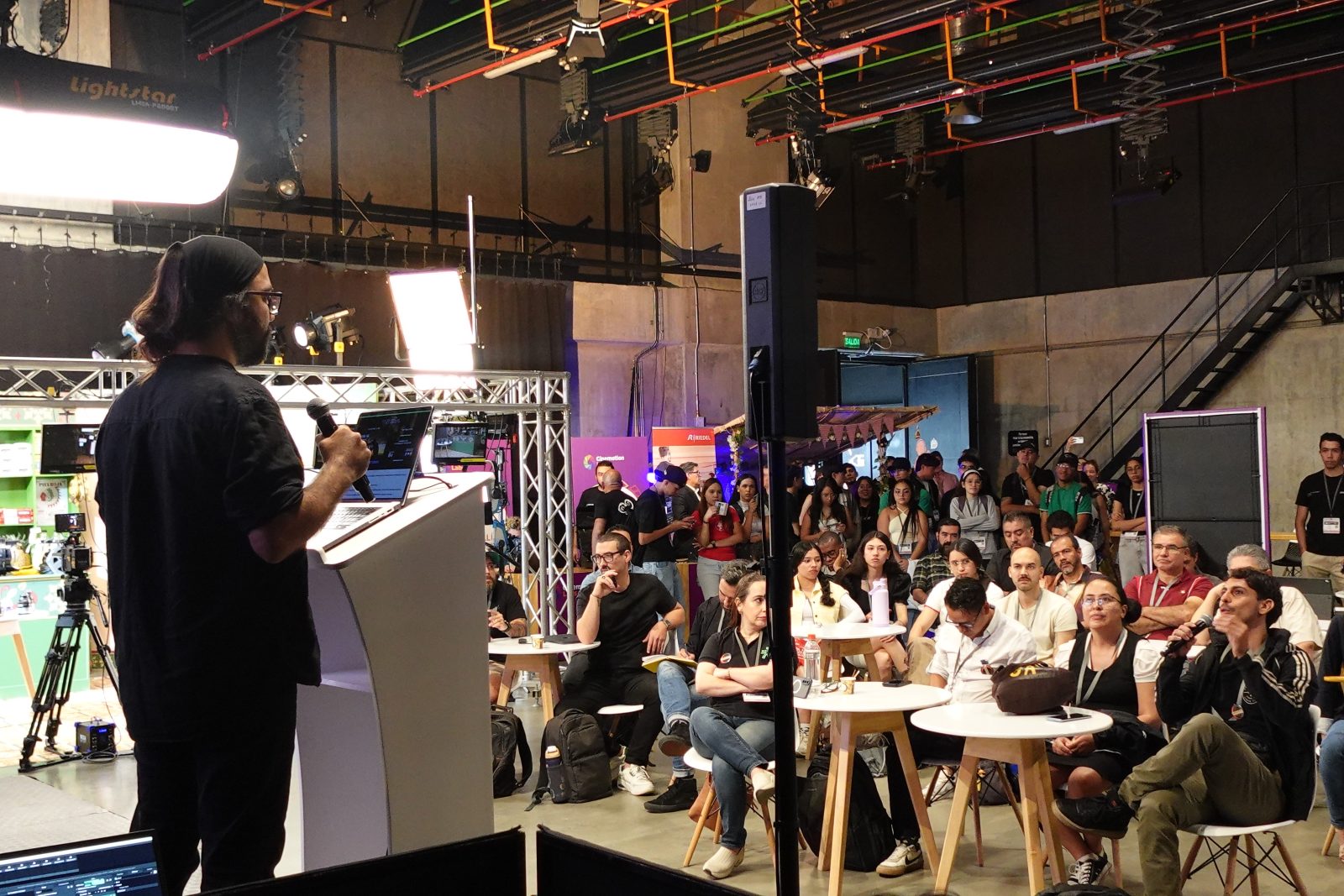
A speaker addresses attendees during Cinemotion Labs’ academic program at Telemedellín’s Studio 2. (Photo courtesy Cinemotion Labs)
Cinemotion Labs’ closing activities were folded into the wrap-up of the Festival de Cine Corto Medellín, where organizers awarded the contest’s top short film and staged the conversation between Gaviria and Lalinde, who shot Gaviria’s 1990 film “Rodrigo D: No Future,” at Telemedellín’s Parque Gabriel García Márquez campus. The week ended with a guided tour of Medellín intended to introduce participants to potential filming locations in the city.
“The balance of this first edition is very positive. We managed to bring together training, technology, creation and talent around film, but also connect participants with the possibilities Medellín offers for developing their projects,” Verónica Marín, Cinemotion Labs’ project manager, told TV y Video Latinoamérica. “Cinemotion Labs was born with the intention of generating these meeting spaces, and we are already working on what the 2027 edition will be.”
The event closed as Colombia expands the tax incentives it uses to compete for international film and television production. Proimágenes Colombia, the nonprofit that administers the country’s film-promotion funds through its Comisión Fílmica Colombia (Colombia Film Commission), said in December 2025 that the 2026 quota for its Certificado de Inversión Audiovisual (Audiovisual Investment Certificate, or CINA) will reach $350 billion COP, a 49% increase over 2025 and the largest allocation since the incentive was created under Law 1556 of 2012. Since CINA’s creation, it has backed more than 165 international audiovisual projects, generating over $3.4 trillion COP ($861 million USD) in investment and more than 130,000 direct jobs, according to Proimágenes Colombia; Law 1556 also created a second instrument, the Fondo Fílmico Colombia (Colombia Film Fund) cash-rebate fund. Beneficiaries with 2026 releases include the second season of Netflix’s (NASDAQ: NFLX) “One Hundred Years of Solitude” and Amazon Prime Video’s (NASDAQ: AMZN) “The Night Manager.”
Cinemotion Labs said it will share details on its 2027 edition through its official channels.
Headline photo: Organizers and guests cut the ribbon at the opening of Cinemotion Labs’ debut edition in Medellín. (Photo courtesy Cinemotion Labs)
Adjusted operating margin fell to 5.4% from 12.9% a year earlier
LATAM Airlines Group (NYSE: LTM; Santiago Stock Exchange: LTM) reported net income of $125 million USD for the second quarter of 2026, down 48.2% from the same period a year earlier, even as revenue rose almost 28%. The Santiago-based group published the results on August 4, 2026.
Revenue reached $4.18 billion USD, up 27.6% from $3.28 billion USD in the second quarter of 2025. Adjusted operating income fell 46.3% to $227 million USD, and the adjusted operating margin narrowed to 5.4% from 12.9%. Adjusted EBITDA totaled $713 million USD, down 16.1%.
Aircraft fuel costs rose 93.1% to $1.71 billion USD, an increase LATAM attributed in its earnings report to jet fuel prices driven higher by geopolitical tensions in the Middle East. The average all-in price the group paid, including hedges, rose 81.3% to $194.50 USD per barrel, while consumption rose 6.8%.
“The second-quarter results demonstrate the group’s structural strength, the value proposition offered to customers and its ability to operate in a volatile and uncertain environment,” said Ricardo Bottas, chief financial officer of LATAM Airlines Group. He added: “The group remains firmly committed to the disciplined execution of a profitable growth strategy. LATAM’s diversified business model — which includes revenue from the Premium segment, integrated cargo and loyalty businesses, and a strong financial position — provided the foundation for maintaining profitability even during a seasonally weaker quarter and amid unprecedented fuel-price pressures that had a significant impact on the group’s costs.”
Passenger revenue rose 27.9% to $3.61 billion USD, which LATAM said showed its ability to “pass through higher fuel costs to fares without compromising demand.” Passenger unit revenue rose 17.5% to 8.1 US cents even though capacity grew 8.9%. The premium segment produced 29% of passenger revenue. Cargo revenue rose 21.8% to $510 million USD on 17.8% higher yields, and the group moved 261,000 tons. LATAM Pass reached 56 million members, who accounted for 67% of passenger revenue.
LATAM operates domestic airlines in Brazil, Chile, Colombia, Ecuador and Peru. It filed for Chapter 11 bankruptcy protection in May 2020, emerged on November 3, 2022, and relisted its American depositary receipts on the New York Stock Exchange in July 2024. Its Colombian subsidiary operates inside a joint venture with Delta Air Lines (NYSE: DAL) that Colombia’s Aeronáutica Civil (Civil Aeronautics), or Aerocivil, approved without conditions in May 2021.
In Colombia, LATAM Carried 5.2 Million Passengers in the First Half
LATAM Airlines Colombia said the group carried 5.2 million passengers during the first half of 2026 across its domestic network and on international routes to and from the country. Bogotá–Medellín remained the busiest domestic route, at 754,925 passengers, up 4% from the first half of 2025. Bogotá–Cartagena grew 11% and Bogotá–Barranquilla 10%. Bogotá–Montería grew fastest, at 27%. On international routes to and from Colombia, the airline reported growth of 46% to Brazil through the São Paulo hub and 18% to Orlando, both against the first half of 2025.
LATAM Restores Its 2026 Outlook but Trims Spanish-Speaking Capacity Growth
LATAM restored every parameter of its 2026 outlook, capacity and revenue among them, and raised its revenue range to $17.3 billion USD to $17.7 billion USD from the $15.5 billion USD to $16.0 billion USD it issued in December 2025. Adjusted EBITDA guidance of $4.1 billion USD to $4.4 billion USD sits above the $3.8 billion USD to $4.2 billion USD range set in May 2026, but below December’s $4.2 billion USD to $4.6 billion USD. Adjusted operating margin guidance stands at 12% to 13%, against an original 15% to 17%. The company assumes jet fuel at $147 USD per barrel in the third quarter and $130 USD in the fourth.
Capacity guidance moved in two directions. For the four Spanish-speaking domestic markets LATAM serves — Chile, Colombia, Ecuador and Peru — the group cut full-year growth to 4% to 5%, from the 5% to 7% it issued in December 2025; capacity across those four countries grew 5.3% during the second quarter. Guidance for Brazilian domestic capacity rose, to 8% to 9% from 6% to 8%, and group-wide capacity growth guidance narrowed to 9% to 10% from 8% to 10%.
Liquidity Reaches $4.23 Billion USD and Shareholders Back a Buyback
The group generated $476 million USD in adjusted operating cash flow and ended the quarter with $2.65 billion USD in cash. Including undrawn committed credit lines, liquidity stood at $4.23 billion USD, or 26.2% of revenue over the previous 12 months. Adjusted net leverage held at 1.5 times, below the 2.0 times ceiling set in the company’s financial policy. At an extraordinary shareholders’ meeting on August 3, 2026, shareholders approved the repurchase of up to 5% of subscribed and paid shares over as long as five years, delegating the launch, mechanism and conditions to the board of directors.
LATAM Expects 28 More Aircraft and Its Brazil Unit Maps the E2 Network
LATAM took delivery of nine aircraft and ended the quarter with a fleet of 383, comprising 304 Airbus (Euronext Paris: AIR) jets and 79 Boeing (NYSE: BA) aircraft, 20 of them freighters. The group expects 28 more deliveries over the rest of the year.
LATAM Airlines Brazil separately set out the first deployment of its Embraer (NYSE: EMBJ) E195-E2 fleet. Through March 2027, up to 14 of the jets are expected to operate 42 domestic routes, eight of them new: four linking Guarulhos with the new destinations of Cabo Frio, Macaé, Ji-Paraná and Rondonópolis, plus four connecting existing bases. LATAM Airlines Brazil will then serve 67 domestic destinations, against 44 in 2019, and is evaluating up to 18 more for a second phase in 2027.
New MinTIC deputies inherit a 20-point urban-rural internet gap
Colombia’s technology minister, Alexandra Falla Zerrate, swore in three senior officials on August 13, 2026, giving the Ministerio de Tecnologías de la Información y las Comunicaciones (Ministry of Information and Communications Technologies), or MinTIC, a full leadership bench six days after President Abelardo De la Espriella took office.
MinTIC reported in May 2026 that rural household internet access had reached 56.9%, passing half for the first time, and that the gain had left the urban-rural gap at around 20 percentage points. The ministry presented those figures to a team of economists from the Organization for Economic Cooperation and Development (OECD) in a session led by then Vice Minister of Connectivity Gloria Patricia Perdomo — the post one of the new appointees now takes over.
That post goes to Camilo Carrascal Vergel, an electronics engineer. Germán Enrique Bacca Medina takes the Vice Ministry of Digital Transformation, and Magda Yolima Amaya Arévalo becomes secretary general, according to the ministry, which supplied the biographical details that follow.
Carrascal Vergel brings more than 20 years across connectivity, regulation, infrastructure, digital inclusion, digital television, information security, data and innovation, and has worked in the public sector on initiatives to widen digital infrastructure and access to communications services in Colombia. Bacca Medina is a lawyer specializing in financial and securities law, with postgraduate study in communications law and in competition and competition economics, and has held posts at the Superintendencia de Industria y Comercio (Superintendency of Industry and Commerce) and the Comisión de Regulación de Comunicaciones (Communications Regulation Commission), alongside work in the private sector and in academia.
Amaya Arévalo takes the Secretariat General. She is a lawyer with a specialization in administrative law and a master’s degree in public management. She has more than 15 years of experience in public management and the handling of public funds. She previously served at the Agencia Nacional del Espectro (National Spectrum Agency) as deputy director for institutional support, with responsibility for administrative and financial processes and for authorizing expenditure.
Amaya Arévalo resigned three days into the job. President De la Espriella publicly instructed Falla on August 15 to review the ministry’s recent appointments and verify appointees’ backgrounds; a ministry document accepting Amaya Arévalo’s resignation effective that date was reported by La República. Semana reported that the appointment had come under scrutiny after it emerged that Amaya Arévalo had worked at the Fondo de Financiamiento de la Infraestructura Educativa (Fund for Financing Educational Infrastructure), or FFIE, an entity tied to the Ministry of Education under the previous government of Gustavo Petro. MinTIC’s organizational chart lists Germán Enrique Bacca Medina, the vice minister of digital transformation, as acting secretary general.
The mandate
MinTIC has named connectivity, artificial intelligence, innovation and the strengthening of public media as the four axes of its agenda, describing them as a technological transformation meant to generate social and economic development, lift productivity and reduce the country’s digital divides.
Those sit inside a longer set of objectives De la Espriella set for the portfolio: a digital sovereignty strategy built on national technological capacity, continued expansion of connectivity into rural and remote areas, and adoption of artificial intelligence to raise productivity and competitiveness. The remainder cover more interoperable state digital services, digital skills training, a secure and resilient digital ecosystem, and a strengthened public media and audiovisual sector.
In his inaugural address, the president said Colombia must join the Fourth Industrial Revolution and pledged to train children and young people in artificial intelligence, programming, data science and robotics:
I do not want, dear compatriots, for our young people to be simple consumers of technology created in other latitudes. I want them to be innovative creators and protagonists of the digital world.
The new minister
Falla has held posts at TransMilenio, as deputy manager for communications and user services, and between 2012 and 2015, she was a member of the Autoridad Nacional de Televisión (National Television Authority), where she led the rollout of digital terrestrial television and took part in decisions on television concessions and broadcast spectrum. From 2015, she directed the Fundación Patrimonio Fílmico Colombiano (Colombian Film Heritage Foundation), and in 2024 she became the first woman to head the Asociación de las Televisiones Educativas y Culturales Iberoamericanas, the association of Ibero-American educational and cultural television networks.
The swearing-in came three days after a magnitude 7.4 earthquake centered on San José del Palmar, in Chocó, struck Colombia on August 10, after which De la Espriella declared an economic emergency to speed reconstruction.
Headline photo: Colombia’s technology minister, Alexandra Falla Zerrate, with the ministry’s two new vice ministers and its new secretary general at their swearing-in, August 13, 2026. From left: Camilo Carrascal Vergel, vice minister of connectivity; the minister; Magda Yolima Amaya Arévalo, secretary general; and Germán Enrique Bacca Medina, vice minister of digital transformation. (Photo courtesy MinTIC)
 Empleobilingue.com

- Director/a de operaciones para hotel, restaurante y discoteca 1626320364.60 - Medellín, Medellin, Antioquia, Colombia
- Coordinador/a de calidad para La Unión 1626483143.1 - La Unión, Antioquia, Colombia
- Desarrollador fullstack - Bogotá, Bogota, Colombia
- Technical Analyst - Remote
- PIM Administrator - Ecommerce - Remote (Bogotá, Bogota, Colombia)
- Auxiliar de gestión humana y bienestar para Girardota 1626060072.28 - Girardota, Antioquia, Colombia
- Marketing Strategist
- Trainer Manager - Bogotá, Bogota, Colombia
- Tolemaida UH- 60 Inspector - Bogotá, Bogota, Colombia
- Virtual Assistant - Team Lead - Remote
Contact Us

