

















Auditors flag a planning breach in EPM’s turbine re-contracting
The Contraloría Distrital de Medellín (Medellín District Comptroller’s Office) has opened a preliminary inquiry into whether a change of contractors on the final works of the Hidroituango hydroelectric project caused a presumed fiscal loss of $108.585 billion COP — 108,585,346,005.76 pesos, or roughly $33 million USD at mid-July exchange rates — to Empresas Públicas de Medellín (EPM), the city-owned utility that operates the plant. The review centers on generating units 5, 6, 7, and 8, the final stage of the megaproject.
The matter reached Medellín’s comptroller from the department’s own auditors. Since February, the Contraloría General de Antioquia (Antioquia Comptroller’s Office) had been conducting a special audit of the contractor change. In June it reported that the Sociedad Hidroituango, the project’s owner, suffered no patrimonial harm from the decision, but that it had identified a presumed breach of the principio de planeación (planning principle) in the contracting process led by EPM. Because EPM does not fall under the departmental comptroller’s jurisdiction, the finding of more than 100 billion pesos was transferred to the Medellín district comptroller, which must now formally open a fiscal-responsibility investigation.
“The new contractor presented values in its proposal that are higher than the values EPM had in its official budget. That difference is what generates the patrimonial detriment.” — Paula Ortega, Comptroller of Medellín
Medellín Comptroller Paula Ortega said the possible harm did not arise from a direct increase in the contract’s value. “The new contractor presented values in its proposal that are higher than the values EPM had in its official budget. That difference is what generates the patrimonial detriment,” she told La FM. Ortega stressed that the process is only at the preliminary-inquiry stage, which could run about six months, and that no fiscally responsible parties have been named so far.
The office will need to reconstruct the contracting process and determine whether the decision to change contractors rested on sufficient technical, legal, and financial grounds, or whether it damaged EPM’s assets. Fiscal-responsibility proceedings move through several stages and can extend for up to two years, meaning a decision on the merits may not come until around 2028.
The decision under review was made between 2022 and 2023, when Daniel Quintero served as mayor of Medellín and chaired EPM’s board of directors. Quintero’s administration defended the change at the time, arguing that the firms then executing the project were under investigation over the 2018 Hidroituango contingency, which followed the collapse of the plant’s auxiliary diversion tunnel. On that basis, EPM awarded the completion of the works on turbines 5 through 8 to the Ituango PC-SC Consortium — made up of the Chinese firms Yellow River Co. and Power China International Group, alongside Colombian firm Schrader Camargo — which Finance Colombia reported was the sole bidder for the works. Quintero has rejected the comptroller’s finding. Finance Colombia has also reported on the earlier stages of the dispute, including the breakdown of mediation between EPM and its original consortium, the utility’s re-bidding of the Hidroituango works, and the broader turmoil at the utility under Quintero.
The inquiry adds to other oversight fronts surrounding Hidroituango and EPM, including an inspection of the company by the Superintendencia de Servicios Públicos Domiciliarios (Residential Public Utilities Superintendency) and judicial proceedings that already involve dozens of people over alleged irregularities during the previous administration. The Medellín district comptroller will ultimately decide whether the presumed detriment is confirmed and who, if anyone, must answer for it.
Above photo: Construction workers labor to complete the Hidroituango hydroelectric project (photo © Loren Moss)
Ruling binds any foreign firm that processes Colombians’ data, SIC warns
Colombia’s data-protection authority has made final its order shutting down the local iris-scanning operation run by World (formerly Worldcoin) and its developer, Tools for Humanity, closing off any further appeal.
The Superintendencia de Industria y Comercio (Superintendency of Industry and Commerce, or SIC), the country’s consumer-protection and data authority, confirmed the sanction it first imposed in 2025 against World Foundation—previously Worldcoin Foundation—and Tools for Humanity Corporation after resolving the companies’ appeals. The confirmation came through Resolution 45710 of June 18, 2026, which upholds Resolution 78798 of October 3, 2025 in full. Because the decision confirms rather than modifies the original ruling, no further recourse is available, the agency said.
The sanction consists of the immediate and definitive closure of every operation in Colombia that involves the processing of personal data. World Foundation and Tools for Humanity may no longer carry out any data-processing activity in the country, and the SIC ordered them to delete all sensitive personal data—including iris codes—collected since they began operating.
“Consent for the processing of biometric data must be free and cannot be conditioned on economic incentives that affect a person’s will.” — Superintendency of Industry and Commerce (SIC)
The two companies started operating in Colombia in the first half of 2024, gathering biometric images of the iris from thousands of people through devices known as “Orb.” In exchange, participants received economic compensation and could create an account to obtain a World ID, the project’s proof-of-personhood credential. The SIC found that the images were put through various forms of processing, such as biometric templates, but that the purposes of that processing were neither sufficiently clear nor properly disclosed.
Investigators at the agency’s data-protection directorate concluded that the operation breached several duties under Ley 1581 de 2012 (Law 1581 of 2012), Colombia’s personal-data-protection statute: the companies lacked compliant data-treatment policies, had no procedures for handling habeas data requests, failed to adopt adequate security measures for sensitive data, and did not obtain valid authorization from the people whose data they collected.
Consent was central to the ruling. The SIC determined that World conditioned people’s willingness to hand over sensitive information on the offer of an economic incentive, and that it did not provide clear, transparent, and simple information about the specific purposes of the processing.
“Consent for the processing of biometric data must be free and cannot be conditioned on economic incentives that affect a person’s will,” the SIC said. The agency added that biometric data such as the iris image carry special constitutional and legal protection, and that measures like encryption, pseudonymization, or fragmentation are legitimate safeguards but do not turn biometric data into anonymous information when the system can still single out an individual.
The regulator, led by Superintendent Cielo Rusinque, framed the decision as a warning to any company—foreign or domestic—whose business model involves processing the data of people in Colombia. The country’s data-protection regime, it said, binds foreign companies regardless of their domicile, business model, or the complexity of their technical architecture. The SIC also stressed that it does not seek to discourage technological development, innovation, or the economic freedoms recognized in Article 333 of Colombia’s Constitution, but that data-driven businesses must operate responsibly and within the law.
The case is not World’s first regulatory clash in Colombia. Finance Colombia previously reported on allegations that the project targeted vulnerable populations for iris scans as it expanded across the country. The company had promoted World ID verification in Colombia as part of a broader global rollout.
Bank sees rates at 12.75% and a deficit near 6.5% of GDP in 2026
Grupo Cibest, the Medellín-based financial holding company that owns Bancolombia (NYSE: CIB), has cut its 2026 economic growth forecast for Colombia to 2.6% from 2.9%, warning that the economy is losing traction as its main growth engines tire, inflation reaccelerates, and the public finances deteriorate.
The downgrade came in the bank’s mid-year update of economic projections, prepared by its economic, sectoral, and market research division under research director Laura Clavijo. The team framed 2026 as a year of macroeconomic stabilization shadowed by mounting medium-term challenges, with risks tilted to the downside for growth and to the upside for inflation and interest rates.
Growth concentrated in consumption and public spending
According to the report, gross domestic product expanded 2.2% year over year in the first quarter of 2026, and just 0.6% from the previous quarter in seasonally adjusted terms, undershooting the bank’s earlier expectations. Grupo Cibest attributes the slowdown to the exhaustion of the two drivers that carried the post-pandemic recovery: private consumption and public spending. The bank had earlier shown Colombia’s economy accelerating into the second quarter, but its NowCast model has since held growth estimates near 2.6%.
“In sum, the Colombian economy moves through 2026 in an environment of converging risks that challenges progress on structural gains.” — Grupo Cibest economic research team
The research team expects private consumption growth to ease to 2.8% in 2026 from 3.5% in 2025, pressured by high interest rates and inflation, even as remittances and a resilient labor market continue to support household spending. Public spending is projected to grow about 6.0%, after 8.4% in 2025, helped by the activation of the escape clause in the Regla Fiscal (Fiscal Rule), which gives the government more room to run an elevated deficit. Fixed investment is forecast to rise 3.5%.
The expansion would be uneven across sectors. Mining is expected to keep contracting, falling about 5.3% on lower coal and oil extraction, while construction declines 1.6% amid high financing costs and a difficult housing market. Manufacturing growth depends largely on household demand, and services, led by entertainment, remain the principal driver of the economy. On the external side, the bank sees exports growing 2.9% and imports 6.3%, narrowing the goods trade gap relative to prior forecasts.
Inflation reaccelerates, central bank turns more restrictive
The report describes a fresh setback in the inflation cycle that will slow convergence toward the central bank’s target. Consumer inflation rose to 5.84% in May from 5.10% at the close of 2025, and Grupo Cibest expects it to climb to roughly 6.4% by the end of 2026, driven by widespread price indexation, this year’s minimum-wage increase, and inflationary inertia. A strong El Niño event, recently declared, poses an additional upside risk through food and energy supply shocks, with the bank estimating a severe episode could add 0.7 to 1.9 percentage points to annual inflation. Pressures are most persistent in services, which make up close to half of the consumption basket.
Against that backdrop, the Banco de la República (Colombia’s central bank) has interrupted its rate-cutting cycle and shifted to a more contractionary stance, having already moved to lift rates earlier in the year amid inflationary pressure. Grupo Cibest projects the policy rate will reach 12.75% by the end of 2026, an additional 150 basis points from current levels and a level not seen since February 2024, and stay elevated through much of 2027 before a gradual normalization that would bring it toward 7.0% by 2030. Twelve-month inflation expectations stand at 5.5% and 24-month expectations at 4.3%, both above the central bank’s 2.0% to 4.0% tolerance range.
Fiscal deterioration the main vulnerability
Grupo Cibest singles out the fiscal front as the principal source of macroeconomic vulnerability. The bank projects a Central National Government deficit of about 6.5% of GDP in 2026, above the 5.3% the Ministerio de Hacienda (Finance Ministry) laid out in its Marco Fiscal de Mediano Plazo (Medium-Term Fiscal Framework) in early June. The research team considers the official framework optimistic, particularly on inflation and primary spending, and estimates the primary deficit will near 3.2% of GDP rather than the official 2.1%.
Revenue performance has been strong: tax collection reached roughly 139.3 trillion COP by May, up 9.4% year over year and surpassing the targets set by the national tax authority, DIAN. But high budget execution and spending rigidity have made the required adjustment difficult, with commitments through May reaching 259.8 trillion COP, about 27.5 trillion COP above plan. To hit its fiscal target, the government would need to cut some 33.2 trillion COP from the 2026 budget, which the bank calls improbable given recent execution. As a result, gross public debt could rise to 65.9% of GDP, approaching 66%, and the heavier reliance on local-currency bond issuance to cover financing needs would keep upward pressure on yields. Grupo Cibest argues the absence of structural adjustment reinforces the need for a tax reform raising close to 1.6% of GDP to stabilize the debt trajectory. The fiscal picture echoes recent warnings from rating agencies, including Fitch’s view that revised deficit targets heighten fiscal uncertainty.
External accounts improve, peso firms
The external picture is more favorable. The bank estimates the current account deficit will narrow to 2.3% of GDP in 2026 from 2.4% in 2025, well below the pre-pandemic decade average, before widening gradually toward 3.3% over the medium term. The improvement reflects stronger exports, favorable commodity prices led by oil, and record remittance inflows that have climbed to near 4.0% of GDP. The bank sees Brent crude averaging $86 USD per barrel in 2026.
The Colombian peso has appreciated 9.2% so far this year, supported by capital flows returning to Latin America, the central bank’s rate-hike cycle, strong remittances, and expectations around the change of government. Grupo Cibest revised its average exchange rate forecast down to 3,635 COP per dollar and expects the currency to trade between 3,400 and 3,650 COP per dollar in the second half, with the trajectory hinging on credible signals of fiscal consolidation. The bank had earlier flagged a firmer peso after the currency’s appreciation in April.
Stabilization, with conditions
For the medium term, Grupo Cibest expects growth to stabilize around potential, near 2.6% to 2.7% annually through 2030, with the unemployment rate averaging 9.0% in 2026, and credit growth moderating to 1.9% in real terms while loan quality holds near a 3.9% non-performing ratio. The bank notes that a new administration, after Colombia confirmed a change of government on June 21, could improve investor expectations to the extent it advances a more market-oriented agenda, though it cautions that high interest rates will continue to weigh on private investment in capital-intensive sectors such as mining and construction.
The report ties its outlook to the persistence of converging risks. “In sum, the Colombian economy moves through 2026 in an environment of converging risks that challenges progress on structural gains,” the research team wrote, pointing to the loss of momentum in growth drivers, persistent inflationary pressures, significant fiscal deterioration, and more restrictive financial conditions.
Real estate fair to showcase housing, investment, and development opportunities
The Gran Salón Inmobiliario, one of Colombia’s largest real estate events, will return to Bogotá’s Corferias from August 20 to 23, 2026, marking its 20th edition with an expected participation of more than 25,000 visitors and nearly 170 exhibitors.
Organized by Corferias and the Lonja de Bogotá, the fair has operated as a sector partnership since 2005, bringing together developers, financial institutions, housing organizations, and specialized service providers.
The 2026 edition will showcase more than 1,600 real estate projects across approximately 4,900 square meters of exhibition space. The offering will include VIS (vivienda de interés social, or social-interest housing) and non-VIS developments, alongside tourism projects, commercial properties, business developments, and investment opportunities.
International showcase highlights tourism and investment projects
This year’s fair will feature an international showcase, where organizers expect more than 30 exhibitors to present projects focused mainly on tourism investment and short-term rental models.
The event announcement states that participating markets include Panama, the Dominican Republic, Mexico, the United States, the United Arab Emirates, Guatemala, and Spain, with Panama serving as the edition’s guest country. The international section will feature residential, commercial, tourism, and business developments from Colombia and overseas markets.
Academic program and visitor support services
The event will also include an academic agenda focused on topics such as real estate financing, housing subsidies, market trends, sustainability, technology, and emerging investment opportunities.
The organizers also announced experiential areas designed to connect visitors with participating brands and provide additional tools for those evaluating property purchases or investment decisions.
Throughout the four-day event, attendees will have access to financing guidance, information on subsidy programs, expert discussions, and real estate options aimed at different buyer profiles and investment objectives.
According to the organizers, the Gran Salón Inmobiliario continues to focus on connecting real estate supply and demand in a specialized environment, while providing visitors with access to guidance and support throughout the event.
Above photo: View from building of Corferias in Bogota Colombia (Photo: {Rainercol@} / Wikimedia Commons)
Farmers hold adjudication papers but no promised deeds as the outgoing president’s term winds down.
Road corridors across the department of Cesar have been blocked since early July by campesino communities demanding something they say they were promised but never legally received: the registered deeds to land that the national government of President Gustavo Petro publicly adjudicated to them. Families who stood at official ceremonies and, in many cases, walked away with adjudication resolutions say that months later they still hold no escrituras (registered deeds) establishing them as the legal owners of their plots.
The gap between the ceremony and the paperwork has left hundreds of rural families in legal limbo over the homes they occupy and the crops they plant. Their central fear is timing. President Petro’s administration leaves office on August 7, when president-elect Abelardo de la Espriella is inaugurated, and the affected communities worry that once the clock runs out, no one will finish titling the parcels handed over in what several protesters have described as largely symbolic acts.
According to Infobae, close to a hundred farmers initially gathered outside the Valledupar offices of the Agencia Nacional de Tierras (National Land Agency), or ANT, the entity responsible for the program. When no officials came out to address them, the group moved to block the department’s main road corridors, halting regional transport. The protesters include campesinos from Cesar, La Guajira, and Magdalena.
A campesino leader from the municipality of Chimichagua, who withheld her name, publicly accused the ANT’s director and two members of Congress — representatives Alexandra Pineda and Nadia Umaña — of handing over land “symbolically and irregularly … generating false expectations in the communities,” according to Noticias Caracol. She said the communities felt they had been used as part of a media event while the documents formalizing ownership never arrived.
“When they carry out those handovers, the mayors are never called in. When they fail to deliver, the problem is left with us, and they block the city.” — Ernesto Orozco, Mayor of Valledupar
The mayor of Valledupar, Ernesto Orozco, placed responsibility on the agency’s management and the absence of its director, Juan Felipe Harman. Orozco said ANT officials had come to the region, handed out some resolutions, and left without completing the legal process, leaving a major social problem in the hands of the municipalities. His administration activated social-dialogue protocols through its security and government secretariats and spoke with the protesters for more than three days, he said, but could not find a single national-government representative in Valledupar willing to meet them.
“Here we are talking about the director of the National Land Agency, whose officials came, symbolically handed over some things, some with a resolution, but they have not given them the titles, and that is what the campesinos are demanding — their land titles,” Orozco said.
The only response, the mayor said, came from Bogota, where an ANT official explained that the agency was in the middle of its institutional handover to the incoming administration and could not send a delegate to Cesar. The agency’s proposed solution was for the farmers themselves to form a commission and travel to the capital. Lacking the resources to do so, the affected families relied on a private citizen, arranged through the Valledupar mayor’s office, to cover the bus fares for five campesino leaders who made the trip to Bogota. Officials warned that the corridors could close again if the delegation returned without concrete answers.
“We are not against agrarian reform or anything of the sort, but let them hand over the titles, or do things the way they should be done,” Orozco said. “When they carry out those handovers, the mayors are never called in. In my case, they did not call me, they did not tell me who received land or anything like that, but when they fail to deliver, the problem is left with us, and they block the city.”
The dispute lands at a moment of unusual instability at the top of the agency. Harman resigned as ANT director in early June to join the presidential campaign of leftist candidate Iván Cepeda, then returned to his post after Cepeda lost the June runoff to de la Espriella. The incoming president has threatened to eliminate the ANT altogether, sharpening the communities’ concern that the titling of their plots could stall in the transition.
The land at the center of the protests is tied to Petro’s flagship agrarian reform program. In its response to Noticias Caracol, the ANT said Harman had met with campesino communities from Cesar and elsewhere and that some titles would be issued during the second half of July. The agency said part of the parcels are properties recovered from the Sociedad de Activos Especiales (Special Assets Company), or SAE, the state entity that manages assets seized through extinción de dominio (asset forfeiture). The agriculture sector’s own tally counted more than 550 parcels recovered across several departments, including Cesar. The plots handed to the Cesar families were formerly SAE-administered properties that the agency acquired for about $1 trillion COP, part of 250 parcels purchased under a single agreement, with a titling process the agency said can take up to seven months but remains in force. Should a plot later face a legal reversal through a forfeiture proceeding, the agency said the parcel would not be taken back from the campesino; instead, the corresponding value would be paid to the former owner or alleged front holder.
Neither Harman nor the ANT’s central office had issued a definitive public resolution for the affected families as of Infobae’s publication. For an incoming administration that has questioned the agency’s very existence, the episode underscores how far a redistribution program can advance politically — through ceremonies, resolutions, and public tallies — while stopping short of the registered title that gives a rural family durable, bankable ownership of the ground beneath it.
De la Espriella suspends transition meetings with Petro administration after president questions election result
Colombian President-elect Abelardo de la Espriella (above right)ordered the suspension of transition meetings with the outgoing administration after President Gustavo Petro (above left) publicly challenged the legitimacy of his election victory in the June 21 runoff.
The decision does not cancel the formal transfer-of-power process, which is governed by Law 951 of 2005 establishing the general rules for the handover and receipt of public affairs and state assets. However, it does suspend the in-person and virtual technical meetings between the outgoing administration and the incoming government.
In a post on X, De la Espriella said he had instructed Vice President-elect José Manuel Restrepo to “immediately suspend the transition process” with the outgoing administration, which he described as “a corrupt government that is reaching the end of its term.”
“I could not allow the transition process to continue with a government that does not recognize the victory of this political project,” De la Espriella said when announcing the decision.
The move came after Petro wrote on X that “the president of Colombia does not recognize the legitimacy of the incoming government” and that “Abelardo did not win the election.” Petro also added that, in his interpretation and according to the will of the Colombian people, “the president is the philosopher Iván Cepeda,” comments that angered the incoming administration.
Does the transition remain a legal obligation?
Although the meetings between the two teams have been suspended, the formal transfer of information remains mandatory.
It is important to understand that Colombian law does not establish the procedures or methodology governing presidential transition meetings themselves. Consequently, in-person meetings such as those organized by De la Espriella and Petro are neither mandatory nor regulated by law. Rather, they are a political tradition developed over time to facilitate the exchange of information between outgoing and incoming administrations.
As a result, it is necessary to distinguish between the meetings and the transition process itself. The transfer of power is not a courtesy between governments or a discretionary political decision; it is regulated by law.
Law 951 of 2005 requires “outgoing public officials to deliver organized information regarding the matters, resources, programs and responsibilities under their authority to ensure transparency, administrative continuity and public accountability.”
The law requires the outgoing administration “to deliver reports, supporting documents and official records within 15 days after leaving office”. Incoming officials then have up to one month to submit observations, request clarifications or seek additional information.
The law requires the outgoing administration “to deliver reports, supporting documents and official records within 15 days after leaving office”. Incoming officials then have up to one month to submit observations, request clarifications or seek additional information.
This means that suspending the meetings does not eliminate the legal obligation to transfer information or prevent oversight institutions from reviewing potential failures to comply.
What is lost by suspending the meetings?
Although transition meetings are not expressly required by law, they serve an important practical purpose.
For the outgoing administration, they provide an opportunity to explain the status of public policies, advocate for the continuation of ongoing programs and document strategic decisions. For the incoming government, they facilitate the identification of administrative challenges, fiscal risks, contractual obligations and sector-specific priorities before taking office.
Without those direct exchanges, the incoming administration will rely primarily on written reports, official documents and alternative mechanisms for gathering information.
“Using the alternative means we have to gather that information, once we take office, we will have clarity regarding the figures we receive,” De la Espriella said.
Former High Commissioner for Peace Miguel Ceballos told Caracol Radio that “public officials leaving office are legally required to account for their administration and that incoming officials may record any concerns or objections in writing so they can later be reviewed by oversight authorities.”
No penalty for canceling meetings, but there are penalties for failing to transfer information
Colombian law does not establish a specific sanction for temporarily or permanently suspending transition meetings.
However, outgoing officials remain legally obligated to provide complete, accurate and timely information. If an agency or public official omits information, submits incomplete records or fails to fulfill reporting obligations, they could face disciplinary, fiscal or even criminal investigations, depending on the seriousness of the conduct.
Law 1952 of 2019, Colombia’s General Disciplinary Code, establishes that failing to properly hand over a public office constitutes a disciplinary offense. In such cases, the Office of the Inspector General may initiate disciplinary proceedings against the officials responsible.
Presidential inauguration will not be affected
Suspending the transition meetings does not prevent the president-elect from taking office or alter the constitutional timetable for the transfer of power.
Under Colombia’s Constitution, the incoming president must assume office on the scheduled date. From that moment, the new president will have full authority to appoint Cabinet members, issue instructions to state institutions and exercise the powers of the presidency.
The transition process therefore facilitates the administrative transfer of government but is not a legal prerequisite for the constitutional transfer of power.
De la Espriella is scheduled to be inaugurated on August 7, 2026. Petro himself confirmed that he will transfer power that day as required by law.
“The transition is before the people. It is a public handover by the government whose term ends at midnight on Aug. 6 because that was the mandate of the people, and I obey the people,” Petro said in a public statement.
The Administrative Court of Cundinamarca has rejected a request by Portugal’s Imprensa Nacional Casa da Moeda to invalidate the proceedings in the lawsuit seeking to determine the legality of the agreement signed with the Colombian government to implement the country’s new passport system.
The ruling allows the case to move forward, enabling the court to begin examining the substance of the dispute.
The case stems from the controversy surrounding President Gustavo Petro‘s decision to replace Thomas Greg & Sons, which had produced Colombian passports for nearly two decades, with a cooperation agreement between Colombia’s National Printing Office (Imprenta Nacional de Colombia) and Portugal’s Imprensa Nacional Casa da Moeda.
Following that decision, Colombia’s Office of the Inspector General (Procuraduría General de la Nación, PGN), the country’s oversight agency, argued that the agreement violated public procurement laws and requested that it be declared null and void. The government, meanwhile, has defended both the legality of the contract and its objective of strengthening Colombia’s sovereignty over the production of its travel documents.
The court order, dated June 30 and made public on July 1, 2026, does not determine whether the agreement is legal. Instead, it addresses a procedural issue: the Portuguese company argued that it had never been properly notified of the lawsuit filed by the Inspector General’s Office and requested that all proceedings be declared null.
However, Judge José Élver Muñoz Barrera concluded that although international notification should have been carried out through letters rogatory because the company is domiciled in Lisbon, that procedural issue was cured when the company voluntarily appeared in court through legal counsel.
However, Judge José Élver Muñoz Barrera concluded that although international notification should have been carried out through letters rogatory because the company is domiciled in Lisbon, that procedural issue was cured when the company voluntarily appeared in court through legal counsel.
The ruling cites Article 301 of Colombia’s General Code of Procedure, which states that “any party that appoints legal counsel shall be deemed notified by conclusive conduct of all rulings issued in the respective proceeding,” a legal doctrine that has the same effect as personal service of process.
The judge also rejected claims that due process had been violated.
“At no point have the rights to due process, defense and adversarial proceedings of Imprensa Nacional Casa da Moeda S.A. been violated,” the ruling states.
The court further noted that it completed all the procedures required for international service of process, including issuing the letters rogatory, translating the documents and coordinating with Colombia’s Foreign Ministry and the Portuguese authorities.
With this decision, the legal proceedings will continue, and the court will now examine whether the passport agreement complies with Colombian law.
The Inspector General’s lawsuit and Portugal’s response
The case originated with a lawsuit filed by the Inspector General’s Office in October 2025 challenging the cooperation and participation agreement signed on July 28 of that year.
The agreement, valued at more than $1.3 trillion COP, was designed to implement a new model for producing, personalizing and issuing Colombian passports.
In its lawsuit, the Inspector General asked the court to declare the contract absolutely null and void and order the Portuguese entity to return all funds it received under the agreement.
According to the oversight agency, the agreement violated Law 1150 of 2007 governing public procurement involving international organizations because Casa da Moeda contributed only 21% of the project’s total value, while Colombian law requires a minimum contribution of 50% for such agreements to be awarded without a public bidding process.
Casa da Moeda, for its part, argued that the lawsuit had never been served in accordance with the applicable international procedures.
Felipe De Vivero Arciniegas, legal counsel for the Portuguese entity, argued that because the company is headquartered in Lisbon, it should have been notified exclusively through letters rogatory in accordance with Colombia’s General Code of Procedure and the Hague Convention. On that basis, he requested that the entire notification process be repeated.
In its latest ruling, the Administrative Court of Cundinamarca rejected that request, concluding that the company’s voluntary appearance in the proceedings remedied any potential defect in service of process.
A dispute that began with Colombia’s passport reform
The legal dispute originated with President Gustavo Petro’s decision to replace the passport production model that had been managed for nearly two decades by the private company Thomas Greg & Sons.
Thomas Greg & Sons is also the company that operates the software used to tabulate votes in Colombian elections, a role that has sparked criticism and confrontation with Petro. The president previously wrote:
“This government is not beholden to Thomas and Greg, whose board includes former presidents and former presidential candidates. It is absolutely immoral that members of the oligarchy who has run for high office oversee the company that counts the votes. It is a tremendous mockery of democracy.”
Thomas Greg & Sons produced Colombian passports continuously from 2007 until its contract finally expired after being extended several times.
After Petro declined to continue with Thomas Greg & Sons, the governments of Colombia and Portugal signed a memorandum of understanding on October 2, 2024, to develop a joint system for producing and personalizing passports, travel documents and visa stickers.
At the time, Colombia’s Foreign Ministry said the agreement was based on “the proven capacity, knowledge and experience of Imprensa Nacional-Casa da Moeda, S.A. of Portugal,” as well as its international reputation and technical certifications.
The parties subsequently signed the cooperation and participation agreement that is now the subject of litigation on July 28, 2025.
One month later, the Foreign Ministry announced that the new passport model would begin implementation on April 1, 2026, with Colombia’s National Printing Office assuming responsibility for passport personalization through a technology transfer process carried out jointly with Casa da Moeda.
According to the Foreign Ministry, the new model was intended to strengthen “the protection of the sovereignty of Colombian citizens’ personal data.”
Timeline of the legal proceedings
The legal dispute advanced quickly after the agreement was signed.
In October 2025, the Inspector General’s Office filed a lawsuit seeking to have the contract declared absolutely null before Colombia’s administrative courts.
On November 4, 2025, Colombia’s National Printing Office filed a motion asking the court to reconsider and clarify the order admitting the lawsuit. Two days later, the Foreign Ministry’s Revolving Fund also requested clarification and supplementation of that judicial order.
Casa da Moeda later requested that all proceedings be declared null, alleging a violation of due process because it had not been properly notified.
Finally, on June 30, 2026, the Administrative Court of Cundinamarca rejected that request and confirmed that both the notification procedure and the guarantees of due process had been respected.
The litigation now moves into its substantive phase.
For now, the court has issued no ruling on the validity of the agreement or on the legality of the procurement model used to implement Colombia’s new passport system. Those issues will be addressed during the next stages of the proceedings.
Meanwhile, the Portuguese company, in partnership with Colombia’s National Printing Office, continues to produce Colombian passports without interruption, and passports issued under the new system remain legally valid until their expiration dates.
Above photo: Former Colombian Foreign Minister Luis Gilberto Murillo (left) and then-Portuguese Ambassador to Colombia Catarina de Mendoza during the signing of the memorandum of understanding between Colombia and Portugal, October 2, 2024. Photo courtesy of Colombia’s Ministry of Foreign Affairs.
Eight towns advance to UN Tourism’s international nomination round
The Colombian Ministry of Commerce, Industry and Tourism (MinCIT) has completed the national evaluation stage to select the country’s candidates for the UN Tourism Best Tourism Villages 2026. This initiative is a global program that recognizes rural destinations for cultural preservation, sustainability, and tourism development.
From an initial pool of 27 municipalities across 13 departments, eight were selected to advance to Colombia’s official international nomination phase, which will be submitted by the ministry’s technical team to UN Tourism.
“Twenty-seven municipalities from 13 departments participated, with proposals that reflect the diversity, richness, and commitment of Colombia’s rural territories.” – Diana Marcela Morales Rojas, Minister of Commerce, Industry and Tourism
The Minister added that the selection process had a technical evaluation and qualitative assessment before identifying the final eight candidates.
The Best Tourism Villages initiative, led by UN Tourism, recognizes rural destinations that preserve their cultural and natural heritage. the goal is to use tourism to support sustainable economic and social development.
The eight shortlisted municipalities now move to the international nomination stage, where they will represent Colombia in UN Tourism’s annual selection process.
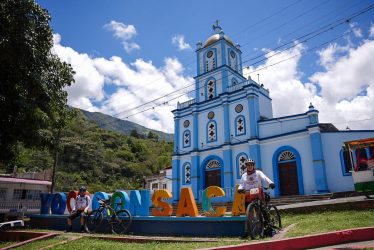
Consaca in Narino (Photo: Alcaldía)
Located on the slopes of the Galeras volcano, Consacá combines high-altitude coffee production with traditional craftsmanship. The municipality is recognized for its toquilla-straw handicrafts and its historical connection to independence-era battles in the region.

(Photo: Alcaldía de El Peñón)
El Peñón is a rural municipality in Santander known for its natural landscapes, caves, and agricultural traditions. Its tourism proposal highlights the connection between local communities, farming activities, and the quiet rural experiences offered by its mountain surroundings.

Jericó in Antioquia (Photo: Alcaldía de Jericó)
Surrounded by the Western Cordillera in Antioquia, Jericó combines coffee culture, historic architecture, and deep-rooted traditions. The municipality is known for its flower-lined balconies, religious heritage, and as the birthplace of the carriel, the traditional leather satchel that has become one of the region’s most distinctive symbols.
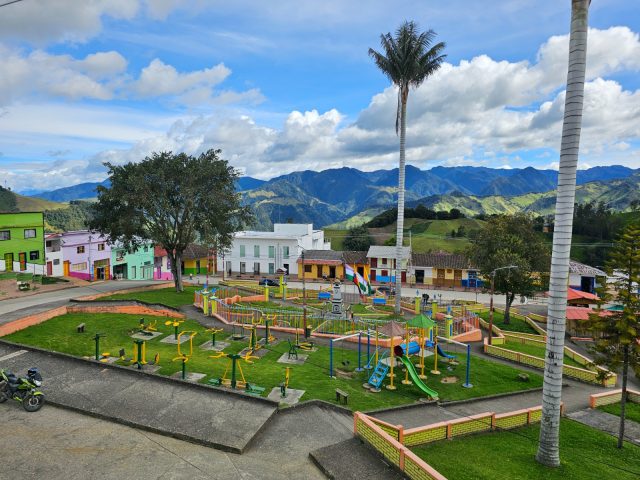
Marulanda in Caldas (Photo: Alcaldía de Marulanda)
Surrounded by high-altitude páramos in Caldas, Marulanda preserves a rural identity built around sheep farming, wool craftsmanship, and traditional textile production. The municipality also maintains its arriería (muleteer) heritage, connecting its cultural traditions with the mountain landscapes that shape its tourism offer.

(Photo: Alcaldía de Norcasia)
Shaped by rivers descending from the Central Cordillera, Norcasia in Caldas blends cacao production, biodiversity, and adventure tourism with community-led initiatives. Its natural surroundings provide a setting for ecotourism experiences while local traditions remain central to the municipality’s tourism identity.
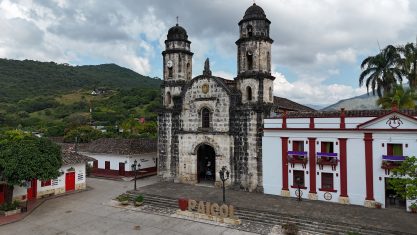
(Photo: Alcaldía de Paicol)
Often called La Puerta del Viento (The Gateway of the Wind), Paicol in Huila combines natural attractions with deep-rooted cultural traditions. The municipality’s caves, cacao production, and Semana Santa celebrations form part of a tourism offer that connects local heritage, landscapes, and community experiences.
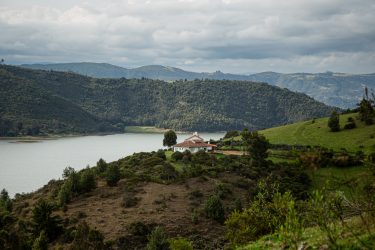
(Photo: Alcaldía de Sesquilé)
Tied to the legend of El Dorado, Sesquilé in Cundinamarca offers a unique connection between ancestral heritage, nature, and rural tourism. Located near Lake Guatavita, the municipality works to preserve its páramo ecosystems and traditional knowledge while showcasing the landscapes that have shaped its cultural identity.
Gas buffer gone; reserves halved, replacement rate turns negative.
Colombia’s energy security is eroding faster than most investors realize. According to the Informe de Recursos y Reservas (Resources and Reserves Report, IRR) 2025, published June 23, 2026 by the Agencia Nacional de Hidrocarburos (National Hydrocarbons Agency, ANH), the country’s proven natural gas reserves — technically designated Category 1P — have fallen to 1,717 billion cubic feet (Bcf), known in Colombia as Giga pies cúbicos (billion cubic feet, Gpc). That figure represents a 54% collapse from the 3,782 Bcf held at the end of 2018. It is not a cyclical dip. It is a structural deterioration that is accelerating, driven in significant part by a government that has made halting hydrocarbon development an explicit policy objective.
For investors and analysts tracking Colombia’s fiscal position, industrial competitiveness, and household energy costs, the IRR 2025 is a report that demands careful reading. What it shows is a country consuming its own energy inheritance — and doing so at a pace it is no longer replenishing.
Seven Years of Losses
In 2018, Colombia held 3,782 Bcf of proven natural gas reserves. By the end of 2025, that figure had been cut nearly in half, to 1,717 Bcf. The 2025 result alone represents a drop of 347 Bcf compared to the 2,064 Bcf recorded at end-2024 — a single-year decline of 16.8%. Against the ten-year average of 3,259 Bcf, the current level is 47.3% lower.
What is striking about the annual trajectory is that the steepest declines have occurred since August 7, 2022 — the date President Gustavo Petro took office. Between 2018 and 2022, reserves moved within a range of 2,817 Bcf to 3,782 Bcf, fluctuating as production and new additions roughly balanced. Beginning in 2022, the trend turned sharply and consistently downward: 2,817 Bcf at end-2022, 2,373 Bcf at end-2023, 2,064 Bcf at end-2024, and 1,717 Bcf today. That is a loss of 1,100 Bcf in just three years.
The reserves-to-production (R/P) ratio — the industry’s standard measure of how many years of supply remain at current extraction rates — stood at 5.9 years as of December 31, 2025. Context: in 2007, when Colombia’s gas reserves reached their historical peak, the R/P ratio was 14.1 years. The current figure is 8.2 years below that peak, and 2.2 years below the ten-year average of 8.2 years. Put simply, at today’s production rate, Colombia would exhaust its proven gas reserves in under six years.
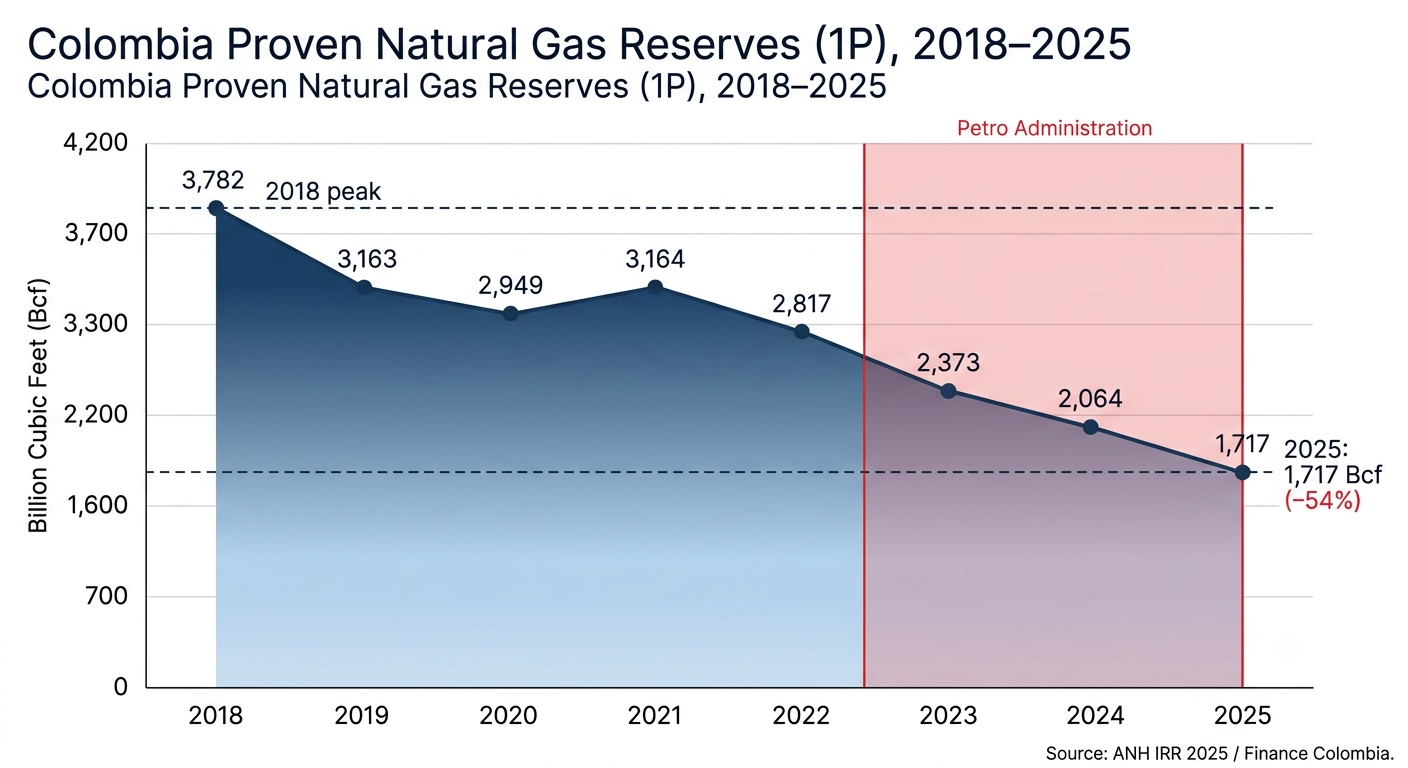
Graphic 1: Colombia proven natural gas reserves (1P, Bcf) 2018–2025.
The Reserve Replacement Crisis
Reserves decline when production exceeds new additions. In 2025, Colombia’s total annual gas reserve additions reached negative 58 Bcf — meaning the country certified less gas than it extracted from the ground. This compares to positive additions of 42 Bcf in 2024, and a ten-year historical average of 146 Bcf per year in new additions. The 2025 figure is the worst annual result in the dataset.
The ANH’s reserve balance formula is straightforward: ending reserves equal starting reserves, minus production, plus total annual additions. With additions at -58 Bcf and production at 290 Bcf, the combined drain on reserves was 348 Bcf in a single year. The reserve replacement rate — which expresses additions as a percentage of production — stood at negative 20%, 32 percentage points worse than the replacement rate recorded in 2024.
“In 2024, Colombia lost its self-sufficiency and became dependent on foreign liquefied natural gas (LNG).” — El Colombiano, June 2026
A reserve replacement rate of negative 20% means that for every 100 cubic feet of gas Colombia produced in 2025, it certified negative 20 cubic feet of new supply. The industry considers a rate below 100% a warning sign. Colombia is now operating at negative territory.
The ANH identifies “technical revisions” — downward reinterpretations of existing field data — as the primary driver of the negative additions figure. Specifically, a downward revision of 125 Bcf from technical reassessments erased 60 Bcf in new discoveries and 5 Bcf in enhanced recovery additions, producing the net negative result. The revision reflects how mature Colombia’s major gas-producing fields have become. Over the last four years, the ANH notes, negative technical revisions have become a consistent pattern, “evidencing the high degree of maturity of the most representative gas fields in Colombia.”
The counterweight — new exploration discoveries — contributed 60 Bcf in 2025, a 62% increase over 2024 and the report’s most encouraging data point. In October 2024, Colombia announced its biggest gas discovery in four decades — a genuinely important find, though its contribution to 2025 additions illustrates that even large individual discoveries cannot compensate for the suppression of systematic exploration activity. It underscores that the remaining path to reserve growth runs through exploration, precisely the activity the Petro government has chosen to suppress.
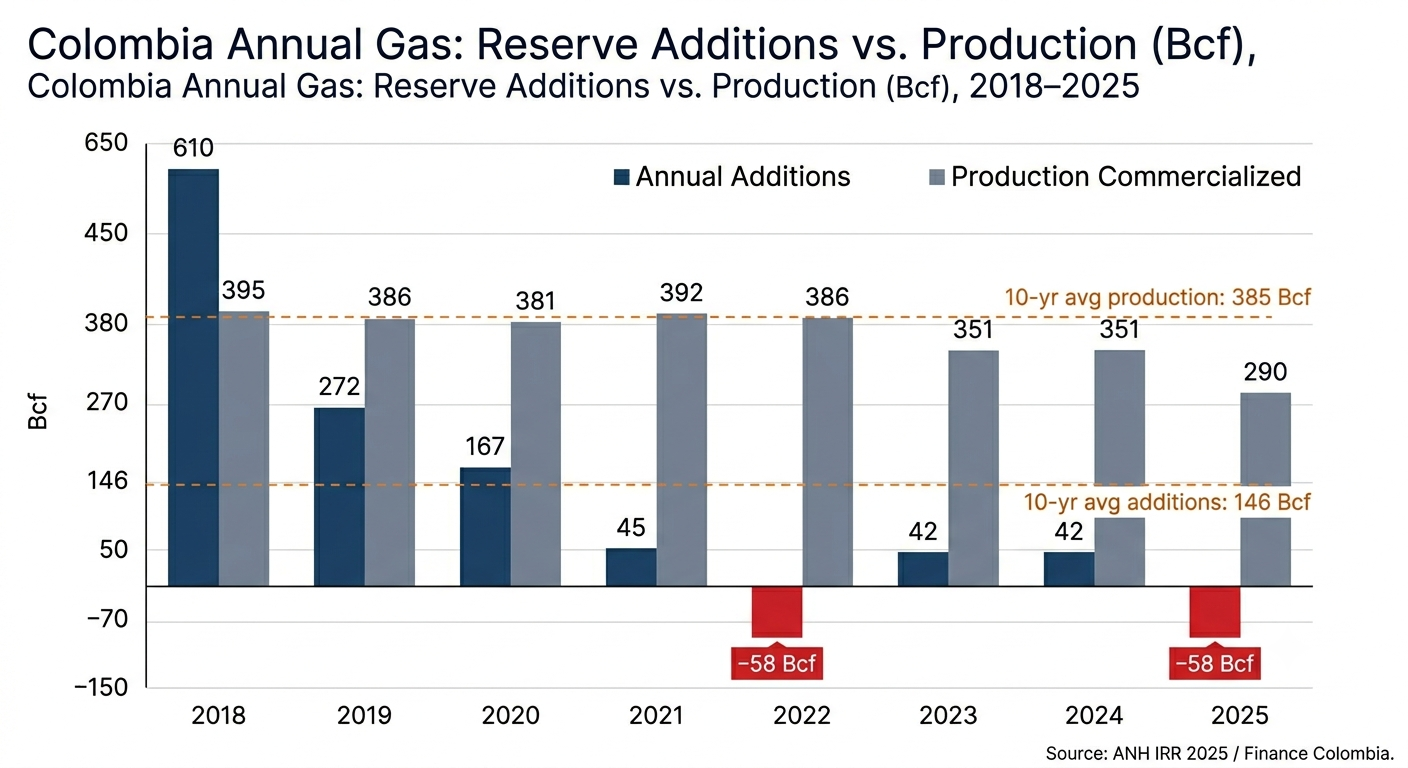
Graphic 2: Annual gas reserve additions vs. production 2018–2025.
Production in Structural Decline
Gas production in 2025 came in at 290 Bcf — 61 Bcf less than the 351 Bcf commercialized in 2024, a reduction of 17.4%. Against the ten-year average of 385 Bcf per year, 2025 production was 95 Bcf below the historical norm.
The decline is not a one-year event. It is a trend line, and independent analysts say it will steepen. According to Luis David Pachón, energy and gas analyst and consultant quoted by El Colombiano in June 2026, Colombia’s average gas production potential in May 2026 was 789 Giga BTU por día (billion BTU per day, GBTUD). That represents a 7% drop from 848 GBTUD the previous year. Pachón’s estimates project a continued descent: 759 GBTUD in 2027, 706 GBTUD in 2028, 612 GBTUD in 2029, and just 542 GBTUD by 2030. That is a 31% decline from today’s already-reduced production level over five years.
These are not projections built on pessimistic assumptions. They are field-level extrapolations of what happens when existing reservoirs mature and no new supply is added. Without new exploration and development, this trajectory is, according to Pachón’s analysis, essentially locked in.
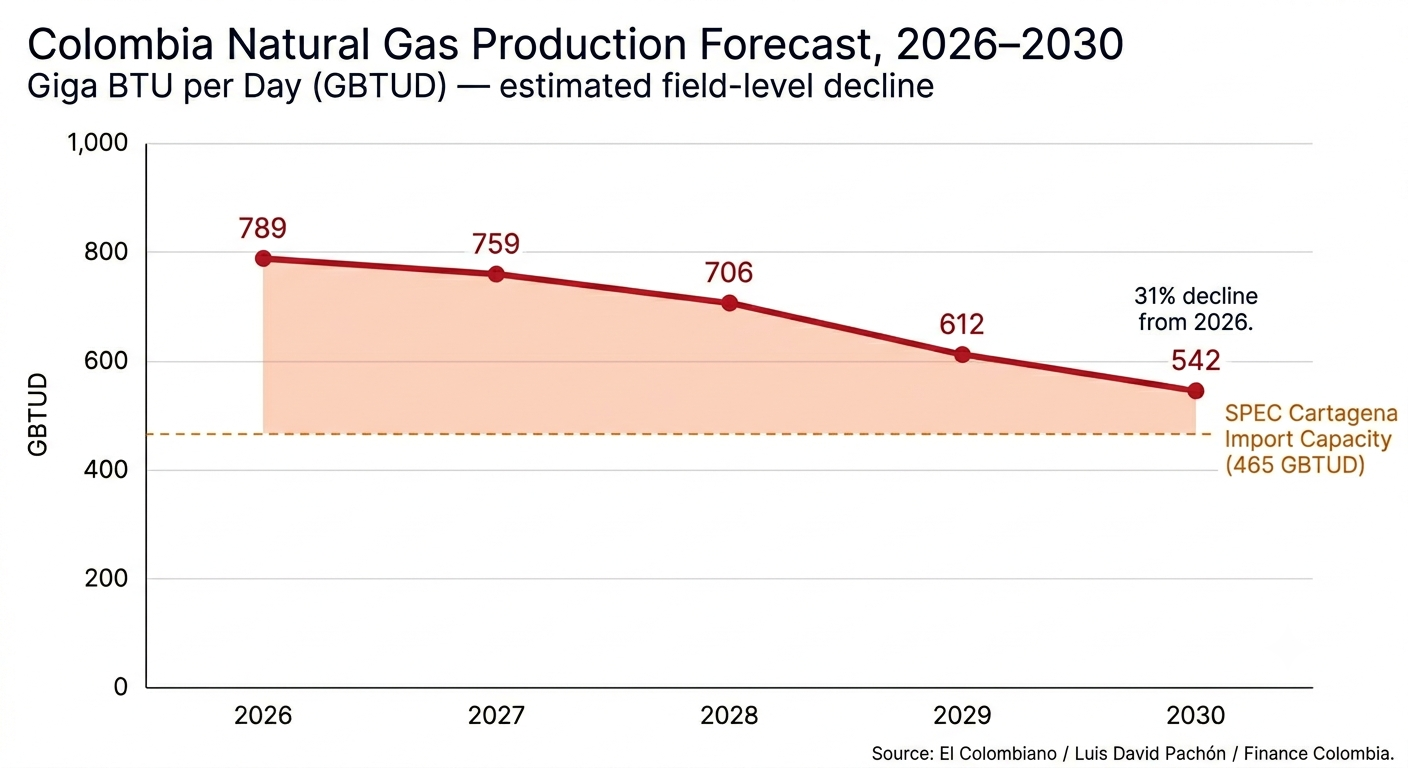
Graphic 3: Colombia gas production forecast 2026–2030 in GBTUD with SPEC import capacity reference line.
Geographic Concentration: A Portfolio with No Diversification
Colombia’s gas reserves are not only shrinking — they are dangerously concentrated. More than 95% of the country’s proven 1P gas reserves are held in just five sedimentary basins. The Cordillera Oriental leads with 714 Bcf, or 41.6% of the national total. The Valle Inferior del Magdalena holds 337 Bcf (19.6%), offshore Guajira contributes 292 Bcf (17%), the Llanos Orientales account for 157 Bcf (9.1%), and the Valle Medio del Magdalena adds 134 Bcf (7.8%). Together, these five basins hold 95.1% of Colombia’s proven gas reserves.
This concentration creates compounding risk. As the ANH’s own technical revisions confirm, the most mature fields driving those downward adjustments are concentrated in precisely these basins. A major operational disruption, regulatory interference, or accelerated depletion in any one of them would hit the national supply balance hard. Offshore Guajira’s 17% share is particularly relevant to watch, as it represents the primary frontier for future offshore development — development that the government’s moratorium on new contracts has deferred indefinitely.
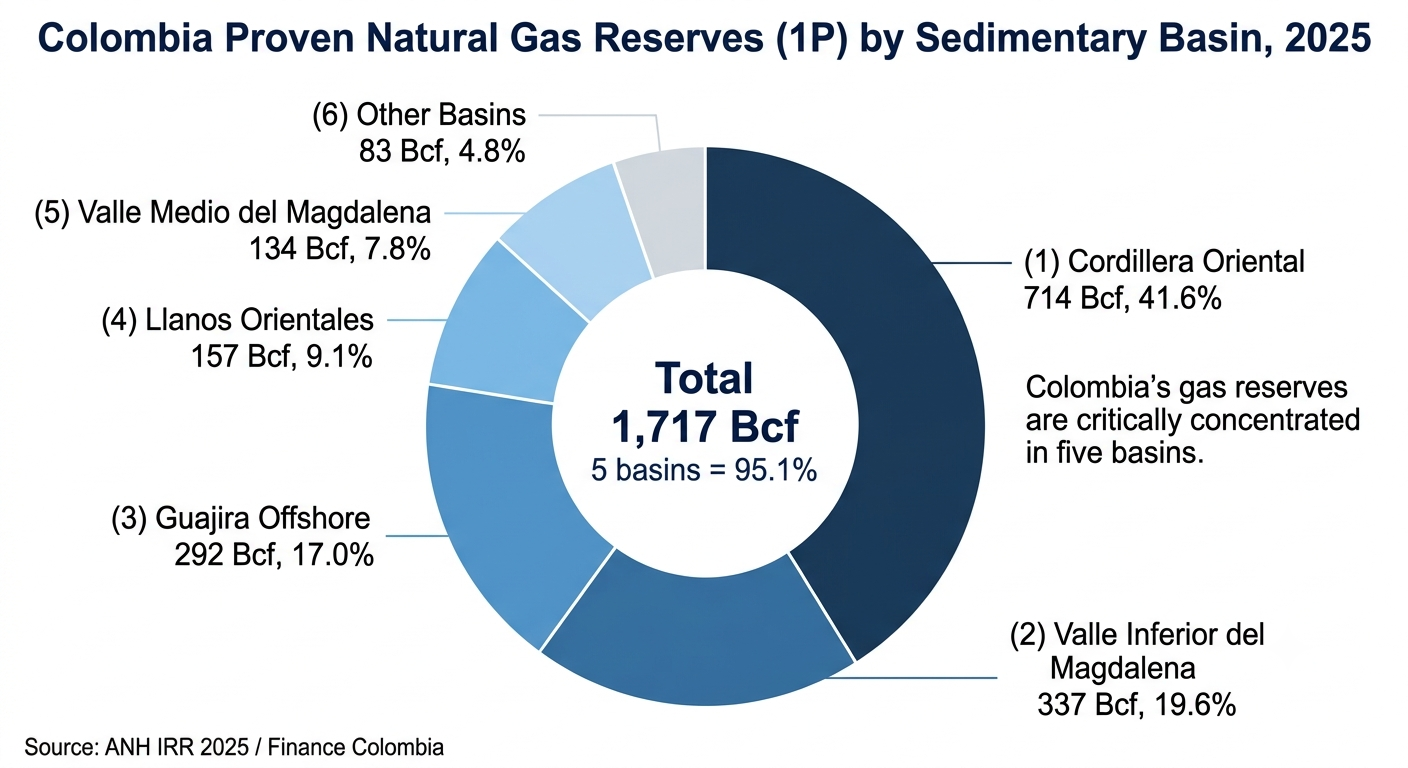
Graphic 4: Colombia gas reserves 1P by sedimentary basin.
Oil Reserves: Stable on the Surface, Hollowed Out Below
Colombia’s proven oil reserves present a more stable picture at first glance. The country held 2,020 million barrels (Mbl) of 1P oil reserves at December 31, 2025, essentially unchanged from the 2,035 Mbl recorded in 2024 — a variation of -0.7%. The oil R/P ratio actually improved slightly, from 7.2 years in 2024 to 7.4 years in 2025, reflecting both effective field management through planes de producción incrementales (incremental production plans, PPI) and enhanced oil recovery (EOR) programs.
The ANH notes that between 2024 and 2025, PPI-EOR programs incorporated 58 Mbl into 1P reserves — 97% of the volume achieved the prior year, demonstrating that intensive management of existing fields is compensating, for now, for the near-complete absence of new exploration success.
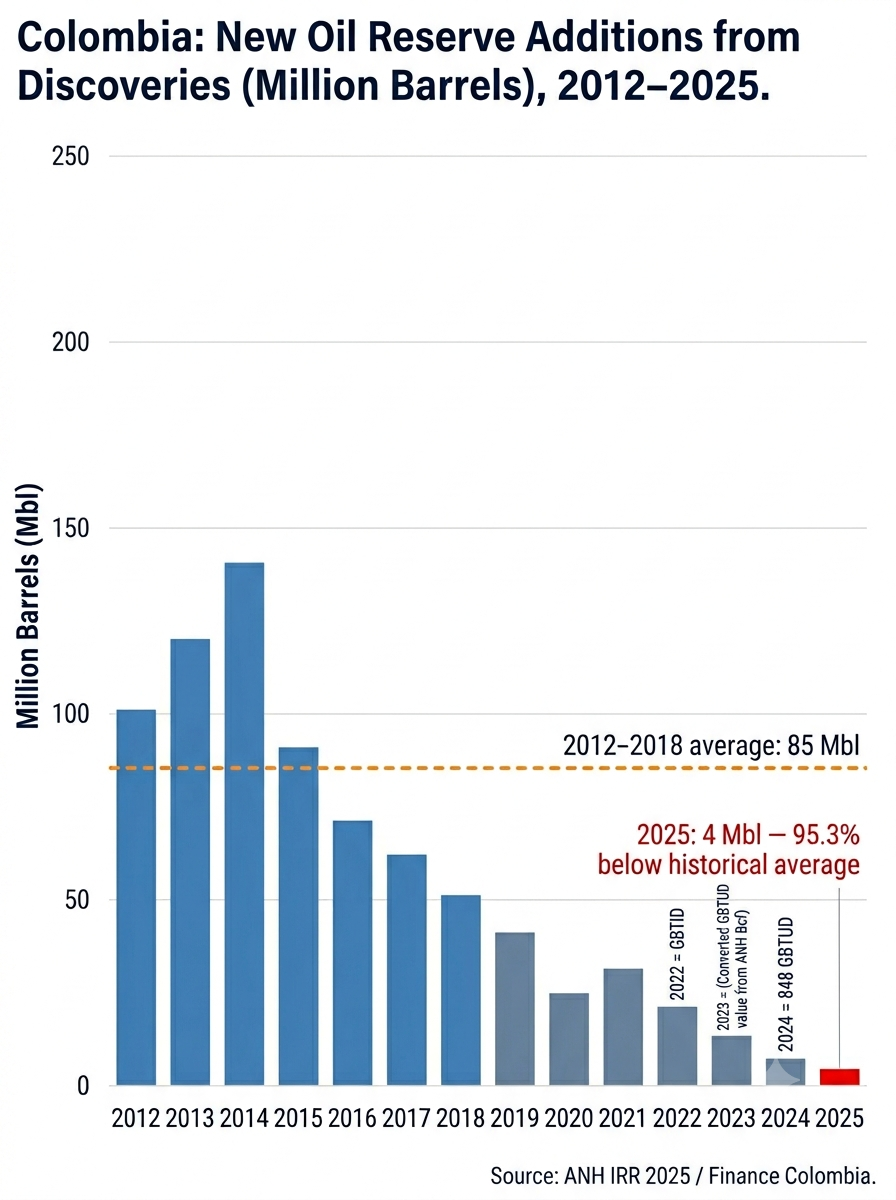
But the stability in headline reserves conceals a critical vulnerability: the exploration pipeline is effectively empty. New oil reserve additions associated with discoveries — new wells finding new oil — reached only 4 million barrels in 2025. Between 2012 and 2018, the average was 85 million barrels per year in discovery-driven additions. That is a 95.3% collapse in exploratory success. When PPI-EOR programs exhaust their incremental potential in the medium term, there will be nothing in the exploration queue to replace them.
Colombia has 2,404 Mbl of contingent petroleum resources at the 3C level — discovered but not yet commercially viable — with 56% (1,358 Mbl) held back by environmental and social contingencies, and 20% (475 Mbl) blocked by unfavorable economics at current prices. The contingent resource base is real, but converting it to production requires investment, permitting, and a government that is not actively discouraging the industry. As Finance Colombia has reported, the Petro administration’s relationship with the hydrocarbon sector has been defined by hostility rather than partnership — a dynamic visible in Shell’s April 2025 exit from Colombian offshore gas projects, joining a parade of majors that have reduced or eliminated their Colombian footprint.
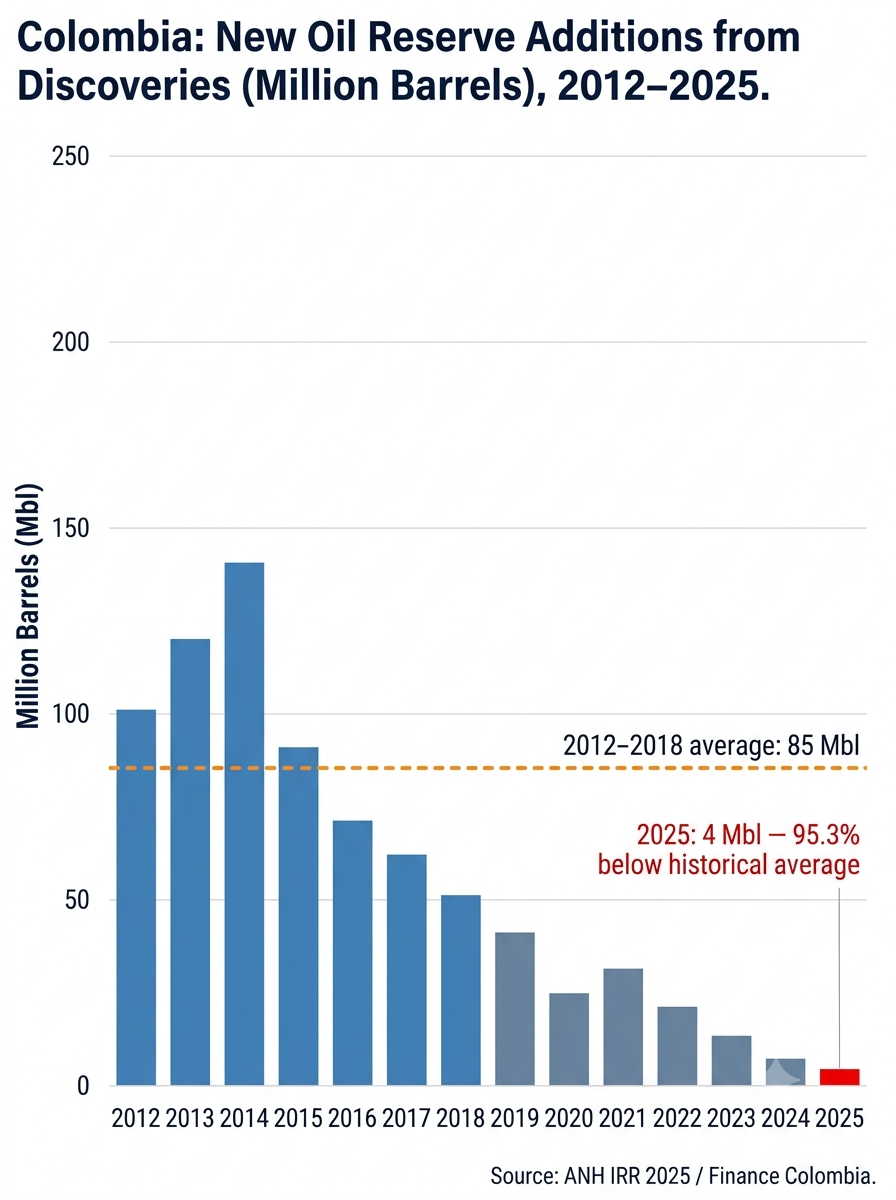
Graphic 5: New oil reserve additions from discoveries (Mbl) 2012–2025.
The Petro Factor: Policy as Accelerant
President Gustavo Petro has made the energy transition a defining banner of his administration. Within that framework, he has chosen not to sign new hydrocarbon exploration contracts — a policy decision with consequences that are now quantifiable in the IRR 2025 data.
The causal logic is not complicated: exploration today yields reserves in five to fifteen years. When exploration stops, the reserve pipeline runs dry on a predictable schedule. Colombia’s gas fields are mature. The industry has known for years that sustaining supply required either deepening work in existing concessions or opening new ones. Petro’s government has constrained both paths — by refusing new contracts and by creating a regulatory and political environment that has chilled investment in existing operations.
The ANH’s own report acknowledges the dynamic indirectly. It highlights that EOR project filings increased 82% comparing the 2020–2022 period to 2023–2025, which it presents as evidence of productive government measures. But this increase reflects the industry pushing harder on existing fields precisely because new exploration is not an available avenue — a compensatory reaction to policy constraint, not evidence that the policy is working. Even Ecopetrol (BVC: ECOPETROL, NYSE: EC), the state-controlled oil company whose board the Petro administration increasingly controls, has had to navigate the tension between engineering reality and the government’s anti-hydrocarbon posture; as far back as 2023, Ecopetrol’s then-new president was publicly advocating for more exploration in direct opposition to Petro’s stated goals.
The Asociación Colombiana del Petróleo y Gas (ACP) has consistently warned that without new exploration contracts, Colombia’s hydrocarbon production would follow a predictable decline curve. The IRR 2025 confirms those warnings with data. The reserves trajectory under Petro — from 2,817 Bcf at end-2022 to 1,717 Bcf today — is the most direct measure available of what a no-new-contracts policy costs in energy security terms.
Import Dependency: An Avoidable Humiliation
The practical consequence of reserve depletion is playing out in real time at Colombia’s gas import terminals — and in consumers’ utility bills. Finance Colombia reported in March 2025 that Bogotá’s Vanti had already raised gas rates 36% and Medellín’s EPM by 21%, with the deficit cited as the direct cause. In 2024, Colombia lost its natural gas self-sufficiency for the first time and began depending on imported liquefied natural gas (LNG) to meet domestic demand — a fact reported by El Colombiano in June 2026. The situation deteriorated further: in the first week of June 2026, 32% of all gas consumed in Colombia came from imports through the regasification plant in Cartagena, operated by Sociedad Portuaria el Cayao (SPEC). That is the highest import share in the country’s history, according to data from the Sistema Electrónico de Gas (Electronic Gas System).
SPEC’s Cartagena facility has an import capacity of 465 GBTUD. Approximately two-thirds of that capacity is already being utilized to serve national demand, leaving a shrinking fraction available to absorb any additional supply shortfall. Given the production decline trajectory outlined by Pachón — down to 542 GBTUD by 2030 — Colombia will require significantly more import capacity than it currently has, or it will face supply rationing.
Additional regasification projects are under development — in Buenaventura, Coveñas (Sucre), and Ballena (La Guajira), in addition to the operating Cartagena facility. These are necessary investments. But they are investments in the infrastructure of dependency: Colombia building the capacity to pay other countries for gas it has in its own subsoil but has chosen not to extract.
The distributional consequence deserves to be stated directly. Over the past two decades, access to natural gas transformed household energy use for millions of lower-income Colombians, displacing wood combustion in cooking and heating. Wood burning accelerates deforestation, degrades air quality, and imposes a disproportionate burden on households that cannot afford cleaner alternatives. A policy that drives Colombia back toward LNG import dependency — at premium prices — is a policy that will price gas out of reach for those same households, potentially reversing one of the country’s most concrete environmental gains. Cheaper domestic gas served the poor. Expensive imported LNG will not.
Graphic 6: Gas production decline vs. growing import share / SPEC capacity.
Contingent Resources: The Potential That Policy Cannot Unlock
There is one genuinely encouraging number in the IRR 2025: Colombia holds 10,540 Bcf of contingent gas resources at the 3C level — discovered, potentially recoverable volumes that are not yet classified as commercial reserves. Of that total, 7,855 Bcf (74.5%) sits offshore, with the remaining 2,685 Bcf onshore. Offshore resources are more than twice the onshore total, consolidating the offshore Caribbean as Colombia’s primary future supply option.
The obstacle is not geology. Of the 10,540 Bcf in contingent gas resources, 55% (5,818 Bcf) is held back by environmental and social contingencies — primarily offshore licensing processes, consulta previa (prior consultation), and community negotiations. Another 29% (3,037 Bcf) is blocked by legal and contractual contingencies, including the unresolved regulatory framework governing connections to the national transport system for offshore production. Only 9% is technically constrained.
The ANH has identified acceleration of environmental licensing for the offshore Sirius project as a priority measure for 2026. That is a constructive step. But accelerating the licensing of a single project does not substitute for the policy framework that would enable the industry to develop this contingent resource base systematically. The government’s refusal to sign new exploration contracts means the 10,540 Bcf of contingent offshore gas will remain contingent for the foreseeable future — a frustration the industry has tracked for years, as Finance Colombia documented as early as 2023 when a second consecutive failed tender for Pacific region gas infrastructure signaled the depth of the supply challenge.
Fiscal Implications for Investors
The royalty trajectory is one of the clearest financial signals in the IRR 2025. Since August 7, 2022, through December 31, 2025 — a 40-month window spanning the Petro administration — cumulative hydrocarbon royalties reached COP 29.6 trillion, averaging COP 0.74 trillion per month. The ANH projects that the existing 1P proven reserves, valued at current prices, will generate an additional COP 36 trillion in royalties over their remaining life.
That COP 36 trillion projection is not a guarantee. It assumes production continues at roughly current rates, that prices hold, and that the reserves are fully extracted. Given the R/P ratio of 5.9 years for gas and 7.4 years for oil, and given the absence of new exploration, the royalty stream is finite in a way it was not five years ago. Colombia’s fiscal planners and subnational governments that depend on hydrocarbon royalty transfers should be building their budgets around a declining baseline, not a stable or growing one.
For international energy investors, the picture is one of attractive geological potential — 10,540 Bcf of contingent gas resources, 2,404 Mbl of contingent oil — combined with a policy and regulatory environment that has made converting that potential into production exceptionally difficult. As the ANH has noted, the EOR and PPI programs within existing contracts are producing results. But those programs work within existing concessions. Without new exploration acreage, they are rearranging deck chairs on a ship whose fuel is running out.
The Petro administration ends in August 2026. What the next government inherits is not a blank slate: it inherits a reserve base that will take a decade of sustained investment to rebuild, import infrastructure sized to a new dependency it did not choose, and a domestic industry that has spent four years under sustained policy pressure. The IRR 2025 is the most comprehensive accounting yet of what that pressure has cost.
Finance Colombia has covered the evolution of Colombia’s hydrocarbon sector, gas supply outlook, and energy transition policy in depth. For related coverage see: Shell Exits Colombian Offshore Gas Projects (April 2025); Colombia Braces for Surging Energy Costs as Natural Gas Deficit Expands (March 2025); and Petro Administration Announces Natural Gas Rationing Despite Abundant Hydrocarbon Resources (October 2024). Additional technical data is available directly from the ANH at anh.gov.co.
More than $214 billion COP disbursed, yet no terminal tops 19% built.
Colombia’s Procuraduría General de la Nación (Inspector General’s Office) has opened a formal preventive inquiry into a troubled government program to build four airports serving some of the country’s most isolated regions, after the Investigative Unit of Caracol Radio (Unidad Investigativa de Caracol Radio) documented that the projects had spent more than 60% of their budget while completing less than 20% of the physical work. The order, made public on June 17, 2026, directs the Aeronáutica Civil (Aerocivil) to account for the program’s schedules, spending and contracting.
The Procuraduría Delegada Segunda para la Vigilancia Preventiva de la Función Pública (Second Delegate Office for Preventive Oversight of Public Function) ordered monitoring of the airport projects prioritized by Aerocivil. In an official letter to the project’s general manager, delegate inspector Samuel Benjamín Arrieta Buelvas cited “possible delays in the execution of the works, differences between the financial execution and the physical progress of the projects, difficulties related to the supply of materials and inputs, observations on the contractual and logistical management of the project, as well as other risks that could affect the completion of the planned works.” The office gave the entity twelve points to answer, among them a detailed accounting of the funds received, committed, disbursed and executed for each airport; the contracts and supply, transport and oversight orders signed; and an explanation of the gap between the money spent and the physical progress recorded.
“It has happened before that I lay the first stone and they never lay another.” — President Gustavo Petro, at the August 2025 launch of the Bahía Solano airport works.
The inquiry follows the investigation by the Investigative Unit of Caracol Radio, also reported by El País and El Colombiano. The terminals were due to be finished in May 2025; none will be ready before President Gustavo Petro’s term ends on August 7, 2026.
The project is part of the program Aeropuertos para los Servicios Aéreos Esenciales (ASAES), created to keep air operations safe and efficient in hard-to-reach areas. The four terminals are in Bahía Solano, in Chocó; Magüí Payán, in Nariño; and Cumaribo and La Primavera, in Vichada — regions where roads are scarce or nonexistent and air travel is often the only permanent link to the rest of the country. Roughly 122,000 people depend on these airports for access to basic services, commerce and mobility.
The numbers at the center of the controversy come from the project’s own contract and oversight documents. The initiative carries an investment of $363.763 billion COP — more than $100 million USD — including a management fee of nearly $23.8 billion COP (about $6.5 million USD) for the state-owned Empresa Nacional Promotora del Desarrollo Territorial (Enterritorio). Aerocivil had disbursed around $214 billion COP, equal to 60% of the budget. Physical progress lagged far behind: Cumaribo was the most advanced at 18.4%, followed by La Primavera at 15.3% and Bahía Solano at just 5.5%, while in Magüí Payán work had not begun at all.
Three state entities share responsibility under an unusual arrangement. Aerocivil is the contracting party and supervisor; Enterritorio — successor to the controversial Fonade — handles overall management, including procurement, supply of materials and oversight; and the Ejército Nacional (National Army) executes the works through its engineering units, a use of the armed forces that Petro has defended since his 2022 campaign as a way to keep civilian contractors from abandoning the sites. Enterritorio, in turn, hired private operators to supply the soldiers with materials, food, spare parts and lodging.
Petro himself has voiced doubt about the works. At the August 2025 event launching the modernization of the José Celestino Mutis airport in Bahía Solano — more than 18 months after the agreement was signed — the president said, “It has happened before that I lay the first stone and they never lay another.” In the months since, the roughly 122,000 residents who stand to benefit have watched the projects stall amid a series of irregularities.
Minutes of the project’s technical-operating committee show problems from the earliest stages: repeated delays in hiring suppliers, late delivery of materials, difficulties getting equipment running and poor coordination among the participating entities. At a meeting on November 22, 2025, the secretary of airport services, Andrés Arboleda, recorded Aerocivil’s concern with Enterritorio’s management — 55% of the resources had been executed while physical progress stood at just 3%. The Army also objected, sending at least 15 letters since late 2023 warning of delays in hiring specialized personnel and shortfalls in the supply and quality certification of materials; in Bahía Solano, it reported, the works still lack all the required environmental permits.
The reporting also raises pointed questions about costs. Citing the contract documents obtained by the Investigative Unit of Caracol Radio, the project paid an intermediation fee of 4.9% plus VAT on billed goods and services — a charge that was neither written into the contract nor approved by the technical-operating committee, yet has already exceeded $4.2 billion COP (about $1.15 million USD) paid to private contractors. Internal documents flagged striking discrepancies between market prices and the amounts billed: wooden stakes billed at $38,000 COP against a real value of $1,000 COP, pavement baskets billed at $900,000 COP versus a calculated $107,000 COP, and a pavement cutter with a market price of $7 million COP that the project sought to bill at $26 million COP. In Bahía Solano alone, Aerocivil acknowledged total possible overruns of about $22 billion COP (around $6 million USD).
Aerocivil rejected budget-increase requests that would have raised the project’s value by roughly $57 billion COP — about 15% of the total. But it paid a price: the number of aerodromes to be upgraded was cut from six to four, dropping Bajo Baudó, in Chocó, and Barrancominas, in Guainía. El Colombiano named several of the private operators involved — DU Brands, Ferretería El Hidrante S.A., the consortia Aeropistas CPG and IRC, and Organización Tiempos de Paz, the last of which it reported is accused of subcontracting and failing to pay local suppliers.
Enterritorio denies any irregularity and attributes much of the delay to external factors. Its acting president, Esmeralda Molina, told the Investigative Unit of Caracol Radio that the complexity of the institutional structure, logistical difficulties, weather conditions and public-order problems had affected the schedule, and defended the experience of the private operators. The entity nonetheless declined to provide specific figures on the disbursements made and the level of compliance achieved by contractors, citing confidentiality and security.
State oversight bodies had already begun to circle before the latest order. The Procuraduría warned in May 2026 that Colombia’s air-transport system faces a “systemic risk” and asked that an investigation into Aerocivil be opened, as El País and Infobae reported. The Contraloría General de la República (Comptroller General’s Office) has separately flagged the ASAES program’s low execution — a weighted physical advance of just 2.31% as of December 2024 — and, in an unrelated audit of an Aerocivil water-treatment contract awarded without environmental permits, identified a presumed fiscal detriment of $5.67 billion COP, according to Portafolio and El Nuevo Siglo.
The episode has renewed scrutiny of convenios interadministrativos (inter-agency agreements) — widely used by public entities subject to state procurement rules to move resources to other state bodies that can then contract more freely, and more opaquely. The accumulated delays have produced four extensions of the agreement; the latest runs to August, though the entities involved already acknowledge that the new deadlines will be hard to meet. The works also drew earlier scrutiny: in November 2025, El País reported that Aerocivil had grounded most of Colombia’s passenger aircraft amid broader oversight failures.
For now, the next administration will inherit a project with the money largely spent but the infrastructure unbuilt — and the communities that were promised the terminals are still waiting. As El País put it, the promised terminals “remain more a project than a reality.”
This article is based on the original investigation by the Investigative Unit of Caracol Radio and the June 17, 2026 order of the Procuraduría General de la Nación, as reported by El País and El Colombiano.
 Empleobilingue.com

- Director/a de operaciones para hotel, restaurante y discoteca 1626320364.60 - Medellín, Medellin, Antioquia, Colombia
- Coordinador/a de calidad para La Unión 1626483143.1 - La Unión, Antioquia, Colombia
- Desarrollador fullstack - Bogotá, Bogota, Colombia
- Technical Analyst - Remote
- PIM Administrator - Ecommerce - Remote (Bogotá, Bogota, Colombia)
- Auxiliar de gestión humana y bienestar para Girardota 1626060072.28 - Girardota, Antioquia, Colombia
- Marketing Strategist
- Trainer Manager - Bogotá, Bogota, Colombia
- Tolemaida UH- 60 Inspector - Bogotá, Bogota, Colombia
- Virtual Assistant - Team Lead - Remote
Contact Us

