

















Atlanta-based talent firm makes Bogotá its Latin American hub
Insight Global, the Atlanta-based talent and consulting company, has opened a capability center in Bogotá, Colombia. It has now established the city as the base for its Latin American operations as demand for nearshore services continues to grow.
The center officially launched on June 1 and will support corporate, client, and consultant delivery functions across Insight Global’s operations. The company said the facility is part of its broader international expansion strategy to better serve clients and consultants across multiple markets.
Insight Global currently has more than 1,500 active workers supporting projects throughout Latin America, according to the company.
“It will serve as an extension of our middle and back-office functions as well as being our hub for Latin American Operations.” – Chris Abbeduto, Vice President of Global Operations, Insight Global
Chris Abbeduto, Insight Global’s vice president of global operations, described the Bogotá facility as a strategic investment in the company’s regional growth.
The company said the Bogotá initiative was more than a year in development. The center’s workforce consists of fully bilingual employees fluent in Spanish and English, who were integrated into Insight Global’s culture, systems, and training programs from the beginning.
Insight Global selected Bogotá partly because of its established talent market and its ability to support collaboration with US-based teams during overlapping business hours. The company said this alignment enables same-day communication between teams in North America and Latin America, a key factor for nearshore delivery models.
The opening shows growth in Colombia’s business services sector, where companies have increasingly established regional centers focused on technology, customer support, operations, and specialized services. Bogotá’s combination of skilled talent, language capabilities, and geographic proximity to North American markets has contributed to its position as a major nearshore destination.
Founded in Atlanta, Insight Global provides staffing, consulting, and AI services through nearly 40,000 employees supporting more than 3,200 companies across over 40 countries. The company works across areas that include cloud, artificial intelligence, data, enterprise operations, and applied engineering.
Above image of Insight Global’s Bogotá site, courtesy of the company.
In a week’s time, Colombia will have a new president, and the reign of “The Tiger” will begin. What will that mean for the country? The truth is, no one would bet their mortgage on the outcome.
Historically, not only in Colombia but around the world, incoming presidents and prime ministers typically achieve only a fraction of what is promised during their campaigns. Even if 30% of commitments are delivered, Abelardo could still disappoint some of his supporters, particularly those in Medellín who became deeply disaffected with Gustavo Petro’s administration. Ultimately, only time will tell. Much has been promised, but the pudding still has to be proven.
One major challenge will be the currency, which has moved to levels not seen in many years. The peso reached COP 3,100 against the dollar on Friday, and while many had feared a move toward COP 3,000, the surprise decision by Banco de la República to leave interest rates unchanged at 12%, despite rising inflation, quickly reversed that trajectory. COP 3,200 appears possible as the week begins.
These are extremely challenging levels for exporters and, in turn, for Abelardo, who has promised a golden age for overseas sales. Key sectors such as coffee and flowers have already publicly expressed concerns about declining competitiveness. Even if the new administration succeeds in creating a new oil boom, revenues generated at current peso levels will be significantly lower than anticipated.
The past four years have been dominated by discussions around debt and deficits, which economists understand are the cumulative result of decisions made by previous governments. These pressures are unlikely to ease if the peso remains at current levels.
Consumer confidence from Fedesarrollo remains solid. Retail sales are supporting imports of durable goods, particularly vehicles and electronics, adding more than $1 billion USD to the monthly deficit.
Other sectors likely to feel pressure include tourism and real estate, both of which have experienced significant growth in recent years. Colombia has become an increasingly fashionable destination, and many visitors have later returned to invest in houses and apartments. Today, however, those investments have slowed, while visitors are finding hotels, restaurants and excursions considerably more expensive than they were two years ago.
The reasons behind the peso’s current level are many, but a key factor has been investment flows into Colombia’s attractive local TES bond market through carry trade strategies. That said, profit-taking could soon emerge, particularly if investors begin positioning for a stronger dollar.
Let’s see how “The Tiger” addresses the challenge.
My regards,
Roops
First-half growth overall of 2.4% keeps activity below its potential
Colombia’s economy expanded at an estimated annual pace of 2.7% in the second quarter of 2026, according to the latest reading of the Grupo Cibest NowCast Bancolombia indicator. The figure sits 20 basis points below the rolling quarter ending in May, which the group revised upward by 20 basis points to 2.9%. With the second-quarter estimate in hand, the economy is now judged to have grown 2.4% year-over-year in the first half of the year, a pace the analysts say confirms that activity remains below its potential.
“The economy is estimated to have grown 2.4% year-over-year in the first half, confirming that economic activity remains below its potential.” — Grupo Cibest, Economic, Industry and Market Research (July 2, 2026)
NowCast Bancolombia is a family of proprietary, high-frequency indicators built by Grupo Cibest — the financial holding group that owns Bancolombia (NYSE: CIB) and adopted its current name in May 2025 — from transactions across the group’s payment channels. The indices are designed to complement, not replace, the official statistics published by the Departamento Administrativo Nacional de Estadística (DANE, the National Administrative Department of Statistics), whose figures are available through its website.
For the second quarter, the group revised its NowCast forecast upward by 10 basis points to 2.7%, bringing the projection into line with the market consensus average among analysts. The indicator rose from 2.6% at the end of May to 2.7% at the end of June, matching the 2.7% consensus.
Subdued Growth Across the Board
The monthly readings were more subdued. On a seasonally adjusted basis, the NowCast index contracted 1.2% from the prior month in June. In year-over-year terms against June 2025, growth eased to 1.9%, some 0.5 percentage points below the May reading of 2.4%. Measured as a three-month moving average, year-over-year growth held at 2.7%.
At the sector level, the second quarter showed a divergence between primary and secondary activities. Faster growth appeared in recreation, professional services, agriculture, and manufacturing. The public sector, real estate, communications, trade, and electricity utilities held steady growth rates. Construction activity continued to decelerate, while mining was the only sector to contract by the close of the quarter.
Grupo Cibest’s sector heat map, which tracks year-over-year change on a three-month moving-average basis, put entertainment as the standout in June at 9.7%, followed by financial services at 6.0%, and wholesale and retail trade at 4.0%. Manufacturing reached 3.7% and agriculture 3.5%, both near the top of their recent ranges. At the other end, construction slowed sharply to 0.6% after running above 3% for much of the past year, the information sector managed just 0.2%, and mining slipped to -0.5%.
The report was prepared by Grupo Cibest’s Economic, Industry and Market Research area, led on quantitative work by Arturo Yesid González Peña, the group’s Head of Quantitative & Analytics, with Sebastián Ospina Cuartas serving as data controller. It follows the group’s prior-month estimate, which had pointed to a second-quarter acceleration toward 2.6%.
Above: The construction industry’s growth continued to decelerate as Grupo Cibest reports a 2.7% economic growth for Colombia as a whole in the second quarter. Stock photo by Ncpancy via Pixabay.
Colombian genomicist joins Pew’s 2026 biomedical fellowship class
Colombian scientist Laura González García has been selected for the 2026 class of the Pew Latin American Fellows Program in the Biomedical Sciences, a competitive postdoctoral fellowship supporting early-career researchers from Latin America.
González García is one of ten scientists selected for this year’s cohort and one of two fellows representing Colombia. The program, established by The Pew Charitable Trusts, provides two years of research funding for fellows to conduct research in United States laboratories under the mentorship of established scientists.
“If we know which RNAs have DHU and can associate that modification with a particular context, like cancer or crop performance, we can use them as potential biomarkers.”
— Laura González García, 2026 Pew Latin American Fellow, Boyce Thompson Institute
The 2026 fellows represent seven Latin American countries: Argentina, Brazil, Chile, Colombia, Mexico, Peru, and Uruguay. According to Pew, the program has supported more than three decades of biomedical research development, with nearly 70% of previous fellows going on to establish laboratories or research programs in Latin America.
“For 35 years, Pew has proudly supported talented scientists from Latin America as they pursue cutting-edge research in US labs,” said Donna Frisby-Greenwood, Pew’s senior vice president for Philadelphia and scientific advancement. “This year, we’re excited to support 10 new fellows whose research will accelerate global health and carry on this legacy of impactful biomedical research.”
González García is a postdoctoral researcher in the laboratory of Andrew D. L. Nelson at the Boyce Thompson Institute, an independent research institute located on the Cornell University campus in Ithaca, New York.
Her Pew-funded project focuses on epitranscriptomics, an emerging field that studies chemical modifications added to RNA molecules after transcription. These modifications can influence how RNA functions without changing the underlying DNA sequence.
The research centers on dihydrouridine (DHU), a relatively understudied RNA modification, and the enzymes responsible for creating it, known as dihydrouridine synthases (DUS proteins). While these molecules are conserved across plants, animals, and humans, scientists still have limited understanding of their broader biological roles.
In humans, changes in DUS activity have been associated with certain cancers, while in plants, the modification has been linked to stress responses and photosynthetic performance.
A major challenge in studying DHU has been the difficulty of identifying where the modification appears within RNA. González García plans to address this using Nanopore sequencing, a technology that can detect molecular changes by measuring electrical signals as RNA passes through microscopic pores.
Her project will combine experimental data with machine learning to develop a model capable of identifying DHU modifications across RNA sequences. Although the initial research is being conducted using the plant Arabidopsis thaliana, González García said the approach could eventually be adapted to other organisms, including humans.
The fellowship builds on González García’s background in computational biology and genomics. She earned dual doctorates in computer engineering and evolutionary biology from Universidad de los Andes in Bogotá and Université de Montpellier in France.
Her previous research has focused on comparative and computational genomics, including studies of Leishmania parasite genomes, genome-analysis software development through NGSEP, methods for annotating transposable elements, and research into transposable-element dynamics in lima bean.
The Pew fellowship represents a transition from her previous DNA-focused research toward RNA biology, with applications that could contribute to future advances in medicine, agriculture, and biotechnology.
Following her postdoctoral training, González García plans to establish her own laboratory at a Latin American research institution, aligning with Pew’s objective of strengthening scientific capacity across the region.
Fair value nears $3,720 COP signals downside risk for peso holders
The Colombian peso strengthened 115 pesos against the US dollar last week to close at $3,335.46 COP, a 3.35 percent weekly appreciation that Grupo Cibest’s economic research team attributed to a weaker US dollar globally and to a larger-than-expected interest-rate increase at home. In its July 6 weekly report, Radar Bancolombia, the research unit of Bancolombia argued that the currency now trades well below the level its fundamentals would justify.
The Junta Directiva del Banco de la República (the central bank’s board of directors) raised its benchmark policy rate by 75 basis points to 12.00 percent, its highest level since March 2024, surprising a market that had priced in a 50-basis-point move. Even so, the bank argued that a rate consistent with Colombia’s macroeconomic and fiscal conditions should push the exchange rate toward a range between $3,400 and $3,650 COP.
What is moving the peso?
To isolate the drivers of the currency, the research team estimated a structural vector autoregression (SVAR) model that breaks the annual change in the market representative exchange rate (TRM) into international factors, local factors, exchange-rate dynamics and a speculative gap. The exercise found that during 2026 local factors have gained prominence and now explain close to half of the peso’s movements.
In June, Colombia’s sovereign risk premium corrected sharply, reflecting an improved perception of country risk tied to the coming change of administration. The nation’s five-year credit default swaps fell 69 basis points from the first round of the presidential vote — a 29 percent annual decline in June — and now sit about 24 basis points below the level the bank considers consistent with fair value. Among regional peers, Colombia’s policy rate is exceeded only by Brazil’s 14.25 percent, which the bank said keeps carry-trade strategies attractive.

The chart shows how the Colombian peso and the US dollar has detached from the fair value rate of the government. Chart by Finance Colombia.
Measured against where it should trade if it merely tracked its peer currencies and incorporated the deterioration in external fundamentals, the exchange rate should stand near $3,720 COP, Bancolombia estimated. The bank placed the currency’s fair value in a range between $3,710 and $3,880 COP, and noted that the United States economy has shown resilience, backed by technology investment, while inflationary pressures continue to limit the room for maneuver of the US Federal Reserve.
From September 2025, the observed rate detached significantly from that fair value. The bank linked the move first to monetization by the Ministerio de Hacienda (Finance Ministry) — foreign-currency sales of roughly $9 billion USD between September and December, against average daily spot volume of about $1,337 million USD in 2026 — and later to optimism over the change of administration. Those operations drew on a Total Return Swap, new euro-denominated bond issues and a direct placement to Pimco of $23 trillion COP, which raised about $5 billion USD. The gap against peer currencies turned negative after the first-round vote and has since averaged -$225 COP.
The bank described the pattern as a trade electoral — a repricing of Colombian assets in anticipation of a more market-friendly government — that held through much of the second half of 2025 and into 2026, interrupted only when polls showed a wider gap among the presidential candidates.
Bancolombia expects the peso to stay stronger than its fundamentals over the coming months, but not indefinitely. The bank projected the exchange rate in a range between $3,400 and $3,650 COP for the second half of 2026, converging gradually toward fair value in 2027. As long as the local interest-rate cycle keeps favoring long-peso carry positions and optimism persists, the bank said, the peso could reach the lower bound of that range.
“A persistent deviation looks unlikely, since over the long run the exchange rate has not structurally departed from the level observed in its peers.” — Grupo Cibest economic research, Radar Bancolombia
On the external side, the bank flagged persistent pressure toward depreciation from falling international oil prices and limited room for further US dollar weakness. Brent crude, which rose 5.8 percent year over year in the first quarter and 51.2 percent in the second amid the Middle East conflict, had already fallen 26 percent from a peak near $118 USD per barrel to around $72 USD. The bank cautioned that sustaining the currency’s current strength would depend on credible fiscal consolidation, given challenges related to inflation, the El Niño phenomenon, weak investment, the health system, security conditions and the lag in strategic sectors such as mining, energy and construction.
International backdrop
The US unemployment rate fell 0.1 percentage point to 4.2 percent in June, its lowest in a year, the Bureau of Labor Statistics reported, though the economy added just 57,000 jobs, below the 114,000 analysts expected. Hiring concentrated in professional services, up 36,000, social assistance, up 25,000, and health, up 22,000, while lodging shed 61,000. The labor participation rate fell 0.3 percentage point to 61.5 percent, its lowest since March 2021, as 720,000 people left the labor force.
Eurozone inflation eased 0.4 percentage point to 2.8 percent in June, a three-month low and below the 3.0 percent consensus, though still a fourth month above the European Central Bank’s 2 percent target. Core inflation fell to 2.4 percent. In China, the composite purchasing managers’ index rose to 50.6, above the 50 threshold that separates expansion from contraction, with manufacturing at 50.3 and non-manufacturing at 50.2, while construction stayed in contraction.
Colombia’s economy
The Banco de la República resumed its tightening cycle, lifting the policy rate to its highest level since March 2024. Bancolombia expects a further 75-basis-point increase, to 12.75 percent, as inflation expectations drift higher. Consumer inflation was set to rise for a fourth straight month in June, to about 6.13 percent annually and its highest reading since July 2024, on the bank’s estimate of a 0.38 percent monthly gain; analysts polled by the central bank had expected 0.32 percent. Analysts see inflation ending 2026 near 6.52 percent, against the bank’s own 6.4 percent scenario.
Colombia’s national unemployment rate stood at 8.0 percent in May, down 1.04 percentage points from a year earlier and a record low for the month, according to the national statistics department (DANE). Informality was 54.2 percent, and the bank maintained its 9.0 percent urban unemployment projection for 2026. Business sentiment moved the other way: Fedesarrollo’s commercial confidence index fell to 20.5 points and its industrial confidence index to -2.9 points in May, which the bank tied to uncertainty around the presidential election.
Goods exports likely extended double-digit growth in May, to an estimated $5.46 billion USD FOB, up 25 percent year over year, led by non-traditional products — non-monetary gold, copper ores and flowers — and by oil sales at an average price near $107 USD. The bank noted a 37 percent accumulated drop in the first quarter and expected exports to stabilize following the normalization of the tariff dispute with Ecuador.
Fixed income and yields
The US Treasury curve steepened bearishly, with short-dated yields up about 8 basis points and long-dated yields up about 11, after Iran’s foreign minister said no direct US-Iran meetings were scheduled and after US Federal Reserve chair Kevin Warsh, speaking at the European Central Bank’s Sintra forum, reiterated the central bank’s commitment to its 2 percent inflation target. Citi’s economic surprise index held in positive territory for a sixth consecutive month at 57.8. Advanced-economy 10-year yields were mixed over the month, with Japan up 10 basis points and France up 3, against declines of 12 in Germany and the eurozone and 11 in the United Kingdom.
Colombia’s fixed-rate TES curve rallied, with yields down 22 basis points at the short end, 23 in the middle and 9 at the long end, supported by calmer Middle East conditions, the fall in the country’s five-year CDS to levels last seen in 2021, and announcements from the incoming government — among them, the report said, the naming of Miguel Gómez as finance minister. The cash balance of the Dirección del Tesoro Nacional (National Treasury) rose to an average of $20.7 trillion COP in June, up $5.6 trillion from May, or 1.16 percent of GDP. Tax collection grew 7.4 percent year over year in May, to $35.1 trillion COP, led by income tax at $15.3 trillion COP and internal value-added tax at $11.8 trillion COP, according to the tax authority (DIAN).
Commodities and equities
Gold rose to about $4,112 USD per ounce after the US jobs report, while Brent crude closed at $71.94 USD per barrel and West Texas Intermediate at $68.69 USD, little changed on the week as traffic through the Strait of Hormuz recovered and the Organization of the Petroleum Exporting Countries prepared to announce a production increase at its July 5 meeting.
The COLCAP index closed the week up 0.4 percent at 2,295.7 points. The biggest gainers were Cementos Argos (BVC: CEMARGOS, PFCEMARGOS), up 3.5 and 3.1 percent, and Grupo Cibest (NYSE: CIB; BVC: CIBEST), up 3.1 percent, while Davivienda (BVC: PFDAVVNDA), the PEI real estate vehicle and Grupo Nutresa (BVC: NUTRESA) led the declines. Grupo Nutresa launched a share-repurchase offer for up to 3,333,333 shares at $300,000 COP each, with an acceptance deadline of July 3. Davivienda placed $270.1 billion COP in the sixth tranche of its twelfth ordinary bond issuance, drawing offers of $343.99 billion COP.
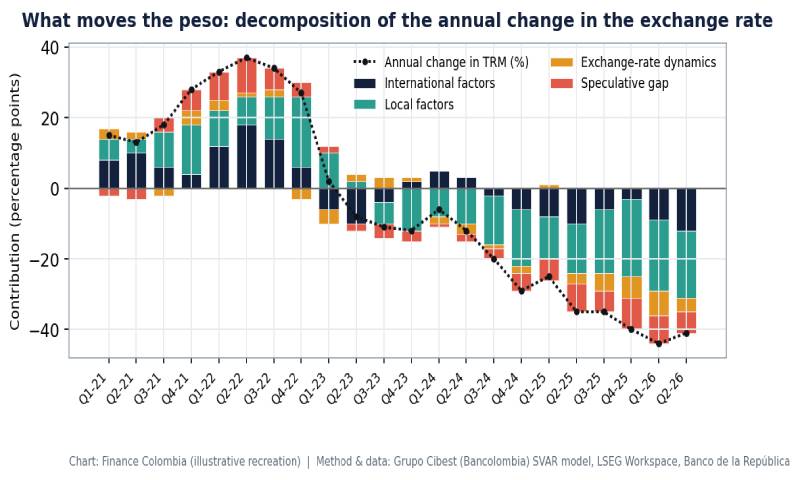
The figure shows the change in the Colombian peso and how local and international factors seem to be affecting it in a negative direction. Chart created by Finance Colombia.
On Wall Street, the S&P 500 rose 1.8 percent, the Dow Jones 2.0 percent and the Nasdaq 2.1 percent, their best quarter in six years, led by semiconductor and artificial-intelligence infrastructure shares even as investors questioned the sustainability of those valuations. Tesla (NASDAQ: TSLA) lifted deliveries 25 percent year over year in the second quarter, and Lime (NASDAQ: LIME), the shared electric-bike and scooter operator, debuted on the Nasdaq with a $167 million USD raise and a valuation near $1.6 billion USD.
European indices advanced, with the Stoxx 600 up 2.7 percent, the DAX 4.5 percent, the CAC 40 1.5 percent, the FTSE 100 1.6 percent and the IBEX 35 2.2 percent, led by defense shares and with Siemens (XETRA: SIE) contributing to the DAX. KNDS postponed a planned Frankfurt and Paris listing, while Renk (XETRA: R3NK) agreed to acquire Britain’s David Brown Defence for about $200 million USD. In Asia, the Hang Seng rose 3.0 percent, the Nikkei 225 0.6 percent and the Shanghai Composite 0.4 percent; China Resources New Energy staged Asia’s largest listing so far in 2026, raising about $3,600 million USD in Shenzhen.
The full report, Fortaleza del peso colombiano bajo la lupa: entre el optimismo y sus fundamentales, was published by Grupo Cibest’s Dirección de Investigaciones Económicas, Sectoriales y de Mercado, led by Laura Clavijo.
Headline image description: The chart shows how the Colombian peso has depreciated significantly in comparison to other similar currencies in the market by a margin of 500 points. Chart created by Finance Colombia.
Composition of the new Congress
Colombia’s National Electoral Council (CNE) has officially certified the members of the country’s new Congress for the 2026 – 2030 legislative term, which was sworn in on July 20, through Resolution 3328 of 2026, concluding the national vote-counting process for the legislative elections.
More about Colombia’s electoral process? Colombia Officially Certifies President-Elect Abelardo de la Espriella. Here’s How the Country’s Vote Validation System Works
The resolution confirmed the election of 102 senators chosen by popular vote following the official tally of 19,478,739 ballots. The Senate will also include former presidential candidate Iván Cepeda, who was awarded the opposition seat guaranteed under Colombia’s Constitution after finishing second in the presidential election.
In the Senate, the Pacto Histórico coalition, led by outgoing President Gustavo Petro, emerged as the largest bloc with 26 seats, although well short of an outright majority. It is followed by the Centro Democrático party with 17 seats, the Partido Liberal Colombiano with 13, the Alianza por Colombia coalition, led by the Partido Verde (Green Party), with 11, the Partido Conservador with 10, the Partido de la U with eight, the Cambio Radical-ALMA coalition with seven, the Ahora Colombia coalition with five, and the National Salvation Movement, President Abelardo de la Espriella‘s party, with four seats.
The remaining two Senate seats correspond to Indigenous constituencies and are held by representatives of the Indigenous and Social Alternative Movement (MAIS) and the National Organization of Indigenous Authorities of Colombia.
The CNE also certified the composition of the House of Representatives, which consists of 183 lawmakers elected from Colombia’s departments, the Capital District of Bogotá and the country’s special electoral constituencies.
Unlike the Senate, which is elected through a nationwide constituency, members of the House of Representatives are elected from territorial and special constituencies, resulting in a more geographically diverse chamber with stronger representation from regional political parties.
The 183 House seats are distributed as follows: 161 represent Colombia’s departments and Bogotá; 16 are reserved for victims of the country’s armed conflict through the Special Temporary Peace Constituencies; two represent Afro-Colombian communities; one represents the Raizal community of San Andrés, Providencia and Santa Catalina; one is reserved for Indigenous communities; one represents Colombians living abroad; and one additional seat is reserved for the opposition and will be held by Aida Quilcué, the vice presidential running mate of Iván Cepeda.
Coalition alignments begin
With the installation of the new Congress, the deadline also began under Law 1909 of 2018, known as the Opposition Statute, requiring political parties represented in Congress to formally declare whether they will support the government, join the opposition or remain independent. The deadline expires on August 20, 2026.
So far, President Abelardo de la Espriella has secured the support of four political parties: National Salvation, Cambio Radical, Centro Democrático, and the Partido Conservador.
The backing of Cambio Radical is particularly significant because newly appointed Interior Minister Rodrigo Lara Restrepo belongs to the party and will be responsible for building legislative majorities for the new administration. The Char clan, the influential political and business group based in the Caribbean city of Barranquilla, has supported De la Espriella since the beginning of his presidential campaign, is also part of Cambio Radical.
By contrast, the Pacto Histórico announced it will serve as the main opposition force under the leadership of former President Gustavo Petro and Senator Iván Cepeda. Meanwhile, the Liberal, Green Party, and De La U have yet to decide whether they will join the government coalition, remain independent or declare themselves in opposition.
A fragmented Congress
Combined, the Pacto Histórico will hold the largest congressional caucus with 69 lawmakers (43 in the House of Representatives and 26 in the Senate), followed by the Centro Democrático with 47 seats, and the Liberals with 37.
The distribution confirms a highly fragmented Congress, with no political force holding an outright majority in either chamber, where 52 votes are required in the Senate and 92 in the House. As a result, both the government and the opposition will need to negotiate support for each bill individually, a situation similar to that faced by the outgoing administration.
The first legislative session provided an early example of that dynamic. During the vote for Senate president, widely considered the most influential position in Congress, De la Espriella’s government backed Senator Alfredo Deluque of Partido de La U in an effort to strengthen ties with the party, which has yet to define its relationship with the new administration.
Instead, Senator Honorio Henríquez of the Centro Democrático won the post with 56 votes, defeating Deluque, who received 45.
The outcome underscored the absence of stable legislative majorities and suggested that relations between the executive and Congress will depend on continuous negotiations over the next four years within Colombia’s constitutional system of separated powers and institutional checks and balances.
Provisional operating permit moves Colombia closer to the return of seaplane services.
Colombia’s Civil Aviation Authority (Aerocivil) has granted ALMA Air S.A.S. a Provisional Operating Permit as a non-scheduled public air carrier, marking a significant step toward the return of amphibious aviation services in the country.
The approval allows ALMA Air to continue advancing toward commercial operations for passenger, cargo, and mail air taxi services, following more than two years of technical preparation, operational testing, and coordination with Colombian authorities.
The company’s planned amphibious aviation model is designed to connect regions that may have limited access to traditional airport infrastructure, while creating new opportunities for tourism and regional connectivity.
“The decision confirms that the company has satisfied the requirements necessary for the issuance of the Provisional Operating Permit and represents a significant step forward in the regulatory process, enabling ALMA Air to continue advancing toward the commencement of its commercial operations.” – ALMA Air
More than 75 water operations completed during testing
As part of the approval process, ALMA Air conducted an operational testing programme in Ayapel, Mompox, and the Guatapé Reservoir, evaluating the procedures required for amphibious aircraft operations in Colombia.
According to the company, the programme included more than 75 water takeoffs and landings, completed without accidents, incidents, injuries, aircraft damage, or harm to third parties.
The testing evaluated key operational areas that include flight procedures, risk management protocols, coordination with relevant authorities, and the implementation of the company’s Safety Management System (SMS).
ALMA Air said the exercises also provided technical information to support the development of coordination mechanisms between aviation authorities and other institutions responsible for activities on inland waterways.
A new transport option for Colombia’s regions
Amphibious aircraft can operate from both conventional runways and bodies of water, creating potential connectivity solutions for destinations where traditional airport infrastructure may be limited.
ALMA Air’s proposed operations are focused on expanding access to riverside communities, tourism destinations, and other areas where alternative transport options could support economic activity.
The company believes amphibious aviation could complement Colombia’s existing air transport network by providing greater flexibility for regional travel.
Two years of regulatory and technical development
The provisional permit follows an extended development process involving private investment, aircraft testing, regulatory reviews, and collaboration with government institutions.
ALMA Air recognized the work of Aerocivil, the Ministry of Transport, inspectors, technical teams, and other public officials involved in supporting the initiative.
The company will continue working through the remaining operational steps required before commercial services begin, as it moves toward introducing amphibious air transport as a new option within Colombia’s aviation sector.
Early 2026 in-fill drilling hits up to 27.83 g/t gold at Zancudo
Denarius Metals Corp. (Cboe CA: DMET) (OTCQX: DNRSF) has reported the first assay results from its 2026 surface in-fill diamond drilling program at the Las Brisas target on its wholly owned Zancudo gold-silver project in Colombia, located in the Cauca Belt about 30 kilometers southwest of Medellin.
The results cover the final assays for the first four drill holes, totaling roughly 660 meters, completed from the first purpose-built surface drill platform. The holes confirmed the high-grade gold and silver mineralization previously modeled on the Manto Antiguo and Santa Catalina structures.
Highlight intercepts included 7.43 grams per ton (g/t) gold and 15 g/t silver over 1.20 meters from 93.8 to 95.0 meters in hole ZM-195 on the Santa Catalina structure, including 28.70 g/t gold and 38 g/t silver over 0.30 meters. Hole ZM-197, on the Manto Antiguo structure, returned 8.36 g/t gold and 1,670 g/t silver over 1.0 meter from 160.3 to 161.3 meters, including 27.83 g/t gold and 5,564 g/t silver over 0.30 meters.
Key Drilling Results at Las Brisas
| Hole ID | Structure | From (m) | To (m) | Length (m) | Au (g/t) | Ag (g/t) | AuEq (g/t) |
| ZM-195 | Santa Catalina | 93.8 | 95.0 | 1.2 | 7.43 | 15 | 7.58 |
| incl. | 94.3 | 94.6 | 0.3 | 28.70 | 38 | 29.18 | |
| ZM-195 | Manto Antiguo | 148.3 | 149.1 | 0.8 | 3.57 | 98 | 4.80 |
| incl. | 148.7 | 149.1 | 0.5 | 5.33 | 98 | 6.56 | |
| ZM-197 | Manto Antiguo | 160.3 | 161.3 | 1.0 | 8.36 | 1,670 | 29.24 |
| incl. | 160.6 | 160.9 | 0.3 | 27.83 | 5,564 | 97.38 | |
| ZM-197 | Unknown | 167.4 | 168.2 | 0.8 | 2.93 | 10 | 3.10 |
| incl. | 167.9 | 168.2 | 0.3 | 7.81 | 26 | 8.10 | |
| ZM-199 | Santa Catalina | 136.0 | 137.0 | 1.0 | 3.08 | 9 | 3.20 |
| incl. | 136.6 | 137.0 | 0.4 | 6.32 | 24 | 6.32 | |
| ZM-199 | Manto Antiguo | 161.1 | 162.1 | 1.0 | 1.86 | 2 | 1.86 |
| incl. | 161.4 | 161.8 | 0.4 | 4.61 | 5 | 4.61 |
Notes: Intervals are core lengths; true widths are estimated at 80% to 90% of the reported lengths. Gold-equivalent (AuEq) grades were calculated using prices of $3,200 USD per ounce of gold and $40.00 USD per ounce of silver. “Unknown” denotes a new structure that does not correlate with any known structure or vein. Hole MT-196 returned no results above the 4 g/t AuEq cut-off, and hole MT-198 was aborted at shallow depth due to excessive deviation.
The Las Brisas target is an unexploited block within the Manto Antiguo structure that was preserved by past mining. The in-fill program is designed on 50-by-50-meter drill centers from eight platforms (IF-5 to IF-12) to better delineate and confirm the consistency of two ore shoots outlined by earlier drilling on the Manto Antiguo and Santa Catalina structures. The Manto Antiguo ore shoot, controlled by the intersection of the two structures, typically shows wider and higher-grade intercepts.
“This early progress at the Las Brisas Target reinforces our confidence in the continuity and quality of the known ore deposits at Zancudo.” – Serafino Iacono, Executive Chairman, Denarius Metals
Drilling at Las Brisas began in late April 2026 with a single rig and comprises about 6,000 meters across 29 diamond drill holes. The reported results cover the first four holes, about 660 meters, drilled from the first platform (IF-7). All holes completed to date on Manto Antiguo, totaling about 560 meters, intersected the structure at the estimated depth, with a maximum grade of 27.83 g/t gold and 5,564 g/t silver over 0.30 meters in ZM-197. On Santa Catalina, holes totaling about 660 meters intersected the structure at depth, with a maximum grade of 28.70 g/t gold and 38 g/t silver over 0.30 meters in ZM-195.
“This early progress at the Las Brisas Target reinforces our confidence in the continuity and quality of the known ore deposits at Zancudo,” said Serafino Iacono, executive chairman of Denarius Metals. “The 2026 in-fill drilling program has been designed taking into account the successful results achieved in our 2024 in-fill drilling campaign and underscores the potential and prospectivity of delineating new zones and expanding existing ones near planned mining infrastructures. We look forward to providing further updates through the course of this year’s drilling campaign.”
Structures and Geology
The Manto Antiguo structure, historically the main structure mined, is interpreted as a west-northwest to east-southeast trending brecciated manto that merges into the footwall of the Santa Catalina structure.
The northerly-trending Santa Catalina structure, which dips steeply to the east near surface and gently at depth, is interpreted as a mineralized master fault and the feeder of mineralization for the entire vein system. The typically narrow Manto Antiguo structure shows a breccia texture with incipient quartz-sulphide banding and milled wall-rock clasts, with mineralization consisting of pyrite, arsenopyrite, sphalerite, and galena.
2026 Program and Processing Plant
The 2026 drill program totals a planned 15,000 meters across several targets within the Zancudo project, including Las Brisas, El Castano, the Independencia mine, and brownfield areas. The company said the program is intended to provide data for resource modeling, mine planning, and stope design as it ramps up mining at Zancudo in 2026 and 2027 to feed the project’s new 1,000-ton-per-day flotation processing plant, which is under construction and expected to be operating later this year.
The resource evaluation work was completed by Scott E. Wilson, CPG, president of Resource Development Associates and an independent qualified person under Canada’s NI 43-101, who inspected the Zancudo project on June 2-3, 2026. Core samples were prepared and assayed for gold by Actlabs at its laboratory in the Rionegro free-trade zone in Antioquia, Colombia, with multi-element analysis completed at its laboratory in Ancaster, Ontario.
Denarius Metals is a Canadian junior mining company focused on precious metals and polymetallic projects in Colombia and Spain, and trades on Cboe Canada as “DMET” and on the OTCQX Market in the United States as “DNRSF.”
At Zancudo, its 100%-owned high-grade gold-silver deposit that includes the historic Independencia mine, the company is producing in an early-production phase while completing the processing plant, which it expects to begin producing high-grade gold-silver concentrates in the third quarter of 2026.
In Spain, Denarius holds a 21.8% interest in and operates the Aguablanca nickel-copper project, recognized by the European Union as a Strategic Project, and owns 100% of the Lomero polymetallic project and the Toral zinc-lead-silver project.
Headline image description: The diagram showcases the target location of Denarius Metals in their Las Brisas mine site, and what they projected to have discovered there. Photo provided by Denarius Metals.
The new findings expand the copper resources to be extracted by the company
Copper Giant Resources Corp. (TSXV: CGNT | OTCQB: LBCMF | FRA: 29H0) has released assay results from two drill holes at its Mocoa copper-molybdenum porphyry project in Putumayo, Colombia, extending mineralization below the current conceptual pit and confirming a third mineralized breccia corridor at the deposit.
Deep infill hole MD-064 intersected 1,052 meters of continuous mineralization from 155 meters downhole, including 486 meters grading 0.57% copper equivalent (CuEq) — 0.41% Cu and 0.029% Mo — which exceeds the deposit’s current mineral resource estimate (MRE) average of 0.51% CuEq. A higher-grade core of 115 meters returned 0.65% CuEq (0.34% Cu and 0.058% Mo) from 552 meters. The final 180 meters of the hole intersected the western breccia, returning 0.44% CuEq (0.36% Cu and 0.015% Mo), including 72 meters of 0.55% CuEq (0.51% Cu and 0.008% Mo).

Cross-section along hole MD-063 (section width of 100 meters), showing the 2026 MRE block model and the Cu and Mo grades intercepted. Results to date continue to demonstrate Cu and Mo mineralization below the current conceptual pit design and within areas previously modeled as waste, supporting the potential for resource expansion along the southern margin of the system toward the La Estrella corridor. Kick-off (KO) points for directional daughter holes are indicated. (CNW Group/Copper Giant Resources Corp.)
Further Expansion of Directional Drilling
The western breccia intersection provides the first modern drill confirmation of a corridor identified only historically, establishing Mocoa as a system with three drill-tested mineralized breccia corridors — western, central, and eastern — consistent with a large, multi-phase porphyry deposit with multiple mineralized centers.
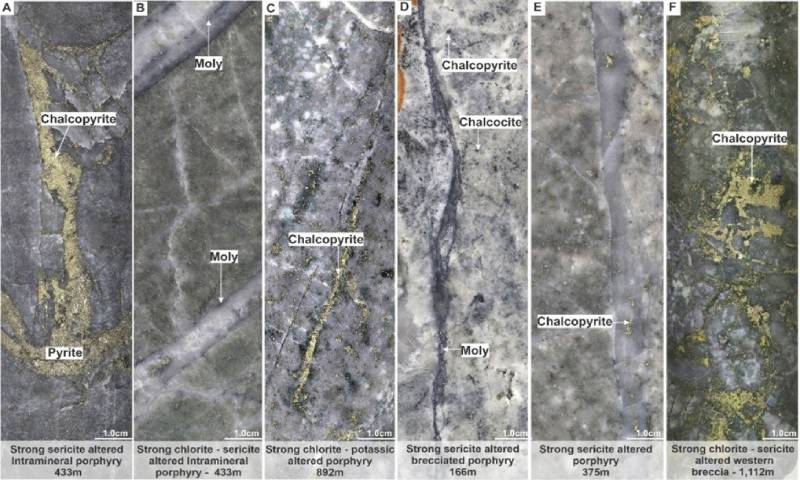
Representative core photographs from MD-063 (Figures 2A–C) and MD-064 (Figures 2D–F) illustrating porphyry-style mineralization, hydrothermal alteration, and vein-hosted copper and molybdenum mineralization. (CNW Group/Copper Giant Resources Corp.)
Directional daughter hole MD-063, drilled from the platform of mother hole MD-056, targeted the southern expansion of the deposit below the current conceptual pit. It returned 808 meters of continuous mineralization from its kick-off point, including 303 meters grading 0.41% CuEq (0.25% Cu and 0.031% Mo) from 541 meters downhole — ground the company had previously modeled as waste. The result extends known mineralization at depth and to the south toward the La Estrella target area, where Copper Giant’s third drill rig is currently conducting maiden drilling from the other direction.
“We are increasing confidence in what we have and adding to what is still to come, exactly what we want heading into the PEA.” -Edwin Naranjo Sierra, Vice President of Exploration
Copper Giant uses directional drilling to test multiple targets from a single pad without constructing new roads or platforms in Mocoa’s steep terrain, which reduces surface disturbance and cost per meter of geological information. MD-063 follows a series of holes — MD-054, MD-056, MD-058, and MD-061 — that have progressively identified stronger mineralization along the southern margin of the current MRE footprint. The area was historically tested only by shallow and sub-vertical drilling.
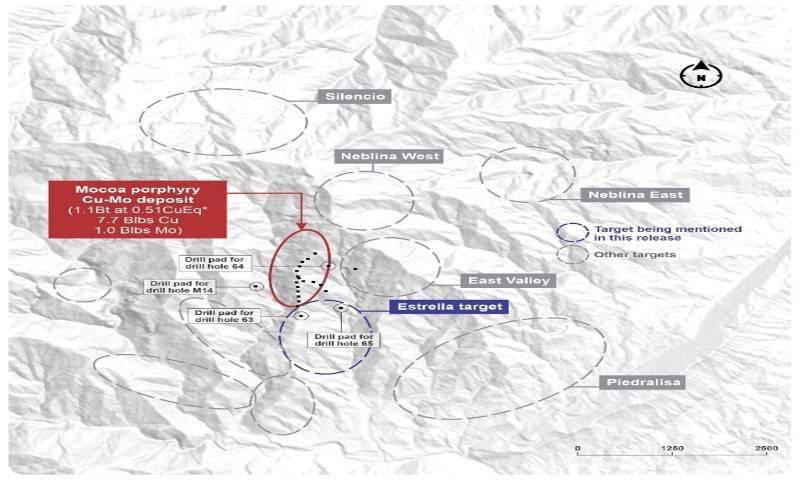
Plan view of the Mocoa porphyry Cu-Mo deposit and surrounding exploration targets. Black dots represent drill pads. The location of historical hole M14, where the western breccia was first recognized, is also shown. (CNW Group/Copper Giant Resources Corp.)
“These two holes do something more valuable than chasing a high number. MD-064 confirms the continuity and grade of the deposit across more than a kilometre of core, which leads us to believe the resource model we will build the PEA on is sound. MD-063 shows the system continuing below the current pit, in ground we had modelled as waste, and the first modern confirmation of the western breccia tells us Mocoa is a larger, multi-center system than the current resource captures. We are increasing confidence in what we have and adding to what is still to come, exactly what we want heading into the PEA,” said Edwin Naranjo Sierra, Vice-President of Exploration.
More Testing Planned for the Future
The Mocoa project hosts a 1.12-billion-tonne Inferred resource containing 12.7 billion pounds of CuEq — 7.7 billion pounds of copper at 0.31% Cu and 1.0 billion pounds of molybdenum at 0.039% Mo — with an effective date of November 18, 2025. Upcoming catalysts include an updated MRE, a second stage of metallurgical testing, the planned preliminary economic assessment (PEA), and assay results from the La Estrella maiden drilling program. Earlier metallurgical tests at Mocoa returned copper recoveries of up to 92.3% and molybdenum recoveries of up to 97.4%, exceeding the recovery assumptions used in the current resource model.
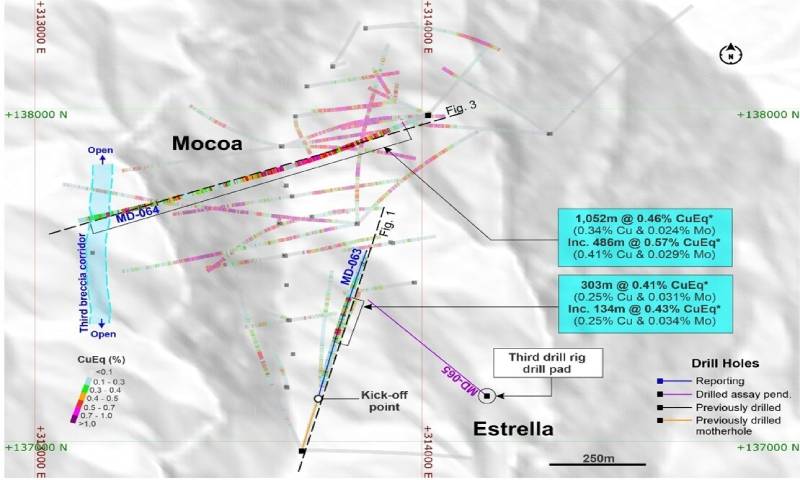
Drilling is advancing toward the emerging Mocoa–La Estrella corridor from both directions, while MD-064 validates higher-grade domains within the MRE footprint. Plan view of holes MD-063 and MD-064 and the location of the cross-sections shown in Figures 3 and 5. MD-063 extends mineralization southward from Mocoa while the company’s third drill rig advances northwest from La Estrella. Kick-off (KO) points for directional daughter holes are shown, illustrating the use of a single drill platform to test multiple targets. (CNW Group/Copper Giant Resources Corp.)
The Mocoa project is located approximately 10 kilometers from the town of Mocoa in southern Colombia’s Department of Putumayo. Copper Giant controls more than 128,300 hectares of district-scale tenure through granted titles and applications across a portion of the Jurassic porphyry belt in the northern Andes. The deposit was first identified in 1973 through a regional geochemical survey conducted by the United Nations and the Colombian government, with follow-up drilling by B2Gold (NYSE American: BTG; TSX: BTO) in 2008 and 2012. In 2025, Copper Giant finalized a prior consultation agreement with the Inga Condagua Indigenous Nation, a prerequisite for advancing exploration permitting.
Edwin Naranjo Sierra, VP of Exploration, is the NI 43-101 Qualified Person who reviewed and approved the technical disclosure. Assay samples were prepared at the ActLabs certified facility in Medellín and analyzed for a full multi-element suite at ActLabs’ certified laboratory in Guadalajara, Mexico. Copper equivalent values are calculated using copper at $4.00 USD/lb and molybdenum at $20.00 USD/lb, with metallurgical recoveries of 90% for copper and 95% for molybdenum.
Headline image description: Plan view of the Mocoa porphyry Cu-Mo deposit and surrounding exploration targets. Black dots represent drill pads. The location of historical hole M14, where the western breccia was first recognized, is also shown. Photo provided by CNW Group/Copper Giant Resources Corp.
Colombian newsweekly Semana published an investigation on July 25 alleging that Juliana Guerrero — the young Cesar-born political operator the magazine describes as the most powerful woman in the administration of outgoing President Gustavo Petro — and her sister Verónica Guerrero built a structure that charged businessmen millions of pesos in exchange for promised access to contracts at the Ministerio de Vivienda, Ciudad y Territorio (Ministry of Housing) and the Ministerio del Interior (Interior Ministry). The report is based on testimony from three businessmen who say they participated in the scheme, backed by WhatsApp chats, voice recordings, airline tickets, and bank deposit receipts reviewed by the magazine.
According to Semana, neither sister held any employment or contract with the government during the period in question, yet between 2024 and 2026 they accumulated enough influence to sway executive-branch decisions, and — according to the magazine’s sources — effectively took control of three state entities: the Departamento Administrativo de la Presidencia de la República (Dapre, the administrative department of the presidency), the Fondo Colombia en Paz (Colombia in Peace Fund), and the now-liquidated Ministerio de la Igualdad (Ministry of Equality). El Tiempo, El Espectador, and other Colombian outlets picked up the allegations within hours.
A Price List for Access
The three whistleblowers, whose identities Semana withheld citing safety concerns, described a fixed tariff structure. A first meeting with the sisters cost $1 million COP. Juliana Guerrero would then allegedly handle the lobbying inside the government in exchange for an advance of $200 million COP plus 10 percent of the value of each project awarded, while businessmen were instructed to communicate exclusively with Verónica Guerrero for status updates. A separate $1 million COP fee applied for arranging meetings between mayors and national government officials.
The money, according to the report, was initially collected by David Trespalacios, a young Barranquilla man close to the family, who told the businessmen in a December 10, 2024 message that Verónica “does not want money in her accounts, which is why I have been collecting and delivering. I am handing her cash in Bogotá.” After an apparent falling-out with Trespalacios, Semana reports, the sisters began receiving deposits directly — including through the mobile payments platform Nequi, to an account number that Verónica identified in a December 28, 2024 chat as belonging to her sister Juliana. Deposit receipts reviewed by the magazine include transfers of $5 million COP, $1.8 million COP, $3.2 million COP, $3.95 million COP, $3.05 million COP, and $10 million COP, among others, and one distribution instruction attributed to Trespalacios reads: “Verónica Guerrero, savings account, 12.5 here; Juliana Guerrero, 12.5 here; Wilmer Trespalacios, 10.”
“If it is true, they gave money like fools, thinking that the ministers or I myself act under pressure from women or out of greed.” — President Gustavo Petro, on X
Aqueducts, Housing, and Security Cameras
The promised projects included an aqueduct in a Cesar municipality to be funded by the Ministry of Housing and channeled — according to what Verónica Guerrero told the businessmen — through then-Vice Minister of Water and Basic Sanitation Edward Libreros, whom Petro later fired on camera during a televised October 2025 council of ministers. Airline tickets purchased by the businessmen on December 5, 2024, to fly Verónica from Bogotá to Aguachica, Cesar, and back from Bucaramanga the same day, form part of the evidence. Semana’s report documents her subsequent WhatsApp updates: “My sister is already on it. She already spoke with him (Edward Libreros). They agreed to meet so she can tell him about the commitment.”
Other promised deals included home-improvement programs across multiple municipalities — under terms one businessman described as $35 million COP per municipality awarded, plus 10 percent of each project’s value — a security camera initiative financed by the Fondo Nacional de Seguridad y Convivencia Ciudadana (Fonsecon, the Interior Ministry’s security and coexistence fund), and, in June 2025, an aqueduct contract in La Guajira worth more than $27 billion COP through the Ministry of Housing. “That one is only with me, because I am the one who assigns it,” Verónica allegedly wrote of the La Guajira project.
“The Boss of Bosses”
Throughout the chats, Verónica Guerrero invoked her sister’s access to the highest levels of the government. “Juliana has a meeting today with the boss of bosses,” she wrote on January 21, 2025, when businessmen pressed for results — an expression the whistleblowers say the sisters used to refer to President Petro. In other messages she claimed to be sitting in budget-release meetings, reported that “the boss of bosses has already given clarity and is signing the unfreezing of ministry resources,” and described maneuvering to protect a secretary general at the Ministerio de Ambiente y Desarrollo Sostenible (Ministry of Environment): “If they topple my secretary, I lose a lot of things here.”
The magazine’s evidence also points to alleged influence or attempted influence at Fiduagraria S.A. (the state agricultural fiduciary), the Agencia Nacional de Tierras (National Land Agency), the Ministerio de Defensa in contracts at the Hospital Militar Central, and the Dapre. One chat suggests money flowed beyond the sisters: “I understand that is for the people inside (the government) and for you,” a businessman wrote, a characterization Verónica confirmed in the exchange, according to Semana.
More Than $600 Million COP, and Nothing Delivered
None of the promised contracts materialized. The three businessmen told Semana they handed over more than $600 million COP in total between 2024 and 2025. “They robbed us and do not want to give the money back,” they told the magazine. When one of them confronted Juliana Guerrero in the second half of 2025 over $70 million COP transferred to her Nequi account, she replied, per the chats: “I have no problem returning that, but let me talk to her (Verónica) first.” No refund followed, the businessmen say. None of the reports reviewed by Finance Colombia includes a public response from either sister; Semana published video of the two attending the Fiestas del Mar festival in Santa Marta on July 24, the night before the story broke.
Las pruebas que aquí se indican, reflejan, que los llamados “empresarios* se pusieron furiosos y a lo mejor entregaron los chats, porque no les cumplieron. Si es verdad, dieron dineros como pendejos, pensando que los ministros o yo mismo, actuamos por presiones de mujeres o por… https://t.co/JWaAtnGYz0
— Gustavo Petro (@petrogustavo) July 25, 2026
Petro: They “Gave Money Like Fools”
President Petro responded on his X account the same day, arguing that the story proves his government’s safeguards worked precisely because the contracts were never awarded. “The evidence indicated here reflects that the so-called ‘businessmen’ got furious and probably handed over the chats because they were not delivered for. If it is true, they gave money like fools, thinking that the ministers or I myself act under pressure from women or out of greed,” he wrote, adding: “The magazine would do a great favor by handing those chats to the prosecutor’s office… The corrupt businessmen appear to have been swindled, and the government prevented the theft.” He also quipped that the “boss of bosses apparently torpedoed the deals because he thinks about things other than greed,” and suggested the businessmen might “even turn out to be abelardistas” — a reference to supporters of President-elect Abelardo De La Espriella, who takes office August 7.
Criticism came from inside Petro’s own coalition. Carlos Carrillo, former director of the Unidad Nacional para la Gestión del Riesgo de Desastres (UNGRD, the national disaster risk management unit) — itself the center of an earlier procurement scandal that shook the Petro administration — wrote on X that although Semana “has an evident political bias, the evidence it publishes against the Guerrero sisters is very serious. The justice system must investigate what crimes may have been committed. It is very worrying that Fonsecon is also being mentioned — the multibillion-peso Interior Ministry fund in the hands of Armando Benedetti’s friends.” Benedetti, the interior minister whom Colombian media have long described as Juliana Guerrero’s political sponsor, was himself sanctioned by the US Treasury’s OFAC in October 2025 alongside President Petro and members of the president’s family.
The report also vindicates warnings made months earlier by Angie Rodríguez, the former Dapre director who left the government in January 2026 and gave an explosive interview to Semana in April: “She (Juliana Guerrero), without any scruples, has the nerve to go to state entities to give orders, to say what gets contracted, who gets hired and who does not. She and her sister go to the Ministry of Equality and make decisions without being public officials,” Rodríguez said at the time.
The Only Case So Far: Fake Diplomas
Despite the mounting allegations, the only criminal proceeding currently facing Juliana Andrea Guerrero Jiménez is the fake-credentials case that derailed her 2025 nomination as vice minister of youth. The Fiscalía General de la Nación (Office of the Attorney General) has finalized an indictment charging her with procedural fraud and ideological falsehood in a public document, alleging she uploaded fake accounting degrees from the Fundación Universitaria San José — an institution where prosecutors say she never attended class or sat an exam — to the government’s SIGEP II résumé system in order to qualify for the vice ministry. The accusation hearing is set for August 5 at 4:00 p.m. before Bogotá’s 46th Circuit Court, two days before Petro leaves office. The university’s former secretary general, Luis Carlos Gutiérrez Martínez, faces charges of falsehood in a public document in the same proceeding for signing off on the degrees.
Guerrero remains the presidency’s delegate to the university council of the Universidad Popular del Cesar (Popular University of Cesar) and retains a state-funded protection detail from the Unidad Nacional de Protección (National Protection Unit). Prior to the events described in the investigation, her only documented government work was an $11 million COP advisory contract at the Interior Ministry, while Verónica Guerrero held two contracts totaling $19 million COP at Colombia Compra Eficiente (Colombia’s public procurement agency) and one for $11 million COP at the Interior Ministry, according to public procurement records cited by Semana.
The scandal lands in the final two weeks of a presidency already battered by corruption cases — from the UNGRD contracting affair to the illicit-enrichment investigation of former foreign minister Laura Sarabia — and hands incoming president De La Espriella’s attorney general appointees an early test: whether the chats, audios, and bank records now in Semana’s possession become a criminal file.
Who’s Who in the Guerrero Case
- Juliana Guerrero — Cesar-born political operator, former Interior Ministry adviser, and failed nominee for vice minister of youth; described by Semana as the most powerful woman in the Petro government. Accused by three businessmen of selling access to ministry contracts; separately indicted for uploading fake university degrees, with an accusation hearing set for August 5.
- Verónica Guerrero — Juliana’s sister and, per the chats, the network’s day-to-day interlocutor with the paying businessmen. Former contractor at Colombia Compra Eficiente and the Interior Ministry, with no state role during the alleged scheme.
- David Trespalacios — A young Barranquilla man close to the Guerrero family who, according to the report, collected cash and deposits so the sisters could keep money out of their own accounts, before a falling-out changed the arrangement.
- Gustavo Petro — Outgoing president of Colombia, leaving office August 7. The “boss of bosses” invoked in the chats, per the whistleblowers. He says the story shows his government blocked the corruption and that the businessmen were swindled.
- Edward Libreros — Former vice minister of water and basic sanitation, named in the chats as the channel for the Cesar aqueduct project; fired by Petro during a televised council of ministers in October 2025. The chats record the sisters’ claims about him; no response from Libreros appears in the published reports.
- Angie Rodríguez — Former Dapre director and one-time Petro confidante who publicly warned in April 2026 that the sisters were giving hiring and contracting orders inside state entities without holding any public office.
- Armando Benedetti — Interior minister and Juliana Guerrero’s longtime political sponsor, per Colombian press reports; sanctioned by OFAC in October 2025. Carrillo warned that Fonsecon, a fund under Benedetti’s ministry, figures in the allegations.
- Carlos Carrillo — Former UNGRD director who called the published evidence “very serious” and urged the justice system to investigate.
- Elvia Milena Sanjuán and Jorge “Popo” Barros — Governor of Cesar and a Cesar departmental deputy linked to the Gnecco political clan, respectively; the businessmen asked the sisters to broker meetings with both. An audio records Juliana agreeing. Neither is accused of wrongdoing in the report.
- Luis Carlos Gutiérrez Martínez — Former secretary general of the Fundación Universitaria San José, dismissed in late 2025 and charged with falsehood in a public document for certifying Guerrero’s degrees.
- The three businessmen — Unnamed contractors from Norte de Santander, Valle del Cauca, Cesar, and Santander who say they paid more than $600 million COP and received nothing. Petro suggests they were simply defrauded; they remain the case’s key witnesses.
 Empleobilingue.com

- Director/a de operaciones para hotel, restaurante y discoteca 1626320364.60 - Medellín, Medellin, Antioquia, Colombia
- Coordinador/a de calidad para La Unión 1626483143.1 - La Unión, Antioquia, Colombia
- Desarrollador fullstack - Bogotá, Bogota, Colombia
- Technical Analyst - Remote
- PIM Administrator - Ecommerce - Remote (Bogotá, Bogota, Colombia)
- Auxiliar de gestión humana y bienestar para Girardota 1626060072.28 - Girardota, Antioquia, Colombia
- Marketing Strategist
- Trainer Manager - Bogotá, Bogota, Colombia
- Tolemaida UH- 60 Inspector - Bogotá, Bogota, Colombia
- Virtual Assistant - Team Lead - Remote
Contact Us

