















Record drilling, zero safety incidents, zero environmental breaches
Collective Mining Ltd. (NYSE American: CNL; TSX: CNL) reported zero lost-time injuries among its direct employees and no environmental non-compliance during 2025, while investing approximately $1.45 million in community programs across its exploration projects in Caldas, Colombia.
The company released its 2025 Sustainability Report on July 22, 2026, covering its environmental, social and safety performance as Collective expanded exploration at the Guayabales and San Antonio projects. During the year, the company completed 62,500 meters of exploration drilling, its largest annual drilling campaign to date.
“The outcomes outlined in our latest sustainability report reflect the company we are building: technically ambitious, locally rooted and disciplined in how we grow.” – Omar Ossma, President, Collective Mining
Improving safety and local employment
Collective reported zero Lost Time Injuries among direct employees during 2025 and a Total Recordable Injury Frequency Rate (TRIFR) of 0%. The company also reported zero instances of environmental non-compliance during the year.
Direct employment increased 38% year-over-year as the company expanded its exploration, engineering and social activities. Employees from Caldas represented 81% of the company’s direct workforce at year-end, while women accounted for 35% of direct employment.
The results come as Collective continues to expand exploration around the Apollo system, the centerpiece of its Guayabales Project.
$1.45 million directed toward communities
Collective invested approximately $1.45 million in social programs during 2025. The company said 57.5% of the funding came directly from Collective, while strategic partners contributed the remaining 42.5%.
The programs reached 18,880 beneficiaries across 1,745 families and strengthened the capabilities of 237 community leaders.
The initiatives operate under Collective’s “The Collective Way” framework, which emphasizes long-term partnerships in areas including water access and sanitation, infrastructure, education, agricultural development, technical training and community capacity building.
The company’s community strategy is particularly relevant to its operations in Caldas, where Collective’s exploration activities are located alongside established mining operations.
Exploration expands in 2026
Collective has continued its aggressive exploration campaign into 2026. The company reported in June that it had completed more than 184,000 meters of diamond drilling across the Guayabales and San Antonio projects, including 120,000 meters at Apollo.
The Apollo system has produced further exploration results during the year. On June 29, Collective reported a newly identified tungsten-enriched high-grade subzone approximately 300 meters below surface. Drill hole APC-162 intersected 27.35 meters grading 37.55 grams per tonne gold equivalent, including 1.68% tungsten oxide, 11.62 grams per tonne gold, 54 grams per tonne silver and 0.43% copper.
Collective said in July that it had also secured additional mining titles from Colombia’s National Mining Agency following public hearings in Supía and Marmato. The company said the new titles materially expanded its titled land position and created additional drill-ready targets within and adjacent to the Guayabales project area.
As of March 31, 2026, Collective reported $113.3 million in cash and said it was fully funded for its 2026 exploration program, which calls for up to 100,000 meters of drilling. The company had 13 diamond drill rigs operating across Guayabales.
Management and the path toward development
Ned Jalil became Collective’s chief executive officer in April 2025, while Omar Ossma remained president. Finance Colombia previously reported that the appointment brought a mining executive with more than 25 years of international experience into the company’s leadership as Collective considered the longer-term development potential of Guayabales.
Ossma said the sustainability results reflect the company’s approach as it advances both Guayabales and San Antonio.
“As we advance the Guayabales and San Antonio projects, we remain focused on deepening local partnerships, managing our environmental responsibilities and ensuring that the value created through discovery is inclusive and long-lasting,” Ossma said.
Collective was founded by members of the team that developed and sold Continental Gold Inc. to Zijin Mining Group for approximately $2 billion in enterprise value. The company is exploring for gold, silver, copper and tungsten in Caldas, where Guayabales and San Antonio form the core of its Colombian portfolio.
The company’s flagship Guayabales Project is anchored by the Apollo system, which Collective describes as a bulk-tonnage, high-grade gold-silver-copper-tungsten system. Current exploration priorities include expanding the Ramp Zone, testing the Northern Apollo Oxidized area, drilling the northwestern extension of the Trap target and pursuing additional greenfield targets.
Collective’s 2025 Sustainability Report provides the company’s latest formal account of its safety, environmental and community performance as it moves into a larger 2026 exploration program.
Headline photo : A mural showing artisanal mining in Supía Colombia, where Collective Mining has participated funding of municipal improvement projects.. (Photo by Finance Colombia)
Five departments gain satellite-triggered agricultural insurance as Colombia prepares for climate risks
Colombia’s national government has contracted five parametric agricultural insurance policies covering 14,402 smallholder farmers across Sucre, Córdoba, Cundinamarca, Meta and Chocó, with protection extending to as many as 41,600 people in farming households. The policies provide up to $20.14 million in coverage against drought and excess rainfall as Colombia prepares for the anticipated effects of El Niño in the second half of 2026.
The policies took effect August 1, 2026, giving participating departments a financial mechanism designed to respond more quickly when severe weather thresholds are reached.
“Preparing for El Niño means acting before disasters strike. Through this collaboration between the national government, the five participating departments and international partners, we are providing smallholder farmers with the financial protection they need to manage climate risks and protect their livelihoods.” – Lucy Inés García Montes, Governor of Sucre
The initiative is led by the Ministry of Agriculture and Rural Development (MADR) and FINAGRO, in coordination with the governments of the five participating departments.
The program was delivered through the Tripartite Agreement Programme, a public-private partnership involving the Insurance Development Forum (IDF), the United Nations Development Programme (UNDP) and Germany’s Federal Ministry for Economic Cooperation and Development (BMZ), with financing channeled through the InsuResilience Solutions Fund (ISF).
How parametric insurance works
Unlike conventional agricultural insurance, which generally requires an assessment of physical losses before a claim can be paid, the policies use a satellite-derived Water Balance Index monitored at the municipal level.
The index compares current conditions with historical data to identify periods of severe drought or excess rainfall. When predetermined thresholds are exceeded, payments are triggered automatically, potentially allowing affected farmers to receive financial support without waiting for individual loss assessments.
The product was co-designed by MADR with an IDF-member consortium comprising Guy Carpenter, Swiss Re, AXA Climate, Munich Re, insurtech company Raincoat and Colombian insurer La Previsora.
The consortium members and ISF co-financed the initiative, while the first-year premium was jointly funded by the Colombian government and ISF.
First departmental use of parametric insurance
The program represents the first use of parametric insurance by departmental governments in Colombia as a tool for agricultural risk management, according to the organizations involved.
For participating departments, the coverage is intended to provide a source of rapid financing following severe climate events while reducing reliance on emergency public funds. The initiative is also designed to establish the technical, legal and financial foundations for expanding parametric agricultural insurance to additional departments.
José Fernando Sánchez, senior vice president of Guy Carpenter Colombia and an IDF member, said the consortium’s participation demonstrated the potential of public-private collaboration to protect livelihoods and strengthen Colombia’s insurance market.
Dr. Annette Detken, head of the InsuResilience Solutions Fund, said climate-risk insurance can help smallholder farmers and rural communities recover more quickly from drought and excess rainfall.
The UNDP worked with MADR and FINAGRO to integrate the insurance policies into Colombia’s broader agricultural risk-management framework. Its work included supporting product development and strengthening the institutional capacity of departmental governments to adopt parametric insurance.
The program comes as Colombia seeks to strengthen financial tools for managing agricultural exposure to increasingly volatile weather conditions. By using predefined climate indicators rather than conventional claims assessments, parametric coverage is designed to provide liquidity soon after a qualifying event and help farmers maintain their livelihoods and productive capacity.
Building a model for climate-risk financing
The five policies cover farmers in departments with different agricultural profiles and climate exposures, creating a multi-region test of how satellite-based insurance can operate within Colombia’s decentralized agricultural risk-management system.
The initiative’s backers say the experience could provide a foundation for scaling parametric insurance to other parts of the country, while building local government capacity to identify, finance and manage climate risks.
For smallholder farmers, the immediate benefit is financial protection against weather events that can damage crops and undermine household income. For governments and insurers, the program offers a way to shift part of the financial burden of climate-related agricultural losses away from emergency response and toward pre-arranged risk financing.
The Insurance Development Forum is a public-private partnership co-chaired by UNDP and the World Bank Group that brings insurance expertise together with public policy and development priorities to strengthen resilience to disasters.
Headline photo by Frank Meriño via Pexels)
Case links alleged Syria-based arms network to ELN cocaine shipments
Colombia’s National Police extradited five Colombian nationals to the United States on August 6, 2026, handing them over to US federal authorities in connection with investigations into drug trafficking, money laundering and transnational organized crime.
The five men were delivered by officers from the Dirección de Investigación Criminal e Interpol (DIJIN) and transported under security escort on a flight accompanied by the US Marshals Service. The extraditions followed requests from US courts and investigations involving alleged cocaine trafficking, financial operations and international arms networks.
“This extradition represents a decisive blow against networks involved in drug trafficking, money laundering and crimes against collective security operating in the region.” – Policía Nacional de Colombia
Alleged arms-for-cocaine network
Among those extradited was Wilmar Cortés Hurtado, who is wanted by the US District Court for the Eastern District of Virginia on drug trafficking and criminal conspiracy charges.
Wisam Nagib Kherfan Okde and Alirio Rafael Quintero Quintero were also handed over to US authorities. Colombian investigators accuse the pair of leading a criminal organization involved in money laundering and international arms trafficking.
According to the Colombian government, investigators allege that the organization used connections with members of the regime of Bashar al-Assad in Syria to divert military weapons. Those weapons were allegedly subsequently routed to structures of the Ejército de Liberación Nacional (ELN) in exchange for cocaine shipments between 2024 and 2025.
The investigation also alleges that cryptocurrency and complex financial transactions in countries such as Ghana and Morocco were used to facilitate money laundering connected to drug trafficking organizations and terrorist groups.
The allegations have not been established as findings of guilt, and the defendants will face proceedings in the United States.
Cocaine trafficking and international routes
Helmer Hurtado Hurtado, also wanted by the US District Court for the Eastern District of Virginia, was extradited on drug trafficking and criminal conspiracy charges connected to an international narcotics investigation.
Jacob Estenyer Jory Salazar was also among the five. Colombian authorities allege that he coordinated cocaine shipments destined for the United States and Mexico using multiple transportation methods, including speedboats, container vessels, semi-submersible vessels and aircraft.
Seven additional extraditions
The August 6 handover followed the extradition of seven other individuals to the United States and Panama during the previous week.
Six Colombian nationals were delivered to US authorities. They included Jheison Rodríguez López and Edilberto López Farelo, who were initially taken to the Unidad de Reacción Inmediata in Valledupar after their capture. Colombian authorities said the two attempted to escape from the facility but were immediately recaptured.
Eufrosino Ramos Díaz was captured during a raid at his residence and faces extradition proceedings in the United States on a charge involving a conspiracy to distribute at least five kilograms of cocaine.
Daniel Alfonso de la Rosa Robles and Pedro Lucas Robles Iguarán were identified by Colombian authorities as alleged members of a trafficking network that obtained narcotics from clandestine laboratories in the Catatumbo region and Alta Guajira. Investigators allege that the pair coordinated maritime shipments using speedboats to move cocaine toward Central America and the Caribbean, with the United States as the final destination.
Nilson Snyder Vásquez Duarte, known as “El Sobri,” was identified as an alleged financial operator responsible for receiving and managing large sums of money generated by drug trafficking organizations, with alleged connections to Colombian and Mexican cartels.
The seventh person extradited during the previous week was Panamanian national Jorge Antonio Zurita Julian, known as “El Gordo Pibe,” who was handed over to Panamanian authorities. He is wanted in Panama on money laundering and crimes against collective security charges related to drug trafficking. Colombian investigators allege that he used a company registered in his wife’s name to disguise illicit funds as legitimate business proceeds.
The extraditions form part of Colombia’s continuing cooperation with foreign authorities through DIJIN and Interpol. The individuals remain subject to judicial proceedings in the requesting countries, and the allegations described by Colombian authorities have not resulted in final convictions.
Headline photo: Five men being escorted to board on the plane extraditing them to the US. (Photo by the Colombian National Police)
Four people were arrested after authorities uncovered an unauthorized meat-processing operation in the Prado neighborhood.
Medellín authorities seized 2,794 kilograms of beef and pork considered unfit for human consumption during a July 23 operation in the Prado neighborhood, where four people were arrested in flagrante as authorities investigated an alleged clandestine meat-processing operation.
The operation was carried out jointly by the Alcaldía de Medellín, the Policía Metropolitana del Valle de Aburrá, the Fiscalía General de la Nación and INVIMA. Authorities conducted two search-and-seizure procedures at the property, which investigators said was being used for the unauthorized slaughter and processing of pork and beef.
According to information released following the operation, the meat had an estimated commercial value of more than more than $108 million COP. Authorities said the property did not have the required authorization to operate and that the meat was being handled and stored under conditions that did not comply with Colombia’s applicable sanitary requirements. Technical inspections determined that the seized products were not suitable for human consumption.
The investigation also raised concerns about where the meat was being sold. Authorities said the products were allegedly being commercialized in the Plaza Botero area and surrounding parts of central Medellín, one of the city’s busiest areas for pedestrians, visitors and informal and formal commerce.
The four people captured during the operation were placed at the disposal of the Fiscalía General de la Nación and face investigation for the Colombian criminal offense of corruption involving food, medical products or prophylactic materials. Their capture and the seizure of the meat do not, by themselves, establish a final judicial finding of guilt.
The case highlights the public-health risks associated with unauthorized meat processing, particularly where products enter commercial channels without the traceability, sanitary controls and operating permits required by Colombian regulations.
The operation also forms part of a broader pattern of enforcement against illicit or non-compliant meat activity in Antioquia. In May, the Policía Nacional reported the seizure of approximately 9,000 kilograms of meat products and the capture of one person in Donmatías, where authorities were investigating alleged violations involving food products and illegal animal slaughter. That case was separate from the Medellín investigation.
As of August, no additional publicly reported development that materially changes the July 23 account could be independently verified in the sources reviewed for this article. The four July detainees are still being placed at the disposal of the Fiscalía while the investigation proceeds.
For consumers, the operation underscores the importance of traceability and sanitary controls in the meat supply chain. For authorities, the investigation will need to establish the full scope of the alleged operation, including how the meat was processed, stored and distributed and whether additional individuals or businesses were involved.
Headline photo: Some of the meat seized by the Medellin authorities. (Photo provided by Medellín’s mayor’s office)
Gutiérrez prepares new evidence for U.S. authorities
Medellín Mayor Federico Gutiérrez is preparing to take additional information to U.S. authorities as his administration investigates whether money allegedly diverted through corruption during the city’s previous government was moved through Panama and into the United States.
Gutiérrez said he has already provided evidence to U.S. government agencies and plans to deliver more information during an upcoming visit to the United States. The mayor says the material could help authorities trace the alleged movement of funds and identify people who may have benefited.
The allegations concern the 2020-2023 administration of former Medellín Mayor Daniel Quintero. They remain allegations, with responsibility for determining criminal liability resting with Colombian and U.S. authorities.
Alleged money trail leads beyond Colombia
The latest development follows a July 27 update from the Medellín government, which said investigations into alleged corruption during the previous administration had reached 666 findings, 165 more than the 501 previously identified.
According to the city, prosecutors and other authorities have collected more than 13,000 pieces of evidence and 157 witness statements and have conducted 97 expert assessments. The cases have so far resulted in 55 people being formally charged, three arrests, one conviction and 25 asset-forfeiture measures.
Gutiérrez has now placed particular emphasis on tracing what allegedly happened to money after it left Colombia.
The mayor said there is information about alleged business partners and nominees, including people who are reportedly living in Miami. He said the evidence provided to U.S. agencies is intended to help trace a potential route from Colombia to Panama and then to the United States.
If confirmed, an international financial trail could expand the investigation beyond Medellín and require cooperation from authorities in other jurisdictions.
Investigation covers multiple public entities
The corruption investigations extend across several Medellín institutions and public contracts.
The city has cited alleged irregularities involving Afinia, EPM’s Caribbean subsidiary, the Metropolitan Area of the Aburrá Valley, Metroparques, the Institute of Sports and Recreation, Buen Comienzo and the maintenance of Parque de las Aguas, among others.
Gutiérrez’s administration says potentially directed contracting during the 2020-2023 period exceeded COP 1 trillion.
One investigation cited by the city concerns the alleged sale of the management position at Afinia. According to information presented by the administration, a witness alleged that the position was negotiated for $8 million in exchange for influence over company contracting. The case includes alleged international connections that are being examined by authorities.
Other investigations involve alleged contract steering, inflated costs and the improper use of public resources.
Quintero rejects the allegations
The accusations have also intensified the political confrontation between Gutiérrez and Quintero.
Gutiérrez has attributed the alleged corruption findings to the previous administration, while Quintero has rejected the accusations and accused his successor of using the Medellín mayor’s office to pursue political attacks.
The distinction between allegations and established judicial findings remains important as the cases continue through Colombia’s justice system.
U.S. cooperation could determine where funds went
The planned engagement with U.S. authorities could become a significant next step if investigators are able to verify the alleged international financial trail.
Gutiérrez said the information could ultimately contribute to legal proceedings against people allegedly involved in the schemes, including potential extradition requests. However, no U.S. authority has publicly established that illicit Colombian funds entered the United States based on the allegations described by the mayor.
For now, the alleged movement of corruption proceeds into the United States remains an investigative lead. The next stage will be determining whether Colombian and U.S. authorities can independently establish the origin, movement and destination of the funds.
(Headline photo: Medellin’s mayor, Federico Gutiérrez. (Photo by John Acosta via Wikimedia Commons)
Ecopetrol S.A. (BVC: ECOPETROL; NYSE: EC) has successfully completed the Brazilian tender offer that will allow the Colombian energy company to take control of Brava Energia S.A. (B3: BRAV3), acquiring approximately 25% of the Brazilian oil and gas producer through an August 5 auction on the B3 exchange.
Ecopetrol’s Brazilian subsidiary, Ecopetrol Investimentos do Brasil Ltda., acquired 116,110,717 common shares at R$23 per share. The shares represent approximately 25% of Brava Energia’s issued and outstanding share capital. Ecopetrol said the auction attracted strong market demand and was completed after all applicable regulatory requirements and conditions precedent for the offer were satisfied.
“We expect to disclose the results of the OPAV together with any other material developments related to the transaction.” – Ecopetrol S.A.
The auction is the second major component of Ecopetrol’s plan to obtain a 51% controlling voting stake in Brava Energia. In April, Ecopetrol agreed to acquire approximately 26% of Brava from a group of significant shareholders through a separate share purchase agreement. Combining that transaction with the shares acquired through the OPAV is expected to give Ecopetrol approximately 51% of Brava’s voting share capital.
CVM suspension cleared the way for the auction
The successful auction follows a regulatory dispute that temporarily interrupted the transaction.
Brazil’s Comissão de Valores Mobiliários (CVM) suspended the tender offer on June 16 after its technical division identified issues requiring adjustments to the offer documentation. The suspension initially threatened the planned June 25 auction.
Ecopetrol and the offer’s intermediary institution appealed the decision. On July 14, the CVM’s Collegiate Board granted the appeal, reversing the basis for the suspension and allowing the offer process to proceed following the required amendments.
Ecopetrol subsequently published a revised offer document on July 20 incorporating the regulator’s recommendations and reopened the OPAV. The revised timetable established August 5 as the auction date and August 17 as the financial settlement date.
The transaction also cleared another important condition before the auction. Brazil’s competition authority, CADE, granted the relevant merger-control approval, which became final in June. The amended offer documentation also reflected waivers obtained from Brava’s debenture holders concerning the change of control.
Ecopetrol targets a larger Brazilian oil and gas position
The Brava transaction represents a bigger expansion of Ecopetrol’s position in Brazil, where the Colombian company has operated for approximately two decades.
Brava Energia was created in 2024 through the merger of 3R Petroleum Óleo e Gás and Enauta Participações. The company operates oil and natural gas assets across multiple Brazilian basins, including both offshore and onshore operations, as well as midstream activities. At the end of 2025, Brava reported approximately 459 million barrels of oil equivalent in reserves.
Ecopetrol said the acquisition is intended to strengthen its international exploration and production portfolio and diversify its reserve and production base. The company already holds Brazilian upstream interests, including a stake in the Gato do Mato development in the Santos Basin.
Settlement will complete the control transaction
Although the auction has been successfully completed, the transaction is not yet fully settled.
Ecopetrol said the OPAV shares will be paid for and settled on August 17, 2026. On the same date, the company expects to consummate the April share purchase agreement covering the approximately 26% stake held by the existing shareholder group, subject to completion of the remaining procedures required under the transaction agreements and applicable regulations.
Ecopetrol plans to initially finance the transaction through a short-term bridge facility arranged through Ecopetrol Capital AG. The company said it expects to refinance that facility through a combination of long-term debt and equity contributions, with the objective of maintaining a capital structure consistent with its leverage targets and credit ratings.
Once both components are completed, Ecopetrol is expected to hold approximately 51% of Brava Energia’s voting share capital, giving Colombia’s state-controlled energy company control of a major independent Brazilian oil and gas producer.
The successful August 5 auction therefore marks the key operational step in Ecopetrol’s planned takeover. The remaining milestone is financial settlement on August 17, after which the company expects the combined transactions to establish its controlling position in Brava Energia.
Headline photo: Ecopetrol headquarters in Colombia (Photo shared by Ecopetrol via their website)
Abelardo de la Espriella took the oath of office in Cali on August 7, 2026. MercoPress reported it as the first time a Colombian leader has been sworn in outside Bogotá, before a ceremony guarded by more than 11,000 security personnel, with Kfir jets flying over the city during the speech. Two days earlier, El Tiempo reported, officers of the Policía Nacional (National Police) had stopped a bus a few kilometers outside Cali carrying 420 kilograms of ammonium nitrate in seven cylinders, fitted with seven concealed launch ramps and rigged, investigators concluded, to strike military and police installations connected to the inauguration. Outgoing Defense Minister Pedro Sánchez attributed the plot to the Jaime Martínez Front, part of the dissident Estado Mayor Central (Central General Staff) of the former Revolutionary Armed Forces of Colombia, or FARC, under alias Iván Mordisco, and identified the man who built it as Dubán Ramiro Castillo Cortés, an explosives specialist known by the alias “Mad Max.” Less than a week before that, a truck bomb detonated beside a police station in Cúcuta, near the Venezuelan border, wounding at least 11 people, according to CBS News.
Three days after the ceremony, a magnitude 7.4 earthquake hit western Colombia and rewrote the agenda entirely. The inheritance came first, though, and it is the reason he is president at all.
The numbers that elected him
The Centro de Paz y Seguridad (Center for Peace and Security) at Universidad Externado counted 40,663 homicides in Colombia between August 2022 and August 2025 — Gustavo Petro’s first three years in office — an annual average of 13,554. Over the equivalent stretch under Iván Duque, the figure was 37,795, averaging 12,598 a year, and under Juan Manuel Santos it was 36,646, averaging 12,215. El Tiempo published the center’s findings in December 2025.
Under Paz Total (Total Peace), the policy that opened simultaneous negotiations with practically every armed and criminal structure in the country, those structures grew. Infobae reported a military intelligence count showing membership rising from 15,120 in December 2022 to 25,278 by July 2025, an increase of 10,158, concentrated in the Nariño Pacific, Catatumbo, Cauca, Bajo Cauca Antioqueño and Arauca — zones, in Infobae’s words, of weak institutional presence. The Fundación Ideas para la Paz (Ideas for Peace Foundation), working from the same count, puts 48 percent of that total under arms and the remaining 52 percent in support networks. By July 2026 the figure had reached 28,802, a 90 percent increase across the Petro years, according to El Colombiano. That is not an interpretation of the policy; it is the count.
The sharpest version of that failure, for a business, is extortion. Ministry of Defense data reviewed by La FM shows 2,914 extortion complaints filed in the first three months of 2026, the highest quarterly figure in 10 years. Gen. William Rincón, director of the National Police, told La FM that more complaints do not automatically mean more crimes, and put the year-over-year increase at 13.1 percent for the same period. La FM identifies merchants, shopkeepers, cattlemen and small business owners as the standing victims of that economy.
A mandate Medellín paid for
De la Espriella won the June 21, 2026, runoff with 12,959,542 votes against 12,708,712 for Iván Cepeda — a margin of 250,830 votes, which El Tiempo put at 0.96 percentage points of all ballots cast, blank and null included, in the Registraduría Nacional del Estado Civil (National Civil Registry) preliminary count. MercoPress called it the narrowest margin in a Colombian runoff in 32 years. In the same El Tiempo breakdown, Medellín gave him 819,285 votes against 421,839 for Cepeda — a net margin of about 397,000, larger than the entire national margin, out of a single metropolitan area. Bogotá went the other way, 2,235,514 to 1,933,243. World Population Review puts Bogotá at roughly 7.9 million against 2.5 million for Medellín, so the smaller city delivered the decisive block. Take Medellín out of the arithmetic and Abelardo de la Espriella is not the president of Colombia.
Click above to watch the video!
That is arithmetic, not commentary, and Medellín knows it. The city will expect a return, and an itemized one: the international airport expansion, highway concessions, hard security and continued support for the business climate that made it a destination for nearshoring and technology investment. That is the first political claim on the new government, and it arrives ahead of everything else in the program.
The inauguration was supposed to happen somewhere else. De la Espriella wanted to be sworn in at a military garrison in Popayán, and the Senate approved moving Congress to Cauca for it. Petro killed that on July 24, 2026: “I give no permission to any garrison or military establishment to make itself ready for the swearing-in of any official of the civil power in Colombia,” he said, in a statement carried by El Colombiano that extended to the Army, the Navy and the National Police. La Silla Vacía traced what followed: the House approved the switch to Cali 117 to 7 on July 28, the Senate followed on July 29 by 58 to 30 with 15 abstentions, and de la Espriella’s team cited volcanic activity around Popayán, whose Guillermo León Valencia airport had been shut more than a third of the preceding 20 days. Pacto Histórico (Historic Pact) lost its own blocking motion 114 to 6 and then announced it would not attend the ceremony at all. Per MercoPress, Congress convened at Universidad Santiago de Cali’s arena, Senate President Honorio Henríquez placed the presidential sash on him, and de la Espriella then moved to the Pichincha Battalion, where he spoke to armed forces and police commanders for more than an hour. The same report lists King Felipe VI of Spain among the attendees, along with Javier Milei of Argentina, Daniel Noboa of Ecuador, Santiago Peña of Paraguay and José Raúl Mulino of Panama, with José Antonio Kast of Chile there for bilateral meetings on the sidelines, and records Cepeda ending the day by announcing a shadow cabinet.
Worth noting, because it complicates the symbolism: Cali voted against him, 682,166 to 443,047, and so did Barranquilla, 375,178 to 309,652 — the city he wants recognized as an alternate capital. That designation is not ordinary legislation. Infobae laid out the route: Article 322 of the Constitution makes Bogotá the sole capital and Capital District, so recognizing Barranquilla requires an acto legislativo (constitutional amendment) — eight debates across two rounds, against the four an ordinary law needs. “The forgetting is over, the neglect is over, the centralist abandonment is over,” de la Espriella said in announcing it, per Semana. He has cast it as a break with Rafael Núñez: “A hundred and forty years ago Colombia did not have a president from the Caribbean. The last was President Núñez. But I am not going to make Núñez’s mistake. I am not going to defend the centralism that President Núñez defended. I am going to defend decentralization,” he said, in remarks reported by Infobae. The physical seat is already going up: El Heraldo reported that the Army’s Second Brigade at the Batallón Paraíso will house it, with the Atlántico governor’s office under Eduardo Verano executing the works. El Tiempo counts three regional seats in all: Barranquilla, plus the Centro Cultural de Cali, offered by Mayor Alejandro Eder and plaqued as an alternate presidential seat, and Medellín’s Palacio de la Cultura Rafael Uribe Uribe. In Bogotá itself the presidency moves to the Palacio de San Carlos, which currently houses the Foreign Ministry, while the Casa de Nariño becomes a museum open to the public.
His diagnosis is sound, and the problem is older than any of us: power in Colombia has been concentrated in the capital since independence, and the coast, the Pacific, the plains and the south have paid for it. Whether this becomes an actual redistribution of investment and institutional capacity, or a series of well-photographed ceremonies in cities that did not vote for him, will take a year or more to read.
A mandate without a legislature
The Consejo Nacional Electoral (National Electoral Council) granted legal status to de la Espriella’s Defensores de la Patria (Defenders of the Homeland) on August 3, 2026 — six magistrates in favor, one against and two absent — on the strength of the 12,960,166 votes certified to the ticket in the final scrutiny — 624 more than the preliminary count above — or 49.66 percent, nearly 14 times the 3 percent threshold the law requires, as Infobae reported. He was inaugurated four days later. The party holds no seats in either chamber; Infobae puts its first electoral outing at the regional elections of October 2027, and the next congressional cycle is March 2030.
The Congress he has to work with was elected on March 8, 2026, and seated on July 20, 2026. El País of Cali reported Pacto Histórico rising from the 20 Senate seats it won in 2022 to 25, and Centro Democrático (Democratic Center) from 13 to 17. In the House, La República counted 183 seats, with Pacto Histórico again the largest bloc at 41, Centro Democrático second at 30 and the Partido Liberal (Liberal Party) at 24, one Cundinamarca seat still disputed. The largest single bloc in both chambers belongs to the coalition he just defeated.
That matters more than the usual first-100-days handicapping, because the marquee items all need a legislature. Abolishing the Instituto Nacional Penitenciario y Carcelario (National Penitentiary and Prison Institute), or INPEC, would require statutory change and a redefinition of the state’s role in prison administration. The alternate capital requires a constitutional amendment. So would eliminating the Jurisdicción Especial para la Paz (Special Jurisdiction for Peace), or JEP, a tribunal created by constitutional amendment under the 2016 peace accord. What a president can do alone is issue decrees and direct the security forces, and that is what week one consisted of.
The traditional right cannot rescue him, because it is coming apart at exactly the moment he needs it. Centro Democrático’s candidate, Paloma Valencia, won the right-wing inter-party consultation in March 2026 with more than 3 million votes and had been polling near 20 percent going into the May 31, 2026, first round. A Guarumo poll published by El Tiempo had her at 19.9 percent in March 2026, up from 6.9 percent in January. She finished the May 31 first round with 1,639,668 votes, 6.92 percent, behind de la Espriella’s 43.74 percent and Cepeda’s 40.90 percent, per El Espectador’s tally of the Registraduría count — ending roughly where she had started the year. A party founded in 2013 to be the wall against the Colombian left finished third, behind both the man who beat it and the left coalition it exists to stop.
María Fernanda Cabal left the party in January 2026 along with her husband, José Félix Lafaurie, who heads the Federación Colombiana de Ganaderos (Colombian Federation of Cattle Ranchers), telling Infobae that the internal process which selected Valencia over her was irregular. In August 2026, she went further and filed for an escisión (a formal legal split) of the party. “No party can survive when it renounces the ideas that gave it origin,” she wrote, in remarks also carried by Infobae. Valencia, for her part, told a meeting in Antioquia that “we have to understand very clearly what party we are in. This is not a right-wing party.”
Álvaro Uribe’s own legal position complicates the popular version of this story. Judge Sandra Liliana Heredia sentenced him on August 1, 2025, to 12 years of house detention and a fine of $3.444 billion COP for procedural fraud and bribery in a criminal proceeding, the first former Colombian president convicted by the ordinary courts after waiving his congressional privilege in 2020. “The damage was colossal,” she said, as El Espectador reported. The Tribunal Superior de Bogotá (Bogotá Superior Court) acquitted him on October 21, 2025, finding he had committed neither offense. Infobae reported that the court held the interceptions of Uribe’s calls with his attorney Diego Cadena to be illegal and threw them out, and found contradictions and personal motives in the accounts of the former paramilitaries whose testimony carried the case. The Fiscalía General de la Nación (Attorney General’s Office) and the accredited victims filed cassation appeals with the Corte Suprema de Justicia (Supreme Court of Justice) on January 13, 2026, as Infobae reported, and Infobae also reported the court halting the proceeding in February 2026 over a recusal motion against one of its magistrates. Convicted, then un-convicted, with the final word still pending.
Regardless of how that ends, the political cost has landed. Centro Democrático was built around Uribe’s personal ability to anoint a candidate and deliver the votes behind them, and the legal fight, his age and the unpopularity of the Duque administration have drained that ability. The loyalists still worship the man, but his base is aging along with him and that circle is visibly shrinking. Younger conservatives who were not around to admire his successes against the guerrillas went a different direction this cycle, in some respects further right than Uribe and his movement.
“The peace commissioner’s office is finished, because there will be no more false peace processes in my government.” — Abelardo de la Espriella, president of Colombia
The program, and what it will cost
On his first day, de la Espriella signed the decree creating the Bloque de Defensa para la Seguridad Urbana (Urban Security Defense Block), which he had announced on July 5, 2026, while convening the mayors of Bogotá, Medellín, Cali, Barranquilla and Bucaramanga. “To issue effective measures matched to the needs of the worst-affected cities, I am convening the mayors of Bogotá, Medellín, Cali, Barranquilla and Bucaramanga so that, starting from their needs, we can create the largest urban security operation in Colombia,” he said, in remarks reported by El Tiempo. Bogotá Mayor Carlos Galán backed it in the same account: “the country needs to redefine its criminal policy. Far from rewarding criminal gangs, we must punish them. Anyone who commits a violent crime or reoffends in criminal conduct that harms the lives of others belongs in prison, not on the streets.” Medellín Mayor Federico Gutiérrez answered, in a post carried by El Heraldo, “We are ready, President Abelardo de la Espriella… The only ones who should feel afraid are the criminals.” His inauguration address added a tax reform aimed at evasion, elimination of the wealth tax, publication of an official list of narco-terrorist organizations, coca eradication and financial inclusion for informal workers, according to MercoPress.
The centerpiece of the longer program is a set of maximum-security megacárceles (mega-prisons) modeled on the Terrorism Confinement Center, or CECOT, built by Salvadoran President Nayib Bukele. Speaking to Caracol Radio in March 2026, in an interview Infobae wrote up, he described “ten mega-prisons in the middle of nowhere, where not even the signal of the Holy Cross gets in,” to be built with private capital in exchange for concessions of “fifty, seventy, eighty years, whatever it takes,” and confirmed the Bukele model when asked directly. On INPEC he was blunter: “INPEC is a cancer for Colombian justice and for Colombian society. It has to be taken out.” The number is not settled — El Tiempo’s summary of his 10 governing pillars put it at seven. A senior Salvadoran government official said Bukele’s administration is willing to advise Colombia on the build, in an interview with Semana reported by Chicanoticias. Medellín is not waiting: Gutiérrez has announced a high-security facility for more than 1,300 inmates, financed with public and private funds, guarded by its own dedicated force rather than INPEC officers, and expected to open in 2027, according to AFP reporting carried by France 24.
The baseline is genuinely bad. A Contraloría (Comptroller General) review running to 306 findings, reported by El Tiempo, puts overcrowding at 27.1 percent at the close of March 2026, against 19.9 percent in February 2022. Installed capacity rose by 378 beds in four years, from 80,647 to 81,025, while the inmate population grew by 6,246, from 96,703 to 102,949. El Tiempo puts the guard shortfall at up to 12,000, even as the custody corps itself grew from 12,715 to 14,142 officers. The economics are the harder problem. La Nación of Neiva estimates each facility at more than $1 trillion COP and three to four years to build, and cites the Universidad de los Andes security and drugs research center noting that five earlier national planning-council prison-infrastructure plans rarely executed more than 20 percent of their targets, while the combined budget of INPEC and the prison services agency USPEC went from $1.6 trillion COP to more than $4 trillion COP between 2015 and 2025 without improving recidivism.
Colombia does not bring a strong balance sheet to that negotiation. The Finance Ministry’s own investor relations office lists S&P Global Ratings at BB- in foreign currency with a stable outlook as of April 2026, Fitch Ratings at BB stable as of December 2025, and Moody’s Ratings at Baa3 stable as of June 2025 — two of the three agencies below investment grade, with Moody’s alone still holding the sovereign at its lowest investment-grade notch. The April cut was Colombia’s fourth on S&P’s scale since 2020, El Espectador reported, quoting José Ignacio López of the financial research institute ANIF that the country “keeps moving away from investment grade.” A government proposing a mega-prison program on that scale, a national urban security surge and the elimination of the wealth tax, from that starting point, will be judged on sequencing rather than on ambition.
Then the ground moved
At 7:34 a.m. on Monday, August 10, 2026, a magnitude 7.4 earthquake struck western Colombia, centered on San José del Palmar in Chocó, a community of 4,800 people about 400 kilometers west of Bogotá. Al Jazeera, reporting with AP and Reuters, sourced the epicenter to the United States Geological Survey and put the toll at 250 dead or more by August 11, with more than 2,700 people reported missing on citizen-run websites and about 1,600 buildings damaged or destroyed. Several upper floors of Cali’s Hospital Universitario del Valle collapsed, including pediatric wards, with roughly 600 patients treated in a street full of rubble; hospital director Irne Torres Castro described the scene to Caracol television. The same report cites the Servicio Geológico Colombiano (Colombian Geological Service) recording 21 aftershocks by late Monday, and quotes Camila Gómez, deputy director of programs for Colombia and Venezuela at the International Rescue Committee, calling it the largest earthquake Colombia has experienced in two decades.
Imágenes desgarradoras del terremoto en Pereira muestra como se les viene encima la casita a esta familia. Pensando más en lo material que en sus vidas, pero nadie sabe cuánto costó conseguirlo. #terremoto #temblor pic.twitter.com/i7gqeZmy5B
— Don Ramon (@RuedaJohnn37191) August 15, 2026
Per that same account, de la Espriella declared a national state of emergency, mobilized what he called “the entire military and police apparatus,” traveled to Quibdó and to Cali, and promised rental subsidies for people whose homes were damaged. Curfews went up in Cali, Armenia and Manizales; hospitals in five cities went to red alert; airports at Pereira, Manizales, Quibdó, Armenia, Cartago and Buenaventura suspended operations for structural inspection. “Chocó will never again be the land of the forgotten,” he said in Quibdó. MercoPress reported his appointment of geological engineer David Suárez Tamayo to head the Unidad Nacional para la Gestión del Riesgo de Desastres (National Disaster Risk Management Unit).
That Quibdó sentence is the decentralization argument, delivered under conditions nobody would have chosen. Counting the departments behind the cities named above — Chocó, Valle del Cauca, Risaralda, Quindío and Caldas — the quake hit the exact periphery the alternate-capital project is nominally about, and it hit the department where he had been sworn in three days earlier. It is also the first hard test of a government whose organizing promise is that the state can show up where it never has. On the early evidence, the machinery is being learned in real time. Colombia requested supplies but not foreign rescue personnel, despite offers from at least six countries, issuing a diplomatic note on August 11, 2026, that MercoPress noted does not formally amount to an international appeal. The same report has Bukele making Colombia’s position public before Bogotá did, and quotes international relations scholar Sandra Borda saying “the government is learning on the go how the mechanism works,” and that cities cannot channel aid directly. The posture shifted within days. By August 15, in the same El Tiempo report that carried his call with Trump, the Unidad Nacional para la Gestión del Riesgo de Desastres (National Disaster Risk Management Unit), or UNGRD, had begun formalizing requests for specialized teams from the United States, El Salvador, Ecuador and Israel, and de la Espriella had thanked Benjamin Netanyahu by telephone for the Israeli search-and-rescue crews.
🔴Se conocen impactantes imágenes del momento exacto en el que colapsó una edificación en la entrada del Centro del Comercio, en la ciudad de Pereira, durante el terremoto de 7,4 que se registró en Colombia el pasado 10 de agosto.
Las grabaciones muestran la caída de fragmentos… pic.twitter.com/oNZGvdbCJC
— EL TIEMPO (@ELTIEMPO) August 14, 2026
For the fiscal picture above, the quake is not a footnote. Reconstruction across those five departments now competes directly with prison concessions and an urban security surge for the same constrained peso. That belongs in any risk model built on the strength of the new security program.
Washington promises a billion dollars, and raises the tariff
The external position moved faster than anything domestic. On inauguration day, the US State Department released a statement titled “A New Era in US-Colombia Relations”, announcing that Washington, in coordination with Congress, intends to provide $1 billion USD as part of a security package supporting the new administration. El Tiempo noted the money is not approved: the statement says only that Washington will work with Congress to assemble it. The reversal it implies is still steep. US assistance to Colombia, which once ran at about $400 million USD a year, fell to roughly $187 million USD during the first year of Trump’s second term, according to a report to the US Congress cited by Infobae — a cut made in Washington, not in Bogotá, during a period of open dispute over drug policy. In 2025, the United States declined to certify Colombia’s counternarcotics performance for the first time since 1997, with a national-interest waiver that withheld the harshest consequences.
MercoPress reported that acting Attorney General Todd Blanche led the US delegation to the inauguration, with Office of National Drug Control Policy director Sara Carter and the vice president’s national security adviser, Cliff Sims; Donald Trump, JD Vance and Marco Rubio did not travel. The same State Department statement folded Colombia into Escudo de las Américas (Shield of the Americas), a regional security initiative backed by the Trump administration. De la Espriella had already placed its Colombian seat in Medellín, announcing on July 22, 2026, that the headquarters would go there “because this is where the head of the serpent of drug trafficking and organized crime is,” in remarks reported by Portafolio — a strategic choice, and also a second payment on the electoral debt described earlier.
Five days after the inauguration that relationship acquired a considerably harder edge. At an Escudo de las Américas meeting in Panama on August 12, 2026, US Defense Secretary Pete Hegseth said the new Colombian government had asked Washington to join its fight against narcoterrorism, “authorizing joint military operations to destroy the terrorists and the terror networks,” and named Colombia the 19th member of the Coalition Against the Cartels of the Americas. El Universal of Cartagena reported the announcement, and Vanguardia and El Tiempo both described what was authorized as joint military operations inside Colombia. That is a different proposition from an assistance package. Aid is a budget line Washington can adjust; foreign forces operating alongside Colombian ones inside Colombia is a sovereignty question, and it was settled in the first week of a presidency that commands no bloc in Congress. Whether that arrangement stays executive or ends up before the legislature is among the most consequential open questions he leaves himself.
The billion-dollar headline needs one piece of context that did not make the statement. CBS News reported that at the end of July 2026, roughly a week before the “new era” release, the United States raised its general tariff on Colombian imports from 10 percent to 12.5 percent, with exceptions including coffee and oil. After the earthquake, de la Espriella’s first substantive ask of Trump was to undo it. He told El Tiempo that the 10-minute call was “very friendly and cordial,” that he had asked Trump to consider a temporary suspension “to relieve our businesspeople, who are facing very difficult times because of the effects of the earthquake,” and that he had described the task ahead as rebuilding Colombia “in the middle of the economic situation — so difficult, so apocalyptic — that I inherited.” CBS News put the accompanying US assistance at $26.5 million USD, up from the $15.5 million USD announced on the day of the quake.
In his victory speech in Barranquilla, covered at the time by Finance Colombia, he framed the shift as Colombia returning to its place among the free nations, as a serious partner and a loyal ally rather than a dependent one. A relationship in which the ally sets your tariff rate and you ask for relief by telephone is a workable relationship. Whether it stays reciprocal, or curdles into dependency on whichever administration holds the White House, is a fair question over four years, and it is worth asking no matter who is in Washington.
Troublesome tendencies in Abelardo’s background
Between 2008 and 2019, de la Espriella filed 109 criminal complaints for defamation and slander against journalists, reporters and other citizens, according to Fiscalía figures provided to the Fundación para la Libertad de Prensa (Foundation for Press Freedom), or FLIP. Most were archived, withdrawn or went nowhere, which is precisely FLIP’s point about them: the organization argues that the effect of repeated recourse to lawsuits, injunctions, rectification demands and platform complaints is measured not in convictions but in legal costs, attrition and self-censorship.
Ahead of the runoff, FLIP and the International Federation for Human Rights issued a joint statement describing a pattern of attacks against the press, and FLIP’s own June 18, 2026, statement characterized it as “public disparagement, accusations of alleged political agendas, judicial harassment of journalists, baseless challenges to editorial independence, and actions aimed at undermining journalism on matters of public interest related to his candidacy.” The same LatAm Journalism Review summary records de la Espriella’s answer, that it is necessary to “set limits on journalists who believe they are untouchable.” He now says that with the machinery of the state behind him rather than a private lawyer’s caseload. Whether he has matured on this point, or simply acquired better tools, is one of the first real tests of the term.
In July 2026, he announced the closure of the Office of the High Commissioner for Peace along with the presidential offices for National Reconciliation and for Human Rights and International Humanitarian Law, folding their functions into the Interior, Foreign Affairs and Defense ministries on the argument that those competencies already sit there and the offices duplicate them. “The peace commissioner’s office is finished, because there will be no more false peace processes in my government,” he said, as El Tiempo reported. The Unit for Implementation of the Final Agreement goes with them, its responsibilities passing to a new National Security Commissioner — the postconflict brief absorbed into a security structure. Infobae put the scope at 229 positions cut from the Presidency as of August 7, 2026, for a projected annual saving of $10 billion COP. Winding down a negotiating strategy that failed on the numbers above is a defensible decision. El Tiempo’s reading of the rest is the part worth sitting with: the move dismantles the two offices that tracked state human rights policy and compliance with Colombia’s international commitments, and leaves those subjects with no unit reporting directly to the president.
The prison model carries the same risk in another form. The attraction of Bukele’s system, in de la Espriella’s own telling, is the collapse in gang violence that followed it. What it also produced is documented: Amnesty International found that four years into El Salvador’s state of emergency more than 90,000 people had been detained and at least 470 had died in state custody, in a report titled «Seguridad» sin derechos (“Security” Without Rights) built on six documentation visits between May 2022 and January 2025, 109 interviews and direct examination of more than 80 individual cases. The organization argues the pattern could amount to crimes against humanity. Whether Colombia’s version imports the first result without the second is unknown, because the program does not exist yet. It belongs near the top of the watch list for the coming year, and not only on financial grounds.
What to watch
In the Barranquilla victory speech quoted earlier, de la Espriella struck a different note than his record suggests: no victors and no vanquished, no retaliation, no persecution, rights respected even for those who did not vote for him. With a margin under 1 percentage point, a party four days old at inauguration and no bloc in Congress, that posture is arithmetic before it is generosity. It is also the only version of this presidency with a chance of surviving past a single term.
The collapse documented here fell hardest on low-income Colombians in the cities and the countryside — the people without private security, who cannot simply avoid a dangerous neighborhood. If the crackdown that began under the urban security decree goes after the armed structures themselves rather than the poorest people living next to them, the homicide and extortion trends can reverse. If it does not, the country trades one set of victims for another and buys a human rights problem on top of a security problem.
Five markers will tell the story faster than any speech. Whether quarterly extortion and homicide figures move, and in which municipalities. Whether financing for the prison program appears as an actual budget line rather than a concession announcement, now that reconstruction has a prior claim on it. Whether the Corte Suprema rules on Uribe, and what that does to what is left of Centro Democrático. Whether the alternate-capital amendment survives even the first of its eight debates. And whether any rating agency moves an outlook on the strength of the new fiscal posture, or against it on the cost of the quake.
The armed groups tested every recent transition in Colombia early, and there is no reason to expect this one to be different. The FARC dissident structures and the National Liberation Army, or ELN, will test the response, and the way this administration answers that first test — in Cauca, in Catatumbo, in the Bajo Cauca — will tell you more about the next four years than the first 100 days of decrees.
Ecopetrol S.A. (BVC: ECOPETROL; NYSE: EC) has called two bondholder meetings for August 18, 2026, to vote on absorbing Parque Solar Portón del Sol S.A.S., the 130-megawatt solar park Ecopetrol picked up in a portfolio purchase from Norway’s Statkraft that closed November 13, 2025. The votes cover $894,750 million COP in outstanding local bonds and are required under Colombian securities rules whenever a merger affects existing bondholders.
Ecopetrol closed its purchase of Enerfín Colombia — the Statkraft renewables subsidiary that owns Portón del Sol — along with six other special-purpose solar entities totaling roughly 0.6 gigawatts, on November 13, 2025, for $157.5 million USD, part of a broader deal that also includes wind assets still pending closing. Announcing the sale in May 2025, Statkraft’s Executive Vice President for Europe, Barbara Flesche, said: “The deal confirms that Enerfín has built a skilled team and an attractive portfolio in Colombia. We are looking forward to watching the business grow under new ownership.” Ecopetrol and Portón del Sol signed a merger commitment on March 5, 2026, and Ecopetrol’s shareholders approved the absorption at the General Shareholders’ Meeting on March 27, 2026. The plant, located in La Dorada, in the department of Caldas, was Colombia’s first utility-scale solar plant and would fold entirely into Ecopetrol, which has said the move is meant to simplify management of its renewable-generation assets and capture tax and administrative efficiencies. Because Ecopetrol is the surviving entity, Article 6.4.1.1.42 of Decree 2555 of 2010 requires it to bring the transaction before a General Bondholders’ Meeting for each outstanding local issuance before it can close.
Alianza Valores Fiduciaria S.A. and Itaú Fiduciaria Colombia S.A., the legal representatives of Ecopetrol’s local bondholders, issued the meeting notices at Ecopetrol’s request under Article 6.4.1.1.18 of Decree 2555 of 2010, publishing them in the newspaper La República.
Holders of the 2010 issuance, Series A (COC04CBVP023) — Colombian peso bonds indexed to the Consumer Price Index (CPI), placed December 1, 2010, maturing December 1, 2040, paying CPI plus 4.90%, with $284,300 million COP outstanding — meet at 2 p.m. Bogotá time. Attendance is in person at Carrera 37 No. 24-24, Centro de Innovación Bogotá, or virtually via Ecopetrol’s 2010 bondholder platform, hosted on the electronic system of Deceval S.A. (Depósito Centralizado de Valores de Colombia), Colombia’s central securities depository. Besides voting on the merger itself, that meeting will hear Alianza Fiduciaria’s opinion on the transaction and a reading of the opinion issued by Fitch Ratings Colombia S.A.S., and will delegate the appointment of a chairperson and secretary to the Bondholders’ Representatives under Legal Circular 006 of 2025 from the Superintendencia Financiera de Colombia (Financial Superintendency of Colombia).
Holders of the 2013 issuance (COC04CBVP007) — also CPI-linked pesos, placed August 27, 2013, split into a 15-year tranche maturing 2028 at CPI plus 4.90% ($347,500 million COP outstanding) and a 30-year tranche maturing 2043 at CPI plus 5.15% ($262,950 million COP outstanding) — meet at the same venue at 3:30 p.m., or virtually via Ecopetrol’s 2013 bondholder platform. That meeting follows a similar agenda, with two differences: bondholders appoint their own chairperson and secretary directly rather than delegating the task, and the opinion on the merger comes from Itaú Fiduciaria Colombia S.A. (formerly Helm Fiduciaria S.A.) rather than Alianza.
Both meetings are convened under Article 19 of Law 222 of 1995 and Decree 398 of 2020, Colombia’s rules governing virtual corporate meetings. Requirements for participating are posted on Ecopetrol’s investor relations site.
The bondholder votes follow other recent debt moves at Ecopetrol, which in April 2026 refinanced $1.25 billion USD in external debt and closed a separate state subsidy settlement. Ecopetrol employs more than 19,000 people and, besides oil and gas production and refining, holds a 51.4% stake in Interconexión Eléctrica S.A. (ISA) (BVC: ISA), giving it interests in regional power transmission, the Barranquilla-Cartagena highway concession, and, through XM, administration of Colombia’s wholesale electricity market.
Above image: Gas well Orca Norte -1. Photo: Ecopetrol
Margin pain looks temporary; Colombia’s new government is a tailwind
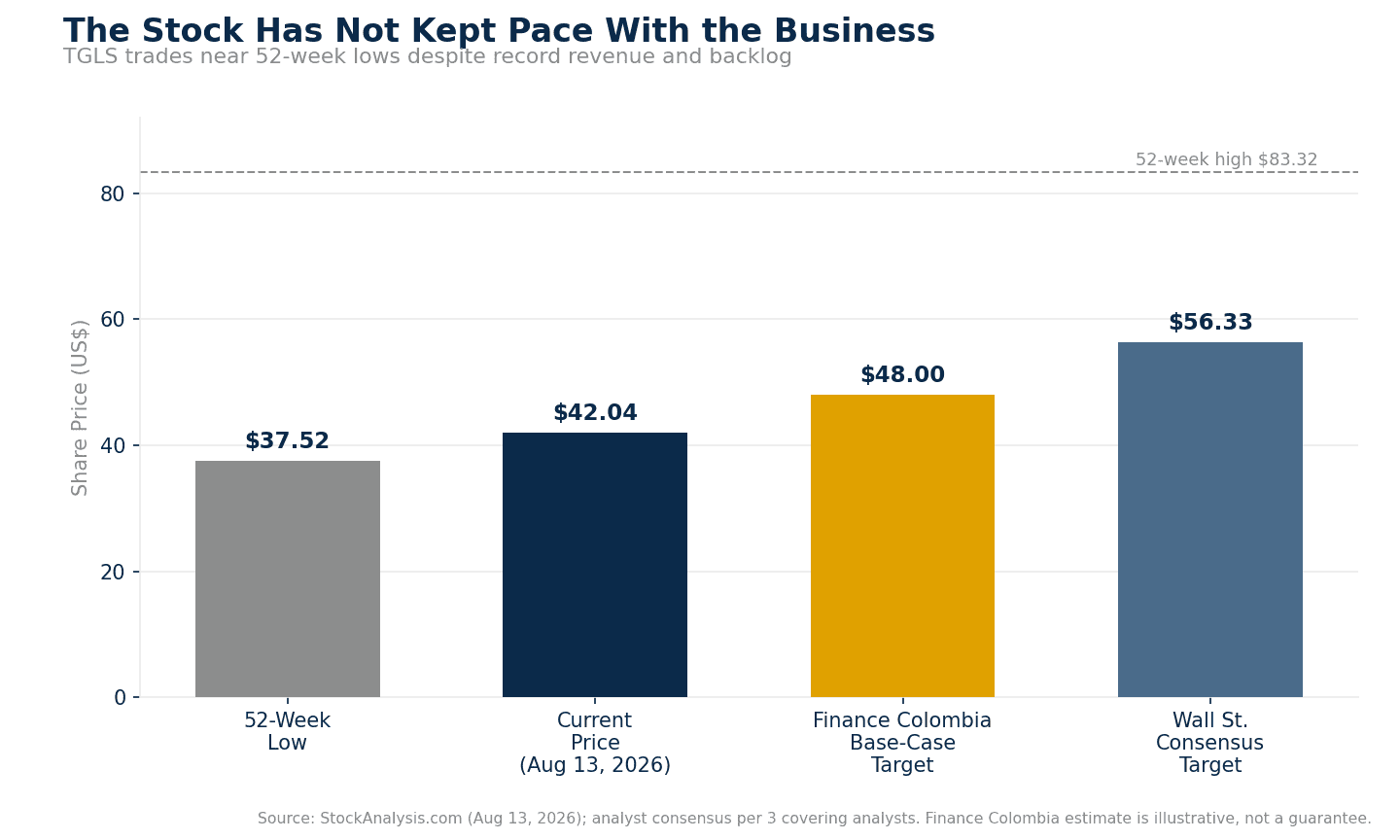
Tecnoglass Holdings Inc. (NYSE: TGLS), the Barranquilla, Colombia-based manufacturer of architectural glass and aluminum windows, reported record second-quarter revenue of $295.3 million USD on August 6, up 15.6% from $255.5 million USD a year earlier, even as new US tariffs on imported aluminum cut deeply into profitability. Shares, trading near $42 USD as of August 13, sit closer to their 52-week low of $37.52 USD than their 52-week high of $83.32 USD — a gap that looks increasingly out of step with the underlying business.
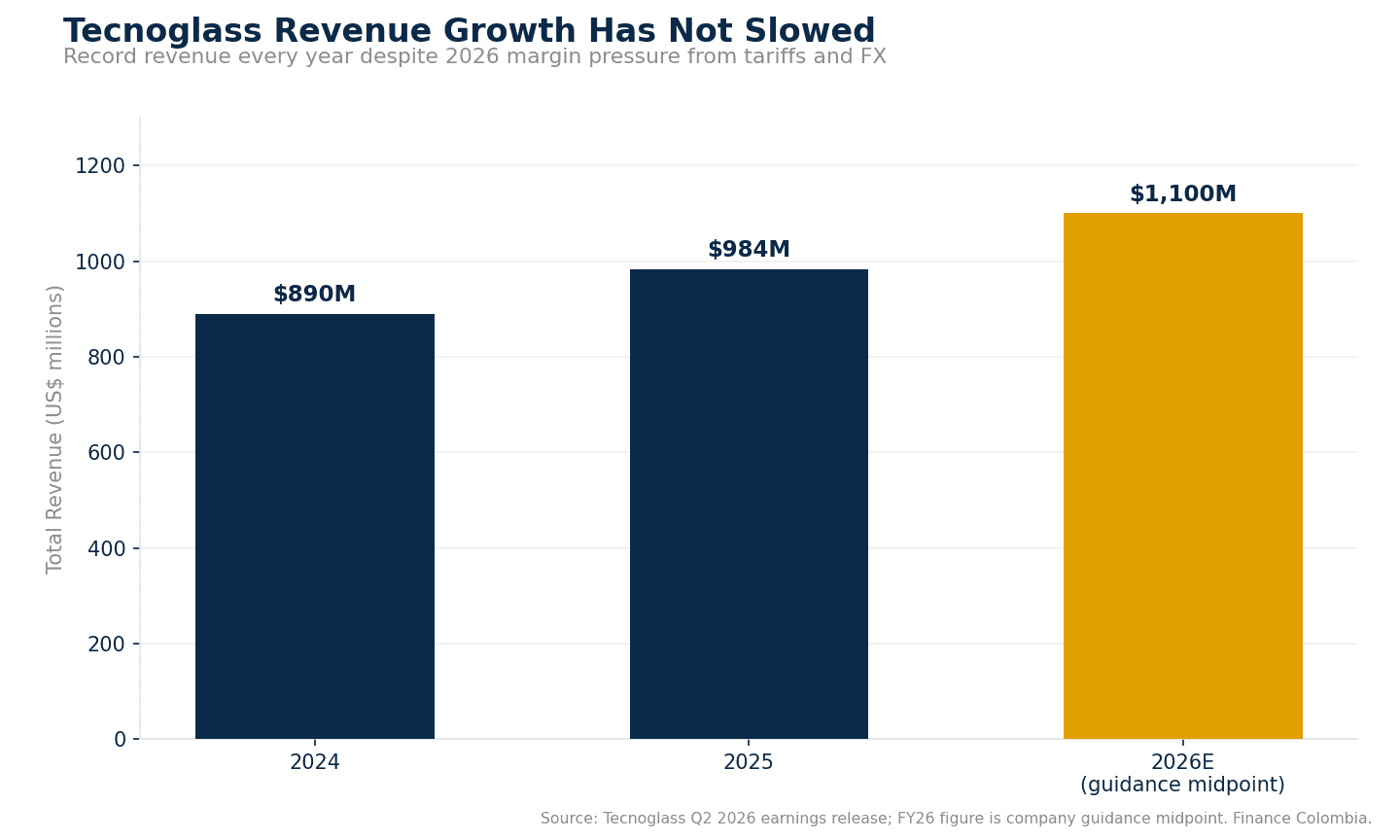
Tecnoglass has posted record revenue every year since 2024, including into 2026 guidance
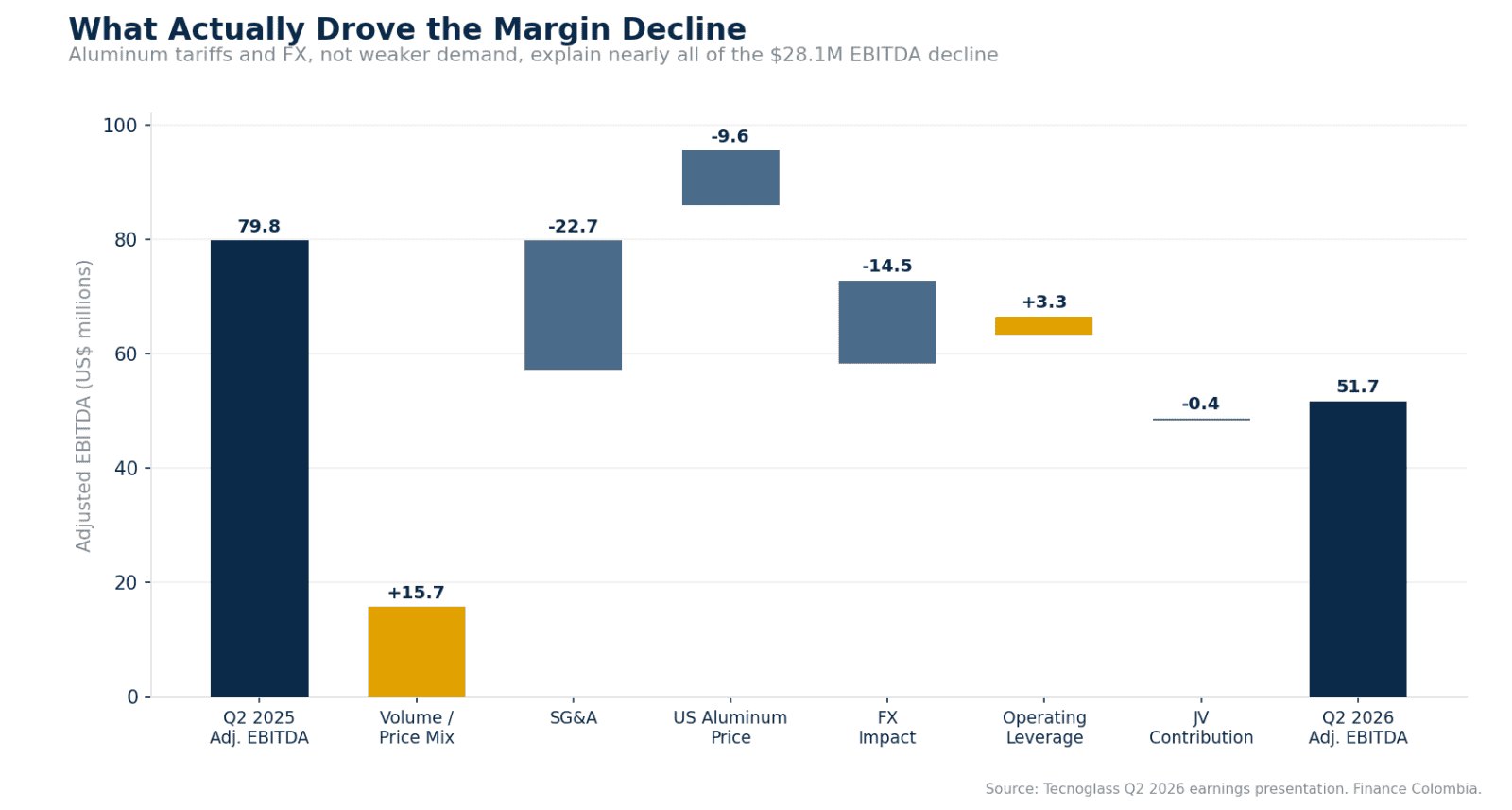
Quarterly net income fell to $24.6 million USD, or $0.55 USD per diluted share, from $44.1 million USD, or $0.94 USD per diluted share, a year earlier. Adjusted EBITDA dropped to $51.7 million USD, or 17.5% of revenue, from $79.8 million USD, or 31.2% of revenue, in the second quarter of 2025, and gross margin compressed to 37.3% from 44.7%.
Chief Executive Officer José Manuel Daes attributed nearly all of the decline to external cost pressures rather than softening demand. “Margins developed largely as we outlined last quarter, reflecting elevated aluminum costs, a stronger Colombian Peso and the initial impact of the April enactment of Section 232 tariffs on certain aluminum-based products,” Daes said in the company’s August 6 earnings release. Management said pricing actions taken since May and accelerated automation should begin offsetting costs in the second half of 2026, with tariff impact fully offset by 2027.
The company’s own reconciliation of the year-over-year Adjusted EBITDA decline shows where the pressure came from: higher US aluminum prices cut $9.6 million USD, the stronger Colombian peso cut $14.5 million USD, and general and administrative cost growth tied largely to the new tariffs cut $22.7 million USD. Those three items alone total more than the entire EBITDA decline, while higher sales volume and pricing added back $15.7 million USD.
Tariffs, currency and cost inflation, not weaker demand, explain nearly all of the EBITDA decline
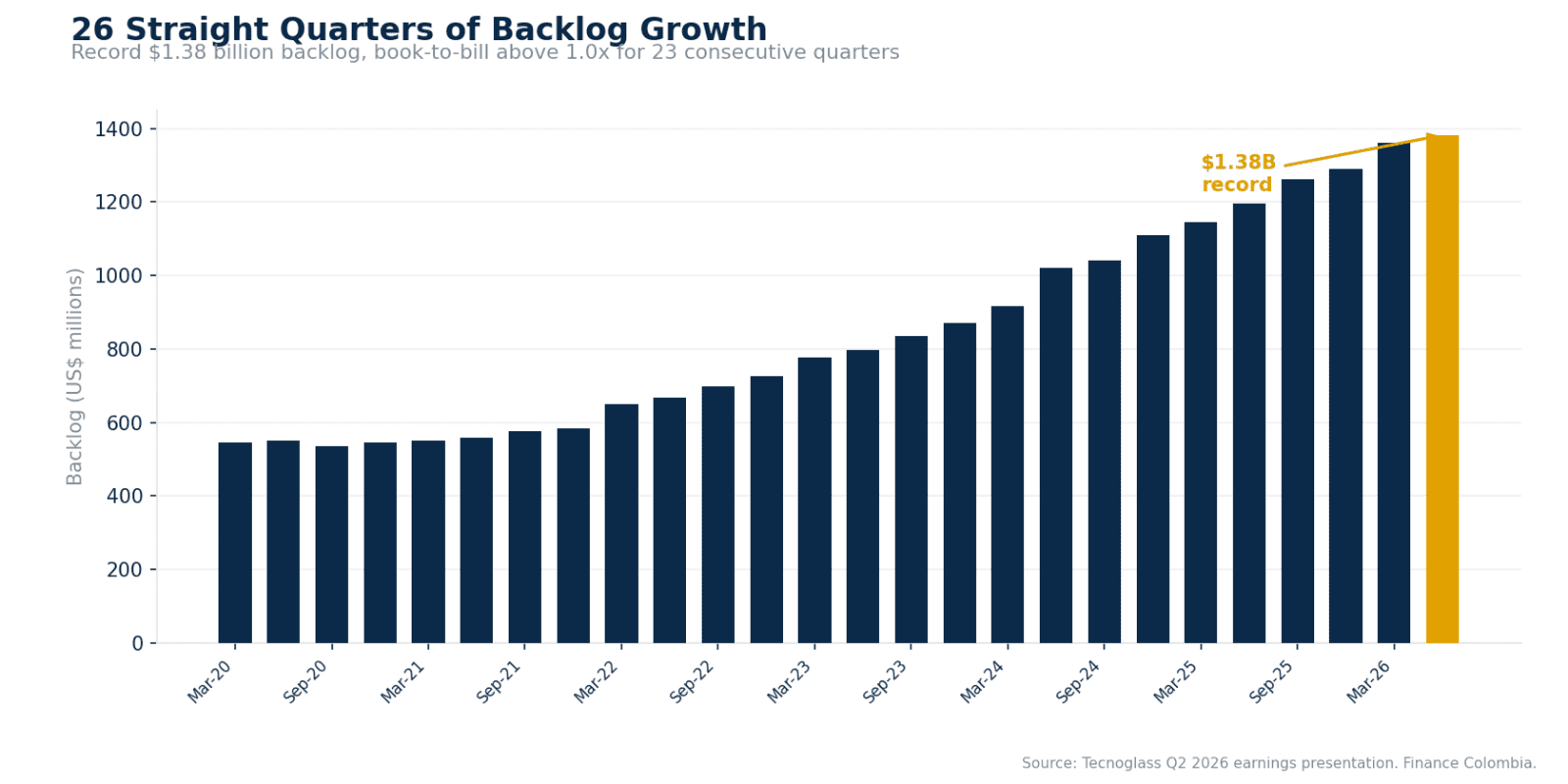
Backlog — orders not yet recognized as revenue — grew 15.6% year-over-year to a record $1.38 billion USD, extending a streak of consecutive quarterly gains that Chief Operating Officer Christian Daes said dates to 2021. “Our backlog grew to another record of $1.38 billion, extending our track record of sequential quarter growth since 2021 and reflecting consistent execution on a growing pipeline of multi-family and commercial projects,” Christian Daes said.
Backlog has grown for 26 consecutive quarters, reaching a record $1.38 billion
Chief Financial Officer Santiago Giraldo (above photo) narrowed full-year 2026 guidance to revenue of $1.08 billion USD to $1.12 billion USD and Adjusted EBITDA of $220 million USD to $230 million USD. “The revision primarily reflects sustained high aluminum costs and a Colombian peso that has strengthened beyond our prior assumptions, not a change in the demand for our products,” Giraldo said, adding that the company is “committed to fully offsetting the impact of tariffs in 2027.”
That distinction — a company executing well against an external cost shock, rather than one with a demand problem — sits at the center of the bull case. Tecnoglass discloses a three-year average return on invested capital of 34%, versus roughly 10% for the building-products peer group it tracks against in its own investor materials, a group that includes Apogee Enterprises Inc. (NASDAQ: APOG), Armstrong World Industries Inc. (NYSE: AWI) and Fortune Brands Innovations Inc. (NYSE: FBIN).
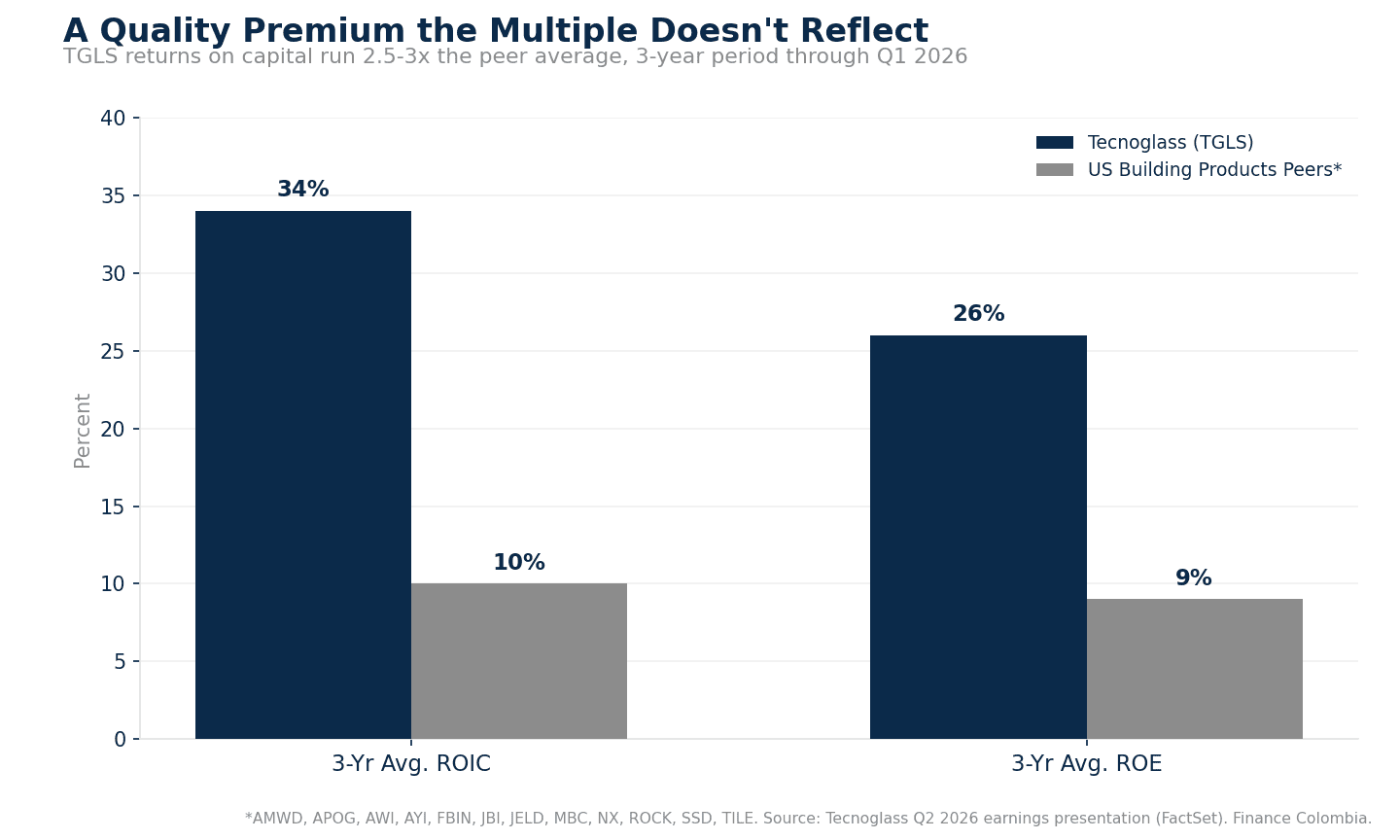
Tecnoglass’s returns on capital run roughly three times the peer average
At roughly 8.6 times enterprise value to trailing Adjusted EBITDA — near the low end of its 52-week range for that multiple, according to StockAnalysis.com — Tecnoglass trades well below the mid-teens multiple the stock has commanded in stronger periods over the past two years. Three analysts covering the stock hold an average price target of $56.33 USD, according to the same source — roughly 34% above the stock’s August 13 level.
The stock trades well below both its 52-week high and Wall Street’s own consensus target
Colombia’s own political calendar adds a variable outside Tecnoglass’s control. Abelardo de la Espriella won a narrow June 21 runoff for the Colombian presidency — by less than one percentage point over Iván Cepeda, according to election results — and was inaugurated August 7 in Cali. He campaigned on a smaller state, lower taxes and closer security and economic cooperation with the United States. Law firm Herbert Smith Freehills Kramer and the Atlantic Council have described the shift as a potential catalyst for renewed foreign investment, though both note Colombia’s fiscal deficit, estimated at 7% to 8% of GDP, a divided Congress, and outgoing president Gustavo Petro’s public dispute of the election’s legitimacy leave significant execution risk around the transition itself. For a manufacturer with 5.8 million square feet of production capacity concentrated in Barranquilla, a more stable currency and investment climate in Colombia would work in the opposite direction of the peso appreciation that hurt second-quarter margins — though that relationship is not mechanical, and the president’s narrow mandate is no guarantee of smooth execution.
“The revision primarily reflects sustained high aluminum costs and a Colombian peso that has strengthened beyond our prior assumptions, not a change in the demand for our products.” — Santiago Giraldo, chief financial officer, Tecnoglass
None of this guarantees a rebound. Tecnoglass’s own guidance assumes aluminum costs and the peso remain elevated through the balance of 2026, and the company does not expect to fully offset tariff costs until 2027. Selling, general and administrative expense rose to 24.9% of revenue from 20.8% a year earlier, largely on about $17.0 million USD in costs tied to the Section 232 tariffs on finished aluminum window imports — a cost base that could grow if tariff policy shifts again. The company also cut headcount by 10% as of the end of June as part of its automation push, evidence the cost pressure was significant enough to require structural changes, not just pricing actions.
Tecnoglass ended the quarter with $360.0 million USD in total liquidity, including $80.8 million USD in cash, against $225.4 million USD in total debt, a net-debt-to-EBITDA ratio the company puts at approximately 0.6 times. It paid $6.7 million USD in dividends during the quarter and had roughly $92.5 million USD remaining on its share buyback authorization as of August 6. On July 7, the company completed a previously announced move of its corporate domicile from the Cayman Islands to Florida, a step management said should broaden the pool of index funds and US-only investors able to hold the stock.
For investors willing to look through a quarter defined by input costs rather than demand, the combination of a record backlog, capital returns and returns on capital well above peers, and a valuation multiple already below its own historical average makes Tecnoglass one of the more interesting names in US building products heading into the back half of 2026 — with Colombia’s political transition as a wild card that could work in the company’s favor if it delivers the currency and investment stability its early backers expect.
SFC gives finance industry two business days to comment on quake relief plan
Colombia’s Superintendencia Financiera de Colombia (Financial Superintendency of Colombia, or SFC) has published for public comment a draft external circular that would give banks, insurers and other supervised financial institutions temporary instructions to assist consumers affected by the magnitude 7.4 earthquake that struck the country on August 10, 2026. The comment period, open since August 12, closes at 11:59 p.m. on August 14, 2026, giving industry and the public a two-business-day window to respond, according to the draft text and the SFC’s own consultation record.
The earthquake, with an epicenter in the municipality of San José del Palmar in Chocó department and a depth of 96 kilometers, triggered 991 additional seismic events within a 900-kilometer radius, according to figures cited in the SFC’s draft circular, including 115 in the magnitude 5.0-to-5.9 range, 18 between magnitude 6.0 and 6.9, and three exceeding magnitude 7.0. The national government declared a state of national disaster the following day, August 11, through Decree 1171, covering Antioquia, Caldas, Cauca, Chocó, Quindío, Cundinamarca, Risaralda, Huila, Valle del Cauca, Tolima, Putumayo, Norte de Santander and other affected territories for an initial 12 months, renewable for an equal term, as Finance Colombia reported at the time.
Death toll still climbing
As of the evening of August 12, Colombian President Abelardo De La Espriella cited a balance from the Unidad Nacional para la Gestión del Riesgo de Desastres (National Unit for Disaster Risk Management, or UNGRD) showing a toll that had continued to climb since the quake struck two days earlier.
“We have 25,872 affected families, 53,816 people, sadly 265 dead, 3,494 injured, and the number of missing has risen alarmingly to 496.”— Colombian President Abelardo De La Espriella, citing the UNGRD balance, August 12, 2026
The same balance reported 11,347 homes destroyed and 53,526 damaged, 140 buildings collapsed, and 1,819 schools and 631 community centers affected. Earlier counts from the same day had put the toll lower, underscoring that the figures remained provisional; international search-and-rescue teams, coordinated by UNGRD, were still arriving as of August 13 to assist Colombian personnel, and officials have cautioned the toll is likely to keep rising.
Colombia’s disaster management law, Ley 1523 de 2012, activates a special legal regime once a national disaster is declared, including articles 86 and 87, which allow affected debtors to seek refinancing of existing obligations. The SFC’s draft circular says it is exercising its instruction authority under the Estatuto Orgánico del Sistema Financiero (Organic Statute of the Financial System) and Decree 2555 of 2010 to translate that legal framework into binding instructions for the institutions it supervises.
Refinancing terms for affected borrowers
Under the draft measures, lending institutions would be required to adopt refinancing programs for borrowers affected by the disaster, subject to conditions drawn directly from the 2012 law: refinancing would apply only to obligations contracted before August 10, 2026, with payments due on or after that date; the new loan term could not exceed double the remaining term or 20 years, whichever is shorter; refinanced terms could not be more burdensome than the original ones; and borrowers would have to apply while the disaster declaration remains in force. No interest or late fees would accrue between the disaster declaration and the completion of the renegotiation, a period the draft caps at 90 days. Lenders could also offer additional voluntary relief, such as grace periods or special interest rates, provided the terms are no more burdensome for the consumer and the measures are not applied as a blanket restructuring practice rather than case-by-case review.
Credits refinanced under the program would keep the risk rating they carried before the disaster was declared, with credit-bureau reporting frozen for up to 12 months after the refinancing is completed, and the draft specifies the refinancing would not count as a modification or restructuring for prudential reporting purposes. Lenders would also be permitted to use alternative data sources to assess a borrower’s future repayment capacity, accounting for the likely economic recovery of the borrower’s sector.
Insurers, fund managers and severance withdrawals
Insurance companies would be required to establish expedited claims and payment channels for policyholders in affected areas, prioritize payment of healthcare providers’ invoices tied to the disaster, and adopt policies to facilitate premium payments, including for policies unrelated to credit operations. Trust companies and brokerage firms would be asked to evaluate mechanisms to speed redemptions from open-end investment funds without a minimum holding period, and to consider waiving early-redemption penalties for funds that carry one, for consumers affected by the disaster. Severance-fund administrators would be instructed to expedite housing-related severance withdrawals for affected members, within the bounds of Colombia’s existing severance-withdrawal rules.
The draft also directs supervised entities more broadly to maintain continuity of financial services where security conditions allow, disclose any changes to branch hours or closures, strengthen digital channels, and activate business-continuity plans in affected zones; to clearly publicize the terms of any relief programs; and to set up priority service channels for complaints and claims tied to the disaster. The SFC said it would establish its own priority contact channel to help affected consumers navigate complaints against supervised entities.
In its internal cost-benefit review, the SFC’s research and analysis unit found no reason to delay the proposal, concluding that reduced default risk, faster insurance payouts and improved liquidity access for affected consumers would outweigh the compliance costs institutions face in adapting systems, training staff and expanding service channels. The regulator said the draft requires no new budget appropriations and can be implemented with existing staff and technology. It also said a competition-impact questionnaire it completed under Colombia’s competition-advocacy rules returned entirely negative responses, meaning no referral to the Superintendencia de Industria y Comercio (Superintendency of Industry and Commerce) was required.
A two-day window, and a toll still being counted
The SFC set the unusually short two-business-day comment window under an exception in Colombian regulatory procedure that allows shortened public consultation periods when a rule responds to urgent, unforeseeable circumstances. The regulator said the scale of the disaster and the need for a prompt, uniform response from the financial sector justified the shortened timeline. Comments can be submitted using a standard form referencing filing number 2026182440, by email to [email protected] or in writing to the SFC’s deputy director of regulation. If adopted, the circular would take effect upon publication and would remain in force for as long as the national disaster declaration stands, though any relief already granted to consumers would continue on its own terms after the circular expires.
Colombia has also drawn $1.3 billion USD in international pledges since the earthquake struck. The comment window closes before search-and-rescue operations are expected to conclude, and the casualty figures the SFC cites as justification for the rule are themselves preliminary and likely to keep changing.
Above photo – Damage in Pereira, Colombia (Photo: Vance Campbell)
 Empleobilingue.com

- Director/a de operaciones para hotel, restaurante y discoteca 1626320364.60 - Medellín, Medellin, Antioquia, Colombia
- Coordinador/a de calidad para La Unión 1626483143.1 - La Unión, Antioquia, Colombia
- Desarrollador fullstack - Bogotá, Bogota, Colombia
- Technical Analyst - Remote
- PIM Administrator - Ecommerce - Remote (Bogotá, Bogota, Colombia)
- Auxiliar de gestión humana y bienestar para Girardota 1626060072.28 - Girardota, Antioquia, Colombia
- Marketing Strategist
- Trainer Manager - Bogotá, Bogota, Colombia
- Tolemaida UH- 60 Inspector - Bogotá, Bogota, Colombia
- Virtual Assistant - Team Lead - Remote
Contact Us

