Previous Story

Finance Ministry Moves to Reshape Ecopetrol’s Board at September 15 Shareholder Meeting
Posted On September 4, 2026
Comment: Off
Tag: abelardo de la espriella, ANH, Article 20 bylaws, Asocodis, Betzy Patricia Martínez Zapatero, bogotá, BVC: ECOPETROL, Carlos Augusto Suarez Rojas, César Loza, Claudia Margarita Lafaurie Taboada, colombia, Corporate Governance, CREG, Diana Marcela Acero Rojas, ecopetrol, Ecopetrol board of directors, Ecopetrol extraordinary shareholders meeting, energy transition, Ernesto Alfonso Gómez Cabarcas, grupo argos, Grupo Éxito, Henryk Manuel Porras Villamil, hocol, isa, Jorge Alberto Jaller Jaramillo, jorge mario velasquez, José Camilo Manzur Jattin, Juan Carlos Hurtado Parra, Ludmila del Carmen Vergara Rosales, luis felipe henao cardona, miguel gomez martinez, Ministerio de Hacienda, Ministry of Finance and Public Credit, NYSE: EC, Oil and Gas, proxy voting, Ricardo Roa, Ricardo Rodríguez Yee, Sergio Andrés Moreno Acevedo, shareholder meeting, state-owned enterprises, superintendencia de transporte, superintendencia financiera, uso
Bylaw rewrite would clear the way for a mostly new nine-member board
Ecopetrol S.A. (BVC: ECOPETROL; NYSE: EC) will hold an extraordinary shareholders’ meeting on September 15, 2026, at which the Colombian government, acting through the Ministerio de Hacienda y Crédito Público (Ministry of Finance and Public Credit) as holder of 88.49% of the company’s shares, intends to elect a new nine-member board of directors and amend the bylaw that has limited how many sitting directors can be replaced in a single vote.
Ecopetrol reported on August 28 that all corporate procedures required to formalize the Nation’s slate of candidates have been completed and that the slate will be put to shareholders at the meeting. The government’s request arrived in a letter dated August 26 from Finance Minister Miguel Gómez Martínez to Juan Carlos Hurtado Parra as Ecopetrol’s acting president, answering communications the company sent on August 4, 10 and 14 reporting director resignations and asking that an assembly be convened to fill the vacancies.
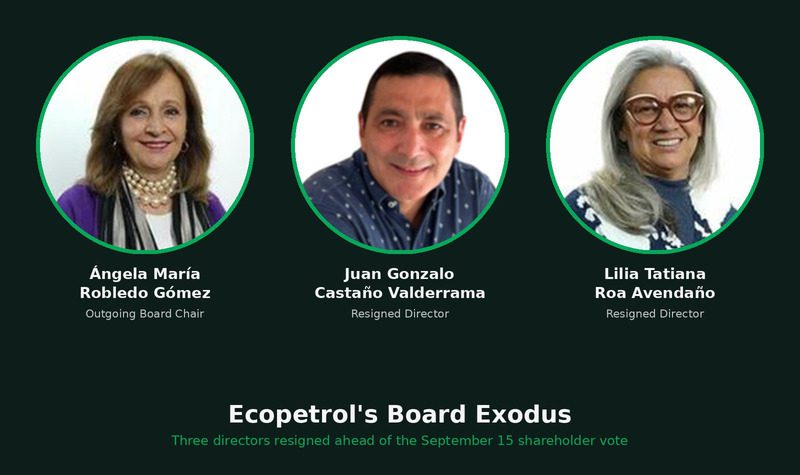
Three of the board’s nine seats have been empty since July 31. According to the ministry’s letter, Juan Gonzalo Castaño Valderrama resigned as a non-independent director on May 12, 2026, and Ángela María Robledo Gómez, who chaired the board, and Lilia Tatiana Roa Avendaño resigned effective July 31. The letter also notes that Ricardo Roa Barragán remained at the head of the company through July 30 and that Hurtado Parra has held the acting presidency since July 31, one week before President Abelardo de la Espriella was inaugurated on August 7. Hurtado Parra, the company’s executive vice president of hydrocarbons, had already been running Ecopetrol on an interim basis since April 7, the day after the board approved Roa’s request for vacation followed by unpaid leave, according to Portafolio. Roa’s exit followed months of controversy, including the leak in March of an internal report pointing to a possible $42 million USD payment to a company in the British Virgin Islands.
The first substantive item on the agenda is a reform of Article 20 of Ecopetrol’s bylaws. The current text requires that any slate presented to the assembly include at least three sitting directors, not counting the candidates for seats eight and nine. The ministry proposes replacing that requirement with language under which the slate “will seek to” retain at least three current members, without making it a condition of the slate’s validity or a bar to a full renewal of the board. A second change to the same article would allow the Nation to renominate the employee representative already elected for the current period without repeating the employee vote.
The ministry argues that the existing rule makes the composition and validity of a slate depend on whether a set number of directors agree to be renominated, so that a decision belonging to shareholders is conditioned on the individual will of the administrators themselves, which it describes as an unjustified risk of blocking the electoral process. “The continuity of current members would remain a relevant corporate governance criterion, but not an absolute condition that could prevent the recomposition of the body when the company’s circumstances, the vacancies that have arisen or the profiles required call for its renewal,” Gómez Martínez wrote.
Shareholders will then elect all nine directors by the electoral quotient system for the remainder of the 2025–2029 institutional period. Six of the nine names on the Nation’s slate are new to the board: Carlos Augusto Suárez Rojas, Jorge Alberto Jaller Jaramillo, José Camilo Manzur Jattin, Ludmila del Carmen Vergara Rosales, Betzy Patricia Martínez Zapatero and Claudia Margarita Lafaurie Taboada.
According to the candidate profiles Ecopetrol published, Suárez Rojas is a lawyer who founded and heads Estrategia & Poder and previously served as secretary general and operations director of the Contraloría General de Cundinamarca (Cundinamarca comptroller’s office); El Tiempo describes him as the president’s political communications strategist. Jaller Jaramillo was vice president of retail and vice president of Éxito and Carulla at Almacenes Éxito S.A., which trades as Grupo Éxito (BVC: EXITO). Manzur Jattin has been president of the Asociación Colombiana de Distribuidores de Energía Eléctrica (Colombian Association of Electric Power Distributors, Asocodis) since 2006 and previously served as an expert commissioner of the Comisión de Regulación de Energía y Gas (Energy and Gas Regulatory Commission, CREG). Vergara Rosales was named head of the Superintendencia de Transporte (Superintendency of Transportation), the agency announced on August 14. Martínez Zapatero is a lawyer who has held several public-sector advisory posts and currently manages the Fundación Sé Valiente. Lafaurie Taboada is a former head legal adviser and vice president of hydrocarbon contracts at the Agencia Nacional de Hidrocarburos (National Hydrocarbons Agency, ANH) and is now legal vice president of CNE Oil & Gas. El Tiempo also reported that Jorge Mario Velásquez, the former president of Grupo Argos (BVC: GRUPOARGOS) whom de la Espriella had named in July as a prospective director, was left off the slate.
The remaining three seats are filled under procedures set out in Article 20 rather than chosen directly by the ministry. Seat seven belongs to a representative elected by Ecopetrol’s employees; the company reports that César Eduardo Loza Arenas, a former president of the Unión Sindical Obrera (Workers’ Trade Union, USO), was previously elected under that procedure and has been nominated again. For seat eight, the governors of the hydrocarbon-producing departments where Ecopetrol operates reaffirmed Ricardo Rodríguez Yee in a communication received August 26. For seat nine, the minority shareholders with the largest holdings reaffirmed Luis Felipe Henao Cardona, the board’s current chairman and a former housing minister, in a communication received August 21.
The agenda also asks shareholders to instruct the board, including the one elected at the meeting, to bring the company’s director succession policy into line with the amended Article 20 and provides that any internal rule still requiring a minimum number of continuing directors will not apply to this election. Ecopetrol stated that its board and Corporate Governance and Sustainability Committee completed the verification of all candidates, so no dispensation from the succession policy’s review procedures will be needed.
The board reshuffle is unfolding alongside a turnover in senior management. At its August 31 meeting, Ecopetrol’s board accepted the departure of Sergio Andrés Moreno Acevedo as corporate vice president of science, technology and innovation and named Diana Marcela Acero Rojas, who manages that portfolio, to the post on an acting basis from September 1. The same meeting formalized the appointment of Henryk Manuel Porras Villamil, until then a project leader in the energy transition projects department, as acting executive vice president of energy transition from August 31, succeeding Ernesto Alfonso Gómez Cabarcas, who had held the job on an interim basis through August 30 and will take statutory leave before pursuing other opportunities. The company said permanent appointments will be disclosed when made.
Four days earlier, at its August 27 meeting, the board had approved five other interim replacements covering the vice presidencies of territorial transformation and health, safety and environment; administration and services; strategy and new business; and refining and industrial processes, as well as the corporate directorate of institutional relations and communications, with outgoing executives leaving August 30 and internal replacements taking over the next day. La República also reported management changes at the Ecopetrol subsidiary Hocol, where general manager Luis Eduardo Parra left on August 25.
Ahead of the vote, Ecopetrol published the measures it will apply to shareholder representation, as required by the Circular Básica Jurídica (Basic Legal Circular) of the Superintendencia Financiera de Colombia (Financial Superintendency of Colombia). Proxies that do not meet the legal minimums or that fail to name the representative will be rejected, and none may be granted to Ecopetrol employees or to anyone tied to its management. Managers and employees are barred from suggesting proxy names, recommending a vote for any slate, or coordinating with shareholders on proposals or votes; the Corporate Legal Vice Presidency and the General Secretariat will review the powers of attorney.
The meeting is scheduled for 11 a.m. at Ecopetrol’s main building at Carrera 13 No. 36-24 in Bogotá, in person and streamed live on the company’s website, according to the convocation notice the company published on August 28. Registration of shareholders and proxies opens at 9 a.m. Meeting documents, candidate profiles and acceptance letters are posted on the company’s investor site.
Ecopetrol says it accounts for more than 60% of Colombia’s hydrocarbon production and holds 51.4% of the power transmission company ISA (BVC: ISA). Finance Colombia reported in May that the company’s first-quarter results were weighed down by lower crude prices and reduced output even as refining margins recovered.
Headline image: The six new nominees on the Nation’s slate for the Ecopetrol board, to be voted on September 15. (Photos courtesy Ecopetrol; composite: Finance Colombia)