Previous Story
Colombia’s Inspector General Opens Inquest Into Four Stalled Rural Airport Projects
Posted On July 7, 2026
Comment: Off
Tag: aerocivil, Aeropuertos para los Servicios Aéreos Esenciales, Andrés Arboleda, ASAES, bahia solano, caracol radio, chocó, colombia, contraloria general de la republica, convenios interadministrativos, cost overruns, Cumaribo, Ejército Nacional, Enterritorio, Gustavo Petro, La Primavera, Magüí Payán, Nariño, procuraduria general de la nacion, public procurement, rural connectivity, Samuel Benjamín Arrieta Buelvas, vichada
More than $214 billion COP disbursed, yet no terminal tops 19% built.
Colombia’s Procuraduría General de la Nación (Inspector General’s Office) has opened a formal preventive inquiry into a troubled government program to build four airports serving some of the country’s most isolated regions, after the Investigative Unit of Caracol Radio (Unidad Investigativa de Caracol Radio) documented that the projects had spent more than 60% of their budget while completing less than 20% of the physical work. The order, made public on June 17, 2026, directs the Aeronáutica Civil (Aerocivil) to account for the program’s schedules, spending and contracting.
The Procuraduría Delegada Segunda para la Vigilancia Preventiva de la Función Pública (Second Delegate Office for Preventive Oversight of Public Function) ordered monitoring of the airport projects prioritized by Aerocivil. In an official letter to the project’s general manager, delegate inspector Samuel Benjamín Arrieta Buelvas cited “possible delays in the execution of the works, differences between the financial execution and the physical progress of the projects, difficulties related to the supply of materials and inputs, observations on the contractual and logistical management of the project, as well as other risks that could affect the completion of the planned works.” The office gave the entity twelve points to answer, among them a detailed accounting of the funds received, committed, disbursed and executed for each airport; the contracts and supply, transport and oversight orders signed; and an explanation of the gap between the money spent and the physical progress recorded.
“It has happened before that I lay the first stone and they never lay another.” — President Gustavo Petro, at the August 2025 launch of the Bahía Solano airport works.
The inquiry follows the investigation by the Investigative Unit of Caracol Radio, also reported by El País and El Colombiano. The terminals were due to be finished in May 2025; none will be ready before President Gustavo Petro’s term ends on August 7, 2026.
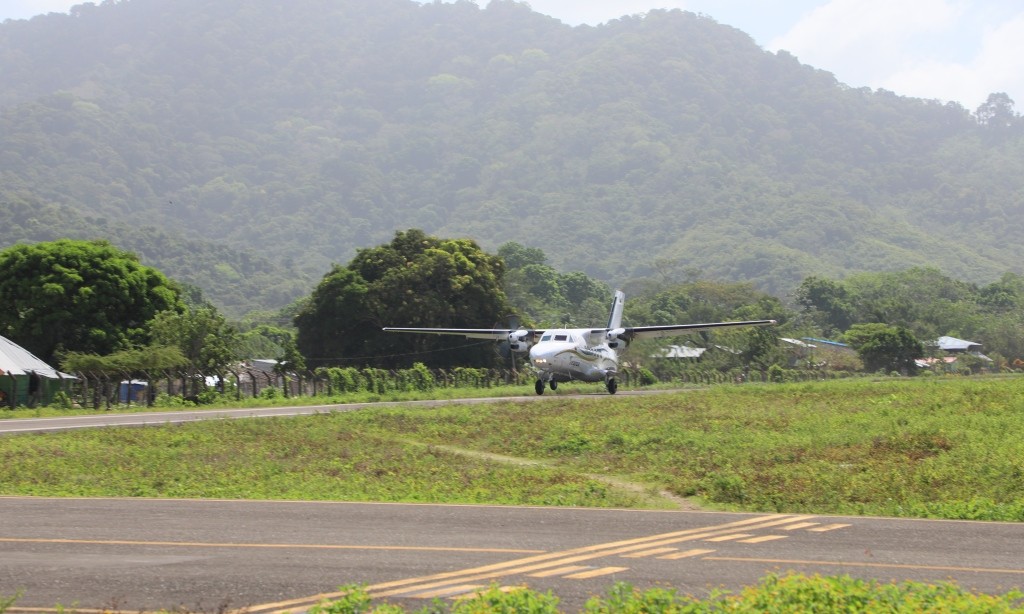
The project is part of the program Aeropuertos para los Servicios Aéreos Esenciales (ASAES), created to keep air operations safe and efficient in hard-to-reach areas. The four terminals are in Bahía Solano, in Chocó; Magüí Payán, in Nariño; and Cumaribo and La Primavera, in Vichada — regions where roads are scarce or nonexistent and air travel is often the only permanent link to the rest of the country. Roughly 122,000 people depend on these airports for access to basic services, commerce and mobility.
The numbers at the center of the controversy come from the project’s own contract and oversight documents. The initiative carries an investment of $363.763 billion COP — more than $100 million USD — including a management fee of nearly $23.8 billion COP (about $6.5 million USD) for the state-owned Empresa Nacional Promotora del Desarrollo Territorial (Enterritorio). Aerocivil had disbursed around $214 billion COP, equal to 60% of the budget. Physical progress lagged far behind: Cumaribo was the most advanced at 18.4%, followed by La Primavera at 15.3% and Bahía Solano at just 5.5%, while in Magüí Payán work had not begun at all.
Three state entities share responsibility under an unusual arrangement. Aerocivil is the contracting party and supervisor; Enterritorio — successor to the controversial Fonade — handles overall management, including procurement, supply of materials and oversight; and the Ejército Nacional (National Army) executes the works through its engineering units, a use of the armed forces that Petro has defended since his 2022 campaign as a way to keep civilian contractors from abandoning the sites. Enterritorio, in turn, hired private operators to supply the soldiers with materials, food, spare parts and lodging.
Petro himself has voiced doubt about the works. At the August 2025 event launching the modernization of the José Celestino Mutis airport in Bahía Solano — more than 18 months after the agreement was signed — the president said, “It has happened before that I lay the first stone and they never lay another.” In the months since, the roughly 122,000 residents who stand to benefit have watched the projects stall amid a series of irregularities.
Minutes of the project’s technical-operating committee show problems from the earliest stages: repeated delays in hiring suppliers, late delivery of materials, difficulties getting equipment running and poor coordination among the participating entities. At a meeting on November 22, 2025, the secretary of airport services, Andrés Arboleda, recorded Aerocivil’s concern with Enterritorio’s management — 55% of the resources had been executed while physical progress stood at just 3%. The Army also objected, sending at least 15 letters since late 2023 warning of delays in hiring specialized personnel and shortfalls in the supply and quality certification of materials; in Bahía Solano, it reported, the works still lack all the required environmental permits.
The reporting also raises pointed questions about costs. Citing the contract documents obtained by the Investigative Unit of Caracol Radio, the project paid an intermediation fee of 4.9% plus VAT on billed goods and services — a charge that was neither written into the contract nor approved by the technical-operating committee, yet has already exceeded $4.2 billion COP (about $1.15 million USD) paid to private contractors. Internal documents flagged striking discrepancies between market prices and the amounts billed: wooden stakes billed at $38,000 COP against a real value of $1,000 COP, pavement baskets billed at $900,000 COP versus a calculated $107,000 COP, and a pavement cutter with a market price of $7 million COP that the project sought to bill at $26 million COP. In Bahía Solano alone, Aerocivil acknowledged total possible overruns of about $22 billion COP (around $6 million USD).
Aerocivil rejected budget-increase requests that would have raised the project’s value by roughly $57 billion COP — about 15% of the total. But it paid a price: the number of aerodromes to be upgraded was cut from six to four, dropping Bajo Baudó, in Chocó, and Barrancominas, in Guainía. El Colombiano named several of the private operators involved — DU Brands, Ferretería El Hidrante S.A., the consortia Aeropistas CPG and IRC, and Organización Tiempos de Paz, the last of which it reported is accused of subcontracting and failing to pay local suppliers.
Enterritorio denies any irregularity and attributes much of the delay to external factors. Its acting president, Esmeralda Molina, told the Investigative Unit of Caracol Radio that the complexity of the institutional structure, logistical difficulties, weather conditions and public-order problems had affected the schedule, and defended the experience of the private operators. The entity nonetheless declined to provide specific figures on the disbursements made and the level of compliance achieved by contractors, citing confidentiality and security.
State oversight bodies had already begun to circle before the latest order. The Procuraduría warned in May 2026 that Colombia’s air-transport system faces a “systemic risk” and asked that an investigation into Aerocivil be opened, as El País and Infobae reported. The Contraloría General de la República (Comptroller General’s Office) has separately flagged the ASAES program’s low execution — a weighted physical advance of just 2.31% as of December 2024 — and, in an unrelated audit of an Aerocivil water-treatment contract awarded without environmental permits, identified a presumed fiscal detriment of $5.67 billion COP, according to Portafolio and El Nuevo Siglo.
The episode has renewed scrutiny of convenios interadministrativos (inter-agency agreements) — widely used by public entities subject to state procurement rules to move resources to other state bodies that can then contract more freely, and more opaquely. The accumulated delays have produced four extensions of the agreement; the latest runs to August, though the entities involved already acknowledge that the new deadlines will be hard to meet. The works also drew earlier scrutiny: in November 2025, El País reported that Aerocivil had grounded most of Colombia’s passenger aircraft amid broader oversight failures.
For now, the next administration will inherit a project with the money largely spent but the infrastructure unbuilt — and the communities that were promised the terminals are still waiting. As El País put it, the promised terminals “remain more a project than a reality.”
This article is based on the original investigation by the Investigative Unit of Caracol Radio and the June 17, 2026 order of the Procuraduría General de la Nación, as reported by El País and El Colombiano.