Previous Story
Analysis: Colombia’s President-Elect Inherits a Fragmented Congress, a Suspended Fiscal Rule, and a Widening Conflict
Posted On July 20, 2026
Comment: Off
Tag: abelardo de la espriella, andi, August 7 inauguration, CARF, Clan del Golfo, Colombia 2026 election, Colombia security, ecopetrol, ecuador, eln, elsa noguera, Fabio Arjona Hincapié, FARC Dissidents, fenalco, fiscal rule, fragmented Congress, Gustavo Petro, israel, ivan cepeda, Jaime Andrés Beltrán, jorge mora, jose manuel restrepo, Mauricio Gómez Amin, Miguel Gómez, mining, pacto historico, peru, petroleum, presidential transition, rodrigo lara, salvación nacional, total peace, Viviane Morales
After a sub-1% win, governing will be harder than campaigning.
The honest answer to “what comes next” is that nobody knows. Abelardo de la Espriella is the rarest thing in Colombian politics: a genuine outsider, a man who has never held so much as a dogcatcher’s post, elected president by a margin so thin it barely registers. On June 21 he defeated Senator Iván Cepeda by less than one percentage point. Anyone who claims to know exactly how he will govern is selling something. But we can read the tea leaves he has left so far — the cabinet, the coalition math, and the mess he is inheriting — and they tell us a good deal.
Start with the result itself, because it is the key to everything that follows. In the May 31 first round de la Espriella took 43.7% of the vote — 10,361,473 ballots — finishing ahead of both Cepeda and Paloma Valencia, the establishment-right candidate backed by former president Álvaro Uribe. To me the message was unmistakable: Colombians rejected Gustavo Petro’s collectivist experiment, but they also rejected Uribe as the standard-bearer of the right. It was a vote of “we don’t like them, but we don’t much like you either.” The two old duopoly parties, the Liberals and Conservatives, have not put a president in the Casa de Nariño since the 1990s, and this election confirmed that the country is exhausted with its traditional institutions.
The runoff was closer than expected. Valencia’s votes drifted to de la Espriella, as anticipated, but Cepeda’s Pacto Histórico (Historic Pact) mobilized its base with real skill and nearly pulled even. That near-parity is now the defining fact of the incoming presidency.
A mandate for conciliation — whether he wants one or not
Here is de la Espriella’s central problem: he won with roughly half the vote and, as an outsider, he has almost no one in Congress. His movement, Salvación Nacional (National Salvation), holds just three Senate seats and one in the House of Representatives — effectively nothing in a body of 103 senators and 183 representatives, as Finance Colombia laid out in its analysis of the fragmented Congress. Cepeda, meanwhile, returns to the Senate as the runner-up and will lead an opposition bloc of roughly 30 unified legislators who intend to fight nearly everything the new government proposes.
So de la Espriella will govern by horse-trading. Expect the Conservatives, Cambio Radical — especially strong on the Caribbean coast, where he is based — the Party of La U, and much of Uribe’s Centro Democrático to drift into his camp. That is precisely why his most consequential early pick is his interior minister. In Colombia that job is the government’s legislative fixer, and de la Espriella has handed it to Rodrigo Lara, a former senator whose father was murdered by the Medellín cartel and who left politics years ago to build a career in cybersecurity. He knows how Congress works, and he is going to need every bit of that knowledge.
“He campaigned as a firebrand and delivered a conciliatory victory speech. Which is the real Abelardo? We simply do not know yet.” — Loren Moss, Finance Colombia
The cabinet: technocrats and costeños
The names announced so far tell two stories. The first is competence. The vice president-elect is José Manuel Restrepo, whom I interviewed a decade ago when he was rector of the Universidad del Rosario and could not stop talking about social inclusion. He served as commerce minister and then finance minister under Iván Duque, and while I regard the Duque presidency as largely a failure, Restrepo did a genuinely good job in both posts. The finance portfolio goes to Miguel Gómez, another respected Rosario figure and former ambassador to France who has led the state development bank Bancóldex, the insurance federation Fasecolda, and the flower-growers’ association Asocolflores. His remit is to restore fiscal balance, and it is a brutal assignment.
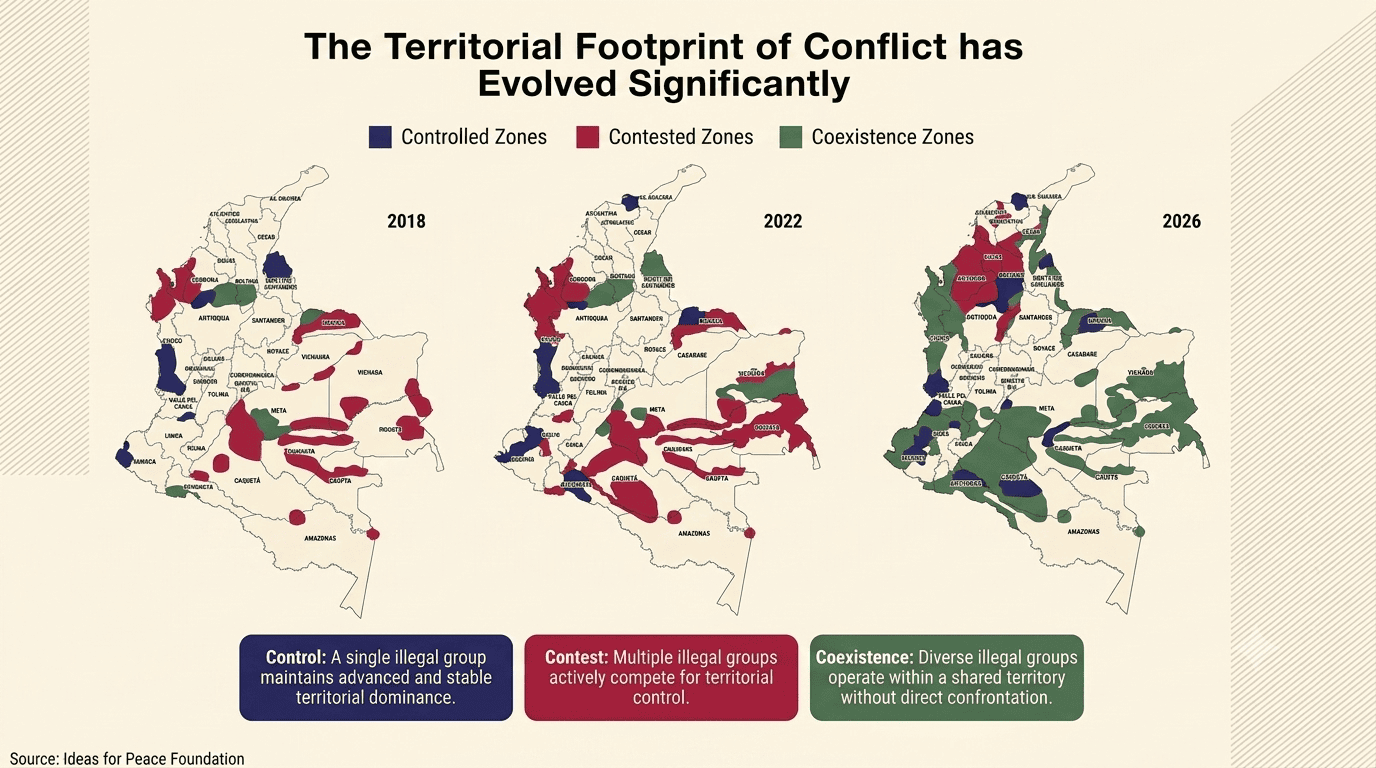
The territorial footprint of Colombia’s armed groups, 2018–2026: blue marks zones under a single group’s control, red marks zones where groups actively fight, and green marks zones where they coexist without direct confrontation. Source: Fundación Ideas para la Paz (Ideas for Peace Foundation).
The security portfolio went to a pointed choice: Gen. (r) Jorge Mora, a retired general whom Petro forcibly retired during a purge of the senior officer corps and who has since been a vocal critic of the outgoing government’s security policy. He is calling for a stronger military and police presence in the vast rural areas where the state has simply ceased to exist. Rounding out the bench are a striking number of costeños, people from the Caribbean coast: Elsa Noguera at Transportation (former mayor of Barranquilla, former governor of Atlántico, former housing minister), Mauricio Gómez Amin at Commerce, and, most controversially, Viviane Morales at Education. Morales is an evangelical conservative who has said the country should “take Marx out of the schools and put God back in,” and she is drawing more opposition than any other appointee. My guess is that reality — a hostile Congress and a powerful teachers’ union — will moderate whatever she has in mind, and that if she becomes a distraction she will not last. The reassuring pick is Fabio Arjona Hincapié at Environment: a marine biologist and former director of Conservation International in Colombia. He is a career environmentalist, not an extremist, and business need not fear him chaining himself to a drilling rig. Jaime Andrés Beltrán, the former mayor of Bucaramanga, takes Housing.
Foreign policy: a great reset
On the international front, de la Espriella’s team is signaling a return to career diplomacy rather than campaign loyalists in ambassadorial chairs. He has said he will restore relations with Israel, which Petro severed. He is warmer toward Washington — US President Donald Trump’s affection for him is no secret — and I expect the personalized, temperamental feuds Petro picked with Peru and Ecuador to cool. Those were real: Colombia and Ecuador escalated to 100% border tariffs, and Petro manufactured a dispute with Peru over an Amazon river island that had not been an issue in a century, later inflamed by a gunfire incident on the Putumayo River. One irony worth noting: both Petro and de la Espriella are, in addition to being Colombian, Italian citizens.
The business mood: relief bordering on celebration
Objectively, this is a win for the business sector. The mining and petroleum industries are already popping corks, because the outgoing government issued no new drilling permits and the sector had warned for years that Colombia was heading toward a natural-gas shortfall. De la Espriella has pledged to restart exploration and production onshore and offshore, and the reaction has been immediate — the petroleum guild ACP and the mining sector are visibly re-energizing ahead of the September mining expo. The merchants’ federation Fenalco and the industrialists of ANDI endorsed him outright. I did not see a single major trade group line up behind Cepeda. This matters because confidence had quietly drained away: a European manufacturer that announced a glass factory in Cundinamarca shelved it in 2023 for lack of confidence, and the pace of tech and services investment into Medellín slowed markedly over the past three years. I expect that to reverse — barring a US recession, which would shrink the pool of investment capital regardless of who governs Colombia.
The security inheritance
This is the inheritance that makes Mora’s harder line resonate. The map above is not subtle: the green and red have spread across far more of the country than when Petro’s Paz Total (Total Peace) policy began. As I argued in March, that policy delivered its opposite. Colombia logged 40,663 homicides in the first three years of the Petro presidency, more than 400 human rights defenders were killed between 2022 and 2025, and Human Rights Watch found that the ELN and FARC dissidents expanded their territory by as much as 55%, pushing Colombia back into the Global Terrorism Index top ten. Five years ago I would drive from Medellín to the coast without a second thought; today I would fly. Expect violence to rise before it falls: if you go to war with the mafias and the guerrillas, there will be a war.
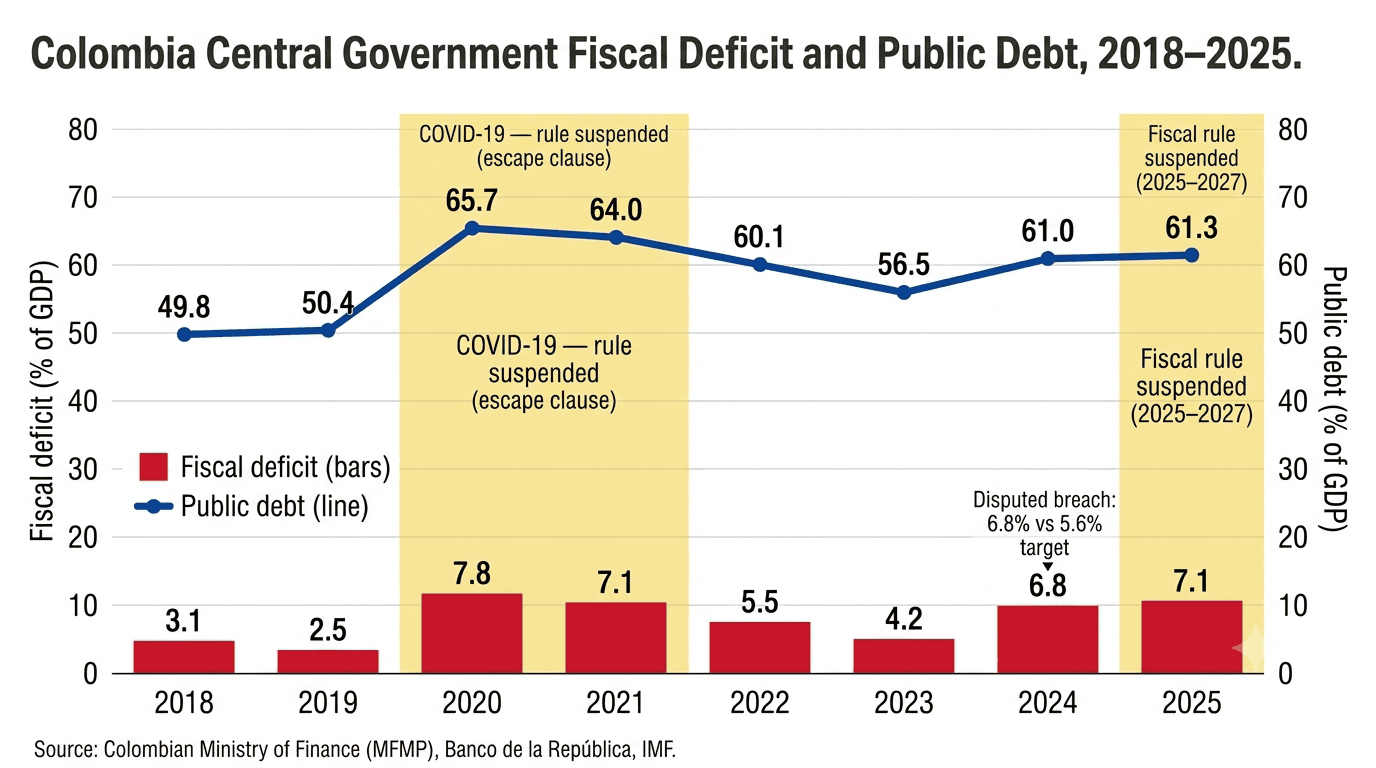
Colombia’s central-government fiscal deficit (bars) and public debt (line) as a share of GDP, 2018–2025. Sources: Colombian Ministry of Finance, Banco de la República, IMF.
The fiscal reckoning
The harder story is fiscal, and Gómez’s assignment is the least enviable in the cabinet. Colombia’s fiscal rule (Ley 1473 de 2011, reformed in 2021) is meant to anchor net debt toward 55% of GDP, with a hard ceiling of 71%, and it is monitored by the independent CARF (Comité Autónomo de la Regla Fiscal, the Autonomous Fiscal Rule Committee). In 2024 the government ran a deficit of 6.8% of GDP against a 5.6% target, which the CARF classifies as non-compliance. Then, in June 2025, facing a widening gap, the government invoked the rule’s escape clause to suspend it through 2027 — over the CARF’s formal objection — and raised the deficit target from 5.1% to 7.1% of GDP, with a stated return to the rule in 2028. That is the box the new finance minister must climb out of. The one cushion is a strong peso, which rallied 7.4% in June on the election result and makes dollar-denominated debt cheaper to service. But that will not last; when the peso weakens, those payments get more expensive, and the opposition will blame the people cleaning up the mess for the mess itself.
What I am watching
Three things give me pause. First, human rights are a blank page: as a defense lawyer de la Espriella represented some unsavory clients, yet he also pursued, pro bono, a landmark femicide case that changed Colombian law. We simply have no governing record to read. Second, he is thin-skinned and has a history of filing nuisance suits against journalists who anger him — the goal being to impose cost and induce self-censorship. Third, and most fundamentally, he is a blank slate. A candidate campaigns the way he must to win; how he governs may or may not follow. He ran an aggressive campaign and then gave a conciliatory speech on election night. Which is the real Abelardo? We will find out.
All my sources say the handover happens on August 7 as scheduled, despite Petro’s noise — he has questioned the result, the two camps suspended their technical transition meetings, and Cepeda has floated a citizenship challenge that the constitution does not support. I believe the transfer will be peaceful. Then again, we all thought January 6th would be routine, too. If it holds, de la Espriella has a narrow, real window to do what he promised on election night and govern for all Colombians. With less than half the vote, that is the only mandate he actually holds.