Previous Story
Colombia’s Inflation Edges Up to 6.30% as Services Account for Two-Thirds of the Monthly Rise
Posted On November 17, 2026
Comment: 0
Tag: 2027 outlook, banco de la republica, bancolombia, bank of the republic, banrep, blackberries, Camila Caballero Mercado, central bank, cib, CIBEST, citi, colombia, Colombia Economy, colombia inflation, colombian peso, Consejo de Estado, consumer price index, core inflation, Core-15, council of state, cpi, dane, Departamento Administrativo Nacional de Estadística, education, eggs, el niño, food inflation, food prices, goods prices, Grupo Cibest, Gustavo Petro, health, imported goods, imputed rent, indexation, inflation, inflation forecast, inflation target, interest rates, Jose Luis Mojica, Laura Clavijo, minimum wage, monetary policy, National Administrative Department of Statistics, perishable foods, peso appreciation, PFCIBEST, plantains, policy rate, potatoes, processed food, regulated prices, Rent, restaurants and hotels, restrictive monetary policy, services inflation, tubers, Valentina Guáqueta Sterling
Cooling Core Measures Meet the Fastest Food Inflation Since 2023
Colombia’s annual inflation rate rose for a third consecutive month in October, edging up to 6.30% from 6.29% in September, according to figures the Departamento Administrativo Nacional de Estadística (DANE, the National Administrative Department of Statistics) published on November 9. Consumer prices rose 0.20% over the month, the smallest monthly increase since July, and have risen 5.94% so far in 2026.
The October inflation analysis published on November 10 by the Economic, Industry and Market Research Area of Bancolombia, the Colombian banking subsidiary of Grupo Cibest (NYSE: CIB; BVC: CIBEST, PFCIBEST), puts the monthly print above the 0.13% that October typically delivers. Services alone contributed 13 of the 20 basis points in the monthly result, a share the department puts at 67% of monthly inflation. The report was signed by Valentina Guáqueta Sterling, inflation and central bank analyst; Camila Caballero Mercado, intern; Laura Clavijo, chief economist; and José Luis Mojica, macroeconomics manager. The department identifies the pass-through from indexation and strong demand as the main force behind this year’s acceleration.
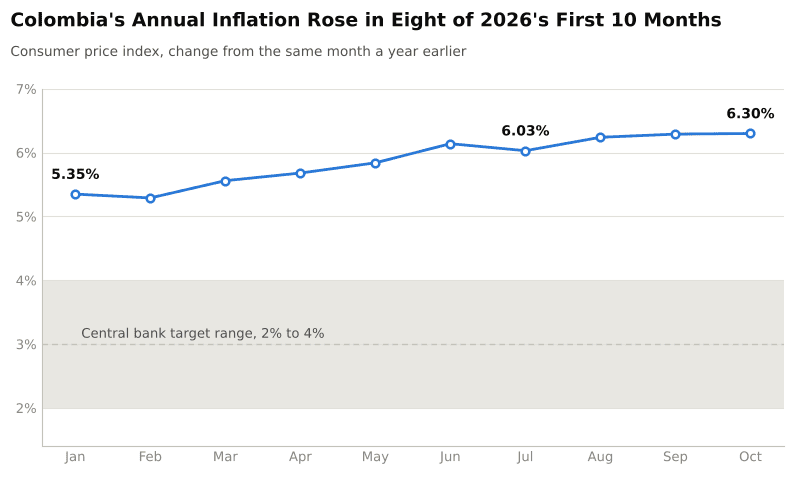
Colombia’s annual inflation rate by month in 2026, against the central bank’s 2% to 4% target range. (Chart: Finance Colombia, based on DANE data)
The result came in below market expectations. Of the 21 institutions in the expectations survey run by Citi (NYSE: C), 20 had expected the annual rate to accelerate from September’s level, with the consensus at 6.38% and Bancolombia’s own call at 6.36%, according to La República. Headline inflation has now held above 6% for five straight months and sits at more than twice the 3% midpoint of the central bank’s 2% to 4% target range.
Rents and Restaurant Meals Keep Services Elevated
Annual services inflation eased four basis points to 7.15%, its lowest level since July 2026. At 0.27%, the monthly services rate ran ahead of the 0.16% the segment has averaged in October, according to the report. The research department traces the result to price adjustments stemming from the minimum wage increase and to indexation against the previous year’s inflation, with the heaviest pressure in labor-intensive categories and items that reset once a year.
Imputed rent rose 0.28% over the month and actual rent 0.29%, while meals at table-service restaurants climbed 0.23%. Travel packages rose 2.16%, and movie theaters and live entertainment 2.20%. Passenger air travel, auto body and paint work, private medical consultations and health insurance made the smallest contributions.
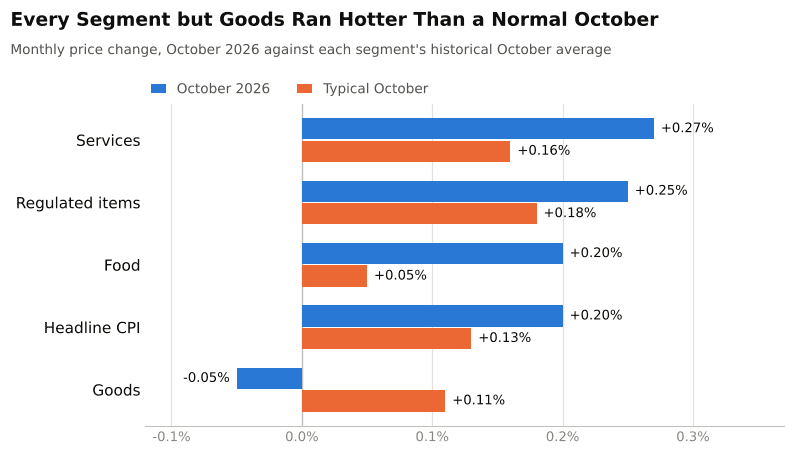
Monthly price change in October 2026 by segment, against each segment’s historical October average. (Chart: Finance Colombia, based on Grupo Cibest calculations from DANE data)
Food Turns Up as Goods and Regulated Items Cool
Measured on the classification the central bank uses, annual food inflation accelerated for a third consecutive month, from 6.79% to 7.37%, its highest level since November 2023. DANE’s own expenditure-division grouping, which draws the category’s boundaries slightly differently, put food and non-alcoholic beverages at 7.31%. The monthly rate of 0.20% stood well above an October average of roughly 0.05%, and food prices have now risen 8.26% so far this year.
Fresh food accounted for most of the move. Annual inflation for perishables reached 17.78%, the fastest since March 2023, led by potatoes, eggs, plantains, tubers and blackberries, amid pressures the research department attributes to El Niño and rising costs. Processed food eased for a second month to 4.14%, its slowest since February 2025, as cooking oil, dried legumes, cheese and coffee all became cheaper.
Goods prices, by contrast, fell outright for a second consecutive month. Annual goods inflation slowed to 2.65% from 2.97% in September, its lowest reading since December 2025, and prices fell 0.05% over the month against a historical October increase of 0.11%. New and used passenger vehicles led the declines, alongside consumer electronics, jewelry and precious stones, and cleaning products. The research department notes that currency appreciation continued to ease price pressure on imported goods.
Regulated items eased for a second consecutive month as well, falling from 6.69% to 6.56%, though they remain above their 2025 average of 5.99%. Within the component, five subclasses posted monthly increases, seven recorded declines and two were unchanged. Motor fuels, electricity, gas, and water and sewer services pushed the segment up, while lower education fees, vehicle ownership costs and copayments to Colombia’s entidades promotoras de salud (EPS, the health benefit administrators) pulled it down.
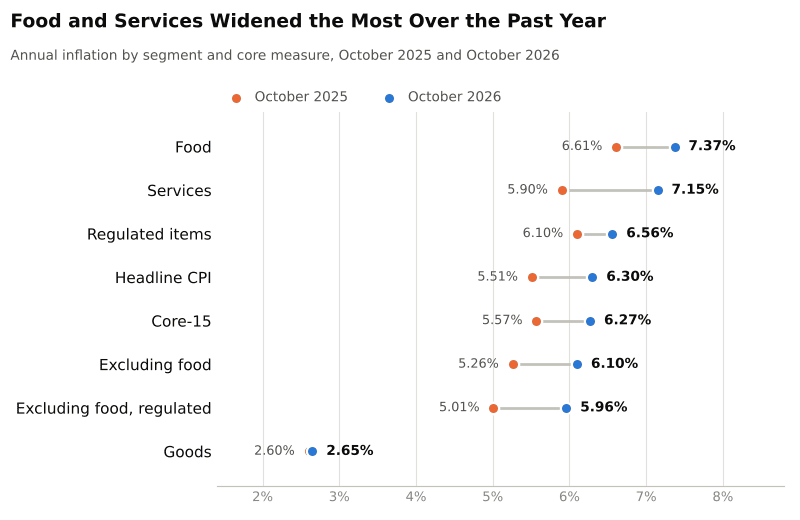
Annual inflation by segment and core measure, October 2025 against October 2026. (Chart: Finance Colombia, based on Grupo Cibest calculations from DANE data)
Core Measures Point the Other Way
Core-15 inflation stood at 6.27%, inflation excluding food slowed for a second consecutive month to 6.10%, and the measure excluding both food and regulated items came in at 5.96%. The research department characterizes the set as a moderation, while noting that inflation excluding food has nonetheless stayed above 6% for five months.
Across DANE’s 12 expenditure divisions, restaurants and hotels again posted the steepest annual increase at 9.39%, followed by education at 7.44% and health at 7.37%. Clothing and footwear remained the slowest at 3.14%.
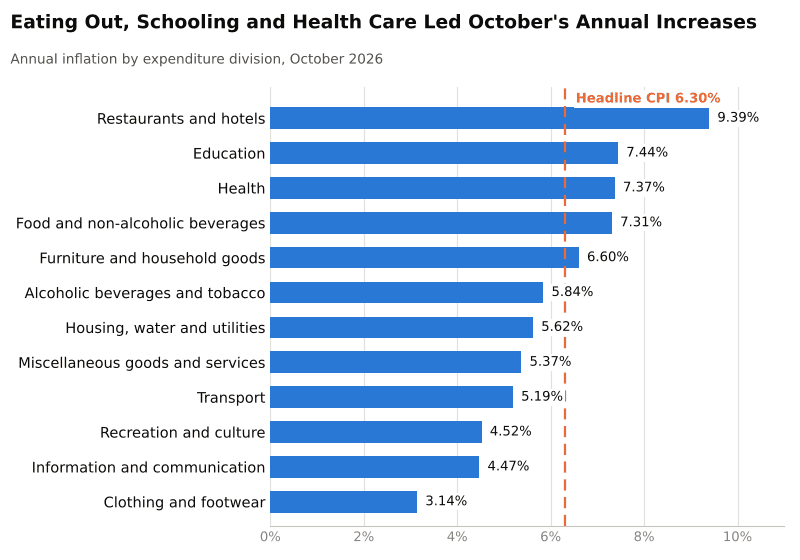
Annual inflation by expenditure division in October 2026, with the 6.30% headline rate marked. (Chart: Finance Colombia, based on DANE data)
The Wage Decree Is Still Working Through the Basket
The indexation the research department points to traces back to a decision taken in December 2025, when then-President Gustavo Petro decreed a 23% increase in the legal minimum wage for 2026, lifting it to $2 million COP a month once the transport allowance is counted. The Consejo de Estado (Council of State) provisionally suspended that decree, Decree 1469 of 2025, on February 12, 2026, according to El Colombiano, and the government reissued the wage at the same value to comply. In July 2026, the court’s Second Section revoked the suspension and restored the original decree, El Tiempo reported, leaving the increase in force while the nullity suit over its legality proceeds.
The Central Bank Stays Put
The board of the Banco de la República (Bank of the Republic), Colombia’s central bank, held its policy rate at 12.25% on October 30, saying the decision preserves a restrictive stance consistent with a declining inflation path in 2027. The vote was four to three.
The four directors who backed the hold called the evidence inconclusive and preferred to wait for more data on core inflation and on El Niño rather than risk what the minutes describe as a costly overadjustment of monetary policy. The three who voted for a 25-basis-point increase argued that credibility in the inflation target has been seriously weakened, and that 2027 inflation should not exceed the technical staff’s 4.8% forecast. Those positions were set out in the minutes published on November 5 and reported by Portafolio. The board holds an ordinary meeting on November 30 and takes its next rate decision on December 18.
Bancolombia’s research department is holding its forecast for inflation to end 2026 at 6.7%, a call it also made after September’s 6.29% reading. In its October outlook the department projected that inflation would peak at 7.3% in the first half of 2027 before easing to 5.5% by the end of that year, still above the target range.
For the months ahead, the department expects indexation and higher labor costs to keep inflationary pressure elevated, with additional risk from regulated tariffs and from El Niño, while currency appreciation should continue to offset part of the pressure on imported goods. On that balance, it argues, the central bank will need to hold a restrictive stance for an extended period.
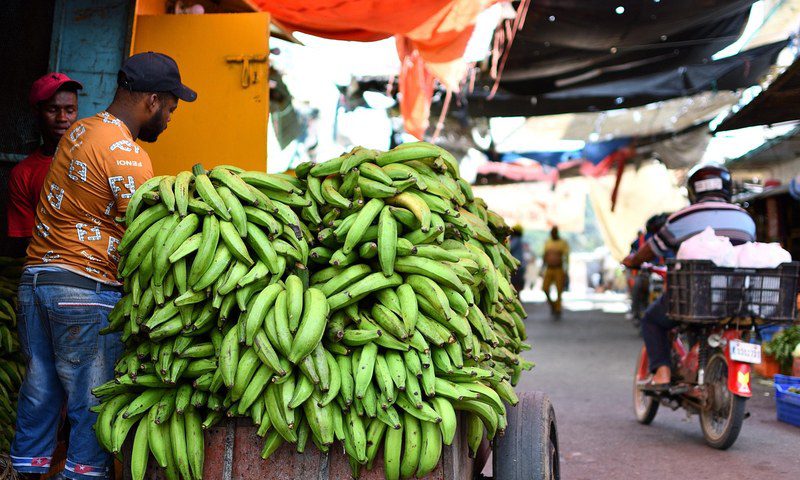
Headline photo: Plantains for sale at an open-air market. Fresh food led October’s pickup in Colombian food inflation. (Photo: Image by faustino26 from Pixabay)