Previous Story
Higher Grades Lift Aris Mining’s Segovia Gold Reserves to 1.9 Million Ounces
Posted On November 16, 2026
Comment: 0
Tag: antioquia, aris mining, Aris Mining Corporation, caldas, colombia, Colombia gold, Contract Mining Partners, el silencio, gold, gold grade, gold mining, gold reserves, guyana, Ignacio Vélez, marmato, mineral reserves, mineral resources, mining formalization, mining investment, neil woodyer, NI 43-101, NYSE: ARIS, Pamela De Mark, providencia, sandra k, segovia, segovia operations, Soto Norte, toroparu, TSX: ARIS
Antioquia mine adds 418,000 ounces net of what it mined
Aris Mining Corporation (TSX: ARIS) (NYSE: ARIS) raised the proven and probable mineral reserve estimate at its Segovia Operations in Antioquia by 28% to 1.9 million ounces of gold, up from 1.5 million ounces, with an effective date of November 10, 2026. The Canadian producer put the net addition at 418,000 ounces after accounting for the ounces mined during the period.
Proven and probable reserves now total 4.48 million tons at 13.32 grams per ton (g/t) of gold, against 4.37 million tons at 10.70 g/t in the estimate effective November 28, 2025. Tonnage rose nearly 3% while contained ounces rose 28% and the grade climbed 24%. Proven reserves account for 791,000 ounces from 1.63 million tons at 15.13 g/t, and probable reserves for 1.13 million ounces from 2.86 million tons at 12.29 g/t.
Measured and indicated mineral resources rose 8% to 3.9 million ounces, held in 6.16 million tons at 19.76 g/t, a grade 29% above the 15.3 g/t of the 2025 estimate. Inferred resources fell to 2.6 million ounces at 15.68 g/t, from 2.9 million ounces. Aris Mining attributed the combination to infill drilling and to the conversion of high-grade resources into reserves. Mineral resources are reported inclusive of mineral reserves and have no demonstrated economic viability.
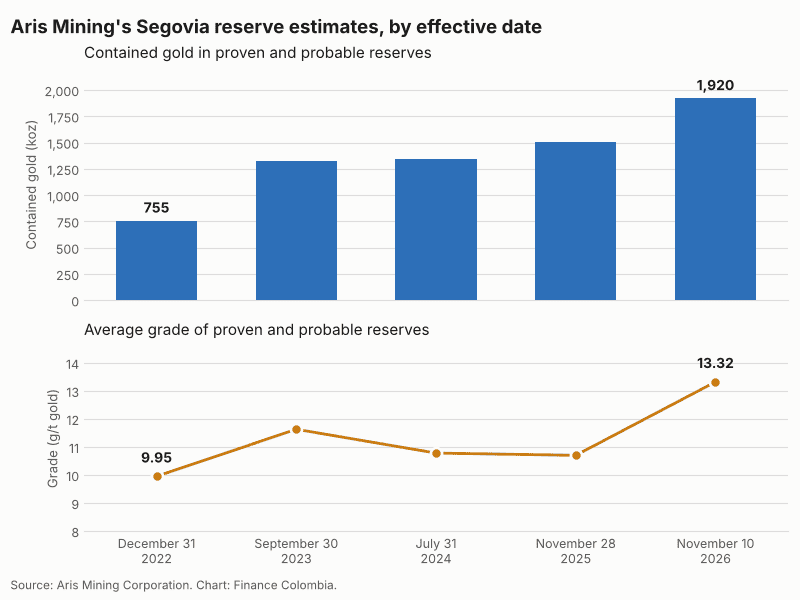
Proven and probable reserves at the Segovia Operations grew to 1.9 million ounces at 13.32 grams per ton as of November 10, 2026. (Source: Aris Mining Corporation; chart: Finance Colombia)
Chair and Chief Executive Officer Neil Woodyer said the increase in both contained ounces and grades “supports our objective of continuing to extend Segovia’s mine life.”
“Mining in the Segovia district spans more than 150 years, yet exploration continues to add gold to the reserve base.” — Neil Woodyer, chair and chief executive officer, Aris Mining Corporation
The reserve estimate used a gold price of $2,800 USD per ounce, unchanged from 2025 and up from $1,915 USD in 2024 and $1,700 USD in the two years before that; the resource estimate used $3,200 USD per ounce. Aris Mining sold gold at an average realized price of $4,205 USD per ounce in the third quarter of 2026. Cut-off grades ran between 3.22 g/t and 4.26 g/t for reserves and between 2.82 g/t and 3.87 g/t for resources, varying by area.
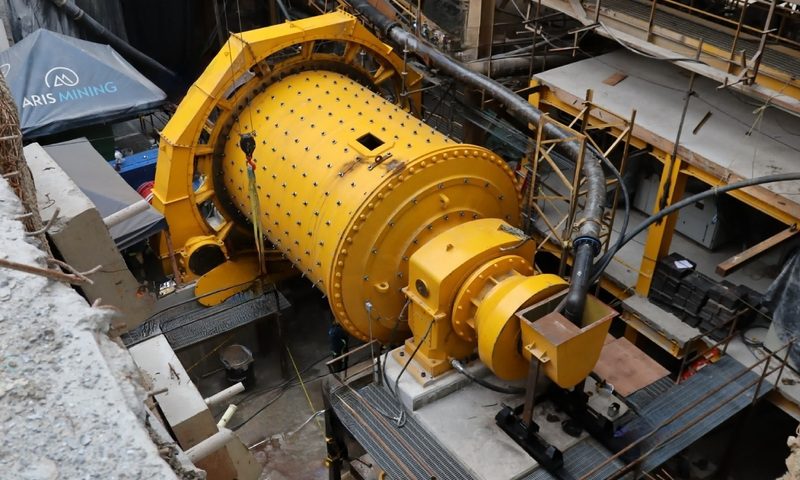
The Segovia Operations sit in a long-worked mining district in northeastern Antioquia. Aris Mining runs several underground mines there and feeds a gravity, flotation and cyanidation plant that produces gold-silver doré. Capacity rose by half, to 3,000 tons per day, when the company completed installation of a second mill in June 2025. Segovia processed 585,900 tons in the first nine months of 2026. Underground spending this year has gone into new ramps and a main haulage circuit linking the El Silencio, Providencia and Sandra K mines.
Not all of the ore feeding the plant is mined by Aris Mining. Under the company’s contract mining partner model, local miners work Aris Mining’s own titles under long-term agreements and sell their ore to the plant, an arrangement the company describes as a route to formalization for small-scale operators. The company says that material accounted for 39% of Segovia’s production in 2025. The company separately buys high-grade mill feed from third-party contractors operating off its titles.
Segovia produced 227,762 ounces in 2025 and about 194,400 ounces in the first nine months of 2026. Company-wide output over the same nine months reached about 217,300 ounces, up 16% year over year. Reporting third-quarter results on November 4, 2026, the company said it is targeting the lower end of its 300,000 to 350,000 ounce guidance for the year. Output from contract partners was held back earlier in the year by temporary constraints on access to explosives, which the company said were resolved in September 2026.
Woodyer said Segovia’s cash generation provides a foundation for the rest of the company’s growth plans, which carry several near-term milestones. Aris Mining expects first gold in December 2026 from the new carbon-in-pulp plant at its Marmato mine in Caldas, where it connected the new surface decline to existing underground workings in April 2026. Woodyer said a prefeasibility study for the Toroparu project in Guyana is targeted for release later in November 2026 and will mark the first time the company declares a mineral reserve estimate for that asset. Aris Mining has said it will assess a construction decision for Toroparu in early 2027, after first gold from the Marmato plant. An updated NI 43-101 technical report for Marmato is expected in the first quarter of 2027. At the Soto Norte project, the company said preparation of the environmental and social impact assessment has been completed for community engagement.
Aris Mining has said the two operating mines should together reach roughly 500,000 ounces a year once the expansions are fully ramped up, and that its portfolio supports a longer-term objective of about 1 million ounces annually. That larger figure rests on a preliminary economic assessment at Toroparu that includes inferred resources, and on permits and construction decisions for both Toroparu and Soto Norte.
Aris Mining technical staff prepared the reserve estimate under the supervision of Ignacio Vélez, FAusIMM, vice president technical services and the qualified person for it under NI 43-101, who also reviewed it. Pamela De Mark, P.Geo., senior vice president of geology and exploration, prepared the resource estimate and is the qualified person for the technical disclosure. The company said no known mining, legal, political, metallurgical, infrastructure, permitting or other relevant factors could materially affect the reserve estimate.
Headline photo: The second mill installed at Aris Mining’s Segovia Operations in Antioquia in June 2025. (Photo: CNW Group/Aris Mining Corporation)