Previous Story
Colombian Peso Surges 7.5% in July as Dollar Weakens and Central Bank Holds Rate
Posted On September 8, 2026
Comment: Off
Central bank’s surprise hold reinforces Colombia’s currency rally
The Colombian peso strengthened 7.5% against the US dollar in July, closing the month at 3,158.44 COP per dollar, a decline of 257 COP from June, according to a report published August 4 by Bancolombia‘s Economic, Industry & Market Research Area. The Medellín-based bank is the flagship banking subsidiary of Grupo Cibest (NYSE: CIB; BVC: PFCIBEST), the group’s holding company, which took on its current name in a 2025 corporate reorganization that renamed the former Bancolombia S.A. parent entity while the banking business itself continued operating under the Bancolombia name. A global sell-off in the US dollar, rising oil prices, optimism over Colombia’s incoming government and heavy dollar sales by local market participants combined to push the exchange rate below the level suggested by its underlying fundamentals, the report said.
During the month, the USDCOP exchange rate fluctuated between 3,086 COP and 3,432 COP. Persistent dollar sales by local participants pushed the Relative Strength Index, a technical momentum gauge, into oversold territory — a reading below 30 — for 19 of July’s trading sessions, with the index ranging between 20.2 and 31.8 over the month.
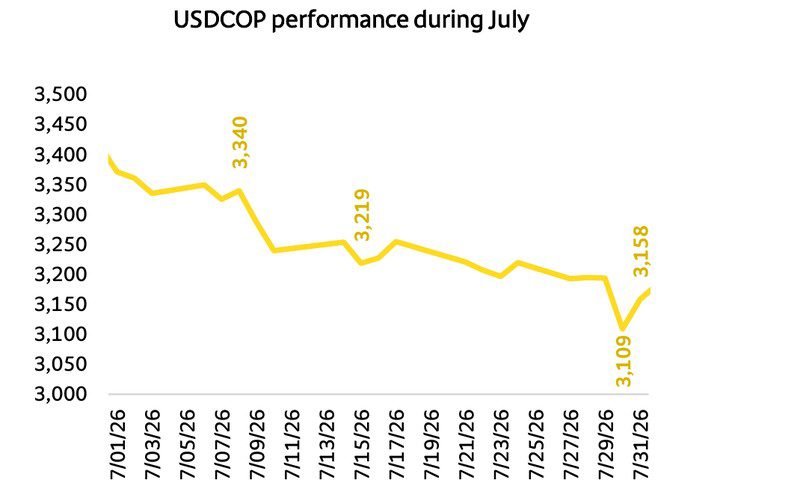
The Colombian peso strengthened through most of July before paring some of its gains in the final trading session, closing at 3,158.44 COP per dollar. (Chart: SetFx / Bancolombia’s Economic, Industry & Market Research Area)
At the end of July, the Banco de la República (Bank of the Republic, Colombia’s central bank) voted by majority to hold its benchmark interest rate at 12.00%, defying market expectations of a hike of 50 to 75 basis points. The board also launched a program to gradually accumulate up to $4 billion USD in international reserves, the report said. “The persistent appreciation of the Colombian peso provided the majority of Board members with room to pause the policy rate cycle,” Bancolombia’s analysts wrote, even as Colombia’s headline inflation accelerated to 6.14% in June.
The peso’s rally tracked a broader retreat in the US dollar. The DXY index, a benchmark that tracks the currency against a basket of major peers, fell 1.5% in July, allowing most G10 and regional currencies to strengthen against the dollar; the Chilean peso was the only major currency in Bancolombia’s peer comparison to weaken instead. The dollar posted its steepest losses during the final week of July, a decline the report tied to a ceasefire in the Middle East, weaker-than-expected US GDP growth, and the Federal Reserve‘s decision to hold its benchmark rate in a range of 3.50% to 3.75%. The European Central Bank held its own rate at 2.25%, and the Bank of Japan kept its policy rate at 1.0%, its highest level since 1995, amid market expectations that Japanese authorities could intervene to support the yen. Bancolombia’s analysts noted that the US Treasury Department had reportedly told certain financial institutions it could also conduct foreign exchange operations to support the Japanese currency.
Brent crude oil prices climbed 23.5% in July to close at $90.09 USD per barrel, while West Texas Intermediate crude rose 21.8% to $84.67 USD, the report said. Tensions in the Middle East drove much of the increase: Trump declared the ceasefire with Iran over on July 8, and after Houthi militants struck two Saudi oil tankers in the Red Sea on July 23, he threatened a major US military response against Iran and the Houthi movement. Crude prices gave back part of their gains in the final week of the month after the United States suspended airstrikes on Iran and negotiations toward a peace agreement resumed.
Locally, the appreciation was driven mainly by domestic flows rather than foreign investors, according to the report. Colombia’s corporate sector posted net dollar sales of roughly $500 million USD during July, and institutional investors supplied additional dollars in the final weeks of the month. Offshore investors, who had been net sellers of about $500 million USD in the spot and next-day markets in June, shifted to a net-buying position in July. Bancolombia attributed continued interest in Colombia’s carry trade — in which investors borrow in a low-yielding currency to invest in a higher-yielding one — to the policy rate hiking cycle that began in January 2026 and to elevated yields on Colombia’s peso-denominated government bonds, known as TES.
Bancolombia expects the exchange rate to trade between 3,150 COP and 3,350 COP in August, saying some of the local factors behind July’s rally are likely to correct. The bank flagged the central bank’s new reserve-accumulation program as a risk that could push the peso weaker, since additional dollar purchases by the Banco de la República would increase demand for foreign currency. Bancolombia expects markets to keep a favorable bias toward Colombia’s incoming government, though how the new administration handles fiscal consolidation will be crucial to sustaining that view; the report said the incoming administration could introduce a new tax reform proposal and undertake a broad reassessment of the fiscal accounts. Risks tied to carry trade positioning still point toward further peso strength, Bancolombia said, but the central bank’s decision to leave rates unchanged in July could help trigger an upward correction in the exchange rate — meaning a weaker peso — in the weeks ahead.
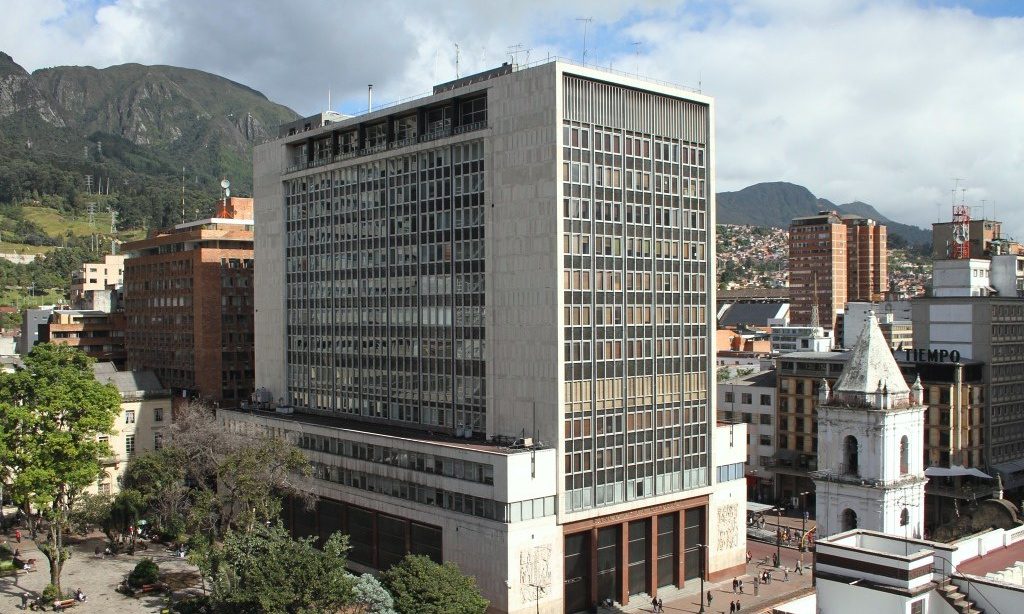
Above image: The headquarters of the Banco de la República, Colombia’s central bank, in downtown Bogotá. (Photo: Banco de la República handout)