Previous Story
Colombian President Gustavo Petro Ignites Diplomatic Dispute With Peru Over Amazon River Island
Posted On August 6, 2025
Comment: Off
Tag: Alejandro Muñante, amazon, amazon river, amazonas, battle of boyaca, Boundary and Fluvial Navigation Treaty, Catatumbo, colombia, Colombia-Peru War, Colombian Foreign Ministry, COMPERIF, dina boluarte, Elmer Schialer, Felipe Arias Escobar, Gustavo Petro, Isla Chinería, Isla Santa Rosa, leticia, Lilian Posada García, Maduro regime, maria fernanda cabal, pedro castillo, Permanent Joint Commission for the Inspection of the Colombo-Peruvian Border, peru, Peru's National Police, PNP, Pontificia Universidad Javeriana, Rafael Orozco, Renovación Popular party, Rio de Janeiro Protocol, Salomón-Lozano Treaty, Santa Rosa de Loreto, Santiago Duque, universidad del rosario, Universidad Nacional de Colombia, Walter Arévalo
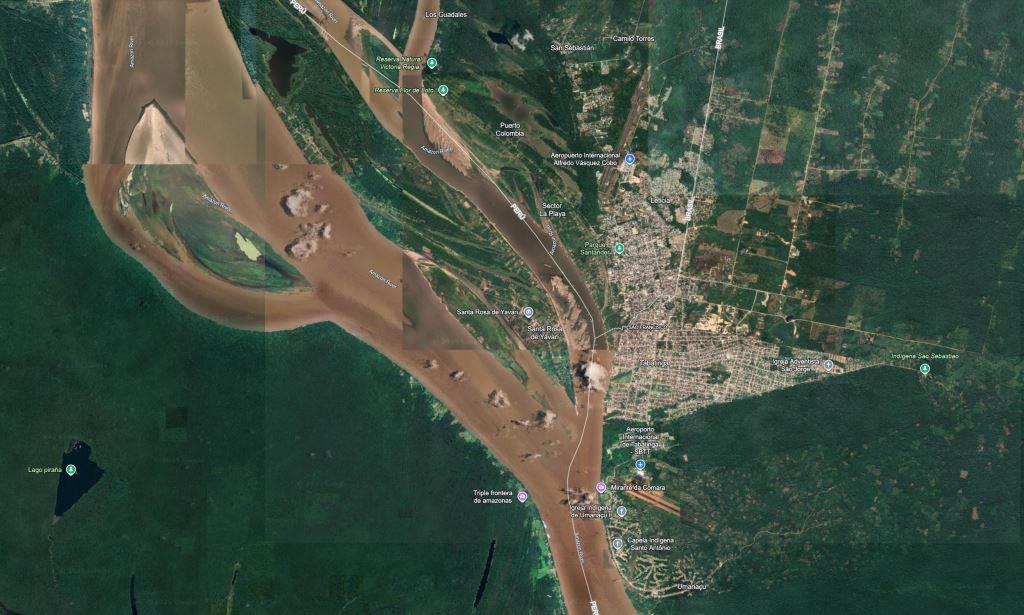
In a significant escalation of diplomatic tensions, the government of Peru has issued a formal protest against statements made by Colombian President Gustavo Petro, who accused the neighboring country of occupying Colombian territory in the Amazon in violation of historical treaties. The dispute centers on the sovereignty of newly formed river islands, particularly Isla Santa Rosa, and unfolds against a backdrop of already fragile relations between the two administrations.
On Tuesday, President Petro alleged via the social media platform X that Peru had illegally claimed land belonging to Colombia. “Again, the government of Peru has taken over territory that belongs to Colombia and has violated the Rio de Janeiro Protocol,” Petro stated. “Islands have appeared that are north of the current deepest line, and the Government of Peru has just appropriated them by law and placed the capital of a municipality on land that, by the treaty, should belong to Colombia.”
Petro’s comments refer to the Peruvian Congress’s recent creation of the Santa Rosa de Loreto district, establishing its capital on Isla Santa Rosa. The Colombian president affirmed that his government “will use, first of all, diplomatic steps to defend national sovereignty.” He also announced the relocation of Colombia’s Battle of Boyacá commemoration to Leticia, the capital of its Amazonas department, as a direct response to the dispute.

Colombia’s President Gustavo Petro (left) has expressed an ideological affinity for disgraced Peruvian President Pedro Castillo (right).
The Peruvian Ministry of Foreign Affairs swiftly responded, expressing “its most firm and energetic protest” and rejecting Colombia’s claims. In a formal statement, the ministry asserted that the new district’s territory “is under the sovereignty and jurisdiction of our country, by the international political limits established” in the 1922 Boundary and Fluvial Navigation Treaty between Peru and Colombia and the subsequent work of the Joint Boundary Demarcation Commission.
Peruvian Congressman Alejandro Muñante of the Renovación Popular party suggested Petro’s motives were political. He urged his country’s foreign minister to “cut off any hidden intention of Mr. Petro to want to divert the focus of attention from the many problems his country has towards a conflict that he has invented.” Muñante added, “Mr. Petro has a not-so-peaceful background; he was a former guerrilla, he still considers himself a communist militant, so we are not talking about a person who is objective.”
In Colombia, opposition Senator and presidential pre-candidate Maria Fernanda Cabal criticized the Petro administration’s handling of the issue. “Don’t be irresponsible! You are mediocre people who understand nothing of what is happening in the country,” she posted on X. “They attack Peru, but allow the genocidal Maduro regime to take over Catatumbo. This is not resolved with threats.”
As both nations trade official communiqués and public statements, the call from academic experts to reactivate the binational border commission remains the most cited path toward a de-escalation of the conflict.
A History of Strained Relations Between Petro & Boluarte
This territorial flare-up is the latest in a series of diplomatic clashes between the governments of Gustavo Petro and Peruvian President Dina Boluarte. Relations soured significantly after the December 7, 2022, impeachment and arrest of former Peruvian President Pedro Castillo following his attempted “self-coup.”
President Petro, an ally of Castillo, has repeatedly defended the ousted leader and questioned the legitimacy of Boluarte’s succession. The diplomatic fallout led to the mutual withdrawal of ambassadors. On February 18, 2023, the Peruvian Congress declared President Petro persona non grata with a vote of 72 in favor, 29 against, and 7 abstentions. The motion expressed rejection of Petro’s “offensive” statements against Peru’s National Police (PNP) regarding their response to social mobilizations that supported the ousted Castillo.
A nearly identical dispute over Isla Santa Rosa arose in July 2024. At the time, a Colombian foreign ministry official stated the island “would not belong to Peru and would be irregularly occupied.” Peru issued a formal protest, and the incident was considered closed after Colombia offered a satisfactory response. The current escalation indicates the underlying issue was never resolved.
Dueling Interpretations of Treaties and Geography
The border between Colombia and Peru was largely defined by the Salomón-Lozano Treaty of March 24, 1922. “The river’s course was divided between the two States not by the middle, but by the best navigable channel, the deepest one,” explains Walter Arévalo, a professor of International Law at the Universidad del Rosario in Colombia. This principle is known as the thalweg.
According to historian Felipe Arias Escobar of the Pontificia Universidad Javeriana, the treaty was initially met with opposition in both nations, leading to the Colombia-Peru War of 1932. The conflict concluded with the signing of the Rio de Janeiro Protocol in 1934, which ratified the 1922 treaty. “It is a conflict in the service of nationalism that at the time served to strengthen national identity,” Arias Escobar notes.
The core of the conflict lies in differing interpretations of historical agreements and the dynamic geography of the Amazon River.
Colombia’s Position
The Colombian Foreign Ministry presented a more nuanced position than President Petro’s direct accusation of illegal occupation. The ministry stated that Isla Santa Rosa is a formation that emerged in the Amazon River after the only official allocation of islands between the two countries in 1929.
Rafael Orozco, Director of the Americas for the Colombian Foreign Ministry, clarified the stance: “For the island ‘Santa Rosa’ and others that have arisen after 1929, an allocation process must be carried out by common agreement between the Foreign Ministries.”
The Colombian government announced it has presented formal protest notes to Peru, requesting the reactivation of the Permanent Joint Commission for the Inspection of the Colombo-Peruvian Border (COMPERIF) “so that, based on an allocation methodology, a decision can be made on the sovereignty of the islands that have emerged in the course of the Amazon River after 1929.” The ministry’s statement emphasized, “For years, Colombia has maintained the need for binational work to be carried out for the allocation of islands and has reiterated the position that the ‘Isla de Santa Rosa’ has not been assigned to Peru.”

Castillo’s failed self-coup led to Dina Boluarte being recognized as Peru’s 1st female vice-president.
Peru’s Position
Peru counters that the island is not a new formation requiring allocation. Peruvian Foreign Minister Elmer Schialer stated that any claim of a border dispute is “a completely mistaken position from a legal, geographical, technical, and historical point of view.”
Schialer argues that Isla Santa Rosa was originally part of Isla Chinería, which was assigned to Peru in the 1929 demarcation. “One of the islands assigned to Peru was Chinería, and, around the 1950s, the river split off a part that was later called Santa Rosa Island. It was not born nor did it emerge, but was part of Chinería,” Schialer explained. He added that the channel that separated it later dried up, reintegrating it with the larger island. “Not only was Santa Rosa Peruvian, but it continues to be Peruvian.”
The Peruvian Foreign Ministry’s communiqué echoed this, stating, “The town of Santa Rosa is an integral part of the Peruvian island of Chinería, assigned to Peru in 1929.” Schialer stressed that Peru has developed infrastructure on the island since the 1970s, including a school and government offices, “without the Colombians ever saying anything.” He concluded, “Santa Rosa is Peruvian, just as Leticia is Colombian… We should not ask a friendly nation what we can or cannot do in our territory.”
The Shifting River and the Fate of Leticia
Compounding the sovereignty dispute is a pressing environmental issue threatening Colombia’s primary Amazon port. Sedimentation, deforestation, and climate change are causing the main channel of the Amazon River to shift away from Leticia and towards Peruvian territory.
A study by the Faculty of Mines at the Universidad Nacional de Colombia warned that Colombia is at risk of losing its most significant fluvial connection. “A model developed by the National Navy anticipated several years ago that, by 2030, the Amazon River could cease to pass in front of Leticia for most of the year… Today, the model is a reality,” the study concluded. Professor Lilian Posada García, involved in the research, warned, “If immediate action is not taken, Leticia will cease to be a riverside city. The implications go beyond the symbolic; they are cultural, economic, and territorial.”
President Petro directly linked this environmental threat to the current dispute, expressing fear that Peru’s actions could “make Leticia disappear as an Amazonian port, taking away its commercial life.”
Experts like Santiago Duque, a limnology professor at the Universidad Nacional de Colombia, emphasize the river’s dynamic nature. “When the treaty was signed, opposite Leticia, there were only two islands… a border between Colombia and Peru is a living, changing border, which both countries must review from time to time.” He added, “It is time for the countries to sit down to review the new geographical situation and make decisions. There are more than seven new islands, including Santa Rosa.”
Headline image: Aerial view of Leticia, Colombia, Tabatinga, Brazil, and Santa Rosa Peru, on the Amazon River. Satellite image by Google Earth.