

















Colombia’s month-over-month inflation number came in for April (up 0.59%), bringing the 12-month consumer price index (CPI) increase to 7.16%.
While this was slightly better than expected, the positive difference is likely not enough to radicalize the central bank into taking more drastic measures at the end of the month. Fedesarrollo continues to anticipate a year-end CPI rate of of 5.51% — but we are already at 3.34% year-to-date.
The complications related to El Niño may be disappearing into the rearview mirror, but La Niña is now on the horizon — and won’t be helpful when it comes to inflation. Even thought we have been falling for 13 straight months — and 12 months ago we were at 12.82% — Banco de la República is behind the curve.
Along the same lines, Fedesarrollo’s forecast for an year-end overnight interest rate of 8.25% is also looking optimistic given the conservative nature of the central bank.
El Niño, as mentioned, is gradually leaving us. This has helped energy reservoir levels rise from 28.0% to 34.5%, and while water rationing continues in Bogotá, consumption has fallen. Next up, also as mentioned, is La Niña and the expectation for heavy rainfall.
In terms of economic inflows, international tourism continues to boom, with 1.6 million visitors arriving in the first quarter of 2024, an increase of 7.6%. While Bogotá had the most visitors, there is no question that Medellín and Cartagena are drawing the most tourists. The main visitors thus far in 2024, accounting for 26.6%, are from the United States. Given the criminal news emanating from Medellín, in particular, in recent months, most are welcome but many are not — including those disparaging referred to as the “passport bros.”
Ecopetrol’s first quarter results were released this week as well, and thye were, as expected, negative year-over-year. Production was slightly down, however it was the decrease in the price of Brent oil and the stronger performance of the Colombian peso that did the damage.
Ricardo Roa, chief executive officer of Ecopetrol, has been under some political pressure recently, but he has no intention of stepping down. Instead Roa is concentrating on 2025 and the anticipated shortfall in gas supply. Venezuela is prepared to sell at a favorable price — but first the pipeline needs a lot of work. Additionally, given that the United States has reimposed its embargo, permission will need to be sought from Washington.
Never miss Rupert’s latest commentary
Follow him now on LinkedIn to see What Jumps Out
Medellín Colombia’s F2R event, also known as the Feria de las 2 Ruedas is the most important motorcycle industry event in Latin America, and said to be one of the top five globally. This year saw around 80,000 visitors, 500 exhibitors, 2,000 brands to the four day event that takes over all of Medellín’s Plaza Mayor convention space.
Finance Colombia’s Loren Moss had a few moments to speak with the event founder Guillermo Pajón about the event’s continuing success, record breaking growth, and importance to both the motorsports and transportation sectors in Colombia and Latin America.
Finance Colombia: I’m here with Don Guillermo, founder of not only Feria de las 2 Ruedas, but also of Prisma Business Management & Events. And I just read a press release from the Municipality of Medellin which states that Feria de las 2 Ruedas impacts the economy of El Valle de Aburrá, of Medellin, with over $20 million USD. And that is so impactful that I can see we already have here, in Plaza Mayor, the convention center in Medellin, over 400 exhibitors, over 2,000 brands. And they are saying you are going to have over 80,000 visitors, is that true?
Guillermo Pajón: First of all, a special greeting. I’m very glad to be sharing with you all, with a man that we also appreciate a lot because he’s always delivering good news about Colombia, about the world, which is what has to be done. We need to try to generate hope, generate faith, say that there are things that can happen. And I believe that with Feria de las 2 Ruedas we are demonstrating that things can be done and can happen. Perhaps in a moment of political uncertainty in Colombia, as well as economic uncertainty…But I believe that the fact that we have 450 exhibitors today; the fact that over 1,500 brands are here today on display; the fact that we have so many people who have arrived from different continents, from different cities, to shake hands and do business, to see what is going on in this dynamic industry that represents almost the 62% of the vehicle pool for Colombia today.
Next year’s event is May 15th to 18th, 2025.
That is, in Colombia there are more motorcycles than four-wheelers (cars and passenger trucks), and it’s a figure that continues to grow. It’s expected that for this year, which is apparently a year of recession after what happened during the pandemic; because 2022 was a really good year, for everything. It is expected that about 650,000 motorcycles will be sold, and that continues to be an interesting figure, not like the figures we’ve been presenting in previous years. Feria de las 2 Ruedas is that space that allows people to make connections through business events, through the business roundtables, through the path that leads to innovation, where 13 brands have presented new models to the industry.
And something else that has caught our attention: the matter of safety. There’s been a lot about the topic of safety in motorcycling. All the ergonomic innovations in motorcycles, with some really special features, with captivating designs…And we can’t forget what’s coming regarding electric mobility, sustainable mobility…Which, today, the Asian delegations are presenting at the fair a large number of offers, and there are also some Colombian brands that today are representing those international brands of sustainable mobility.
Finance Colombia: Yeah, it’s impressive that there is a big delegation here. We conducted an interview with an Indian company, looking for trade links. There’s always a big presence in the pavilion, like China’s as well, and that is very impressive. And one thing I notice because there used to be…Last year the event was successful, but there was a lot of uncertainty coming from many exhibitors about what was going to happen, because of the political-economic situation. But here I notice that brands like Honda, Suzuki, Yamaha are back. Those brands that, due to their own reasons, were not here. And not only the big ones like them, the Japanese, but also those that are always here for the “popular” population, I mean, like Bajaj, like Hero, and AKT, of course, here in Medellin, and TVS, and those brands. But also, another thing I noticed is that this year there are a lot of brands where I asked myself and said, “Wow, I don’t know that brand,” and I went to talk to them and they told me, “No, we are new here, for the first time.” There is a big Mexican brand, Vento which is already big in Mexico, and they told me, “We have big plans for Colombia.” And I think that here, aside from what is happening out there, here there are many votes of confidence in the potential and the opportunity that this sector of motorcycles here in Colombia shows.
Guillermo Pajón: Right, you put it very well. Last year we had a gap, we were really missing these Japanese brands, and now they have come back. They have come back to connect with their users, with their current and potential customers…Because the fair does not choose; they choose us. And they choose us to show themselves, to connect. And I believe the brands understood that it’s not a fair that favors certain brands, or certain origins. It’s the brand…It’s everyone’s fair, and it’s the one that allows us to gather all that supply and demand (in a single place). And yes, there are many new brands. Many brands, not only in motorcycles, but also clothing and equipment. Many brands are coming with new purposes, with new alternatives for this industry. And that’s one of the things the fair is presenting this year: novelties.
Finance Colombia: Yes, that’s true. I have seen that now there are, electric motorcycles, electric bicycles, skateboards…things that I don’t even know how to define, which are already breaking the rules, talking about transportation and innovation. Medellin has always been kind of like the driving force of innovation here in Colombia, and here this event demonstrates so. Another thing that is very important: With 80,000 visitors, I have already spoken with many foreigners, and they say they are in the industry, that they come here to do business; others that are simply tourists or fans. And it’s an event…Today is the day for the press and the industry, but tomorrow…I remember when there were only two days open to the public, but we were shoulder-to-shoulder, and already with three days open to the public.
And I’ve spoken to people who come from the United States, who are not in the industry, but they are people who love motorsports and such. And this event has a positive impact if the mayor and even the president are talking about the correct tourism, responsible tourism, family tourism. And what’s Feria de las 2 Ruedas’ role in promoting the clean, correct, and responsible kind of tourism for Medellin and Colombia?
Guillermo Pajón: Of course. In line with what our Mayor Federico Gutierrez has proposed, we need tourism that contributes to the city, from the social, the economic, the innovation, the knowledge. And the fairs, the conferences, the conventions, the corporate events, are also going to be a priority in the city. Not only the entertainment. To be able to have those international experts, that come here and share with the students, with the university students, with other businessmen, the new dynamics in technologies and production. And I think it’s one of the very important aspects of this fair; those spaces. We hold 127 events, half of which have to do with training, innovation and marketing.
Finance Colombia: Well, this event, to me, aside from being a journalist, being a motorcyclist for many years too, for like 30, 40 years…This event…aside from my professional role, I love it, and I recommend everyone to visit it. My only concern is that we have already run out of space. Plaza Mayor is a huge convention center. And it’s scary to think about how to solve that, it’s a good problem to have, but what will you do next year? Are you going to take up even EPM and Parque de las Luces, and I don’t know what else?
Guillermo Pajón: Yes, truly…I said in my inaugural speech to the secretary of Economic Development, María Fernanda Galeano; I said to her, “We already need to start thinking about how to annex Teatro Metropolitano to Plaza Mayor; how we can be annexing these places around the venue, to give a larger commercial offer.” And logically, to be able to respond to all that demand from national and international exhibitors that want to visit us, and who have found in Feria de las 2 Ruedas, and in the city, a meeting point in this industry. And today we are ranked among the four or five most influential fairs of the world. And we take pride in that, but at the same time, it commits us to raise the bar higher each time.
Finance Colombia: That’s true, and I’m here working, but I’m going to come back… My brother is visiting, I’m going to come back during the weekend to attend as a motorcycle enthusiast. So, I congratulate you on such a special event, aside from its importance, because it is very important, but it’s also something…You know me, I’ve been coming here from even before I was living in Medellin.
Guillermo Pajón: Of course.
Finance Colombia: [Laughs]. So, here’s to another successful year. We want to see many more years. So, Don Guillermo, thank you so much. I know you are the busiest man in Medellin today and in the following four days, so thank you for giving us a little bit of your time.
Guillermo Pajón: No, thank you very much. We’ll be seeing you around here. Follow him, because he will be sharing news with us; he will be telling us what’s in innovation and what this 16th edition of Feria de las 2 Ruedas in Medellin, Colombia will be presenting. Best regards.
Finance Colombia: Feria de las 2 Ruedas, I’ll put the link right down here. Click, register, it’s open to the public. Come! Thanks.
https://www.feria2ruedas.com/en Next year’s event is May 15th to 18th, 2025.
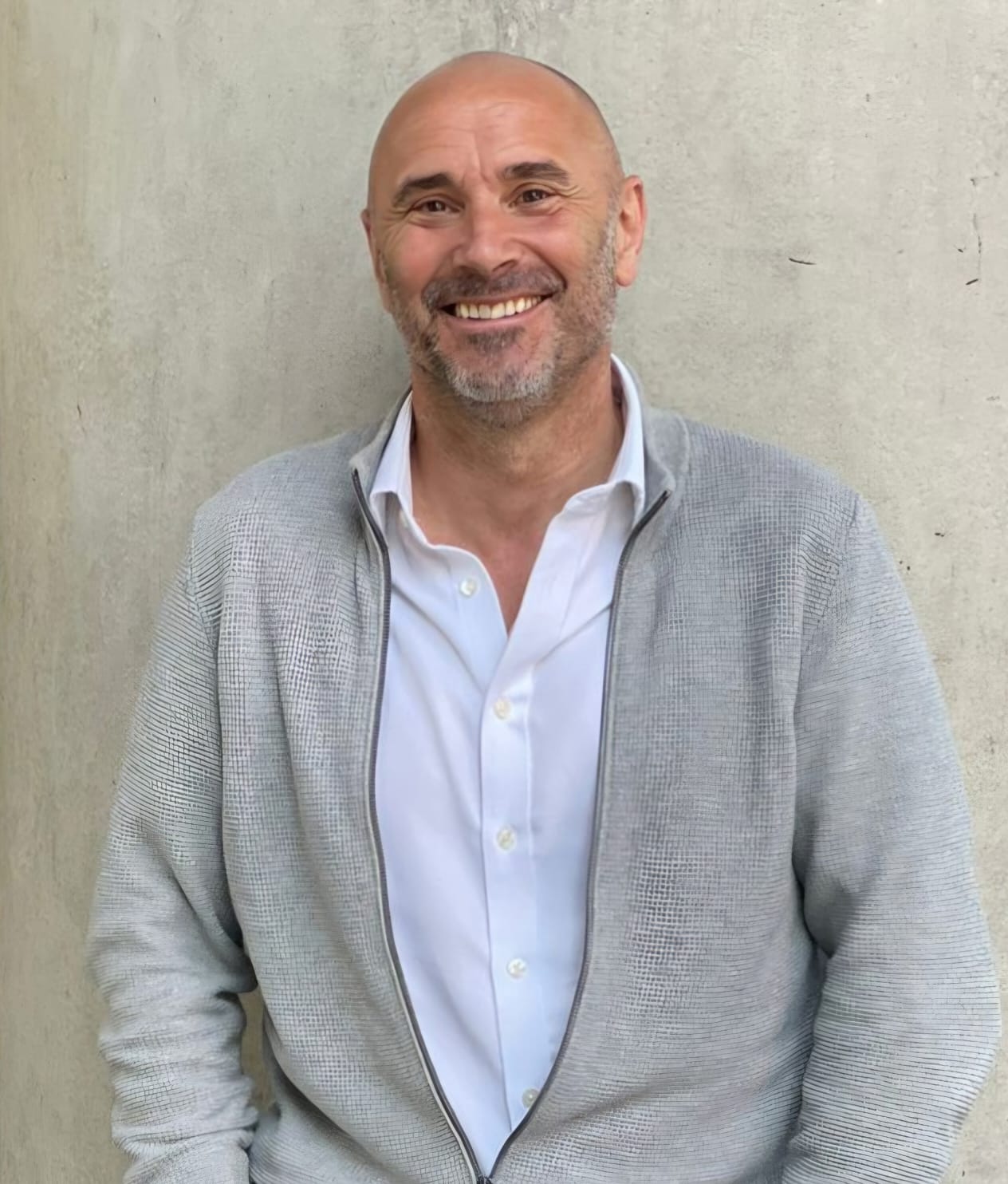
Rupert Stebbings is the new Chief Commercial Officer for Alma Air
Last week, investors and executives associated with the former low cost carrier Viva that ended up acquired by Avianca, made public plans to launch a seaplane airline serving Colombia’s Caribbean coast, beginning operations in Q4 of this year. The airline has financial backing from Irelandia Aviation, the aviation venture capital firm led by airline pioneer Declan Ryan.
The leadership team of the new airline, called Alma Air features Commercial Director Rupert Stebbings, who was a board director of Viva, and also a long term executive with the BVC, Colombia’s stock exchange. Accompanying Stebbings are former Viva executives Francisco “Pacho” Lalinde as special advisor and Jhon Luna as director of operations.
Alma Air plans to transport at least 1,200 passengers per month to destinations on the Caribbean Coast such as Barú, Playa Blanca, the Rosario Islands, Mompox, Palomino, Puerto Colombia, Cabo de la Vela, Punta Gallinas and Valledupar, as well as to other remote places in Colombia’s interior. By using seaplanes that can land on both runways and water, Alma Air will be able to reach every destination in Colombia, including remote airstrips and almost all major rivers.

Francisco Lalinde is special advisor to the new airline.
“We have a clear vision and that is to contribute to a unique, personalized and exciting way of tourism in Colombia, which will connect people to the most beautiful remote areas of the country and the region. Too often, tourists can’t get to destinations they’ve seen on the internet or even time constraints don’t allow for that extra adventure. We want to challenge that and encourage tourists to fly to that destination they dream of and that will remain in their memory for a lifetime,” said Stebbings.
“Beyond the new travel experiences that we want to bring to Colombia, there is another extremely important service that our planes offer. The same remoteness that often makes travel difficult can also be an obstacle when it comes to people’s health and well-being; For this reason, we want to support the Ministry of Health in medical evacuation issues where and when necessary. Arrival by rivers and lakes could be the only solution in some parts of Colombia when it comes to taking patients to the nearest hospital or clinic, and for that, seaplanes play a fundamental role,” Stebbings added.
Collective Mining Ltd. (TSX: CNL, OTCQX: CNLMF, FWB: GG1) just announced that it plans to list its common shares on the NYSE American stock exchange to satisfy the appetite of many US retail and institutional investors seeking to add exposure to Collective. In advance of listing on the NYSE American, Collective will file a Form 40-F Registration Statement with the United States Securities and Exchange Commission. Subject to the review and approval of the listing application and satisfaction of all applicable listing and regulatory requirements, the Company expects its common shares to commence trading on the NYSE American in Q3 2024.
Above photo: David Reading, special advisor at Collective Mining, gives a presentation near the extraction site in Caldas, Colombia. (Photo: Loren Moss)
The company is also pleased to report that all of the outstanding warrants, which expired on April 25, 2024 with a strike price of C$3.25 from the October 2022 financing, have been exercised for total gross proceeds of C$7.8 million.
Collective is on schedule with its 2024 planned 40,000 meter drilling program and has recently added a fifth drilling rig to the Guayabales project. There is currently one rig drilling at the Apollo system, one rig drilling at the Trap target, one rig drilling at the Olympus target and two rigs turning at the Box target.
Founded by the team that developed and sold Continental Gold Inc. to Zijin Mining, Collective is a copper, silver, gold and tungsten exploration company with projects in Caldas, Colombia and options to acquire 100% interests in two projects located directly within an established mining camp with ten fully permitted and operating mines.
The Company’s flagship project, Guayabales, is anchored by the Apollo system, which hosts the large-scale, bulk-tonnage and high-grade copper-silver-gold-tungsten Apollo porphyry system. The Company’s 2024 objective is to expand the Apollo system, prove that the recent discoveries at the Olympus and Trap targets evolve into large scale systems and make a new discovery at either the Box, Tower or X targets.
It has been my vision for more than 15 years that tourism in Colombia represents an economic and social opportunity of a lifetime. In 2008 my first entry to Colombia was registered among only 500,000 foreigners that year. For 2024 it appears certain Colombia will see more than 5,000,000 foreigners enter and exit the country, an astounding 1000% increase in tourism in only 15 years.
Today there are approximately 12,000 hotels and 120,000 Airbnb hosts in Colombia according to Cotelco and Asohost respectively. In December 2023 alone, Airbnb alone recorded more than $87M USD in payouts in a single month to property owners across the country. In 2024 it is likely that Airbnb will pay out nearly $1billion to their Colombian hosts (AirDNA). President Gustavo Petro called tourism “one of the largest drivers of economic well being”, ex-President Ivan Duque called tourism “Colombia’s new petroleum”. Indeed the country has come a long way since 2008.
My own humble beginnings started with a single Airbnb listing in 2010 when Airbnb first opened the market in Medellin. I was literally a pioneer. One listing became 2, then 3, and today more than 500, making my company Casacol the largest Airbnb operator in Medellin. Adding this to our 350 room hotel operations makes us the largest tourism operator in Medellin. More than 250 foreign investors have followed me and the international promotional activities of Procolombia, ACI Medellin and the Ministry of Commerce to help me build and acquire more than $100M USD in Medellin real estate. We sell almost 20,000 rooms per month only in the city of Medellin and support almost 300 direct full time jobs, and hundreds more indirectly. The growth of my company has been nothing but meteoric in line with the growth of tourism in Medellin and Colombia.
Minister German Umaña and Procolombia President Carmen Caballero recently presented a showcase for foreign investment in Colombian tourism infrastructure at the prestigious Raffles Hotel in London which charges guests $1,000 a night. The topic was sustainable tourism and this is the question that I think all foreign investors and local participants have in mind; is tourism quantity and quality in Colombia sustainable? Recently I have had my doubts.
We are ready to work collaboratively with policy makers for a brighter, more sustainable future for all 50 million Colombians with responsible and sustainable tourism as our core values.
In the last 5 years and especially exiting the COVID period, I have been a front row witness to a precipitous decline in tourism quality in Medellin. Our colleagues in Cartagena have reported similar concerns. Social media overflows with content that promotes what can be called international dating at best and just plain sex tourism more appropriately. Not to mention foreigners who wish to obtain cheap cocaine or experiment with locally manufactured synthetic substances can freely indulge with impunity. Colombia has recently been more and more a meeting place for the supply and demand for low quality tourism and their counterparties.
On March 28, 2024, we too became victims when an Aribnb tourist was reported to police with 2 underage victims of presumed sexual abuse. Our property was smeared with the association to the accused despite our strict policies and best efforts being thwarted by the individual. To add insult to injury, politicians suggested that property could now be subject to asset forfeiture, a risk that every investor in Colombian hospitality small and large now has to evaluate.
Colombia is indeed at an inflection point with respect to its reputation in the world. Medellin has recently invoked a brand for the city “aqui todo florece,” and Colombia “the country of beauty.” But responsible tourism in Colombia can start with policy makers inside Colombia collaborating with governments around the world. There are more than 850,000 registered sex offenders in the United States visible in public databases. The Angel Watch Center from the Department of Homeland Security is designed to alert foreign law enforcement about Americans convicted with sex crimes that might be traveling to their countries. Colombia doesn’t yet participate in the program. Countries like Canada work with the US on reciprocal programs like NCIC/CPIC to ensure that any criminal record (of any kind) registered on a citizen of one country means automatic denied entry into the other country. Australia and the UK have similar programs. Colombia would be wise to explore cooperation with those governments to ensure those of us in the private sector never have to deal with criminal tourists in the first place.
But this is not to mention the true victims in this story. How can we overlook the deep social problems that allow for human trafficking in the first place? Where are the parents, where are the grandparents and who are they? What kind of conditions did these children grow up in? What kind of education did they have, if any at all? Were they caught in the vicious cycle of Colombian poverty that the OECD reports takes 11 generations for a Colombian child born today to escape? This is where Colombian policy makers have some deep soul searching to do.
But tourism can be part of the solution. Tourism is a labor intensive industry that benefits every single socioeconomic strata. The workers needed to pour the cement, lay the bricks, the engineers and architects who design the hotels and restaurants where they eat and drink. Every taxi and Uber driver which shuttles the tourists to and from museums, parks, beaches, attractions. The cooks, waiters, baristas. To the maids, receptionists, security guards who keep them safe while they sleep. And the entrepreneurs large and small, local and foreign who risk their capital to develop the infrastructure to bring them to Colombia in the first place. If tourism in Colombia (2% of GDP) rises to meet only the level of Spain (12%) there would be millions of Colombians lifted from poverty into stable, decent jobs in the formal economy.

Brad Hinkelman
I think I speak on behalf of every foreign investor, every hotel owner in Colombia, every Airbnb host when I say we are ready. We are ready to work collaboratively with policy makers for a brighter, more sustainable future for all 50 million Colombians with responsible and sustainable tourism as our core values. But please don’t threaten our capital, our private property. Please don’t break the social contract between the private and public sector based on the criminal action and intent of a few. Colombia can define its place and image in the World, and transform its society with a robust tourism industry. But only through a national tourism policy that protects its citizens, investors, and tourists alike.
Brad Hinkelman is the founder and CEO of Casacol.
Avianca and Viva Aerobus have finalized a new interline agreement that will allow passengers greater connectivity between a range of destinations in Mexico and Colombia.
The key hubs involved on the Mexican end, and operated by Viva Aerobus, are the capital city and Cancun, which then make it easier to connect to 28 more cities in the country, including Guadalajara, Monterrey, Acapulco, Oaxaca, Puerto Vallarta, and Chihuahua.
In Colombia, the Avianca side of the agreement will allow travelers to arrive to Bogotá and connect with 23 cities, including Medellín, Cartagena, Cali, Barranquilla.
What exactly is an interline agreement? It differs from the more commonly known “codeshare” arrangement between airlines, and Manuel Ambriz, chief commercial offer of Avianca, added more insight in the announcement.
“Viva Aerobus is one of the fastest growing airlines with one of the most robust route networks in Mexico,” said Manuel Ambriz, chief commercial offer of Avianca. “An interline agreement like this allows our customers to purchase a single ticket through all our direct sales channels and travel agencies, through a single transaction to make guaranteed connections between Avianca and Viva Aerobus flights within Mexico (or vice versa), with a single check-in and tagged baggage to the final destination.”
This is the full list of cities included in the interline agreement:
Mexico
Acapulco, León, Ciudad de Juárez, Culiacán, Chihuahua, Guadalajara, Hermosillo, Huatulco, Mérida, Monterrey, Mazatlán, Nuevo Laredo, Mexico City, Oaxaca, Puebla, Puerto Vallarta, Puerto Escondido, Querétaro, Reynosa, Los Cabos, Tampico, Tuxtla Gutiérrez, Tijuana, Toluca, Torreón, Veracruz, Villahermosa,Ixtapa/Zihuatanejo
Colombia
Armenia, Barranquilla, Barrancabermeja, Bogotá, Bucaramanga, Cali, Cartagena, Cúcuta, Ibagué, Ipiales, Leticia, Medellín, Monteria, Neiva, Pereira, Popayán, Pasto, Riohacha, Santa Marta, San Andrés, Valledupar, Villavicencio, Yopal
“The alliance with Avianca, an airline with more than 100 years of history and recognized as one of the most important in the continent, strengthens our air offer between Mexico and Colombia,” said Jordi Porcel, director of alliances at Viva Aerobus. “This not only multiplies the possibilities for our passengers to connect with their loved ones, do business, and tourism, but also increases the commercial and cultural exchange between our countries. With more than 150 destinations, Mexico’s youngest fleet and lowest prices, Viva Aerobus is positioned as a reliable and affordable travel option.”
(Photo credit: Viva Aerobus)
Artificial intelligence has been the hottest technology trend of the past year and will be the central theme of this year’s ANDICOM ICT Conference, the largest information and communications technology event in Colombia.
Photo: Manuel Martínez Niño, executive eirector of ANDICOM organizer CINTEL.
ANDICOM 2024, which organizer CINTEL will host from September 4-6 in Cartagena’s Complejo Las Américas convention center, will specifically focus on how the “technologIA” (a stylized rendering of the word technology in Spanish to highlight the Spanish acronym for AI) is set to empower and transform society as well as the business world.
“From CINTEL we invite you to explore the unlimited potential of AI technology to drive business success in all economic sectors,” said Manuel Martínez Niño, executive director of CINTEL. “From tackling complex challenges, identifying practical strategies to uncovering new opportunities for growth and prosperity, as we explore how the responsible use of technology can drive transformation, inspire innovation, and create a sustainable future for all.”
Before the 39th annual edition of the formally kicks off, CINTEL will also host a pre-conference gathering of business professionals on September 2 around the themes of smart cities, blockchain and AI impact.
AI’s Potential to Transform
Beyond the main speaker track, the exhibition hall full of industry companies, and Japan serving as the honorary guest country, ANDICOM 2024 will offer academic, commercial, and networking agendas.
The thematic tracks that will be addressed in the academic agenda are:
Day 1: TechnologIA, Business, and Society
Artificial Intelligence, a central component on this day, acts as a catalyst for innovation. ANDICOM 2024 will center the effective application of emerging technologies, as well as the implementation of ethical frameworks and appropriate regulations for social and business development.
Day 2: Innovation and the Digital Future
Countless opportunities will be unveiled on this day, from automation that simplifies repetitive tasks to personalizing experiences. Thanks to data analytics, the digital future promises efficiency, connectivity, transnational trade, and a more equitable world.
Day 3: Digital Ecosystems & Tech Trends Applications
The third day will explore how digital ecosystems are shaping innovation and business growth, from the integration of emerging technologies to the practical application of technology trends. It will look at how these trends are transforming industries and facilitating global collaboration, promoting sustainable development and an inclusive digital economy.
ANDICOM Talks, Thematic Tracks, and More
ANDICOM 2024 will also develop several thematic tracks — focused on AI, Talent and Innovation, Digital Security, Smart Cities and Sustainability, Connectivity, and 5G.
Additionally, as a preamble to this experience, CINTEL recently hosted guests for Live ANDICOM Talks on April 30 that addressed “Artificial Intelligence: a new horizon for companies. Mario Castaño, technical director of CINTEL, hosted the discussion, which included Javier Mauricio Ortiz of Minsait, Lina Bello at NTT DATA Colombia, and Esteban Numa, and Cencosud S.A.
Guests can register for the upcoming ANDICOM 2024 event at Andicom.co/en/home-2024.
Mathematics was never an educational strongpoint, to say the least, while I was studying.
But I have enough knowledge to call into question analyst expectations regarding Banco de la República during the rest of 2024.
A quick explanation.
Last week, the Colombian central bank cut interest rates by 50 basis points to 11.75%, and we are now sitting 1.5% below the 13.25% peak. But that was not enough for Finance Minister Ricardo Bonilla, who has constantly criticized the committee for their sluggishness over the past nine months. He has even proposed raising the debt ceiling or bending the fiscal rule in order to stimulate the economy if the central bank fails to act.
This week, the National Administrative Department of Statistics (DANE) will publish inflation data for April, and Fedesarrollo expects another marginal decline to 7.15%. The same entity is expecting year-end consumer price index (CPI) number to come in at 5.51%. And it is also predicting an exit overnight rate for 2024 of 8.25% — a forecast that has inched up slightly (compared to 8%) since the last time analysts were surveyed.
Herein comes the math calculation.
The central bank has eight more meetings in 2024. However, three of those meetings are so-called “non-decision” gatherings where little happens and no rate changes occur.
Therefore, to get to Fedesarrollo’s 8.25% forecast by year-end, the committee will need to cut overnight rates by an average of 70 basis points at each of the remaining (decision) meetings during 2024.
That is where my doubt lies. This is an institution that is conservative by nature — and that seems a stretch.
Therefore, while rates need to come down faster in order to stimulate the market and drive confidence, the central bank has now acted too late. And that 8.25% projection now seems optimistic.
Hopefully, I will be proven wrong.
Never miss Rupert’s latest commentary
Follow him now on LinkedIn to see What Jumps Out
This article, written by Henry Shuldiner and Sergio Saffon, was originally published by InSight Crime, a Medellín-based foundation dedicated to the investigation and analysis of crime and security in Colombia and Latin America.
Colombian President Gustavo Petro is being forced to confront the possibility that his flagship security policy, Total Peace (Paz Total), may only have partial peace in its sights.
National-level peace talks have broken down between the government and two of the armed groups in the most advanced stages of negotiations, the National Liberation Army (Ejército de Liberación Nacional – ELN) and the Central General Staff (Estado Mayor Central – EMC). Petro’s negotiators are now engaging with individual blocs or fronts around the country, rather than solely dealing with the national leadership of the two groups.
The president’s Total Peace plan has sought to negotiate with armed groups and criminal gangs to achieve top-down demobilization similar to the process that saw the Revolutionary Armed Forces of Colombia (Fuerzas Revolucionarias Armadas de Colombia — FARC) lay down its arms starting in 2017.
But Petro’s ambitious initiative has floundered since it started in late 2022. And now, internal divisions over the peace talks have sent the ELN and EMC into crisis mode, according to Otty Patino, Colombia’s High Commissioner for Peace (Alto Comisionado para la Paz), who leads the government’s peace negotiations.
ELN
The ELN’s national leaders temporarily suspended the group’s participation in the talks on April 11, enraged by a “regional dialogue” with the group’s Comuneros del Sur Front, which wants to expedite its demobilization process, according to a press release from the ELN delegation.
The ELN’s top commander, Antonio García, claimed in an interview with Spanish newspaper, Berria, that the national leadership did not authorize those separate discussions. Pablo Beltrán, leader of the ELN delegation to the peace talks, urged the government to specify the objectives and purpose of the “parallel negotiations,” while speaking to journalists in Caracas, Venezuela.
The government and the Comuneros del Sur Front had announced the talks in February. The decision was driven by the front’s worries about the threat posed by the EMC’s growing dominance and military strength in the southwestern department of Nariño, a cocaine production and trafficking hub that is the base of operations for the Comuneros del Sur.
Feeling the pressure of potential defeat, the front opted to enter an accelerated peace process after seeing no concrete results from the national-level negotiations.
The ELN’s national leaders later agreed to rejoin the negotiations, but the regional peace talks with the Comuneros del Sur will also continue and could cause more problems down the line. On April 27, government representatives in the ELN negotiations asked Petro to either continue dialogues with the ELN national leadership or with the Comuneros del Sur, as a double negotiation is not viable, according to a press release.
EMC
Internal divisions over the peace talks have also derailed the government’s negotiations with the national leadership of the EMC.
In March, Petro suspended a ceasefire with the EMC in Cauca, Valle del Cauca, and Nariño, in response to an attack that killed an Indigenous leader in Cauca. This sparked tensions within the EMC, with some blocs advocating for continuing dialogue and others unwilling to engage until a national ceasefire is reinstated.
At a meeting in Caquetá on April 5 between the government and the EMC, delegates agreed to continue peace talks, but representatives from EMC blocs in Cauca, Valle del Cauca, and Arauca were notably absent, highlighting internal discord. Leaders of these absent blocs later released videos affirming loyalty to the EMC’s top commander, Néstor Gregorio Vera Fernández, alias “Iván Mordisco,” who has refused to continue in dialogues without a nationwide ceasefire.
Camilo González, the government’s chief negotiator with the EMC, has stated that negotiations would proceed only with the EMC factions willing to continue, namely the Jorge Suárez Briceño Bloc, the Magdalena Medio Bloc, and the Carolina Ramírez Front, despite the partial ceasefire suspension. These factions collectively represent approximately 40% of what was previously considered the EMC. In practice, the government has acknowledged that negotiating with this smaller portion of the group, whom Mordisco seems to have lost command over, is the most viable way forward.
InSight Crime Analysis
The breakdown in negotiations for each group has distinct roots, but both have led to a similar result: the government is ready to risk talks with the larger criminal organizations if they can secure regional-level victories with smaller factions willing to disarm.
Petro’s willingness to engage with the regional blocs of the EMC and with individual fronts in the case of the ELN signifies a change in the government’s approach to peace negotiations. It is a departure from the government’s previous notion of a centralized command structure within these armed groups, and an acknowledgment that neither Antonio García nor Iván Mordisco holds absolute control over the ELN or EMC, respectively.
The strategic shift may yield results. The Petro government has progressed rapidly in discussions with the Comuneros del Sur and has opted to sustain dialogues exclusively with the three factions of the EMC.
If the government achieves a successful and swift demobilization of the Comuneros del Sur, the process could serve as a blueprint for other talks around the country. Other individual fronts fearful of military defeat, or who are also frustrated by the lack of progress at the national level, may see a future in the regional approach.
Similarly, reaching an agreement with the remaining EMC fronts involved in peace talks would be a significant achievement. However, as approximately 60% of what was considered the EMC is now excluded from the process, the success will be only partial and will create a new cycle of dissidents from the peace process.
This regional approach also has its drawbacks. Achieving demobilization agreements with individual fronts or blocs of both the EMC or the ELN may bring localized security improvements, but would likely have less impact on Colombia’s overall internal conflict dynamics.
Additionally, negotiating with multiple fronts or blocs simultaneously requires the government to invest significantly more money and personnel. With resources spread thin, even piecemeal agreements may become harder to achieve.
Barranquilla, Colombia based pharmaceutical manufacturer Procaps Group (NASDAQ: PROC) today announced that it has determined it is unable to file its Annual Report on Form 20-F for the fiscal year ended December 31, 2023, within the prescribed time period.
Additional time is necessary to prepare and complete the company’s review of its financial statements for the year ended December 31, 2023, in order for the company to file its annual report on Form 20-F, including with respect to an ongoing internal investigation initiated by the company´s Audit Committee with the assistance of external advisors into matters involving the company’s historical accounting treatment and associated financial statement disclosure related to a 2012 loan in the amount of approximately $2.5 million that involved related parties.
See Also: Procaps Names Jose Antonio Vieira (above photo) as New CEO
The company is working diligently to complete its financial statements in order to file its Form 20-F as soon as practicable before May 15, 2024.
The company expects to hold a business update call in conjunction with the filing of its Form 20-F and Earnings Release and expects to provide a further update regarding the date of the business update call.
Procaps asked in a statement that all questions be sent to [email protected]. Due to applicable securities laws, the company is unable to provide further details beyond what is publicly disclosed, and accordingly the company expects to address submitted questions in its applicable reports and during its conference call once the results are published.
Procaps has made preliminary determinations of certain results of operations. Revenue for the year ended December 31, 2023, is currently expected to be between approximately $425 and $433 million, compared to $409.9 million for the year ended December 31, 2022, with the difference primarily due to an increase in sales. Income for the year ended December 31, 2023, is currently expected to be between approximately $50 and $55 million, compared to income of $42.5 million for the year ended December 31, 2022, with the difference primarily due to the accounting treatment for non-cash shares and warrants held in escrow and an increase in non-recurring income.
 Empleobilingue.com

- Director/a de operaciones para hotel, restaurante y discoteca 1626320364.60 - Medellín, Medellin, Antioquia, Colombia
- Coordinador/a de calidad para La Unión 1626483143.1 - La Unión, Antioquia, Colombia
- Desarrollador fullstack - Bogotá, Bogota, Colombia
- Technical Analyst - Remote
- PIM Administrator - Ecommerce - Remote (Bogotá, Bogota, Colombia)
- Auxiliar de gestión humana y bienestar para Girardota 1626060072.28 - Girardota, Antioquia, Colombia
- Marketing Strategist
- Trainer Manager - Bogotá, Bogota, Colombia
- Tolemaida UH- 60 Inspector - Bogotá, Bogota, Colombia
- Virtual Assistant - Team Lead - Remote
Contact Us

